May 14, 2026
When the Ground Gives Way: Understanding the Hidden Physics of Underground Coal Mine Disasters
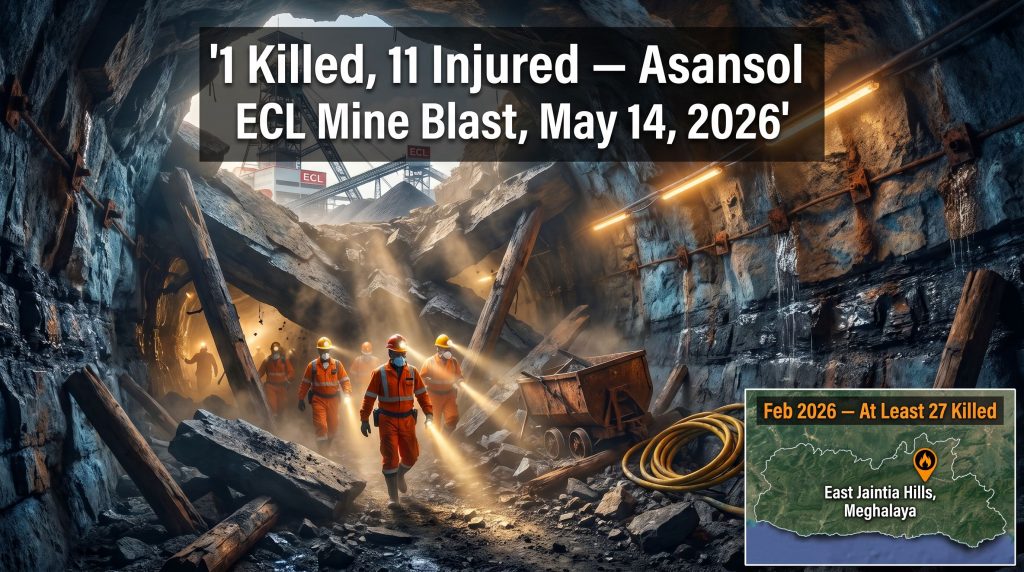
Most discussions about energy security focus on supply chains, pricing, and geopolitics. Far fewer examine what happens hundreds of metres below the surface, where the human cost of coal dependency plays out in milliseconds. The blast in coal mine in eastern India that killed one worker and injured 11 others is a stark reminder of this reality. Underground mining is, at its core, a continuous negotiation with geology — one where the consequences of failure are immediate and human.
Rock strata under immense pressure, gas-saturated coal seams, decades-old tunnel networks, and thousands of workers operating in confined spaces create a risk environment that no regulatory framework has yet fully tamed, regardless of whether the mine in question is a flagship state-run operation or an unlicensed tunnel dug by hand in a remote forest.
When big ASX news breaks, our subscribers know first
What Happened at the Asansol ECL Mine on May 14, 2026?
The verified facts are precise but limited. Around 120 workers were present underground at the Eastern Coalfields Limited mine in Asansol when the incident occurred. One person was killed and eleven others sustained injuries. Rescue operations were completed, according to senior police officer Dhruba Das, who confirmed the casualty figures to Reuters.
An ECL official separately confirmed that mine operations were not disrupted following the incident — a detail that carries considerable weight in understanding how the event was severity-classified internally. According to Mining Weekly, the blast in coal mine in eastern India kills one injures 11 represents one of several serious underground incidents recorded in India's eastern coalfields in recent years.
ECL is a wholly owned subsidiary of Coal India Limited, the state-run enterprise operating under India's Ministry of Coal, and one of the largest coal producers in the world by volume. ECL's operational territory spans the West Bengal and Jharkhand corridor, a region that has historically combined high coal extraction intensity with recurring occupational safety challenges.
How Reliable Was the Early Reporting?
One element worth noting is the gap between initial media reporting and official confirmation. The Economic Times reported at the time that at least 40 mine workers had been injured. Official police and ECL statements subsequently established the confirmed toll at 11 injuries and one fatality.
This kind of discrepancy is common in the immediate aftermath of underground mining incidents, where access is restricted, casualty numbers shift as rescuers reach workers, and early journalistic estimates frequently overshoot verified figures. It reinforces the importance of treating preliminary incident reports as provisional until confirmed by official sources. Indeed, lessons from incidents such as the Moranbah North mine fire demonstrate how rapidly evolving conditions underground can distort early casualty reporting.
What Is an Air Blast, and Why Is It Different from Other Underground Explosions?
The Asansol incident was classified as an air blast — a term that is frequently misunderstood by those outside the mining industry. An air blast is not a gas explosion or a dust ignition event. It is a sudden, violent movement of air caused by a rapid pressure change underground, most commonly triggered by a large-scale roof collapse or the failure of a void within the mine structure.
When a significant mass of rock gives way without warning, it compresses the air column in the surrounding tunnels almost instantaneously. That compressed air then moves through the underground network at high velocity, behaving like a concussive pressure wave. Workers caught in its path can suffer blunt force trauma, lung injuries from the pressure differential, and injuries from debris displaced by the wave itself.
How Do Different Underground Blast Events Compare?
The table below distinguishes the main categories of underground blast events by their primary cause, typical warning indicators, and likely injury profiles:
| Blast Type | Primary Cause | Typical Warning Signs | Likely Injury Profile |
|---|---|---|---|
| Air Blast | Roof collapse or void failure | Ground vibration, cracking sounds | Blunt trauma, pressure-related lung injury |
| Methane Explosion | Gas ignition | Gas detector alerts, unusual odour | Burns, blast trauma, fatalities |
| Coal Dust Explosion | Ignition of suspended dust particles | Dust accumulation, sparks | Burns, severe respiratory damage |
| Explosive Misfire | Blasting agent handling failure | None prior to detonation | Severe trauma, high fatality risk |
Furthermore, what makes air blasts particularly hazardous in legacy underground operations is their unpredictability. Unlike methane accumulation, which can be detected by sensors, a structural void failure can occur with minimal forewarning — particularly in mines where ageing timber or rock bolt support systems have degraded over decades of operation. The tunnel collapse impact seen in comparable incidents internationally highlights just how rapidly these structural failures can escalate.
ECL, Coal India, and the Operational Context
Eastern Coalfields Limited operates as one of eight Coal India subsidiaries concentrated in the eastern mining belt. The Asansol region of West Bengal sits within a geography that has provided India with a substantial share of its domestic thermal coal for over a century. Many mines in this corridor are underground operations with long operational histories, meaning their infrastructure predates modern safety monitoring standards in some cases.
The confirmation that operations continued after the May 14 blast signals that the incident was not assessed internally as requiring a production halt for structural assessment. Whether that determination was made through formal engineering review or operational continuity pressure is not clear from available information. This ambiguity is itself instructive about the accountability dynamics inside large state-run mining enterprises.
"When a state-owned enterprise confirms operations were unaffected following a fatal underground incident, it raises a legitimate governance question: what threshold triggers a mandatory operational pause under Indian mining law, and who makes that determination?"
India's Coal Mine Safety Framework: What the Law Requires
India's regulatory foundation for underground mine safety rests primarily on the Mines Act of 1952 and the associated Mines Rules of 1955, supplemented more recently by the Occupational Safety, Health and Working Conditions Code enacted in 2020. The Directorate General of Mines Safety, known as DGMS, is the central enforcement body responsible for inspections, mandatory inquiries following fatal accidents, and determining whether operations may resume after incidents.
Under the framework, the following steps are legally mandated following a fatal underground incident:
- Immediate notification to DGMS within 24 hours of a fatal accident occurring.
- Site preservation with the accident area remaining undisturbed until official inspectors arrive.
- DGMS formal inquiry which is mandatory for all fatal underground accidents, with findings submitted as an official report.
- Magisterial inquiry which may be ordered in parallel by state government authorities.
- Compensation processing triggered under the Workmen's Compensation Act for fatalities and injuries.
- Operational review with DGMS determining whether affected sections may resume production and under what conditions.
- Report publication with findings theoretically made available through official channels.
However, the gap between what this framework requires and how it functions in practice is significant. DGMS inquiry reports following fatal accidents have historically taken months or, in some documented cases, years to be finalised. Operational resumption decisions are frequently made before formal findings are published, which means corrective actions derived from investigation conclusions arrive after normal production patterns have already been restored. Consequently, effective mine fire safety response protocols and post-incident accountability remain critical areas for improvement across the sector.
The Two Faces of India's Mine Safety Problem: Legal Operations and Illegal Ones
The Asansol blast did not occur in isolation. As reported by Al Jazeera, it took place against a backdrop that includes the February 2026 explosion at an illegal rat-hole mine in East Jaintia Hills, Meghalaya, which killed at least 27 miners. The victims were predominantly migrant workers from Assam state, and rescue operations were suspended due to terrain, equipment limitations, and the presence of residual explosive material underground.
In response to the Meghalaya incident, Prime Minister Narendra Modi announced ex-gratia compensation of approximately ₹200,000 per deceased family and approximately ₹50,000 for injured workers, with Chief Minister Conrad Sangma ordering a formal inquiry into the circumstances.
These two incidents, separated by roughly three months, present a striking contrast that reveals a deeper structural problem:
- The Meghalaya explosion occurred inside an illegal mining operation that had been operating in direct violation of a National Green Tribunal ban on rat-hole mining introduced in 2014.
- The Asansol blast occurred inside a legally operating, state-run facility subject to the full scope of India's mining safety legislation.
- Both resulted in worker deaths.
"Regulatory legitimacy and operational safety are not the same thing. The Asansol incident demonstrates that legal status, state ownership, and formal compliance frameworks do not automatically produce safe underground working conditions."
The next major ASX story will hit our subscribers first
Why Illegal Rat-Hole Mining Survives Despite a National Prohibition
Rat-hole mining refers to a practice where narrow horizontal tunnels — often barely wide enough for a single person to enter — are hand-dug into hillsides or valley floors to access shallow coal seams. The technique is associated almost entirely with the Meghalaya coalfields of northeastern India and has been banned by the National Green Tribunal since 2014 on the grounds of extreme safety risk and environmental destruction.
Despite the ban, the practice has persisted for reasons that are more economic than defiant. Several intersecting factors sustain illegal coal extraction in the region:
- Low barriers to entry: Rat-hole operations require minimal capital investment. A pick, a headlamp, and access to a seam-bearing hillside are sufficient to begin extraction.
- Demand continuity: Coal demand in northeastern India remains strong, and illegal operators can undercut regulated supply chains on price because they carry none of the compliance costs.
- Migrant labour vulnerability: Workers from Assam and other neighbouring states frequently accept employment in illegal mines because formal employment alternatives are scarce and cash payments are immediate.
- Enforcement geography: Meghalaya's forested, hilly terrain creates jurisdictional complexity and physical access difficulties that reduce effective monitoring by regulatory authorities.
- Pattern of recurrence: A 2018 flooding disaster in a Meghalaya rat-hole mine trapped and killed workers in circumstances strikingly similar to the February 2026 explosion. The recurrence of fatal incidents in the same region suggests enforcement responses have not produced durable deterrence.
How India's Safety Performance Compares Internationally
Assessing Coal India's safety performance against international benchmarks is complicated by differences in reporting standards, mine type distributions, and mechanisation levels. India's formal coal sector records fatality rates that are generally acknowledged to be higher than those in Australia, the United States, and the United Kingdom, though direct per-million-tonnes comparisons require caution.
What is less contested is the structural tension at the heart of India's coal safety challenge. India remains heavily dependent on domestic coal for electricity generation, which creates a political environment where aggressive enforcement actions — such as extended production halts following incidents or mine closures for non-compliance — carry significant energy security and economic costs.
Coal India has reported a declining trend in absolute fatality numbers over the past decade, attributed in part to increased mechanisation. However, mechanisation has not been uniformly adopted across ECL's underground fleet. It is precisely these ageing, labour-dense underground sections that carry the highest residual risk, including the kind of void and structural failures that produce air blast events. In addition, improved mining risk management frameworks would help address systemic vulnerabilities across older mine infrastructure.
Frequently Asked Questions: Coal Mine Blasts in India
What caused the blast at the ECL mine in Asansol, West Bengal?
The incident has been classified as an air blast — a sudden pressure event caused by underground roof collapse or void failure, rather than a gas ignition or dust explosion. Official investigations were ongoing following the incident.
How many workers were affected in the Asansol mine blast?
One worker was killed and 11 were injured. Approximately 120 workers were present underground at the time. Rescue operations were completed shortly after the event, according to police officer Dhruba Das.
Is Eastern Coalfields Limited a government-owned company?
Yes. ECL is a wholly owned subsidiary of Coal India Limited, a state-run enterprise under India's Ministry of Coal.
What is rat-hole mining and why is it illegal in India?
Rat-hole mining involves hand-dug tunnels barely wide enough for one person, used to extract shallow coal seams primarily in Meghalaya. The National Green Tribunal banned the practice in 2014 due to severe safety risks and environmental damage. Illegal operations have continued despite the ban, producing multiple fatal incidents including the February 2026 blast that killed at least 27 workers.
What compensation applies to miners killed in Indian coal mine accidents?
Families of deceased miners are entitled to statutory compensation under the Workmen's Compensation Act. Following the February 2026 Meghalaya disaster, the central government announced ex-gratia payments of approximately ₹200,000 per deceased family and ₹50,000 for injured workers as supplementary relief.
Does a fatal accident automatically halt mine operations under Indian law?
Not automatically. DGMS has the authority to require operational suspension following a fatal incident, but the decision involves a formal assessment process. Following the May 14 Asansol blast, an ECL official confirmed to Reuters that mine operations were not impacted.
What Structural Reforms Does the Pattern of Incidents Demand?
Two fatal underground coal incidents within three months of each other in different parts of India — one in a legal state-run facility and one in an illegal hand-dug operation — point toward reform requirements that go beyond incident-specific responses. The blast in coal mine in eastern India that kills one injures 11 is not an isolated event but a symptom of systemic gaps.
The most pressing structural gaps include:
- DGMS resourcing: The directorate's inspection capacity relative to the number of active underground mines has been a persistent concern among mining safety researchers.
- Real-time monitoring technology: Mandatory installation of ground movement sensors, air pressure monitors, and structural integrity monitoring in underground sections with elevated void and strata risk would provide early warning capability.
- Mechanisation incentives: Reducing human presence in the highest-risk underground areas through targeted mechanisation investment addresses both safety and productivity objectives simultaneously.
- Illegal mine prosecution: A more sustained model combining stricter prosecution, alternative livelihood investment in affected communities, and community-level mine registration schemes may be required.
- Transparent inquiry reporting: Requiring interim findings within defined timeframes would strengthen the accountability loop considerably.
Furthermore, investing in responsible mining training for workers, supervisors, and regulatory staff would help build the institutional knowledge needed to prevent recurrence across both legal and informal mining operations.
India's coal dependency is a real constraint, not an abstraction. The country's energy security calculus will not change quickly enough to remove coal from the production agenda in the near term. However, that dependency makes the safety governance question more urgent, not less. The workers underground in Asansol on May 14, 2026, had no particular interest in energy policy. They had an interest in the roof above their heads holding.
This article contains references to the February 2026 Meghalaya mine blast casualty figures and associated compensation announcements based on information included in the article outline. Readers seeking further verification of those specific figures are encouraged to consult contemporaneous reporting from NDTV, Republic TV, and the South China Morning Post, which covered that incident in detail. All financial figures involving currency conversions are approximate and subject to exchange rate movement. This article does not constitute financial or investment advice.
Want to Invest in the Companies Shaping the Future of Responsible Resource Extraction?
Discovery Alert's proprietary Discovery IQ model delivers real-time alerts the moment significant ASX mineral discoveries are announced, transforming complex geological data into clear, actionable investment insights for traders and long-term investors alike — explore historic discovery returns on Discovery Alert's dedicated discoveries page and begin your 14-day free trial to position yourself ahead of the broader market.