May 14, 2026
The Metallurgical Efficiency Equation: Why Flotation Technology Determines PGM Project Value
In the economics of platinum group metal mining, the difference between a viable project and a marginal one often comes down not to what lies in the ground, but to how efficiently that mineralisation can be recovered, concentrated, and converted into a sellable product. Recovery rates, concentrate grades, and mass pull figures are not abstract metallurgical parameters — they are the variables that feed directly into net present value calculations, offtake agreement terms, and ultimately, the commercial feasibility of a project. For large-scale, multi-commodity PGM deposits advancing toward pre-feasibility, incremental improvements in flotation performance can translate into material changes across the entire economic model.
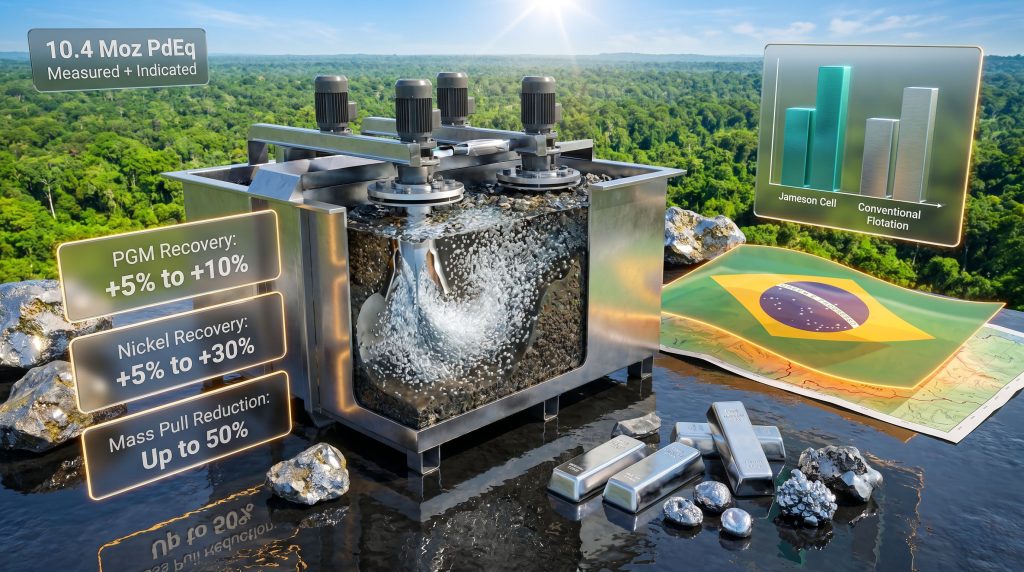
This technical reality forms the backdrop for understanding why Bravo Mining's laboratory results applying Glencore Technology's Jameson Cell at Bravo's Luanga project in Brazil represent a development worth examining in depth. The numbers themselves — PGM recovery improvements of 5% to 10%, nickel recovery gains of 5% to 30%, and mass pull reductions of up to 50% — tell a compelling story when considered against a resource base of 10.4 million ounces of palladium equivalent (PdEq) in the Measured and Indicated categories, plus 5.0 Moz PdEq Inferred.
When big ASX news breaks, our subscribers know first
Understanding the Luanga Project's Position in the Global PGM Landscape
A Multi-Commodity Deposit in One of the World's Premier Mineral Provinces
The Luanga Project sits within Brazil's Carajás Mineral Province, a region recognised internationally as one of the most mineralogically endowed districts on the planet. Carajás hosts world-class iron ore, copper, gold, and nickel operations, and Luanga adds a substantial PGM presence to that inventory. The deposit's commodity basket spans palladium, platinum, rhodium, gold, and nickel — a combination that is unusual in its breadth and carries significant implications for how metallurgical performance affects overall project economics.
Each commodity in that basket responds differently to changes in flotation circuit efficiency. When a single improvement in recovery or concentrate grade lifts multiple revenue streams simultaneously, the compounding effect on project economics becomes multiplicative rather than additive. A rhodium price spike, for example, amplifies the value of even marginal improvements in PGM recovery far beyond what a single-metal calculation would suggest. Furthermore, understanding platinum and palladium dynamics is essential context for evaluating why these recovery gains carry such strategic weight.
Why Resource Scale Demands Metallurgical Precision
The 2025 Mineral Resource Estimate for Luanga, establishing 10.4 Moz PdEq in the Measured and Indicated categories alongside 5.0 Moz PdEq Inferred, positions this as one of the larger undeveloped open-pit PGM projects globally. The planned operational throughput of 10 million tonnes per annum (10 Mtpa) indicates a long-life mining operation where metallurgical efficiency choices made today will compound across decades of production.
At that scale, even modest percentage point improvements in recovery rates generate ounce-count differences that materially alter the project's life-of-mine production profile. This is the mathematical reality that makes the Jameson Cell at Bravo's Luanga project a subject of genuine strategic significance rather than routine test work.
Following completion of the Preliminary Economic Assessment in mid-2025, the project team identified additional metallurgical optimisation opportunities. The incorporation of Jameson Cell technology into the ongoing test programme reflects a deliberate effort to ensure that the definitive feasibility study process is built on the most competitive process flowsheet available, rather than defaulting to conventional flotation assumptions.
The Physics of High-Intensity Flotation: How the Jameson Cell Works
Bubble Generation as the Critical Variable
To appreciate why the Jameson Cell at Bravo's Luanga project delivers different outcomes to conventional flotation, it is necessary to understand the fundamental physics of froth flotation itself. The process depends on air bubbles selectively attaching to hydrophobic mineral surfaces and carrying them upward through a pulp to form a mineral-bearing froth layer at the surface. The size, distribution, and energy state of those bubbles determine how efficiently fine mineral particles are captured.
Conventional flotation cells generate bubbles through mechanical agitation, using rotating impellers and external spargers to introduce compressed air into the slurry. This approach produces a relatively broad range of bubble sizes, with larger bubbles being less efficient at capturing fine mineral particles. When ore mineralisation is fine-grained — as is documented at Luanga — larger bubbles may physically fail to make sustained contact with individual mineral grains before rising through the pulp, leaving recoverable material in the tailings stream.
The Downcomer Jet Mechanism
The Jameson Cell takes a fundamentally different approach. Pulp is pumped down a vertical pipe called the downcomer, generating a high-velocity falling jet. Air is drawn into this downcomer by the natural pressure differential created by the falling slurry, and the intense fluid shear at the jet interface generates extremely fine bubbles without any mechanical moving parts in the bubble generation zone. This creates what the technology is described as producing: high-intensity air-slurry interaction that is particularly effective for fine-grained mineralisation.
The consequences extend beyond bubble size. The Jameson Cell also incorporates built-in froth washing capability — the ability to spray clean water onto the froth layer to displace entrained gangue (waste rock) particles that report to the froth without genuine mineral attachment. This selective cleaning mechanism improves concentrate grade by rejecting diluting material that conventional cells would otherwise pass forward.
Technology at Scale: A Mature Global Footprint
The Jameson Cell is not an emerging or experimental technology. With more than 500 installations across 30 countries, it represents a mature, commercially proven flotation solution with a global operational track record. This breadth of deployment is itself a risk-reduction factor for projects considering adoption; the technology's behaviour across diverse ore types, throughput scales, and climatic conditions is well-documented.
| Parameter | Conventional Flotation Cell | Jameson Cell |
|---|---|---|
| Bubble Generation Method | Mechanical agitation and spargers | Fluid dynamics via downcomer jet |
| Fine Particle Recovery | Moderate | High |
| Mass Pull Control | Lower precision | Up to 50% reduction achievable |
| Froth Washing Capability | Limited | Built-in capability |
| Equipment Footprint | Larger | Compact (up to 50% reduction reported) |
| Global Installations | Widespread | 500+ across 30 countries |
Laboratory Testing Results: What the Jameson L150 Rig Revealed at Luanga
Test Design and Variables
The test programme employed the Jameson L150 test rig, a laboratory-scale device designed specifically for rougher flotation optimisation work. The rougher stage is the initial concentration phase in a flotation circuit, where bulk separation of mineralised material from waste rock occurs. Optimising rougher performance is the logical first priority in any flotation circuit development because losses at this stage cannot be recovered downstream.
Testing varied the following parameters systematically:
- Reagent types and dosages, including collector chemicals that modify mineral surface chemistry to enhance hydrophobicity
- Air flow rate, which influences bubble size distribution and froth residence time
- Feed solids concentration, expressed as percentage solids by weight in the pulp
- Residence time, representing how long the pulp remains in active contact with the flotation environment
Samples from the North Zone of the Luanga deposit, grading between 1.97 g/t and 2.80 g/t PGM, formed the primary feed material for the test programme. This grade range is representative of the deposit's mineralisation character and provides a meaningful baseline for comparing performance against conventional flotation cell results obtained from the same material.
Recovery Results Across the Commodity Suite
The results demonstrated measurable superiority across all target commodities compared to conventional flotation cell performance:
- Platinum, palladium, and rhodium recoveries improved by 5% to 10%
- Nickel recovery improved by 5% to 30%, with the broader range reflecting sensitivity to specific reagent and operating condition combinations
- Gold recovery improved at the rougher flotation stage
- Mass pull reduction of up to 50% was achieved at recovery levels comparable to the conventional flotation baseline
The breadth of the nickel recovery improvement range (5% to 30%) is particularly noteworthy. It indicates that operating condition optimisation has not yet been exhausted — there is likely further performance to unlock as the programme advances through cleaner and scavenger circuit configurations. In addition, given the nickel market importance as both an industrial and battery-critical material, these recovery gains add a meaningful secondary revenue dimension to Luanga's economic profile.
Why Mass Pull Reduction Is the Sleeper Metric
Recovery rates attract the most attention in metallurgical reporting, but mass pull reduction may ultimately carry equal or greater economic significance. Mass pull describes the proportion of total mill feed that reports to the concentrate stream. Reducing mass pull by up to 50% while maintaining equivalent or superior recovery means that far less total material volume advances through the circuit as concentrate.
The downstream consequences cascade through the entire value chain:
- Lower concentrate tonnage reduces material handling, reagent consumption, and equipment wear in subsequent processing stages
- Shipping and logistics costs per unit of contained metal decrease as concentrate grade increases and tonnage per ounce improves
- Smelter and refiner payability terms typically improve with higher-grade concentrates, as penalty deductions for diluting elements decrease
- Capital expenditure on flotation plant infrastructure can potentially be reduced through a more compact, higher-performing circuit design
For a 10 Mtpa run-of-mine operation processing a resource of more than 10 million ounces, even a 5% improvement in PGM recovery compounded across a multi-decade mine life generates ounce totals that translate into meaningful changes to net present value models. When that recovery improvement is paired with a simultaneous increase in concentrate grade, the downstream commercial terms improvements create a second layer of economic benefit on top of the volume gain.
Proven at Scale: Where the Jameson Cell Has Delivered in PGM and Base Metal Operations
Mogalakwena: The PGM Benchmark Case
For projects evaluating new flotation technology, the most credible validation is operational performance at comparable mines. Valterra's Mogalakwena PGM mine in South Africa — one of the largest open-pit platinum operations in the world — has documented Jameson Cell performance that directly parallels what Luanga's laboratory results are indicating.
At Mogalakwena, the technology achieved:
- Mass pull reduction of 23% from baseline
- PGM concentrate grade improvement from 60 g/t to 78 g/t — a 30% uplift in concentrate quality
- These results were achieved at production scale in a major operating mine, not a laboratory environment
The significance of this precedent cannot be overstated for Luanga's development trajectory. The mineralogical parallels between a large open-pit South African PGM operation and Luanga's planned 10 Mtpa open-pit configuration provide a logical basis for extrapolating technology performance, while acknowledging that site-specific ore characteristics will always introduce variation.
Cross-Commodity Validation
The technology's success extends well beyond PGM applications. At the Mt. Isa copper operation in Australia, Jameson Cell deployment demonstrated that the technology's fine-particle recovery advantages apply equally to base metal sulphide mineralisation. Hudbay's New Britannia operation achieved a processing footprint reduction of approximately 50% through Jameson Cell adoption, demonstrating that equipment compactness translates into real capital cost savings at project construction stage.
At the Mina Justa copper project in Peru, the technology demonstrated fine-particle and oxide recovery performance, achieving copper recovery of 76.8% at a concentrate grade of 50.4% Cu — results that confirm the technology's versatility across different ore types and metallurgical environments.
What These Precedents Mean for Luanga's Scalability
The combination of PGM-specific precedent at Mogalakwena and cross-commodity validation at multiple other operations provides what project development teams require before committing to a technology in a Pre-Feasibility Study: evidence that laboratory results are technically supportable and appropriate for scale-up to the intended 10 Mtpa operation. The existing knowledge base around Jameson Cell behaviour at comparable throughput rates reduces the technical risk associated with incorporating it into Luanga's PFS flowsheet design.
The Broader PGM Market Context: Why Metallurgical Gains Matter More Now
Rising PGM Prices as a Multiplier on Recovery Improvements
The economic significance of metallurgical efficiency gains is not static — it scales directly with commodity prices. In a rising PGM price environment, each additional ounce of palladium, platinum, or rhodium recovered through improved flotation performance is worth more than it would have been under lower price assumptions. This creates a dynamic where the value of test work improvements is itself a function of market conditions at the time the project enters production.
Palladium and platinum demand continues to be driven primarily by autocatalyst applications in internal combustion engine vehicles. While electrification trends are often cited as a long-term demand risk for automotive PGMs, the transition timeline remains gradual, and hybrid vehicle adoption has in some scenarios extended the period of combined PGM and battery metal demand rather than simply displacing it. Rhodium demand is highly concentrated in the autocatalyst sector, making it acutely sensitive to automotive production volumes.
Nickel's dual role as both a battery material and a traditional industrial metal adds another dimension of demand optionality to Luanga's commodity basket — particularly relevant given the nickel recovery improvements observed in Jameson Cell testing. Furthermore, PGM supply constraints continue to support the case for developing large, high-quality undeveloped projects such as Luanga.
Concentrate Grade in the Context of Offtake Negotiations
One of the less-discussed but commercially significant implications of Jameson Cell performance at Luanga relates to offtake agreement negotiations. Smelter and refiner terms for PGM concentrates are heavily influenced by concentrate grade. Higher-grade material typically attracts better payability ratios, lower treatment and refining charges, and reduced penalty deductions for penalty elements. For a project not yet at the offtake negotiation stage, improving concentrate grade through flotation technology selection is one of the highest-leverage actions available to management.
The next major ASX story will hit our subscribers first
The Path Forward: From Laboratory to Pre-Feasibility Integration
Expanding the Test Programme
The current results represent completion of the rougher flotation optimisation phase. The programme's natural progression involves:
- Evaluation of cleaner and scavenger circuit configurations incorporating the Jameson Cell
- Locked-cycle testing to simulate continuous, steady-state plant operation rather than batch conditions
- Expansion of sample coverage to include material from the Luanga Central and Southwest sectors, broadening the metallurgical database beyond North Zone samples
- Integration of optimised results into the 10 Mtpa PFS flowsheet design
- Assessment of capital expenditure and operating cost implications for flotation plant design and sizing
- Evaluation of whether improved metallurgical performance broadens the vertical integration scenario — potentially including concentrate upgrading or refining integration options
Locked-cycle testing is a particularly important milestone in this sequence. Batch laboratory tests, including the current Jameson L150 work, establish performance potential under optimised single-pass conditions. Locked-cycle testing circulates material through the flotation circuit repeatedly, simulating the recycle streams and steady-state chemistry that characterise continuous plant operation. Consequently, results from locked-cycle testing provide the statistical confidence needed to support Pre-Feasibility Study economic inputs. The cut-off grade economics of the deposit will also be revisited in light of improved recovery assumptions as the programme advances.
What Investors and Industry Observers Should Watch
| Metric | Conventional Flotation Baseline | Jameson Cell Laboratory Result |
|---|---|---|
| PGM Recovery Change | Baseline | +5% to +10% |
| Nickel Recovery Change | Baseline | +5% to +30% |
| Mass Pull Reduction | Baseline | Up to -50% |
| Concentrate Grade Direction | Lower | Higher |
| Global Technology Installations | N/A | 500+ across 30 countries |
| Luanga M+I Resource (PdEq) | N/A | 10.4 Moz |
Three strategic implications stand out from the current results:
Pre-Feasibility Study uplift potential: Improved recoveries and higher concentrate grades feed directly into the economic inputs of the upcoming PFS, with the potential to improve NPV and IRR projections compared to conventional flotation assumptions. The magnitude of improvement will become clearer once locked-cycle testing confirms rougher stage performance under continuous conditions.
Capital and operating cost efficiency: A compact, high-performing flotation circuit reduces both construction capital requirements and ongoing operating costs per tonne processed. Independent analysis of the test results highlights that the potential 50% footprint reduction demonstrated at other operations could translate into meaningful CAPEX savings at project construction stage.
Downstream optionality: Enhanced metallurgical performance broadens the commercial scenarios available to the project, including potential pathways to concentrate upgrading or refining integration that may become more attractive as concentrate grade and quality improve. Bravo Mining's corporate presentation outlines how these metallurgical advances fit within the company's broader strategic development roadmap for Luanga.
Disclaimer: This article contains forward-looking statements, financial projections, and speculative analysis related to mining project development and commodity markets. Actual outcomes may differ materially from those projected. Readers should not construe any information in this article as investment advice. Mineral resource estimates, recovery rates, and economic projections are subject to the assumptions, risks, and uncertainties inherent in mining project development. Past performance of comparable projects does not guarantee future results at the Luanga Project.
Want To Catch The Next Major Mineral Discovery Before The Market Does?
Discovery Alert's proprietary Discovery IQ model scans ASX announcements in real time, instantly identifying high-potential opportunities across PGMs, nickel, and more than 30 other commodities — turning complex mineralisation data into actionable insights for investors at every level. Explore historic discoveries and the exceptional returns they generated, then begin your 14-day free trial to position yourself ahead of the market.