July 15, 2026
When Geology Speaks Louder Than Headlines: Reading the Okiep Copper Signal
Few disciplines in resource investment demand as much patience and technical literacy as underground copper exploration. Drill results arrive as columns of numbers, geological coordinates, and mineralisation widths that mean little to the untrained eye yet carry enormous implications for project valuation, resource classification, and long-term production planning. For those willing to decode them, the signals emerging from the Northern Cape copper drilling at Okiep Flat Mine East represent exactly the kind of data-driven inflection point that separates speculative excitement from geological conviction.
The Okiep Copper District in South Africa's Northern Cape province is one of the continent's most historically productive copper regions. Over a century of extraction has yielded approximately 105 million tonnes of material across the district, with roughly 77 million tonnes sourced from within the current prospecting and mining rights area now held by Orion Minerals. That scale of historical output does not emerge from an ordinary deposit. It reflects a geological system of unusual persistence, grade consistency, and structural complexity that continues to reward systematic investigation even after decades of commercial production.
When big ASX news breaks, our subscribers know first
What Makes Norite-Hosted Copper Mineralisation Geologically Distinctive
The Okiep district's defining geological characteristic is its norite-hosted copper mineralisation style. Unlike porphyry copper systems, which distribute lower-grade mineralisation across broad, disseminated zones, norite-hosted deposits concentrate copper within discrete, high-grade pods and lenses hosted in mafic to ultramafic igneous rocks. This structural arrangement creates a deposit type where individual intersections can carry exceptionally elevated grades, but where three-dimensional continuity must be carefully established through systematic directional drilling.
Norite is a coarse-grained igneous rock composed primarily of plagioclase feldspar and orthopyroxene. In the Okiep context, copper sulfide mineralisation, principally chalcopyrite, occurs along structural contacts, fracture zones, and within partially replaced norite bodies. The key exploration challenge, and opportunity, lies in the fact that these mineralised zones do not follow simple, predictable geometries. They require careful geological modelling informed by downhole geophysics and closely spaced drill hole arrays.
Technical context: In norite-hosted copper systems, the concept of down-dip continuity refers to how mineralisation extends along the inclination plane of the host rock body. When successive drill holes intersect high-grade mineralisation progressively deeper along this plane, it validates the geological model and directly supports resource expansion.
Why Drilling Interpretation Is Central to This Story
Understanding drilling results interpretation is fundamental to evaluating what Flat Mine East's programme is actually delivering. Furthermore, investors who focus on interpreting drill results correctly are far better positioned to distinguish meaningful resource extension from routine confirmation drilling. In addition, the distinction between true widths vs apparent widths in reported intersections is particularly important in geometrically complex norite-hosted systems, where drill hole orientation relative to the mineralised body can significantly affect how intercept widths are interpreted.
Breaking Down the OFMED157 Drill Hole Results
The most recent drill hole at Flat Mine East, designated OFMED157, was designed with a specific strategic purpose: to test an open zone located approximately 36 metres down-dip from previously reported high-grade mineralisation. This is not exploratory drilling in the conventional sense. It is resource optimisation drilling, a discipline aimed at confirming modelled extensions and progressively tightening the confidence boundaries around a known mineralised system.
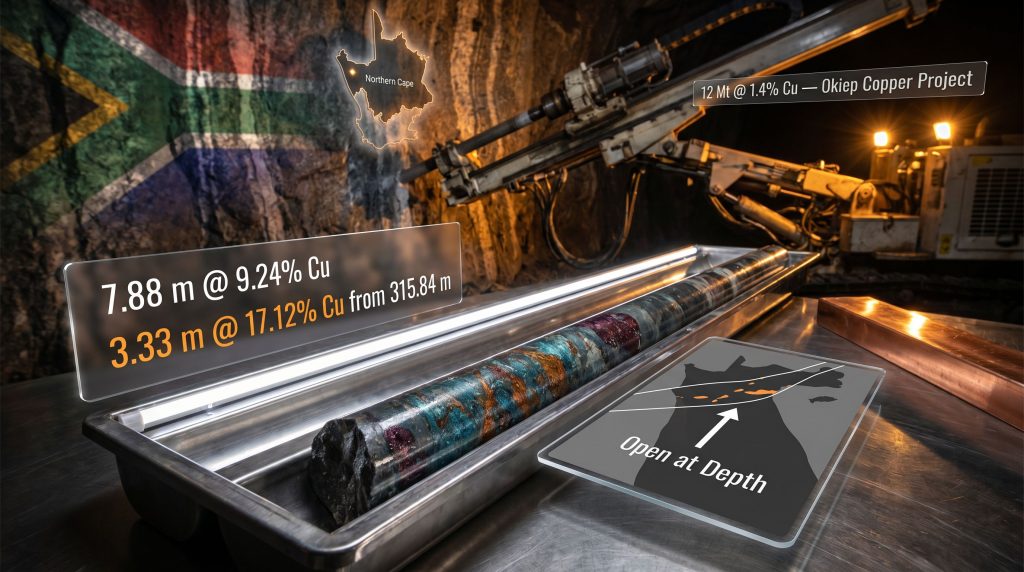
The results from OFMED157 delivered an intersection of 7.88 metres grading 9.24% copper from a downhole depth of 311.29 metres. Within that broader intercept sits a remarkable sub-interval of 3.33 metres grading 17.12% copper from 315.84 metres depth.
| Drill Hole | Intersection Width | Copper Grade | Depth (From) | Notable Sub-Interval |
|---|---|---|---|---|
| OFMED157 (2026) | 7.88 m | 9.24% Cu | 311.29 m | 3.33 m @ 17.12% Cu from 315.84 m |
| OFMED153 (2024) | 49.35 m | 5.05% Cu | — | 21.66 m @ 9.41% Cu |
| OFMED154 (2024) | 78.00 m | 1.57% Cu | — | 15.00 m @ 4.80% Cu |
| OFMED155 (2024) | 50.00 m | 1.09% Cu | — | — |
To contextualise what a grade of 17.12% copper over 3.33 metres represents: the global average copper grade for operating mines sits well below 1%, with most large-scale porphyry operations processing material between 0.3% and 0.6% copper. Even high-grade copper projects globally would consider 2% to 3% copper exceptional. An interval returning grades above 17% places Flat Mine East firmly in the category of very high-grade underground copper mineralisation, the type of result that geological teams design entire follow-up programmes around.
Why the 36-Metre Down-Dip Strategy Matters
The deliberate positioning of OFMED157 exactly 36 metres below the previous confirmed high-grade zone is not arbitrary. It reflects a structured testing methodology where each successive hole is positioned to either validate or challenge the geological model's predicted continuity. When a hole returns high-grade results at the anticipated location, it does two things simultaneously: it confirms the model's predictive accuracy and it reveals that the mineralised system remains open further down-dip, requiring yet another test hole to establish the lower boundary.
This is precisely the scenario now unfolding at Flat Mine East. A follow-up down-dip extension hole is already advancing, targeting the zone below OFMED157's intersection. Until assay results from that hole are received, the current resource envelope remains, by geological definition, incomplete.
The 2026 Campaign in Context: Building on 2024's Confirmation Programme
The 2024 confirmation drilling programme at Flat Mine East established the deposit as a credible growth priority within the broader Okiep Copper Project. Holes OFMED153 through OFMED155 delivered a range of results, from the broad 49.35-metre intersection grading 5.05% copper in OFMED153 to narrower, lower-grade intersections in subsequent holes. Critically, that programme demonstrated that mineralisation was present across multiple geometries and structural orientations, rather than being confined to a single narrow high-grade vein.
The 2026 programme shifts focus from confirmation to resource optimisation, which carries a distinct technical meaning in the JORC Code framework. Resource optimisation drilling targets areas where mineralisation is already modelled but requires additional data to either upgrade the confidence classification of existing resources, from Inferred toward Indicated or Measured, or to extend the resource envelope beyond its current modelled boundaries.
JORC Code Primer: Under the Australasian Code for Reporting of Exploration Results, Mineral Resources and Ore Reserves (JORC Code), resource classification is tied directly to drilling density and geological confidence. Inferred resources carry the lowest confidence level; Indicated resources require closer-spaced drilling demonstrating continuity; Measured resources require the tightest drill spacing with high geological understanding. Converting Inferred to Indicated resources typically unlocks significantly higher valuation multiples and enables inclusion in ore reserve calculations.
Current Resource Base: The Okiep Copper Project at Scale
The Okiep Copper Project currently hosts a total mineral resource of 12 million tonnes grading 1.4% copper, representing approximately 168,000 tonnes of contained copper metal. The Flat Mines area contributes the dominant share of this inventory, with 10 million tonnes at 1.3% copper across the combined Flat Mines sub-deposits. For further context on the project's full scope, the Okiep Copper Project page provides a comprehensive overview of the district's development pipeline.
| Resource Category | Total Tonnage | Copper Grade | Contained Copper |
|---|---|---|---|
| Okiep Copper Project (Total) | 12 Mt | 1.4% Cu | ~168 kt Cu |
| Flat Mines Area (Combined) | 10 Mt | 1.3% Cu | ~130 kt Cu |
| Flat Mines DFS Probable Reserves | 6.1 Mt | 1.17% Cu | ~71.2 kt Cu |
The 703 km² ground position held across the Okiep district is significant not just for its scale but for what it encompasses. By securing tenure over most of the historic mining district, the project controls ground that carries a century of validation through actual production, a risk-reduction factor that exploration-stage projects simply cannot replicate. Ground that has already produced millions of tonnes of copper-bearing material at commercial grades is ground where the fundamental geological questions have already been answered by history.
Definitive Feasibility Study: What the March 2025 DFS Reveals
The March 2025 definitive feasibility study for the Flat Mines project represents the highest level of technical confidence achievable before a final investment decision. A DFS is not a scoping exercise or a preliminary economic assessment; it is a full engineering and economic evaluation conducted at a level of detail sufficient for project financing and construction planning.
The Flat Mines DFS established probable ore reserves of 6.1 million tonnes grading 1.17% copper, containing approximately 71,200 tonnes of copper metal. The proposed operation is a mechanised underground mining method, selected for its operational efficiency in the narrow, high-grade geometries characteristic of norite-hosted deposits.
DFS Key Metrics at a Glance:
- Probable Ore Reserves: 6.1 Mt at 1.17% Cu
- Contained Copper Metal: ~71,200 tonnes
- Mining Method: Mechanised underground operation
- Study Classification: Definitive Feasibility Study (highest pre-construction confidence tier)
The critical point for investors and analysts to understand is that DFS reserve estimates are inherently conservative. They are based on the known resource envelope at the time of the study, constrained by existing drill hole data. When ongoing drilling, as is currently occurring at Flat Mine East, intersects high-grade mineralisation beyond the current resource boundary, it creates the conditions for reserve estimate upgrades in future technical reports. This is the mechanism by which active drilling campaigns directly improve project economics.
The next major ASX story will hit our subscribers first
Three Deposits, Three Simultaneous Work Fronts
One of the less-discussed structural strengths of the Flat Mines project is that development activity is advancing across three distinct sub-deposits concurrently, each at a different stage of the development pathway.
- Flat Mines East is the active drilling frontier, where resource optimisation holes and down-dip extension targets are being pursued to expand the resource envelope.
- Flat Mines North has entered the dewatering phase following completion of a new wastewater dam, a prerequisite infrastructure milestone for accessing historical mine workings and preparing for underground operations.
- Flat Mines South has commenced metallurgical testwork at Maelgwyn, a programme specifically designed to validate the process flowsheet for the South deposit's resources. This is notable because previous metallurgical work was limited to the North and East areas; extending testwork to the South deposit reduces technical risk across the entire project and broadens the foundation for integrated production planning.
Running three sub-deposits through overlapping development stages simultaneously serves a purpose beyond operational efficiency. It reduces the project's dependence on any single work stream succeeding and creates a portfolio of advancement milestones that can maintain investor confidence and technical momentum even if one front encounters delays.
Metallurgical Testwork: Why Process Validation Matters at Flat Mines South
Metallurgical testwork is one of the least glamorous but most consequential activities in the mine development sequence. Before any ore body can be brought into production, the mineralogy of the ore must be understood well enough to design a processing circuit that can efficiently extract the target metal at commercially acceptable recovery rates.
For Flat Mines South specifically, the current programme at Maelgwyn is focused on validating whether the process flowsheet designed for the North and East deposits performs comparably on South deposit material. Copper mineralisation styles can vary even within the same geological district, with subtle differences in grain size, sulfide speciation, or gangue mineralogy having measurable effects on flotation recovery, reagent consumption, and concentrate grade.
Successful metallurgical validation for Flat Mines South would confirm that the project can treat ore from all three sub-deposits through a unified processing circuit, a finding that has direct capital cost implications by potentially avoiding the need for separate processing infrastructure for each deposit.
Prieska Copper-Zinc: The Northern Cape's Second Development Asset
Beyond Okiep, the Prieska Copper-Zinc Mine represents the second pillar of the Northern Cape copper development story. The Prieska DFS has outlined a phased development strategy structured around two distinct production phases.
| Development Phase | Mining Rate | Operation Type | Status |
|---|---|---|---|
| Uppers Phase | 20,000 t/month | Initial underground | DFS-defined |
| Deeps Phase | 200,000 t/month | Deep-level underground | Dewatering preparation |
The initial Uppers phase, targeting 20,000 tonnes per month, is designed to generate early cash flow while the deep dewatering programme prepares the mine for the much larger Deeps phase at 200,000 tonnes per month. This phased approach is a well-established strategy in underground mine development, allowing early revenue generation to partially fund the capital-intensive infrastructure required for full-scale production.
The geographic concentration of both Prieska and Okiep in the Northern Cape creates the potential for regional infrastructure sharing, skills pooling, and supply chain efficiencies that could reduce per-unit operating costs across both operations over time. Consequently, broader copper market trends in 2025 and beyond are particularly relevant to how these assets may be valued as they approach production readiness.
Diamond Drilling Methodology and Sample Integrity at Flat Mine East
The reliability of assay results like those reported from OFMED157 depends entirely on the integrity of the sampling process. Diamond core drilling, the method employed at Flat Mine East, recovers a continuous cylindrical core of intact rock that preserves the three-dimensional relationship between mineralisation and host rock. This contrasts with percussion or rotary drilling methods, where contamination and sample loss can compromise grade estimation.
At Flat Mine East, sample selection involves both visual observation of the recovered core and handheld XRF (X-ray fluorescence) analyser readings, which provide rapid on-site elemental screening before samples are dispatched for certified laboratory assay. This two-stage selection process ensures that sampling focuses on genuinely mineralised intervals while maintaining the systematic coverage required by JORC reporting standards.
The quality of sampling methodology is not merely a technical footnote. It is the foundation upon which resource classification, economic modelling, and ultimately mine planning are built. Methodological rigour at the sample stage propagates through every subsequent technical document, from resource estimates to DFS economics.
How the Northern Cape Fits Into South Africa's Copper Endowment
South Africa is not typically ranked among the world's premier copper jurisdictions, a perception shaped partly by the global dominance of Chilean and Peruvian porphyry systems and partly by South Africa's own identity as a platinum, gold, and coal producer. Yet the Northern Cape represents a genuinely significant copper endowment whose historical production record speaks to district-scale mineralising systems rather than isolated anomalies.
The energy transition's accelerating demand for copper, driven by electric vehicle motors, grid infrastructure, renewable energy installations, and battery storage systems, has elevated the strategic profile of copper globally. Projects with demonstrated high-grade resources, established geological districts, and advanced technical studies occupy a structurally advantaged position in this environment, not because of any specific policy designation, but because the fundamental supply-demand arithmetic increasingly favours near-development copper assets.
The Okiep district's combination of a century-long production legacy, active high-grade drilling results, a completed DFS, and multi-front operational advancement across three sub-deposits positions it as a technically credible case study in Northern Cape copper development. Furthermore, as recently reported, Orion Minerals has been progressively upgrading the Flat Mines area copper resource as the BFS nears completion, underlining the momentum behind Northern Cape copper drilling at Okiep Flat Mine East.
FAQ: Northern Cape Copper Drilling at Okiep Flat Mine East
What is the Okiep Flat Mine East copper deposit?
Flat Mine East is one of three sub-deposits within the broader Flat Mines area of the Okiep Copper Project in South Africa's Northern Cape. It hosts norite-hosted copper mineralisation and is the current focus of resource optimisation drilling.
What were the key results from the OFMED157 drill hole?
OFMED157 intersected 7.88 metres at 9.24% copper from 311.29 metres depth, with a high-grade sub-interval of 3.33 metres at 17.12% copper from 315.84 metres.
What does open at depth mean for a copper deposit?
It means that mineralisation has not yet been closed off by drilling at depth. The lowest confirmed intersection has not encountered the termination of the mineralised system, indicating the deposit likely extends further than currently modelled.
How does the 2025 DFS relate to current drilling?
The DFS established probable ore reserves based on resources known at the time of the study. Successful drilling beyond the current resource envelope has the potential to support resource and reserve upgrades in future technical reports.
What is norite-hosted copper mineralisation?
It refers to copper sulfide mineralisation, primarily chalcopyrite, hosted within norite, a coarse-grained mafic igneous rock. This style typically produces high-grade but geometrically complex deposits that require systematic directional drilling to characterise.
What is the total copper resource at Okiep?
The Okiep Copper Project hosts a total mineral resource of approximately 12 million tonnes grading 1.4% copper, representing around 168,000 tonnes of contained copper.
This article is intended for informational purposes only and does not constitute financial advice. Mineral resource and reserve figures, drill results, and project development timelines are based on publicly available company disclosures and technical reports. Investors should conduct their own due diligence and consult a qualified financial adviser before making investment decisions. Forward-looking statements involve uncertainty, and actual outcomes may differ materially from those described.
Want to Catch the Next Major Copper Discovery the Moment It Hits the ASX?
Discovery Alert's proprietary Discovery IQ model scans ASX announcements in real time, instantly identifying significant mineral discoveries — including high-grade copper results like those reshaping the Northern Cape — and delivering actionable insights to subscribers before the broader market reacts. Explore historic discoveries and their returns to understand what early positioning in major mineral finds can mean for a portfolio, and begin a 14-day free trial at Discovery Alert to secure a market-leading edge.