June 5, 2026
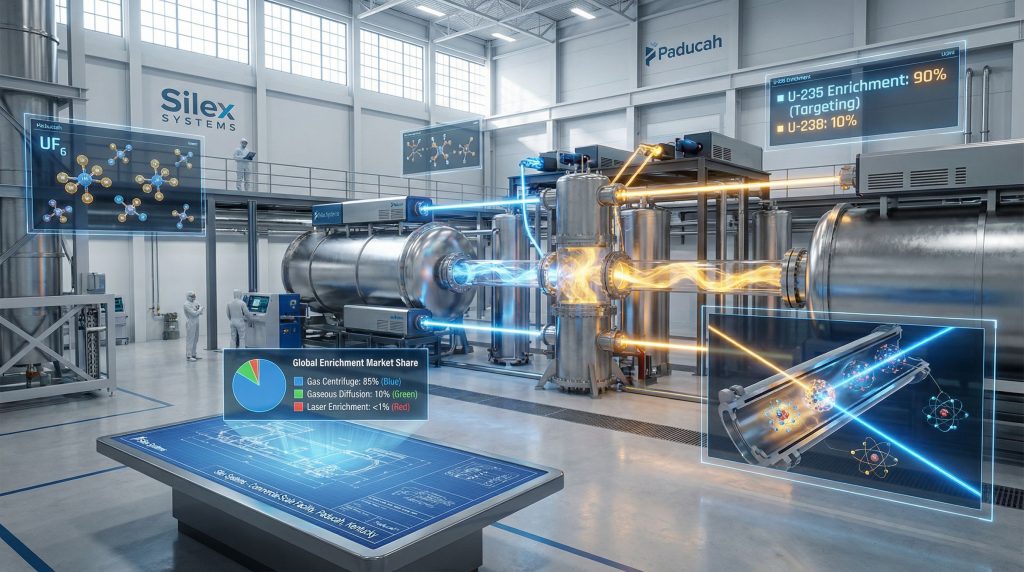
Advanced nuclear fuel enrichment technologies are reshaping global energy infrastructure as nations prioritise supply chain independence and technological sovereignty. While conventional centrifuge systems have dominated uranium processing for decades, innovative laser-based approaches represent a fundamental shift in how enriched nuclear fuel reaches power generation facilities worldwide. Furthermore, Silex Systems nuclear energy technology exemplifies this transformation through its pioneering laser isotope separation capabilities.
The Technical Foundation of Laser-Based Uranium Processing
Precision Isotope Separation Through Photochemistry
The SILEX technology employs state-selective photochemistry to achieve uranium isotope separation with unprecedented precision. Unlike mechanical centrifuge systems that rely on mass differences and rotational forces, laser enrichment utilises infrared wavelengths to selectively excite uranium-235 atoms within uranium hexafluoride gas mixtures.
This process operates through controlled photochemical reactions where specific laser frequencies target the vibrational states of U-235 isotopes. Consequently, this creates opportunities for physical separation without the cascading complexity inherent in centrifuge operations. The uranium hexafluoride operates under precise temperature and pressure parameters that maintain gas stability whilst enabling isotope-selective excitation.
Technical specifications reveal that UF₆ sublimes at -64.5°C under atmospheric pressure, requiring specialised materials compatibility and gas handling infrastructure. The laser systems must maintain coherence across extended operational periods, representing a fundamental departure from the mechanical wear patterns that characterise centrifuge maintenance cycles.
Engineering Performance Advantages Over Traditional Methods
Comparative analysis between laser and centrifuge technologies reveals distinct operational profiles. Centrifuge facilities require thousands of units operating in parallel cascades, each generating mechanical stress and requiring regular component replacement due to rotational wear. However, the laser enrichment architecture consolidates this complexity into optical and gas handling systems with different failure modes and maintenance requirements.
Key Operational Comparisons:
- Facility footprint: Laser systems operate with substantially reduced physical infrastructure compared to centrifuge cascades
- Scalability approach: Modular laser configurations allow incremental capacity additions without complete facility redesign
- Energy consumption patterns: Electrical demand focuses on laser coherence and cooling systems rather than rotational drive mechanisms
- Maintenance profiles: Optical component longevity and gas system integrity replace mechanical component replacement cycles
The Global Laser Enrichment joint venture achieved Technology Readiness Level 6 validation in October 2025. This milestone represents progression from laboratory-scale proof of concept to operational demonstration under realistic conditions.
When big ASX news breaks, our subscribers know first
Strategic Nuclear Fuel Supply Chain Vulnerabilities
Current Global Enrichment Market Structure
Global uranium enrichment capacity demonstrates concerning concentration patterns that create systemic vulnerabilities for Western nuclear power programs. Russian state enterprise Rosatom controls approximately 40% of worldwide enrichment services, whilst gas centrifuge technology maintains roughly 85% market share across all providers.
| Technology Type | Market Share | Primary Operators | Geographic Distribution |
|---|---|---|---|
| Gas Centrifuge | 85% | Rosatom, Urenco, CNNC | Russia, Europe, China |
| Gaseous Diffusion | 10% | Legacy facilities | USA, UK (phasing out) |
| Laser Enrichment | <1% | GLE Partnership | USA (development phase) |
This concentration creates single-point-of-failure risks for Western nuclear fuel supply chains. Moreover, the uranium market volatility resulting from geopolitical tensions has intensified focus on supply diversification strategies.
Geopolitical Risk Assessment and Strategic Implications
Western nuclear utilities historically sourced 60-70% of enrichment services from Russian-origin fuel cycle operations prior to Ukraine-related geopolitical tensions. Supply disruption scenarios shifted from theoretical planning exercises to operational risk management priorities following the 2022 conflict escalation.
Recovery timelines for alternative enrichment capacity development extend across multi-year periods, requiring substantial capital deployment and regulatory approval processes. In addition, the US uranium import ban has accelerated Western efforts to establish domestic enrichment capabilities.
Critical vulnerability factors include:
- Enrichment services contracts typically establish multi-year supply commitments, creating cascading effects from sudden interruptions
- Separative work unit inventory management requires careful balance between storage costs and operational security
- Alternative capacity construction timelines span 5-7 years for conventional centrifuge facilities, with laser facilities potentially offering shorter deployment periods
Advanced Reactor Fuel Requirements and HALEU Market Development
High-Assay Low-Enriched Uranium represents a critical enabling technology for next-generation reactor designs requiring 5-20% U-235 enrichment levels. Small Modular Reactor architectures from companies like TerraPower, NuScale, and X-energy depend on HALEU specifications to achieve compact core configurations.
HALEU Market Segmentation Projections:
| Fuel Category | U-235 Content | Primary Applications | 2026 Market Estimate |
|---|---|---|---|
| Standard LEU | 3-5% | Conventional reactors | $8.2 billion |
| Enhanced LEU | 5-10% | Advanced reactor designs | $1.8 billion |
| HALEU | 10-20% | SMRs, research reactors | $2.1 billion |
HALEU production capabilities remove technical barriers that previously constrained SMR commercial viability. Furthermore, this development synchronises with critical minerals & energy security initiatives essential for advanced reactor deployment.
International Atomic Energy Agency safeguards protocols for HALEU differ substantially from standard LEU oversight requirements. Consequently, this necessitates enhanced monitoring frameworks and storage specifications alongside modified infrastructure to accommodate higher enrichment materials.
Joint Venture Operational Structure and Technology Commercialisation
Partnership Framework and Intellectual Property Management
Silex Systems maintains a 51% controlling stake in the Global Laser Enrichment partnership, with Cameco Corporation holding the remaining 49% equity position. This structure creates joint decision-making requirements whilst preserving Silex's strategic control over technology development and commercialisation pathways.
The licensing arrangement establishes a 7% perpetual royalty rate flowing to Silex Systems. This ensures long-term revenue capture independent of facility ownership transitions or operational changes, minimising Silex's direct capital intensity whilst maintaining technology ownership protection.
Key structural elements include:
- Technology transfer protocols requiring Silex consent for process modifications and derivative applications
- Silex Systems nuclear energy technology subject to US export control regulations under International Traffic in Arms Regulations
- Know-how transfer involving embedded Silex personnel during facility development phases
- Proprietary operational procedures retained under licensing control
Facility Development Milestones and Production Scaling
The progression from Technology Readiness Level 5 to TRL6 validation represents a critical advancement in commercial viability assessment. TRL6 defines technology demonstrated in relevant operational environments, confirming that laboratory-scale processes successfully transition to large-scale demonstration conditions.
Wilmington facility operations provided essential validation data for scaling assumptions and process operability under realistic conditions. However, the planned Paducah, Kentucky facility represents the next commercialisation phase, targeting 6 million separative work units annual capacity.
Paducah facility strategic advantages:
- Access to depleted uranium feedstock reducing raw material transportation requirements
- Existing nuclear-qualified workforce and regulatory infrastructure
- Projected employment creation of 300+ specialised positions
- Regional economic integration with established nuclear fuel cycle operations
Multiple Revenue Stream Development Beyond Traditional Enrichment
Nuclear Fuel Market Diversification Strategy
Silex Systems nuclear energy technology applications extend beyond conventional uranium enrichment into specialised nuclear fuel markets experiencing rapid growth. The laser isotope separation platform demonstrates versatility across multiple isotopic separation requirements, creating revenue diversification opportunities.
Advanced reactor deployment timelines create demand for enrichment services spanning conventional LEU through HALEU specifications. For instance, TerraPower's Natrium reactor design requires HALEU fuel for its 600 MW sodium-cooled configuration, whilst NuScale's modular 77 MW units utilise higher enrichment levels.
Research reactor HALEU conversion programs advancing through 2024-2026 represent immediate market opportunities. These programs enable National Laboratories and international research institutions to transition from highly enriched uranium to HALEU specifications.
Silicon Purification and Quantum Computing Applications
Laser isotope separation technology demonstrates potential for quantum computing silicon purification, addressing critical material requirements for next-generation computing architectures. Silicon isotope purification removes silicon-29 isotopes that introduce magnetic interference in quantum bit operations.
This application leverages identical laser separation principles whilst targeting different isotopic specifications. Furthermore, it requires minimal additional technology development investment, though market sizing remains speculative given quantum computing commercial development timelines.
Technical considerations include:
- Silicon tetrafluoride gas handling requirements similar to uranium hexafluoride processing
- Isotopic separation precision requirements potentially exceeding nuclear fuel specifications
- Specialised packaging and handling protocols for quantum computing substrate delivery
- Limited current market size with exponential growth potential
Medical Isotope Production Capabilities
Medical radioisotope markets represent established revenue opportunities with stable demand patterns independent of nuclear power sector fluctuations. Laser separation technology can potentially produce specialised isotopes for medical imaging and therapeutic applications.
Current medical isotope supply chains demonstrate vulnerability to supply disruptions, particularly for isotopes with short half-lives. However, domestic production capabilities using laser separation could address supply security concerns whilst capturing premium pricing for specialised medical applications.
Market entry requires regulatory approval through pharmaceutical pathways in addition to nuclear regulatory oversight. Consequently, this extends commercialisation timelines but potentially provides higher margins than bulk nuclear fuel production.
Technical Risk Assessment and Operational Challenges
Technology Maturation and Commercial Scale Transition
Despite TRL6 validation success, commercial-scale laser enrichment faces technical challenges that distinguish it from mature centrifuge technology. Laser system reliability across extended operational periods requires validation under continuous production conditions rather than demonstration campaigns.
Critical technical risk factors:
- Laser coherence maintenance over thousands of operational hours
- Process optimisation for consistent isotopic separation ratios
- Quality control protocols meeting nuclear fuel specifications across all enrichment levels
- Operational safety systems for unique laser-gas interactions
Scale-up considerations involve transitioning from demonstration facility operations to commercial production throughput. Unlike centrifuge technology with decades of operational refinement, Silex Systems nuclear energy technology requires development of institutional knowledge through operational experience.
Regulatory Framework and Nonproliferation Considerations
Laser enrichment technology introduces regulatory complexities absent from established centrifuge oversight frameworks. Compact facility configurations and enhanced separation efficiency create nonproliferation concerns requiring modified safeguards protocols.
Physical security measures must address the unique characteristics of laser enrichment facilities, including optical system protection and specialised personnel access controls. In addition, nuclear waste disposal safety considerations require adaptation for laser enrichment operations.
Regulatory pathway requirements:
- Nuclear Regulatory Commission licensing procedures adapted for laser enrichment technology
- Export control compliance for dual-use laser and optical components
- International safeguards protocols specifically designed for compact enrichment facilities
- Emergency response procedures accounting for unique operational hazards
Market Competition and Technology Adoption Barriers
Nuclear utility acceptance of laser-enriched fuel requires demonstration of consistent quality, reliable supply, and competitive pricing. Conservative nuclear industry procurement practices favour proven suppliers with extensive operational histories over emerging technologies.
Long-term supply contracts represent both opportunity and risk for laser enrichment commercialisation. However, utilities prefer multi-year agreements providing supply security, whilst early-stage commercial operations cannot guarantee delivery commitments with the same confidence as mature facilities.
Competitive positioning challenges include:
- Cost competitiveness against optimised centrifuge operations with fully depreciated infrastructure
- Customer acceptance requiring extensive fuel qualification testing and regulatory approval
- Supply chain integration with existing nuclear fuel fabrication networks
- Market penetration strategy balancing premium pricing with volume requirements
Financial Model Analysis and Investment Considerations
Revenue Recognition Timeline and Profitability Pathway
Silex Systems operates under a licensing revenue model that defers substantial cash generation until GLE reaches commercial-scale operations. Current operational structure generates minimal revenue whilst maintaining technology development and partnership management expenses.
Management projections indicate profitability expectations extending at least three years into the future, contingent on successful commercial facility deployment. The 7% perpetual royalty structure provides ongoing revenue streams independent of facility ownership changes.
Financial risk factors include:
- Cash consumption during pre-commercial development phases
- Capital requirements for technology refinement and regulatory compliance
- Revenue concentration risk from single partnership arrangement
- Market timing uncertainty affecting commercialisation timeline
Licensing model advantages include minimal direct capital intensity compared to facility ownership models. However, revenue generation depends entirely on partner execution rather than direct operational control.
Strategic Partnership Value Creation Framework
Cameco Corporation's 49% partnership stake provides uranium supply chain integration benefits extending beyond capital contribution. Cameco's uranium mining operations at Cigar Lake and fuel services capabilities create natural integration opportunities.
GE-Hitachi's reactor technology alignment through advanced reactor designs requiring HALEU specifications creates demand-side integration potential. Furthermore, the US–China trade impact has emphasised the importance of Western supply chain partnerships.
Partnership value drivers:
- Cameco's uranium supply chain providing feedstock security and cost optimisation
- GE-Hitachi's advanced reactor designs creating captive HALEU demand
- International expansion opportunities through partner networks
- Risk sharing across technology development and commercialisation phases
Investment Risk Profile and Portfolio Considerations
Silex Systems nuclear energy technology represents a speculative technology investment with extended development timelines and binary outcome potential. Successful commercialisation could generate substantial long-term returns through perpetual royalty streams.
Investment risk categories and assessment:
| Risk Type | Probability Assessment | Impact Magnitude | Mitigation Factors |
|---|---|---|---|
| Technical execution | Medium | High | TRL6 validation achieved |
| Regulatory approval | Medium | High | Proactive compliance engagement |
| Market acceptance | Low-Medium | Medium | HALEU demand growth |
| Geopolitical support | High | Medium | Western energy independence priorities |
Portfolio diversification considerations favour position sizing appropriate for speculative technology investments rather than core holdings. Nuclear sector exposure through Silex provides differentiated technology risk compared to traditional uranium mining investments.
Recent insider selling activity provides market timing context, with company directors completing share disposals at A$6.63 approximately three weeks prior to current trading near A$5.55. This suggests profit-taking behaviour rather than fundamental concern.
The next major ASX story will hit our subscribers first
Future Market Trajectory and Technology Evolution
Nuclear Power Expansion and Demand Catalysts
Global nuclear capacity expansion forecasts through 2040 support growing enrichment service demand, particularly for advanced reactor designs requiring HALEU specifications. Climate policy initiatives prioritising carbon-free baseload power generation favour nuclear energy deployment across developed markets.
Small Modular Reactor commercialisation timelines accelerating through the late 2020s create concentrated HALEU demand periods. Consequently, early commercial-scale laser enrichment operations would capture significant market share during this transition period.
Market demand drivers include:
- SMR deployment schedules from NuScale, TerraPower, and international reactor vendors
- Research reactor conversions from highly enriched uranium to HALEU compliance
- Energy security considerations driving domestic enrichment capacity development
- Advanced reactor demonstration projects requiring specialised fuel specifications
Process Optimisation and Next-Generation Development
Continued technology evolution focuses on process efficiency improvements, cost reduction through automation, and environmental impact minimisation. Digital control system integration enables precise process optimisation and remote monitoring capabilities unavailable in mechanical centrifuge operations.
Technology advancement opportunities:
- Laser efficiency improvements reducing electrical consumption per separative work unit
- Automation systems minimising labour requirements and human error potential
- Waste stream minimisation and environmental impact reduction
- Modular facility designs enabling rapid deployment and capacity scaling
Competitive positioning against emerging enrichment technologies requires continuous innovation and cost structure optimisation. However, whilst laser enrichment offers inherent advantages over centrifuge technology, future competitors may develop alternative approaches.
Long-Term Investment Thesis and Market Position
Silex Systems nuclear energy technology represents a strategic position within the evolving nuclear fuel cycle, offering exposure to both traditional nuclear power growth and advanced reactor deployment trends. The technology's versatility across uranium enrichment, silicon purification, and medical isotope applications provides multiple pathways to commercial success.
Patient capital investors with multi-year investment horizons may find value in early positioning within laser enrichment technology before widespread commercial adoption. However, speculative risk assessment requires careful position sizing and ongoing monitoring of technology development milestones.
Western government support for energy independence and nuclear fuel supply chain diversification creates favourable policy environments for laser enrichment commercialisation. Strategic importance recognition may translate into supportive regulatory treatment and potential government procurement commitments.
Investment consideration framework:
- Technology leadership position in emerging enrichment sector
- Multiple revenue stream development reducing single-market dependence
- Perpetual royalty structure providing long-term cash generation potential
- Strategic partnership risk mitigation through established industry players
- Speculative risk profile requiring appropriate portfolio allocation
The nuclear fuel security narrative underlying laser enrichment technology reflects genuine strategic requirements rather than temporary market enthusiasm. For investors capable of tolerating extended development timelines and technology risk, Silex Systems provides differentiated exposure to nuclear sector transformation beyond traditional mining and utility investments.
This analysis involves speculative technology investments with substantial risk of loss. Nuclear fuel markets involve complex regulatory requirements, long development timelines, and binary commercial outcomes. Readers should conduct independent research and consider consulting qualified financial advisors before making investment decisions in emerging nuclear technologies.
Ready to Capitalise on the Next Nuclear Technology Breakthrough?
Discovery Alert's proprietary Discovery IQ model delivers real-time alerts on significant ASX mineral and technology discoveries, instantly empowering subscribers to identify actionable opportunities ahead of the broader market. Understand why major discoveries can generate substantial returns by exploring how transformative technologies create investment opportunities, then begin your 14-day free trial to position yourself ahead of the market.