June 30, 2026
Regulatory Calendars and the Reality of Junior Uranium Development
In mineral-rich jurisdictions worldwide, the gap between a signed transaction and actual production is rarely linear. For junior uranium developers operating under complex regulatory frameworks, the approval pipeline frequently determines whether a project reaches its potential or stalls at the permit stage. South Africa's Mineral and Petroleum Resources Development Act (MPRDA) represents one of the more architecturally intricate regulatory systems in global mining, requiring sequential approvals that cannot be compressed or reordered regardless of commercial urgency. Understanding how this system functions is essential context before evaluating any news flow from companies navigating it.
It is within this regulatory architecture that the Neo Energy DMPR approvals for Beatrix 4 Shaft mining right transfer have become the defining near-term catalyst for the company's development timeline. A six-month extension to both regulatory milestones announced in early June 2026 has prompted questions from investors about what the delay signals, and whether the December 2027 first production target remains credible. Furthermore, understanding the uranium market volatility at play adds important context to how regulatory timelines interact with broader investment sentiment.
When big ASX news breaks, our subscribers know first
Understanding South Africa's Two-Step MPRDA Approval Architecture
Section 102 and Section 11: Sequential, Not Parallel
The MPRDA establishes a specific procedural sequence for mining right transfers involving carved-out portions of existing rights portfolios. This sequence is non-negotiable and cannot be accelerated through commercial agreement between the parties involved.
The two distinct approval types work as follows:
- Section 102 authorises the amendment of an existing mining right. In the context of the Beatrix 4 Shaft transaction, this allows Sibanye-Stillwater to formally separate the Beatrix 4 Shaft right from its broader asset portfolio.
- Section 11 authorises the actual transfer of the carved-out right to a new holder. In this case, the recipient entity is Neo Energy's majority-owned subsidiary, Neo Uranium Resources Beisa Mine (Pty) Limited.
These approvals are strictly sequential. Section 11 proceedings cannot lawfully commence until Section 102 is resolved. This architectural dependency explains why a delay in Step 1 automatically cascades to Step 2, regardless of how advanced preparations may be on the operational side.
Why DMPR Processing Times Frequently Exceed Initial Estimates
South Africa's Department of Mineral and Petroleum Resources administers a large volume of concurrent applications across the mining sector. Departmental workload, staffing capacity, and document verification requirements all contribute to processing timelines that regularly exceed applicant expectations.
Crucially, extended processing does not inherently signal opposition to an application. In South African mining regulation, the absence of substantive objections during review is a materially positive indicator, suggesting the application is moving through administrative channels rather than facing legal or policy-level resistance.
This distinction between procedural delay and structural regulatory risk is critical for investors evaluating the Neo Energy situation.
The Beatrix 4 Shaft: Why This Asset Is Strategically Compelling
A Brownfield Uranium and Gold Development in South Africa's Free State Goldfields
The New Beisa Node, which will be developed on the Beatrix 4 Shaft property near Virginia in the Free State Goldfields, represents a brownfield opportunity with a dual-commodity production profile. Brownfield developments carry inherent advantages over greenfield projects: existing surface and underground infrastructure, established geological models, and access to skilled regional labour pools all compress development timelines and reduce execution risk.
The projected production profile for New Beisa is particularly notable:
| Production Metric | Annual Output |
|---|---|
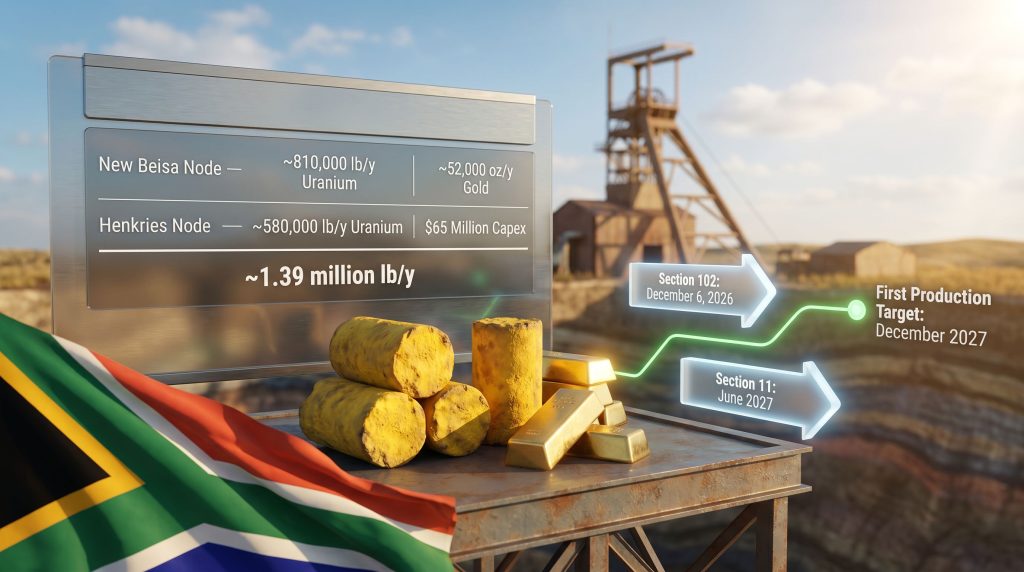
| Uranium | ~810,000 lb/y |
| Gold | ~52,000 oz/y |
The dual-commodity structure creates a natural economic hedge. Gold production provides stable cash flow even during uranium market weakness, while uranium exposure offers meaningful upside participation during periods of elevated spot prices for nuclear fuel. In addition, current uranium market dynamics suggest that dual-commodity producers are increasingly well-positioned relative to pure-play uranium developers.
Infrastructure Already Secured: A Critical Development Advantage
One of the most frequently underappreciated aspects of the New Beisa Node is that mining rights, power infrastructure, and water rights are already in place at the Beatrix 4 Shaft property. These elements, which typically consume 18 to 24 months to secure in new mining developments, represent locked-in value that is not reflected in the MPRDA transfer timeline alone.
According to Neo Energy Metals' project overview, the existing infrastructure base at Beatrix 4 Shaft significantly de-risks the development pathway compared to greenfield uranium projects in comparable jurisdictions.
Important context for investors: The MPRDA mining right transfer is a necessary but not final regulatory hurdle. Restarting uranium production will separately require nuclear and environmental authorisations at a later stage. The current approval process is a critical step, not the last one.
The Witwatersrand Basin Geological Context
The Free State Goldfields sit within the broader Witwatersrand Basin, a geological province with well-documented uranium occurrences associated with specific gold-bearing reef horizons. Uranium in this setting typically occurs in the heavy mineral fraction of ancient conglomerate reefs, co-deposited with gold over billions of years. This geological predictability is a significant de-risking factor compared to uranium deposits in less understood geological terrains.
Historically, South African gold mines extracted uranium as a by-product, with operations such as the Dominion Mine demonstrating the technical and economic viability of co-producing both commodities. Modern processing technology, including ion exchange and precipitation circuits for yellowcake production, has substantially improved recovery efficiencies compared to historical operations, enhancing the economic case for resuming uranium extraction in this geological setting.
How the Regulatory Timeline Has Evolved Since Transaction Signing
Original Structure and Revised Milestones
The transaction between Neo Energy and Sibanye-Stillwater was originally signed on December 6, 2024. Since signing, both regulatory milestones have been extended by six months while the first production target has remained fixed.
| Regulatory Milestone | Original Deadline | Revised Deadline |
|---|---|---|
| Section 102 Carve-Out Approval (Step 1) | June 2026 | December 6, 2026 |
| Section 11 Transfer Approval (Step 2) | December 2026 | June 2027 |
| First Production Target | December 2027 | December 2027 (unchanged) |
The preservation of the December 2027 first production target despite a six-month regulatory slippage is a significant data point. It implies that meaningful operational preparatory work can proceed in parallel with the pending approvals, and that the post-approval development schedule contains sufficient flexibility to absorb the delay without compressing the critical path to production.
Management Signalling and What It Means
Neo Energy's leadership has publicly described its engagement with the DMPR as constructive, with no substantive objections raised against either application. This language carries weight in the context of South African mining regulation, where the presence of formal objections — whether from third parties, communities, or regulators — can materially extend timelines or require procedural remediation.
The absence of such objections suggests the applications are progressing through standard administrative review rather than encountering substantive opposition. As reported by Mining Weekly, Neo Energy remains awaiting one final regulatory clearance before the Beisa Mine acquisition can formally complete.
Management has also confirmed that development preparation teams are actively engaged at the New Beisa site, reinforcing the view that the company is treating the regulatory delay as a procedural matter rather than a signal to pause operational readiness activities.
Is the DMPR Delay a Red Flag or Routine Administration?
Distinguishing Procedural Delay from Structural Risk
Investors unfamiliar with South African mineral rights administration often interpret regulatory delays as negative signals. In practice, Section 102 and Section 11 processing delays are common across the sector and frequently reflect departmental workload rather than transaction-specific concerns.
Several indicators help distinguish between routine administrative delay and structural regulatory risk:
- Presence or absence of substantive objections from regulators, communities, or third parties
- Nature of DMPR engagement described by the applicant (adversarial versus constructive)
- Whether additional documentation has been requested indicating substantive review concerns
- Pattern of delays across comparable transactions in the same period
In Neo Energy's case, management has confirmed no substantive objections exist, engagement is described as constructive, and the production target has been maintained unchanged. This profile is consistent with routine administrative delay rather than structural regulatory opposition.
A constructive DMPR engagement narrative, combined with an unchanged production target and no substantive objections, represents a materially different risk profile than a regulatory delay involving formal opposition, legal challenges, or policy-level resistance.
Neo Energy's Dual-Asset Portfolio: New Beisa and Henkries
The Henkries Node: A Palaeochannel-Hosted Uranium Deposit in the Northern Cape
While the Beatrix 4 Shaft transaction attracts most near-term investor attention, Neo Energy's second project, the Henkries Node in the Northern Cape, provides important portfolio diversification and demonstrates the company's strategic approach to building South African uranium production capacity.
Henkries is a near-surface, palaeochannel-hosted uranium deposit, a geological type that differs significantly from the reef-hosted uranium at New Beisa. Palaeochannel deposits form when uranium-bearing groundwater precipitates uranium minerals within ancient river channel sediments, typically at relatively shallow depths. This near-surface geometry reduces underground development requirements and can lower mining costs compared to deep reef operations.
A 2024 feasibility study confirmed the following for the Henkries Node:
| Parameter | Henkries Node |
|---|---|
| Annual Uranium Production | ~580,000 lb/y |
| Initial Capital Requirement | ~$65 million |
| Deposit Type | Near-surface palaeochannel-hosted |
| Location | Northern Cape, South Africa |
Combined Portfolio Metrics
When both projects are assessed together, Neo Energy's production pipeline and resource base take on considerable scale for a junior developer. However, understanding broader uranium market trends is equally important when contextualising the value this combined portfolio may represent to long-term investors.
| Asset | Uranium Output | Gold Output | Capex |
|---|---|---|---|
| New Beisa Node | ~810,000 lb/y | ~52,000 oz/y | Not yet disclosed |
| Henkries Node | ~580,000 lb/y | Nil | ~$65 million |
| Combined | ~1.39 million lb/y | ~52,000 oz/y |
The combined resource base across both projects totals 31.5 million pounds of uranium and 1.2 million ounces of gold, a portfolio scale that positions Neo Energy meaningfully within the global junior uranium development landscape. For context, looking at the largest uranium mines globally illustrates just how significant even a fraction of that output capacity can be.
The next major ASX story will hit our subscribers first
Capital Markets Implications and the Planned JSE Listing
Current Market Presence and Listing Strategy
Neo Energy is currently listed on the London Stock Exchange (LSE) and South Africa's A2X Markets, with a planned potential listing on the JSE main board indicated for 2026. A JSE main board listing would broaden the company's investor base within South Africa, potentially improving liquidity and access to institutional capital that is increasingly focused on domestic uranium development opportunities.
Regulatory uncertainty in junior uranium development tends to compress valuations as the market prices in execution risk. However, the specific nature of the current delay — administrative processing rather than substantive opposition — suggests that the risk premium embedded in the current valuation may overstate the actual development risk once the broader regulatory context is understood.
The Broader Uranium Supply Context
South Africa's position as a uranium jurisdiction deserves broader consideration. The country was historically among the world's significant uranium producers, with substantial production coming from Witwatersrand goldfields as a by-product of gold mining. The decline of this production, combined with growing global nuclear power capacity and a structural tightening of uranium supply, has revived interest in South African uranium assets.
Furthermore, the uranium mining status in comparable jurisdictions offers instructive parallels for how regulatory environments can shape development timelines across the sector. Global uranium demand projections have strengthened materially in recent years as nuclear energy has gained renewed policy interest across multiple jurisdictions as a low-carbon baseload power source.
New reactor construction programmes in Asia, Europe, and North America are expected to support sustained demand growth for uranium through the 2030s, providing a constructive long-term demand backdrop for projects like New Beisa and Henkries that target first production in 2027.
Frequently Asked Questions: Neo Energy DMPR Approvals and Beatrix 4 Shaft
What is the DMPR and why does it control the Beatrix 4 Shaft transfer?
The Department of Mineral and Petroleum Resources administers South Africa's MPRDA, which governs all mining right applications, amendments, and transfers. No mining right can be transferred to a new party without DMPR approval, regardless of commercial agreements between the parties involved.
What happens if the December 2026 Section 102 deadline is missed again?
A further extension would be negotiated between Neo Energy and Sibanye-Stillwater, as has occurred previously. The critical question would be whether the December 2027 production target could still be maintained. A second extension would meaningfully compress the post-approval development window and would likely require management to reassess the production timeline.
Does the regulatory delay affect the Henkries project?
No. The Henkries Node operates under a separate regulatory and development pathway. The DMPR approval process currently underway relates exclusively to the Beatrix 4 Shaft mining right transfer.
What is the relationship between Neo Energy and Sibanye-Stillwater?
Sibanye-Stillwater is the current holder of the Beatrix 4 Shaft mining right and is the seller in the transaction. The two companies are jointly navigating the MPRDA approval process, with Sibanye-Stillwater required to obtain Section 102 carve-out approval before the Section 11 transfer to Neo Energy can proceed.
When is first production currently expected?
Neo Energy has maintained its December 2027 first production target for the New Beisa Node despite the six-month extension to both regulatory approval deadlines.
Key Takeaways for Investors Monitoring the Beatrix 4 Shaft Approval Process
The central monitoring point for investors is straightforward: the December 6, 2026 deadline for Section 102 approval. If this milestone is achieved without further extension, the Section 11 transfer process can commence with a June 2027 completion target, preserving the December 2027 first production schedule.
Several factors support a constructive assessment of the regulatory path forward:
- No substantive objections have been raised against either application
- DMPR engagement is described as constructive by management
- Development preparation at New Beisa is actively underway
- The first production target has not been revised despite regulatory slippage
- The dual-asset portfolio provides strategic redundancy if one project faces further delays
The cautionary consideration is that a second extension would materially change the risk assessment, both in terms of timeline credibility and investor confidence in management's ability to forecast regulatory outcomes.
South Africa's uranium development sector operates at the intersection of complex mineral regulation, established geological endowment, and a uranium market that is structurally more supportive than at any point in the past decade. For investors with the patience to understand regulatory timelines and the discipline to distinguish administrative delay from substantive risk, the Neo Energy DMPR approvals for Beatrix 4 Shaft mining right offer a case study in how junior resource developers navigate the gap between transaction signing and production commencement.
This article is intended for informational purposes only and does not constitute financial or investment advice. Mining project timelines, regulatory outcomes, and production targets involve material uncertainty. Readers should conduct their own due diligence and consult qualified financial advisers before making investment decisions. Past regulatory precedents are not a guarantee of future outcomes in any specific application.
Want to Track the Next Major Uranium Discovery Before the Broader Market Does?
Discovery Alert's proprietary Discovery IQ model delivers real-time alerts on significant ASX mineral discoveries — instantly converting complex geological and commodity data into actionable insights for investors at every experience level. Explore Discovery Alert's discoveries page to understand how historic mineral finds have generated substantial returns, and begin your 14-day free trial today to position yourself ahead of the market.