June 29, 2026
Why Commodity Traders Are Rewriting the Rules of Uranium Project Finance
The uranium market has spent the better part of a decade clawing its way back from one of the most severe commodity price collapses in recent memory. Spot prices that once exceeded $70 per pound before 2011 collapsed to below $20 per pound by 2016 in the aftermath of Fukushima, gutting the economics of dozens of producing mines and triggering a wave of closures that reshaped global supply for years. What has followed is a structural realignment, not just in uranium prices, but in who is willing to finance the sector's recovery and on what terms.
The entry of major commodity trading houses into uranium project finance represents one of the more consequential shifts in how nuclear fuel supply chains are being rebuilt. Historically, traders occupied a narrow lane in uranium markets: they facilitated physical delivery between producers and utilities but rarely deployed balance sheet capital directly into mining operations. That calculus is changing, and the Mercuria uranium financing deal with Lotus Resources offers a detailed window into exactly how.
When big ASX news breaks, our subscribers know first
How Prepayment Financing Structures Work in the Mining Sector
Before examining the specifics of the arrangement, it helps to understand the mechanics of prepayment financing, a structure that sits in an unusual position within the capital stack.
In a conventional prepayment agreement, a commodity trader advances capital to a mining operator upfront. In return, the trader receives the right to market a defined volume of future production, recovering its advance through product offtake rather than through interest payments or equity distributions. The structure is fundamentally different from a loan or an equity placement:
- No fixed interest rate applies in the traditional sense; the trader's return is embedded in the commercial spread between purchase and resale of the physical commodity.
- No equity dilution occurs for existing shareholders, preserving ownership structure.
- Incentive alignment is strong, since the trader's recovery depends on the mine actually producing and delivering material.
- Credit risk is partially commoditised, meaning the trader assumes both counterparty and operational risk simultaneously.
This hybrid structure has been common in oil, gas, and base metals for decades. In copper, for example, prepayment arrangements between trading houses and mid-tier miners helped fund expansions across Latin America and Central Africa long before project finance banks were willing to lend. The application of this model to uranium has lagged significantly, largely due to the regulatory complexity surrounding nuclear material and the historically illiquid nature of the spot uranium market.
Furthermore, the growing liquidity of uranium markets and the multi-year price recovery appear to have crossed a threshold that now makes prepayment structures commercially viable in the nuclear fuel sector for the first time.
What Is the Mercuria Uranium Financing Deal With Lotus Resources?
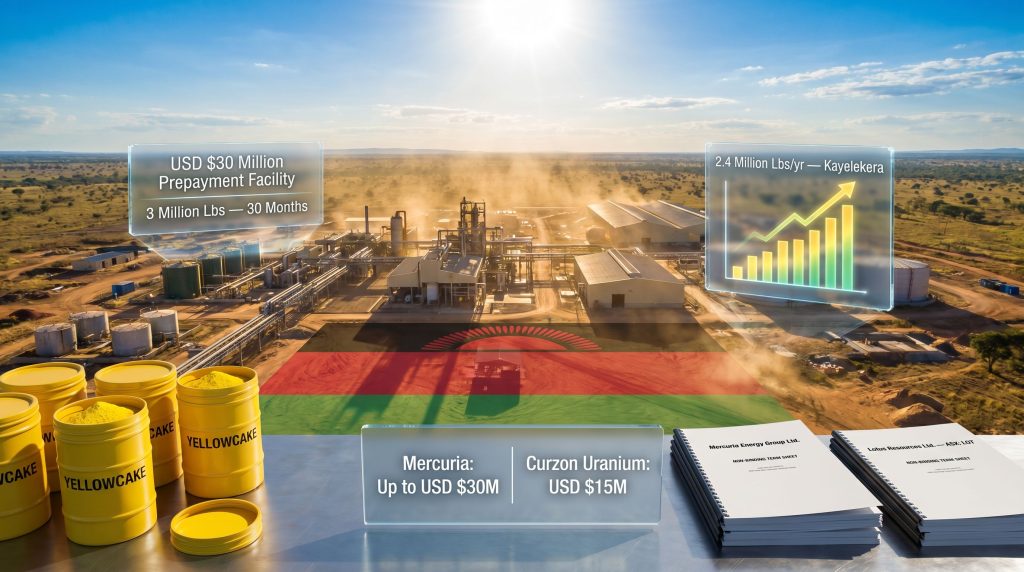
The non-binding term sheet signed between Mercuria Energy Group and ASX-listed Lotus Resources (ASX: LOT) represents Mercuria's inaugural transaction in uranium project finance. The deal centres on the Kayelekera mine restart in Malawi, which Lotus restarted in 2025 after acquiring the asset in 2020, six years after it was originally shuttered due to depressed uranium prices.
Core Deal Parameters at a Glance
| Deal Parameter | Reported Detail |
|---|---|
| Financing Party | Mercuria Energy Group Ltd. |
| Mining Operator | Lotus Resources Ltd. (ASX: LOT) |
| Asset | Kayelekera Uranium Mine, Malawi |
| Prepayment Facility | Up to USD $30 million |
| Uranium Volume (Marketing Rights) | 3 million pounds |
| Marketing Period | 30 months |
| Earliest Fund Availability | September 2026 |
| Deal Status | Non-binding term sheet (as of June 2026) |
Under the non-binding arrangement, Lotus has indicated it retains full commercial control over which counterparties receive Kayelekera's uranium production. Existing utility offtake agreements remain intact and are not displaced by Mercuria's marketing rights. The trader's role is positioned as capital provider and marketing facilitator rather than exclusive buyer, a distinction with meaningful implications for Lotus's pricing optionality across its customer base.
Why the Timing Matters
The term sheet was reported in late June 2026, against a backdrop of a temporary production suspension at Kayelekera. The mine's operations were paused following disruptions to sulfuric acid supply chains, a critical processing reagent used in uranium oxide production. Those disruptions were linked to broader commodity market volatility stemming from the Iran war's impact on global sulfur trade flows. Mercuria's prepayment capital is specifically earmarked to assist in repairing the mine's acid plant and restoring operational capacity.
The fact that funds will not be accessible before September 2026 means Lotus faces a short-term operational gap that will need to be managed through existing liquidity and its previously secured Curzon Uranium facility. For further context on the Kayelekera project and funding update, the project's significance to western supply chains is increasingly difficult to overlook.
The Sulfuric Acid Dependency: An Underappreciated Technical Risk in Uranium Mining
One of the less widely understood aspects of in-situ recovery and heap-leach uranium processing operations is the critical dependence on sulfuric acid as a leaching agent. At Kayelekera, uranium oxide is extracted from ore using an acid leach circuit, where sulfuric acid dissolves uranium minerals from crushed rock before the uranium is recovered through solvent extraction and precipitation.
This creates a supply chain vulnerability that is entirely distinct from the geological or permitting risks more commonly discussed in mining investment analysis:
- Sulfuric acid is produced primarily as a byproduct of sulfur combustion, with significant production capacity concentrated in the Middle East and parts of Asia.
- Geopolitical disruptions affecting sulfur trade, as seen with the Iran war's impact on regional commodity flows, can cascade into operational shutdowns at mines thousands of kilometres away.
- Africa-based uranium producers, which rely heavily on imported acid given limited local production capacity, are particularly exposed to this input cost and availability risk.
- The cost of acid represents a meaningful variable in uranium oxide production economics, and price spikes can materially affect operating margins even when uranium prices are supportive.
In addition, China's reported acceleration of plans to establish sulphur futures markets in 2026 reflects the growing recognition that sulfur and sulfuric acid price volatility is a systemic risk across multiple commodity sectors, including uranium mining.
This technical dependency is precisely why the Mercuria prepayment capital is earmarked for acid plant repair rather than general working capital. Restoring the acid processing circuit is the critical path to resuming production.
How the Mercuria Deal Compares to the Curzon Uranium Arrangement
Lotus Resources has pursued a deliberate strategy of diversifying its financing sources across multiple counterparty types. The Mercuria uranium financing deal with Lotus Resources sits alongside a separate, binding agreement with Curzon Uranium, and the two structures serve distinctly different commercial purposes.
Side-by-Side Comparison: Mercuria vs. Curzon Uranium
| Feature | Mercuria (Non-Binding) | Curzon Uranium (Binding) |
|---|---|---|
| Deal Type | Prepayment / Marketing Agreement | Off-Take + Unsecured Loan |
| Capital Provided | Up to USD $30 million | USD $15 million loan |
| Volume Covered | 3 million lbs over 30 months | 700,000 lbs + 100,000 lbs option |
| Binding Status | Non-binding term sheet | Binding agreement |
| Seller Price Control | Full control retained by Lotus | Fixed price terms apply |
| Timing | Funds from September 2026 | Linked to A$110M equity raise |
The Curzon arrangement also includes an option for an additional 100,000 pounds of uranium between 2030 and 2032 at a fixed price, providing revenue certainty at the cost of some upside participation. Lotus additionally completed an A$110 million equity placement to underpin the restart, creating a layered capital structure that combines equity, debt, and prepayment financing.
What This Multi-Partner Approach Signals
The use of multiple financing structures simultaneously reflects a sophisticated understanding of how junior uranium miners can manage capital risk in a cyclical commodity market. Understanding the broader uranium market dynamics is essential context here:
- Equity placements provide foundational capital but dilute existing shareholders.
- Binding off-take loans from specialists like Curzon provide fixed-rate debt backed by committed volume.
- Trader prepayment facilities fill remaining working capital gaps without requiring security over the asset.
- Non-binding term sheets allow flexibility to negotiate final terms while signalling financing progress to the market.
This stacking approach is increasingly common among mid-tier and junior miners globally, particularly in uranium where traditional bank lenders remain constrained by ESG screening policies that often exclude nuclear fuel producers regardless of their carbon contribution.
Mercuria's Strategic Expansion and What It Reveals About Uranium Market Maturity
Mercuria is not a marginal participant in global commodity markets. The Geneva-headquartered trading house operates across oil, gas, metals, and agricultural commodities, and its decision to deploy balance sheet capital into a uranium mining operation carries genuine signal value.
How the Uranium Trading Landscape Has Evolved
| Institution Type | Role in Uranium Market |
|---|---|
| Mercuria Energy Group | Physical uranium trading + prepayment financing (inaugural deal) |
| Natixis | Uranium-linked structured financial products |
| Citibank | Physical uranium trading participation |
| Specialist Uranium Funds | Direct off-take and royalty financing (e.g., Curzon Uranium model) |
For a major trading house to commit to prepayment financing in uranium, several market conditions must be present simultaneously: sufficient spot market liquidity to hedge exposure, a credible operational counterparty, recoverable production volumes within a commercially reasonable timeframe, and confidence in the long-term demand trajectory for nuclear fuel.
The divergence between spot vs term prices has been a key feature of recent uranium market dynamics, adding further complexity to how traders like Mercuria structure their return expectations. The global reactor construction pipeline, led by China's aggressive buildout of new capacity, has materially strengthened the demand case. Multiple countries that stepped back from nuclear power after Fukushima, including Japan, Belgium, and South Korea, are reassessing fleet extensions and new builds.
The next major ASX story will hit our subscribers first
Geopolitical Supply Chain Diversification: The Strategic Value of African Uranium
Western utilities and the governments that regulate their nuclear fuel procurement are under increasing pressure to reduce reliance on Russian and Kazakh uranium. The Russian uranium import ban has elevated supply security concerns considerably, compelling buyers to seek alternative sources with greater urgency.
Malawi's Kayelekera mine represents a non-Russian, non-Chinese-aligned production source in a jurisdiction that has demonstrated willingness to host uranium operations under internationally recognised environmental and safety frameworks. This geopolitical positioning is not incidental to the Mercuria deal; it is a core component of the asset's strategic value.
Key considerations for African uranium supply in the current environment:
- Malawi, Namibia, and Tanzania collectively hold substantial underdeveloped uranium resources that have attracted growing institutional attention.
- Infrastructure constraints, particularly around reagent supply chains and processing inputs, remain the primary bottleneck preventing faster capacity expansion.
- Logistics costs for African uranium operations are structurally higher than Central Asian alternatives, requiring higher sustained spot prices to remain competitive.
- Botswana, where Lotus also holds a 100% interest in the Letlhakane project, represents an additional non-producing African uranium asset with long-term optionality.
The ongoing uranium supply deficit continues to make assets like Kayelekera strategically attractive to both traders and utilities seeking diversified, politically stable supply.
Risk Factors and Scenario Analysis for the Lotus Resources Mercuria Deal
The following analysis involves forward-looking scenarios and should not be interpreted as investment advice. Investors should conduct independent due diligence before making any investment decision.
Key Risks Embedded in the Current Arrangement
- Non-binding status means the USD $30 million facility is not guaranteed until formal documentation is executed and conditions precedent are satisfied.
- Operational restart risk remains elevated given the acid plant damage and supply chain disruption still being resolved.
- Commodity price sensitivity could affect the commercial attractiveness of prepayment repayment terms if uranium spot prices decline materially.
- Geopolitical exposure in Sub-Saharan Africa includes logistics, regulatory, and political risk factors that are distinct from more liquid mining jurisdictions.
Scenario Analysis: Deal Outcomes and Production Implications
| Scenario | Outcome for Lotus Resources | Production Outcome |
|---|---|---|
| Deal Finalised (September 2026+) | $30M working capital secured; acid plant repaired | Production resumes at ~2.4M lb/yr target |
| Deal Falls Through | Reliance on Curzon facility and equity capital | Potential further production delays |
| Partial Drawdown | Phased capital deployment; reduced marketing volume | Constrained but operational throughput |
| Uranium Price Decline | Prepayment economics deteriorate | Risk of renegotiation or facility restructure |
Frequently Asked Questions: Mercuria Uranium Financing and Lotus Resources
What is the Mercuria uranium financing deal with Lotus Resources?
Mercuria Energy Group has signed a non-binding term sheet with Australian uranium company Lotus Resources to provide up to USD $30 million in prepayment financing. In exchange, Mercuria receives the right to market 3 million pounds of uranium production from the Kayelekera mine in Malawi over a 30-month period. This is Mercuria's first financing transaction in the uranium sector.
Is the Mercuria deal binding?
As of June 2026, the arrangement exists only as a non-binding term sheet. Funds are not expected to be available before September 2026, and full documentation must be executed before capital is deployed.
Why did Kayelekera suspend production in 2026?
Lotus Resources announced a temporary production pause at Kayelekera due to disruptions in sulfuric acid supply chains. The disruptions were connected to commodity market volatility caused by the Iran war's effect on global sulfur trade. Mercuria's prepayment capital is specifically designated for acid plant repair to restore production.
Does Mercuria control which buyers receive Kayelekera's uranium?
No. Under the non-binding arrangement, Lotus retains full commercial control over buyer selection, including the ability to continue fulfilling existing utility offtake agreements independently of Mercuria's marketing role.
What is Lotus Resources' annual production target at Kayelekera?
Lotus Resources is targeting approximately 2.4 million pounds of uranium oxide per year from the Kayelekera mine.
Key Milestones to Watch
The Mercuria uranium financing deal with Lotus Resources will progress through several identifiable stages over the coming months. Consequently, investors and market observers should track:
- Conversion of the term sheet to a binding agreement, expected during the third quarter of 2026.
- Completion of acid plant repairs and confirmation of a production restart timeline at Kayelekera.
- First drawdown under the Mercuria prepayment facility and confirmation of the marketing period commencement.
- Uranium spot price trajectory, particularly any developments affecting the commercial returns embedded in the prepayment structure.
- Whether Mercuria pursues additional uranium financing transactions, which would confirm a strategic commitment to the sector rather than an isolated opportunistic deal.
The broader significance of this arrangement extends well beyond a single mine restart in Malawi. It reflects a maturing uranium market where commodity trading capital is now sufficiently confident in long-term demand fundamentals to deploy structured financing alongside physical trading operations, filling a gap that traditional lenders and equity markets have consistently struggled to bridge.
Want to Stay Ahead of the Next Major Uranium Discovery on the ASX?
Discovery Alert's proprietary Discovery IQ model scans ASX announcements in real time, instantly identifying significant mineral discoveries across uranium and 30+ other commodities — including the kind of structural opportunities emerging as commodity trading capital reshapes uranium project finance. Explore historic discovery returns on Discovery Alert's dedicated discoveries page and begin your 14-day free trial to ensure you're positioned before the broader market catches on.