June 26, 2026
Why Heavy Industry Sits at the Frontier of the Nuclear Energy Transition
The global energy transition has made remarkable progress in sectors where electricity is the primary energy carrier. Solar panels now power homes, wind turbines feed national grids, and electric vehicles are rapidly displacing combustion engines. Yet beneath this visible transformation lies a harder problem: the vast industrial infrastructure of refineries, chemical plants, smelters, and offshore platforms that requires not just electricity, but continuous, high-temperature heat delivered at scale, without interruption, and at predictable cost.
Renewables cannot solve this problem alone. The physics of industrial process heat demand temperatures that heat pumps and resistive electrification struggle to reach economically. Intermittency compounds the challenge further. A refinery or aluminium smelter cannot pause operations when the wind drops or clouds obscure the sun. This is precisely where the industrial use of small modular reactors is emerging as one of the most consequential energy debates of the coming decade.
When big ASX news breaks, our subscribers know first
The Energy Problem That Renewables Cannot Fully Solve
Understanding Hard-to-Decarbonise Industrial Sectors
The term "hard-to-decarbonise" refers to industries where the energy requirements go beyond what current renewable electrification can reliably or economically supply. These sectors include petroleum refining, petrochemical manufacturing, liquefied natural gas processing, mining, aluminium smelting, steelmaking, and offshore oil and gas production. Furthermore, critical minerals demand across these sectors is accelerating the urgency of finding reliable, low-emission energy solutions.
What unites them is a shared dependency on continuous, high-reliability heat and power that is currently delivered almost entirely by fossil fuel-based systems. The consequences of this dependency are threefold:
- Significant and ongoing carbon emissions embedded in core production processes
- Exposure to fuel price volatility that directly affects operating margins and capital planning
- Grid instability risk for operations in remote or energy-constrained geographies
The challenge is not simply one of substituting one fuel for another. These industries require energy systems that can be co-located with production facilities, scaled to match load requirements, and operated continuously over multi-decade asset lifetimes. That combination of attributes defines the industrial opportunity for modular nuclear technology.
What Makes SMRs Structurally Different from Conventional Nuclear?
Traditional nuclear power plants were designed with a single purpose: generating large volumes of electricity for export to national grids. Their scale, typically measured in gigawatts of electrical output, their regulatory complexity, and their centralised siting logic make them fundamentally misaligned with industrial energy requirements.
Small modular reactors and micro modular reactors (MMRs) operate on a different architectural premise. They are engineered to integrate directly with industrial energy systems, functioning as what the sector now describes as nuclear boilers and behind-the-meter generators, rather than utility-scale power stations feeding transmission lines.
The practical distinctions are significant:
- SMRs can be scaled from a few megawatts for remote well pads to several hundred megawatts for integrated industrial hubs
- Behind-the-meter deployment eliminates transmission infrastructure costs and grid dependency
- Multiple reactor modules can be stacked to match industrial load growth over time
- MMR units under certain designs can be relocated as fields mature or operational priorities shift geographically
The structural logic of SMR industrial deployment inverts the conventional nuclear model. Rather than building a power station and selling electricity into a market, the reactor becomes embedded infrastructure serving a specific industrial process, much like a gas-fired boiler, but without the emissions or fuel price exposure.
The Temperature Imperative: Why Reactor Design Determines Industrial Compatibility
Matching Heat Output to Industrial Process Requirements
The single most important technical variable determining whether a given SMR design is compatible with a particular industrial application is operating temperature. Different industrial processes require heat at very different temperature thresholds, and not all reactor designs can deliver across that range.
| SMR / Reactor Type | Operating Temperature Range | Primary Industrial Application |
|---|---|---|
| Light Water SMRs | 300°C to 350°C | Steam supply, district heating, desalination |
| High-Temperature Gas Reactors (HTGRs) | 700°C to 900°C | Oil refining, chemical synthesis, hydrogen production |
| Molten Salt Reactors (MSRs) | 600°C to 800°C | Petrochemicals, steel production |
| Gas-Cooled Fast Reactors (GFRs) | 850°C to 1,000°C | Advanced chemicals, synthetic fuels |
Light water SMRs, the most commercially mature designs currently approaching deployment, are well suited to steam supply, low-grade heating, and electricity generation. However, the most energy-intensive and emissions-heavy industrial processes require heat at temperatures that only advanced reactor designs can supply. High-temperature gas reactors and molten salt reactors are capable of delivering heat in the 700°C to 900°C range, which opens compatibility with oil refining, chemical synthesis, and eventually primary steelmaking.
This temperature gap between commercially ready and technically required designs represents one of the key timelines embedded in industrial SMR deployment planning. Near-term applications will focus on lower-temperature steam supply and electricity generation, while the full industrial decarbonisation potential depends on advanced designs reaching commercial maturity through the mid-to-late 2030s.
Industries Driving Demand: Who Needs Modular Nuclear and Why
Refining and Petrochemicals: The Highest-Value Application
Petroleum refining sits at the apex of industrial SMR opportunity. Refinery operations, including steam cracking, fractional distillation, catalytic reforming, and hydrogen production, are almost entirely dependent on gas-fired heat and steam. These processes run continuously, require reliable high-grade heat, and cannot tolerate the interruptions that characterise renewable energy supply.
The potential carbon reduction from substituting nuclear heat for gas-fired cogeneration in the chemical sector is estimated at up to 60%, a figure that reflects both the direct emissions reduction from displacing fossil combustion and the downstream effect of decarbonising industrial hydrogen production.
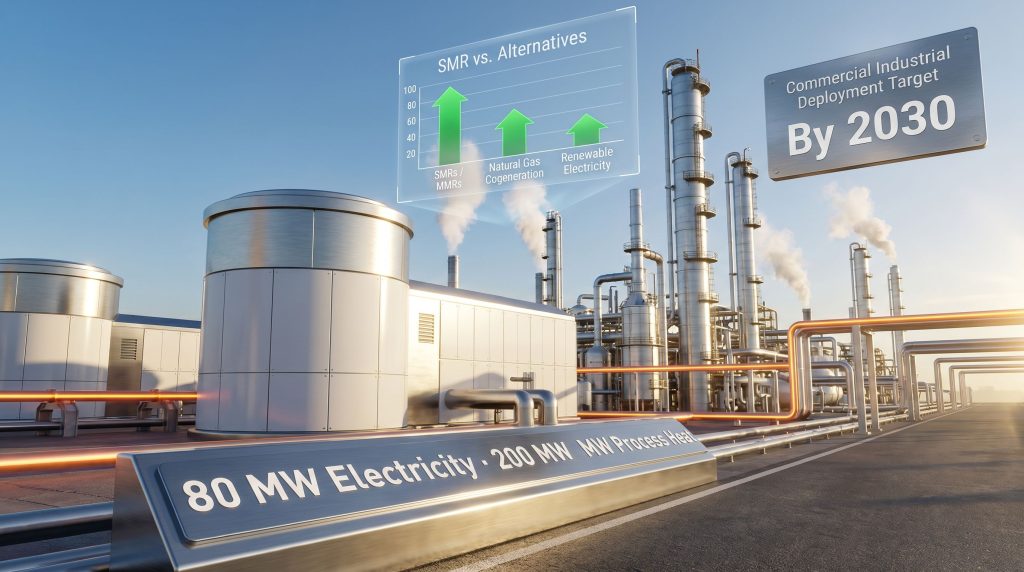
One of the most closely watched industrial nuclear projects is the planned deployment of four X-energy SMR units at Dow Chemical's Seadrift facility in Texas. Each unit is designed to deliver 80 megawatts of electricity and 200 megawatts of process heat, targeting the replacement of legacy fossil heat sources and enabling on-site hydrogen production. This project represents one of the clearest near-term proof points for the industrial use of small modular reactors at commercial scale.
Mining Operations: The Remote Energy Constraint
Mining presents a distinct but equally compelling case. Remote and frontier mining operations face a three-layer energy constraint that conventional solutions address poorly:
- Limited or no grid connectivity, requiring self-contained power generation
- Intermittent renewable resources that cannot guarantee the continuous power required for extraction and processing
- High logistics costs associated with diesel, LNG, and compressed natural gas fuel supply to remote sites
MMRs and smaller SMR configurations address all three constraints simultaneously. They eliminate fuel logistics entirely, deliver continuous baseload power regardless of weather conditions, and can be scaled to match the power requirements of operations ranging from small exploration sites to major integrated mining complexes.
Rio Tinto's participation in industrial nuclear consortiums signals that mining majors are moving beyond early-stage curiosity toward structured evaluation of nuclear deployment. In addition, critical minerals and energy security considerations are driving miners to seek long-term, reliable power solutions. Copper, aluminium, and iron ore operations requiring continuous, high-reliability power represent particularly strong candidates for near-term adoption.
Offshore Energy: Floating Nuclear Platforms
Offshore oil and gas production relies on produced-gas turbines to generate the electricity and process heat that keep floating production, storage, and offloading (FPSO) platforms operational. These turbines are emissions-intensive, maintenance-heavy, and subject to fuel supply variability.
Nuclear modules integrated into offshore platforms or barge-based configurations can replace this combustion infrastructure with zero-emission heat and power systems. The alignment between nuclear operational lifespans and multi-decade offshore field development timelines makes this a structurally attractive pairing. A nuclear platform deployed at the start of a major field development could serve that facility for the entirety of its productive life.
Maritime shipping concepts are also emerging, with SMR designs under evaluation for container vessels and industrial cargo fleets, extending the potential industrial application of modular nuclear beyond fixed offshore infrastructure.
Steelmaking and Aluminium Smelting: Electricity-Intensive Manufacturing
Electric arc furnace steelmaking and aluminium smelting are among the most electricity-intensive manufacturing processes in existence. Both require continuous, high-volume power supply without the grid instability that can disrupt electrochemical production processes.
SMR configurations scaled to the combined electrical and thermal loads of smelters and steel mills, potentially in the hundreds of megawatts, offer a pathway to displacing coal-fired power that currently dominates aluminium smelting energy supply globally. Advanced reactor designs capable of delivering direct process heat could eventually extend this impact to primary steelmaking, one of the most emissions-intensive manufacturing sectors on earth.
Hydrogen Production and Data Centres: Emerging Industrial Loads
Two additional sectors warrant attention as drivers of industrial SMR demand.
Nuclear-assisted hydrogen production operates across two technical pathways. Electrolytic production uses SMR-generated electricity to power water electrolysis, while thermochemical pathways use reactor heat directly in chemical cycles that produce hydrogen without combustion. Advanced SMR thermal output significantly enhances the efficiency of Solid Oxide Electrolytic Cell (SOEC) hydrogen systems, positioning nuclear as both a clean power source and a process heat enabler for hydrogen supply chains serving oil refining, ammonia synthesis, and steel reduction.
Data centres represent a newer but rapidly growing industrial load category. Exponential growth in artificial intelligence infrastructure and cloud computing is driving power demand that hyperscalers are struggling to meet with renewable sources alone. The industrial parallel is direct: data centres require uninterrupted, carbon-free baseload power at scale, a requirement that aligns precisely with SMR output characteristics.
The Industrial Advanced Nuclear Consortium: A Demand-Pull Model
Consortium Structure and Strategic Significance
The Industrial Advanced Nuclear Consortium was established under The Open Group, a globally recognised vendor-neutral technology and standards organisation. Founding members include ExxonMobil, Shell, Chevron, ConocoPhillips, Freeport-McMoRan, Rio Tinto, and steel producer Nucor, a membership profile that spans offshore energy, upstream oil and gas, mining, and heavy manufacturing.
The consortium's approach represents a structural departure from how nuclear commercialisation has historically worked. In the traditional model, reactor vendors develop technology and then seek industrial customers. The consortium inverts this sequence entirely: industrial end users are aggregating their energy requirements first, defining precisely what nuclear technology needs to deliver, and then communicating those specifications to the supply chain.
This demand-pull dynamic, driven by end users rather than vendors or utilities, could meaningfully compress the timeline between technology readiness and commercial deployment. When the customer defines the specification before the product is finalised, the development process becomes market-directed rather than technology-pushed.
The Application Scenarios White Paper: Four Priority Deployment Contexts
The consortium's published white paper identifies four application scenarios as most relevant to current member requirements:
- Maritime heat and power: Nuclear modules integrated into offshore platforms and vessels, replacing combustion-based generation with zero-emission nuclear systems across multi-decade field lifetimes
- Nuclear cogeneration for refining, petrochemicals, and LNG: Simultaneous delivery of heat and electricity to integrated industrial complexes, displacing gas-fired cogeneration infrastructure
- Remote power and heat for upstream oil and gas and mining: MMR deployment at off-grid sites addressing diesel and LNG dependency in frontier environments, with relocatable unit designs for operations that shift as fields mature
- Electricity-intensive industrial loads: Continuous, high-volume electricity supply for aluminium smelting and steelmaking, scaled to combined electrical and thermal loads in the hundreds of megawatts
The consortium has stated its intention to use nuclear as a viable option for industrial projects by 2030, with next steps focused on defining technical architectures for each scenario, analysing regulatory pathways, and developing commercial and ownership models to enable deployment.
SMR Versus Competing Industrial Decarbonisation Technologies
Comparative Analysis: Where Modular Nuclear Fits in the Technology Landscape
Understanding where SMRs are competitively strong, and where they face genuine disadvantages, is essential for evaluating their industrial role.
| Technology | Heat Quality | Reliability | Carbon Intensity | Fuel Cost Exposure |
|---|---|---|---|---|
| Natural Gas Cogeneration | High | Very High | High | High (volatile) |
| Renewables + Heat Pumps | Low to Medium | Intermittent | Very Low | Low |
| Green Hydrogen Combustion | High | Supply dependent | Very Low | Medium to High |
| Carbon Capture on Gas (CCS) | High | High | Low to Medium | High |
| SMRs / MMRs | Medium to Very High | Very High | Very Low | Very Low |
SMRs outperform competing technologies on the combination of heat quality, reliability, carbon intensity, and long-term fuel cost stability. No other currently available technology delivers across all four dimensions simultaneously. However, the disadvantages are real and must be factored into deployment planning:
- Higher upfront capital costs relative to gas cogeneration, though fuel savings over multi-decade operations can offset this
- Longer permitting and construction timelines compared to modular gas or renewable installations
- Social licence and public perception challenges in proximity to industrial communities
- Technology readiness gaps for advanced high-temperature designs, most of which have not yet reached commercial deployment
SMRs and green hydrogen are best understood as complementary rather than competing pathways. SMRs can directly power processes requiring continuous heat and electricity while simultaneously serving as the energy source for large-scale hydrogen production, creating a dual-value proposition that neither technology achieves independently.
The next major ASX story will hit our subscribers first
Regulatory Adaptation: The Critical Path to Industrial Deployment
Licensing Frameworks Designed for a Different Era
Existing nuclear licensing frameworks were developed for utility-scale, grid-connected power plants. They were not designed to accommodate behind-the-meter, industrially co-located reactors operating within chemical plants, refineries, or mining complexes. This regulatory gap represents one of the most significant near-term constraints on deployment timelines.
Regulatory bodies including the US Nuclear Regulatory Commission, the UK's Office for Nuclear Regulation, and Canada's Canadian Nuclear Safety Commission are actively developing adapted frameworks for SMR deployment. The pace and coherence of this adaptation will materially influence whether the 2030 commercial deployment target is achievable. Consequently, uranium energy investments are increasingly being evaluated in the context of these regulatory developments.
The EU's SMR Strategy, adopted in March 2026, represents the most explicit policy-level commitment to date, explicitly targeting SMRs for deployment in hard-to-decarbonise industrial sectors. This is a regulatory framework development, not a project-specific commitment, and its practical impact will depend on how member states translate strategy into licensing processes.
Technical Integration: Safety Cases in Industrial Environments
Co-locating nuclear reactors with petrochemical or chemical processing facilities introduces safety case complexity that does not arise in standalone nuclear plants. The interaction between nuclear systems and hazardous chemical processes requires interface engineering, emergency response planning, and safety case development that goes beyond conventional nuclear licensing.
Additional technical challenges include:
- Interfacing nuclear heat supply systems with existing industrial process control infrastructure
- Designing for both grid-connected and islanded operation depending on facility requirements
- Developing thermal storage solutions to manage variable industrial demand profiles
- Establishing load-following capability for reactor designs that must respond to shifting process heat requirements
The Industrial SMR Deployment Timeline Through 2040
Near-Term: 2026 to 2030
The immediate period is defined by foundational work rather than widespread deployment. Technical architecture definitions for the four priority application scenarios will be developed, regulatory frameworks will be adapted for industrial co-location, and first commercial SMR deployments for industrial applications using light water designs are anticipated. The Dow Chemical and X-energy Seadrift project remains the most visible potential first-mover reference case for this period.
Medium-Term: 2030 to 2035
Successful near-term pilots will open the path to multi-module industrial configurations, broader mining sector adoption in remote environments, and first demonstrations of offshore floating nuclear platforms. SMR-powered hydrogen production at commercial scale is also anticipated within this window, as electrolyser and thermochemical hydrogen technologies continue to mature. Furthermore, uranium market dynamics will play an increasingly significant role in shaping the economics of industrial nuclear deployment during this period.
Long-Term: 2035 to 2040 and Beyond
The long-term industrial SMR opportunity is defined by the commercial maturity of advanced high-temperature reactor designs. When HTGRs and MSRs reach full commercial readiness, their integration into chemicals, petroleum refining, and primary steelmaking becomes feasible at scale. This opens the possibility of SMRs becoming standard infrastructure in new industrial complex development globally. US uranium production capacity will be a critical factor in supporting this expanded deployment at scale.
Frequently Asked Questions: Industrial Use of Small Modular Reactors
What industries are most suited to SMR deployment?
Refining, petrochemicals, LNG processing, mining, aluminium smelting, steelmaking, hydrogen production, and data centres are the highest-priority sectors. Their shared characteristic is a requirement for continuous, high-reliability energy that intermittent renewable sources cannot consistently deliver.
How much power can an SMR provide to an industrial facility?
Output ranges from a few megawatts for remote well pads and small mining sites to several hundred megawatts of combined electrical and thermal output for large integrated industrial complexes. Multi-module configurations allow industrial operators to scale capacity incrementally as operational requirements evolve.
Can SMRs supply high-temperature heat for chemical manufacturing?
Advanced designs including HTGRs and MSRs are capable of delivering heat in the 700°C to 900°C range, sufficient for oil refining, chemical synthesis, and eventually steelmaking. Currently available light water SMRs are limited to lower-temperature applications including steam supply and desalination. The IAEA's guidance on SMR technology provides further context on how these temperature thresholds inform reactor design classifications.
What is the target timeline for commercial industrial SMR deployment?
Leading industrial consortiums are targeting nuclear as a viable option for industrial projects by 2030, with broader adoption across hard-to-decarbonise sectors anticipated through the mid-to-late 2030s as advanced reactor designs reach commercial maturity.
Are regulatory frameworks in place for industrial co-located SMRs?
Existing frameworks were designed for utility-scale grid-connected plants and require adaptation for industrial co-location scenarios. Regulatory bodies across North America, Europe, and the UK are actively developing revised approaches. The EU's SMR Strategy adopted in March 2026 is the most explicit policy-level commitment to directing SMR deployment toward hard-to-decarbonise industrial sectors.
Key Takeaways
- Heavy industry's decarbonisation challenge fundamentally cannot be resolved by renewables alone, as continuous, high-grade heat and power at scale are required
- SMRs and MMRs offer a scalable, co-locatable solution spanning from remote mining operations to large integrated petrochemical hubs
- The demand-pull model, where industrial end users define requirements before engaging vendors, represents a structural shift in nuclear commercialisation that could accelerate deployment timelines
- Four priority application scenarios are driving near-term development: maritime power, refinery cogeneration, remote mining and upstream oil and gas, and electricity-intensive manufacturing
- Commercial deployment at scale is targeted for 2030, with advanced high-temperature applications following in the mid-to-late 2030s
- Regulatory adaptation, technical integration architecture, and commercial model development represent the critical path to realising the industrial use of small modular reactors at meaningful scale
This article contains forward-looking statements and projections based on current industry forecasts, consortium publications, and publicly available research. Actual deployment timelines, technology performance, and commercial outcomes may differ materially from those described. This content is intended for informational purposes only and does not constitute financial or investment advice.
Want to Capitalise on the Energy Transition Driving Demand for Critical Minerals?
Discovery Alert's proprietary Discovery IQ model delivers real-time alerts the moment significant ASX mineral discoveries are announced — spanning uranium, copper, and the critical minerals central to industrial decarbonisation — instantly translating complex data into actionable investment insights. Explore Discovery Alert's dedicated discoveries page to understand how historic mineral discoveries have generated substantial market returns, then begin your 14-day free trial to position yourself ahead of the broader market.