June 4, 2026
The Infrastructure-First Logic Behind ISR Uranium's Quiet Expansion
Across the uranium sector, a recurring pattern separates producers who scale efficiently from those who stall: the companies that build processing infrastructure ahead of full wellfield development consistently outperform those chasing production capacity without a licensed hub to receive it. This infrastructure-first philosophy sits at the heart of in-situ recovery uranium operations, where the relationship between satellite capture facilities and central processing plants defines both the economics and the expansion potential of an entire production platform.
The completion of the enCore Energy Upper Spring Creek ion exchange plant construction milestone in South Texas illustrates precisely how this model functions in practice. Rather than treating the satellite facility as a secondary consideration, the company treated it as the primary enabling asset, one that must be operational and scalable before wellfield volumes can be meaningfully converted into yellowcake. Understanding why this sequencing matters requires a deeper look at ISR uranium mechanics, the geology underpinning the Clay West district, and the operational architecture that makes satellite IX plants such powerful leverage points for domestic uranium producers.
When big ASX news breaks, our subscribers know first
Why ISR Uranium Is Structurally Different From Conventional Mining
In-situ recovery differs from conventional uranium mining in ways that fundamentally reshape the capital and operational profile of a project. Rather than excavating ore and transporting it to a surface mill, ISR operations dissolve uranium directly from underground sandstone formations using a carefully managed chemical solution called a lixiviant, typically oxygenated groundwater, which is injected through a wellfield network and pumped back to surface after absorbing uranium from the ore body.
The key distinctions that make ISR attractive at current uranium price levels include:
- Lower capital intensity compared to open-pit or underground mining, as no ore is physically moved to surface
- Reduced surface disturbance, with operations confined largely to wellheads, pipelines, and processing facilities
- Shorter construction timelines from permit to production, particularly where pre-existing licensed infrastructure is available
- Modular scalability, allowing producers to add wellfield modules incrementally without redesigning the entire processing system
- Established commercial track record, with US ISR uranium production running continuously in the United States for more than five decades
South Texas has been a productive ISR uranium region since the 1970s. The Oakville Formation, which hosts the uranium mineralisation at Upper Spring Creek, is a uranium-bearing sandstone horizon extending roughly 120 miles in length and 20 miles in width across the region. The saturated ore body at Upper Spring Creek sits at depths of between 300 and 450 feet below surface, a range that is highly compatible with ISR wellfield drilling and extraction economics. Importantly, the uranium occurs within permeable, water-saturated sandstone, a geological prerequisite for effective lixiviant circulation and uranium dissolution.
One aspect of South Texas ISR geology that is not widely appreciated outside specialist circles is the significance of aquifer exemption designations. These exemptions, granted by regulators, allow ISR operators to inject lixiviant into formations that would otherwise be subject to drinking water protections. Securing an aquifer exemption is often the most time-consuming regulatory step in establishing a new ISR operation, which is why the exemption originally obtained by Signal Equities LLC at Upper Spring Creek represented a meaningful pre-existing regulatory asset when enCore acquired the project in December 2020.
How the Satellite Ion Exchange Process Works: Step by Step
The enCore Energy Upper Spring Creek ion exchange plant construction project centres on a satellite IX facility that operates as the uranium capture point within a broader two-stage production system. The process flow can be broken down as follows:
- Lixiviant injection: Oxygenated groundwater is pumped into uranium-bearing sandstone through injection wells drilled across the wellfield pattern.
- Uranium dissolution: The oxygenated solution mobilises uranium from the sandstone, creating a uranium-bearing solution known as pregnant leach solution.
- Solution recovery: The uranium-laden solution is pumped to surface through recovery wells positioned to capture the mobilised uranium plume.
- Ion exchange capture: At the satellite IX plant, the solution passes through columns packed with resin beads that selectively bind uranium ions, stripping uranium from the water.
- Resin loading: Once the resin reaches its uranium-bearing capacity, it is classified as loaded resin and prepared for transport.
- Transport to the Rosita CPP: Uranium-loaded resin is physically transported to the Rosita Central Processing Plant, the licensed processing hub serving enCore's South Texas satellite network.
- Stripping and yellowcake production: At Rosita, uranium is chemically stripped from the resin and processed into yellowcake (uranium oxide concentrate), the product sold to nuclear fuel cycle buyers.
- Resin regeneration and process water recycling: Stripped resin is returned to the satellite plant for reuse, and process water is recharged with oxygen and reinjected into the formation, completing the closed-loop cycle.
What Makes Satellite IX Architecture So Operationally Powerful
The structural elegance of the satellite IX model lies in what it decouples. By separating the uranium capture step from the chemical processing and yellowcake production step, a single licensed central plant can serve multiple satellite facilities distributed across a wide geographic area. Each satellite requires only the IX columns, pumping infrastructure, and wellfield connections to function, not a full-scale processing facility.
This has several practical implications for producers like enCore. Furthermore, when considered alongside the broader uranium market dynamics shaping domestic supply investment, the case for this architecture becomes even more compelling:
- Capital deployed in satellite construction is significantly lower per unit than constructing a standalone central processing plant
- Satellite IX plants are relocatable as wellfields mature and uranium grades deplete, allowing the infrastructure investment to follow the ore body rather than being stranded
- Adding satellite capacity at new wellfield sites directly increases the resin feed volume entering the Rosita CPP without requiring any additional investment at the central processing level
- The modular, short-installation-timeline nature of IX plants allows producers to compress the gap between wellfield readiness and first production
Construction Progress at Upper Spring Creek: Where Things Stand
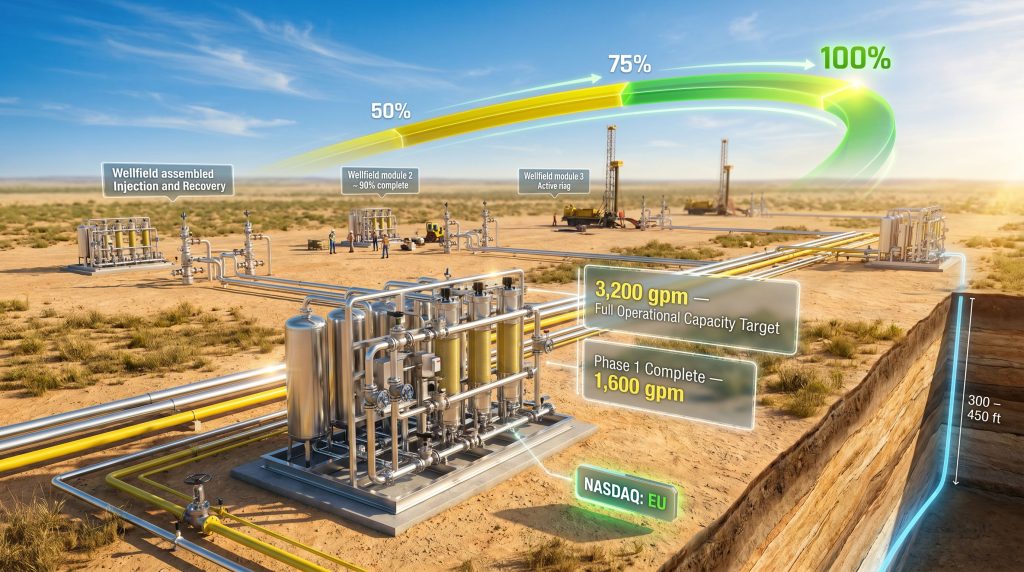
The completion of Phase 1 of the enCore Energy Upper Spring Creek ion exchange plant construction programme represents the company's largest satellite facility to date. The plant's phased ramp to full capacity follows a structured timeline tied to the parallel advancement of four wellfield production modules.
| Metric | Status as of June 2026 |
|---|---|
| Phase 1 construction | Complete |
| Current IX plant capacity | 1,600 gpm (50% of total) |
| Capacity target, end of June 2026 | ~2,400 gpm (75% of total) |
| Full capacity target | 3,200 gpm (end of July 2026) |
| Module 1 drilling | Complete |
| Module 1 wellfield infrastructure | Nearly complete |
| Module 2 drilling progress | ~90% complete |
| Modules 3 and 4 | Drilling and infrastructure underway |
| Uranium extraction start (planned) | Late 2026, subject to final permits |
Each of the four production modules is engineered to contribute 800 gallons per minute to the plant's total throughput, with the four modules in aggregate delivering the full 3,200 gpm operational target. The decision to advance Modules 2, 3, and 4 in parallel with the completion of Module 1 reflects a deliberate sequencing strategy designed to minimise the time between plant commissioning and full-capacity uranium capture.
William M. Sheriff, Executive Chairman of enCore Energy, described the milestone as reflecting the collective commitment of the project team and noted that Upper Spring Creek would strengthen the company's operational position by feeding uranium-loaded resin into the fully licensed Rosita CPP, with the operational phase targeted for late 2026 pending final permit receipt.
The Clay West District: Geological Context That Extends Beyond Upper Spring Creek
What is less commonly understood about the Upper Spring Creek project is its position within the broader Clay West uranium district, a historically active production area with a footprint that extends well beyond the current wellfield boundaries. The Oakville Formation's 120-mile by 20-mile mineralised corridor creates the geological basis for a multi-unit production platform, meaning the satellite IX plant at Upper Spring Creek is not simply designed to serve one wellfield, but to function as the infrastructure hub for a series of potential future production units across the district.
This geological scalability is a key feature that differentiates Clay West from more geographically constrained ISR operations. Uranium mineralisation within the Oakville Formation tends to occur in roll-front deposits, a specific geological configuration where uranium precipitates along a geochemical boundary where oxidising and reducing conditions meet within the aquifer. Roll-front deposits are particularly well-suited to ISR because the uranium is finely dispersed through permeable, saturated sandstone rather than concentrated in hard rock veins, enabling efficient lixiviant circulation.
The aquifer exemption status of the Upper Spring Creek project area, originally secured by Signal Equities LLC prior to the uranium price downturn that halted operations, significantly reduces the regulatory complexity that would otherwise face a new entrant attempting to develop a comparable site from scratch. This pre-existing regulatory foundation, combined with enCore's acquisition of the fully 100% owned asset in December 2020, provided a faster pathway to infrastructure construction than a greenfield ISR development would typically allow.
How Upper Spring Creek Fits Into enCore's Multi-Asset South Texas Platform
enCore Energy (NASDAQ: EU | TSXV: EU) operates exclusively through ISR methods, with its South Texas operations forming the operational core of the company's production strategy. The Rosita CPP serves as the licensed processing anchor for the satellite network, and Upper Spring Creek represents the most significant satellite capacity addition the company has undertaken to date.
| Asset | Location | Stage |
|---|---|---|
| Upper Spring Creek | South Texas | Construction / pre-production |
| Rosita CPP | South Texas | Licensed, operational processing hub |
| Alta Mesa East expansion | South Texas | Expansion phase |
| Dewey Burdock | South Dakota | Pipeline |
| Gas Hills | Wyoming | Pipeline |
The strategic logic connecting these assets is straightforward: increasing satellite resin feed capacity at sites like Upper Spring Creek raises the utilisation rate of the already-licensed, fully operational Rosita facility without requiring proportional new investment in central processing infrastructure. This is one of the more underappreciated leverage points in ISR uranium economics.
Once a central processing plant is licensed and operational, the marginal cost of processing additional resin feed is substantially lower than the cost of the original plant construction, meaning each new satellite plant adds production volume at diminishing incremental capital cost per pound of yellowcake produced. In addition, the Alta Mesa uranium project provides a useful regional comparison for understanding how satellite-to-CPP economics can compound across a multi-asset South Texas platform.
The next major ASX story will hit our subscribers first
Key Risks and Conditions Before Production Begins
Despite the construction momentum, a number of conditions must be satisfied before uranium extraction commences. Investors and industry observers should be aware of the following dependencies:
- Final operating permits from the Texas Commission on Environmental Quality (TCEQ) remain outstanding as of June 2026. Uranium extraction cannot begin until these permits are received, and no timeline guarantee is attached to regulatory processes.
- Wellfield infrastructure completion across all four modules must advance in parallel with the plant ramp-up. Any delays in Module 2, 3, or 4 wellfield readiness could constrain the volume of pregnant leach solution available to the IX plant even after it reaches full flow capacity.
- Resin logistics coordination between Upper Spring Creek and the Rosita CPP must be operationally proven at scale before first commercial extraction. Transportation of loaded resin involves handling a radioactively classified material and requires logistics planning that is more complex than moving conventional mining reagents.
- Capacity ramp timeline from 50% to 75% to 100% must be achieved within the June to July 2026 target window. Construction execution risk remains until those milestones are confirmed.
Disclaimer: This article contains forward-looking statements and projections based on information available as of June 2026. Production timelines, capacity targets, and permit outcomes are subject to change. This content does not constitute financial advice. Investors should conduct independent due diligence before making any investment decisions.
What the Upper Spring Creek Milestone Reveals About the Broader US Uranium Picture
The enCore Energy Upper Spring Creek ion exchange plant construction programme carries implications beyond a single project. The United States historically sourced the majority of its uranium requirements from foreign suppliers, with domestic production falling to minimal levels during the prolonged period of low uranium prices that persisted through much of the 2010s. The combination of growing nuclear generation capacity, utility sector interest in long-term supply security, and the uranium supply-demand outlook for new domestic ISR capacity has created structural demand that producers are now racing to meet.
However, the US uranium production rebound underway across multiple basins demonstrates that ISR producers in South Texas and other established US regions are uniquely positioned to respond to this demand. Their development timelines are significantly shorter than those associated with conventional hard-rock uranium mines, which often require a decade or more from discovery to production. A well-permitted ISR satellite facility can move from construction to first uranium extraction in a timeframe measured in months rather than years, provided the central processing infrastructure already exists.
The Upper Spring Creek milestone is therefore a leading indicator of the type of near-term production capacity additions that the US uranium sector needs to demonstrate if domestic supply is to meaningfully reduce dependence on imported uranium across the nuclear fuel cycle. Whether the broader trend toward utility-sector demand for domestically sourced uranium translates into contracted volumes that support continued infrastructure investment will depend on pricing dynamics, contracting patterns, and the pace at which reactor operators formalise long-term procurement decisions.
What the enCore model demonstrates is that the infrastructure-first approach — building licensed processing capacity and satellite facilities ahead of full wellfield development — is not merely a construction strategy. It is a market positioning strategy, one that allows a producer to move from zero to nameplate production capacity faster than competitors who are still navigating the permitting and construction phases that enCore's South Texas platform has already cleared.
Readers seeking additional context on enCore Energy's South Texas uranium operations and the Upper Spring Creek project can explore related coverage published by Crux Investor at cruxinvestor.com.
Want To Identify The Next Major Uranium Discovery Before The Broader Market?
Discovery Alert's proprietary Discovery IQ model delivers real-time alerts on significant ASX mineral discoveries — including uranium — instantly translating complex geological data into actionable investment insights for both short-term traders and long-term investors. Explore historic discovery returns on Discovery Alert's dedicated discoveries page and begin your 14-day free trial today to position yourself ahead of the market.