June 4, 2026
The Nuclear Fuel Chain Signal Most Investors Are Missing
Most uranium market watchers fixate on spot prices. When uranium moves above US$80 per pound, retail interest surges. When it dips below US$65, the sector fades from headlines. However, the investors who consistently identify durable uranium re-ratings are not watching the spot market. They are watching the enrichment layer of the nuclear fuel cycle, and what is happening there in 2026 deserves serious attention.
Uranium enrichment is the process of increasing the concentration of the fissile isotope U-235 in natural uranium feed, transforming it into the higher-grade material that commercial reactors actually consume. Enrichment capacity is measured in Separative Work Units (SWU), and expanding that capacity requires multi-year planning, substantial capital, and high confidence in long-dated demand from nuclear utilities.
When a major Western enricher announces a significant capacity expansion, it is not a speculative bet. It is a declaration that utilities are already contracting for future fuel supply in volumes that justify the investment. Uranium market volatility plays a significant role in shaping how these signals are interpreted across the sector.
That is precisely why Urenco USA's announced roughly 50% expansion of its Eunice, New Mexico enrichment facility is a structurally meaningful signal, not just a sentiment catalyst. It indicates that nuclear utilities, particularly in the United States, are locking in long-term fuel supply chains with sufficient conviction to underwrite major infrastructure investment. For upstream uranium producers, this kind of downstream commitment is among the most reliable forward demand indicators available.
When big ASX news breaks, our subscribers know first
Why Paladin Energy Shares Jump as Uranium Trade Heats Up Again
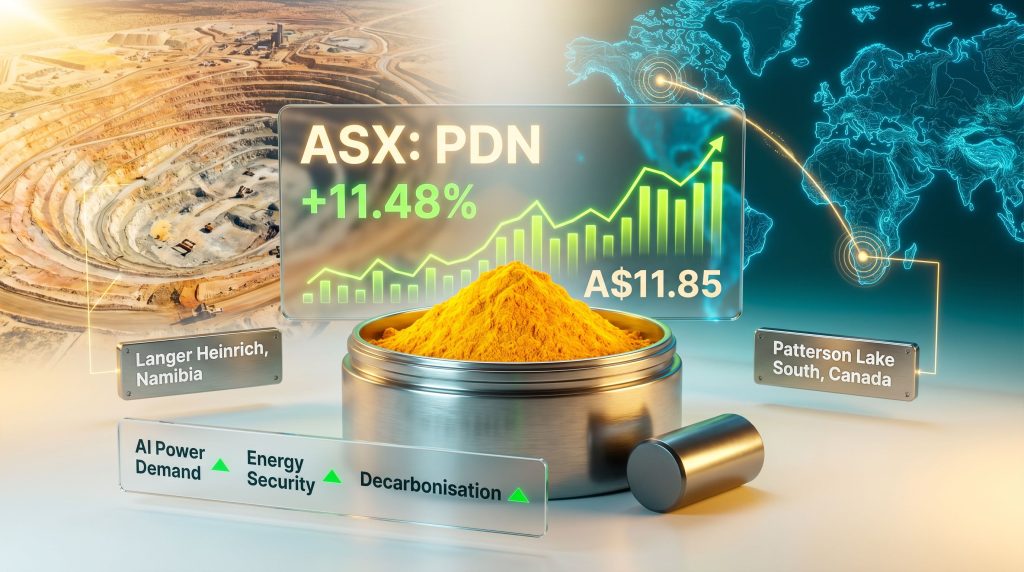
The ASX uranium sector responded decisively to this enrichment expansion signal, with Paladin Energy (ASX: PDN) posting one of the most striking single-session moves among its peers. Paladin Energy shares jumped 11.48% to close at A$11.85, a gain that reflected the company's unique position as the exchange's most liquid, most institutionally accessible uranium pure-play.
Understanding why Paladin amplifies sector-wide moves requires understanding a specific market mechanic. When macro-level uranium news triggers a shift in institutional sentiment, capital does not distribute evenly across the uranium sector. It concentrates in the names that can absorb large order flows without excessive slippage. Paladin, by virtue of its market capitalisation, liquidity profile, and status as an operating producer with live revenue exposure to uranium pricing, becomes the default vehicle for rapid sector positioning.
This dynamic cuts both ways. The same liquidity that attracts inflows during rallies makes Paladin the easiest exit point during sector sell-offs. Investors need to hold this asymmetry in mind when evaluating single-session moves of this magnitude. For context, Paladin's history is notably volatile, with its share price having ridden previous uranium booms and busts through multiple market cycles.
| Metric | Detail |
|---|---|
| Recent Single-Session Move | +11.48% |
| Closing Price | A$11.85 |
| Primary Catalyst | Sector-wide uranium rally linked to enrichment capacity expansion |
| Supporting Factor | Ongoing operational improvements at Langer Heinrich Mine |
| Key Operating Asset | Langer Heinrich Mine, Namibia |
| Growth Pipeline Asset | Patterson Lake South, Athabasca Basin, Canada |
Langer Heinrich Mine: The Operational Engine Behind the Investment Case
For all the macro narrative around nuclear power, Paladin Energy's investment case ultimately rests on a single operating asset: the Langer Heinrich Mine in Namibia's Erongo Region. Understanding this mine in detail is essential for separating the structural from the speculative.
What Is Langer Heinrich and Why Does It Matter?
Langer Heinrich is an open-pit, calcrete-hosted uranium deposit, which is geologically distinct from the high-grade unconformity-type deposits found in Canada's Athabasca Basin. Calcrete deposits like Langer Heinrich are typically lower grade, with mineralisation occurring in near-surface calcium carbonate-rich sediments. The trade-off is that the open-pit, near-surface nature of the deposit allows for relatively straightforward, lower-cost mining compared to deep underground operations.
The mine's ore is processed using an alkaline leach circuit, a method well-suited to calcrete-hosted uranium that avoids the aggressive acid leaching required for some other uranium deposit types. This processing approach has significant implications for operating costs and environmental management. Namibia's regulatory framework for uranium mining is well-established, partly because the country hosts several major uranium operations and has developed the institutional capability to manage them effectively.
Langer Heinrich was originally developed by Paladin and brought into production in 2007, before being placed on care and maintenance in 2018 when uranium prices collapsed following the post-Fukushima demand shock. The mine's restart, completed in 2023, marked a critical de-risking milestone. Furthermore, Paladin Namibia operations have remained a central point of focus for analysts assessing the company's near-term production outlook. Transitioning an asset from cold storage back to active production is operationally complex, and the successful restart removed one of the key uncertainties that had weighed on Paladin's valuation.
What the Operational Numbers Are Telling Investors
Recent quarterly updates from Paladin have shown a trajectory that experienced mining investors recognise as characteristic of a successful ramp-up:
- Rising production volumes of uranium oxide (U₃O₈) measured in pounds, reflecting improving plant throughput and recoveries
- Upgraded FY2026 production guidance, signalling management confidence that the ramp-up trajectory is sustainable
- Reduced capital expenditure guidance, indicating the high-cost establishment phase is giving way to a more capital-efficient steady-state operating regime
- Improving sales volumes, confirming that production is converting to revenue rather than accumulating in inventory
One of the most underappreciated signals in mining company reporting is the combination of upward production guidance revisions alongside downward capex revisions. This pattern suggests the operation is behaving better than initially modelled, which is the opposite of the cost overruns and production disappointments that characterise troubled mining ramp-ups.
Key Metrics for Monitoring Langer Heinrich's Progress
Investors tracking Paladin's fundamental performance should focus on these specific data points in each quarterly and half-year report:
- Quarterly U₃O₈ production measured in pounds, tracked against annualised guidance targets
- Cash cost per pound of U₃O₈ produced, the primary efficiency metric for uranium operations
- All-in sustaining cost (AISC) per pound, which captures sustaining capital and provides a fuller picture of profitability at current uranium prices
- Realised sales price per pound, which reflects Paladin's actual contract and spot pricing mix rather than headline spot market figures
- Shipment timing and volumes, since uranium is shipped in discrete consignments and delays can cause significant quarter-to-quarter earnings variability
- Plant utilisation rates, reflecting how efficiently the processing circuit is operating relative to nameplate capacity
A less commonly understood aspect of uranium mine financial reporting is the timing mismatch between production and revenue recognition. Because uranium is shipped in drums to conversion facilities, and sales are often structured around specific delivery schedules, a quarter of strong production may not produce proportionally strong revenue if shipments fall late in the quarter or into the following period. This creates earnings volatility that can mislead investors focused on short-term results rather than through-cycle production trends.
Three Structural Demand Pillars: Is the Nuclear Bull Case Durable?
Uranium has experienced several false dawns since the 2007 commodity supercycle peak. Each previous rally attracted investor enthusiasm before fading as demand disappointment or supply responses reasserted themselves. The critical question for 2026 is whether the current cycle has genuinely different structural foundations, or whether it is another momentum-driven episode that will eventually correct.
There are three demand pillars worth examining seriously.
Pillar One: AI Infrastructure and the Baseload Power Problem
Hyperscale data centres present a power demand challenge that intermittent renewable generation cannot fully address. Solar and wind generation is inherently variable, and grid-scale battery storage at the capacity required to firm gigawatt-scale data centre loads remains economically and technically challenging. Nuclear power, which operates at capacity factors typically exceeding 90%, offers something that no other low-carbon generation technology can match: firm, continuous, location-flexible baseload electricity.
Several major technology companies have already demonstrated their willingness to contract directly with nuclear operators for power supply. Microsoft's agreement with Constellation Energy to restart the Three Mile Island Unit 1 reactor in Pennsylvania is a landmark example of this trend, and it has opened a template that other hyperscalers are now actively exploring. This creates a fundamentally new demand vector for nuclear power that was absent from previous uranium bull cycles and is not easily reversed once infrastructure commitments are made.
Pillar Two: The Russian Enrichment Dependency Problem
A less publicly discussed structural feature of the global uranium market is Western dependence on Russian enrichment services. Russia, through its state-owned nuclear corporation Rosatom, has historically supplied a significant proportion of the enrichment capacity consumed by US and European utilities. Following the geopolitical rupture triggered by Russia's actions in Ukraine, Western governments and utilities have faced pressure to reduce this dependency, even though commercial contracts have proven difficult to unwind quickly.
The Russian uranium import ban passed by the US Congress in 2024 has initiated a structural reorientation that benefits Western-aligned uranium producers and enrichers, including those with assets in jurisdictions like Namibia and Canada. It also explains why Urenco USA's capacity expansion carries strategic weight beyond simple demand-supply modelling.
Pillar Three: Decarbonisation Policy and the SMR Pipeline
Nuclear power's relationship with decarbonisation policy has shifted materially over the past five years. Countries that previously treated nuclear as a transitional technology to be phased out are reconsidering those positions. Japan has restarted reactors that were idled after Fukushima. Several European nations are extending reactor lifetimes rather than closing them.
Beyond existing reactor fleets, Small Modular Reactors (SMRs) represent a genuinely new demand pipeline. SMRs are factory-built reactors typically in the 50 to 300 megawatt range, compared to the 1,000+ megawatt scale of conventional large reactors. Their modular construction approach promises shorter build times, lower upfront capital requirements, and greater flexibility in siting. Multiple SMR designs are currently in various stages of regulatory review and early deployment, and their eventual commercialisation would expand uranium demand beyond what existing reactor fleet projections suggest.
Scenario Modelling: Three Paths for Paladin Energy from Here
Bull Scenario: Uranium spot prices sustain above US$80 per pound, enrichment capacity expansions in Western jurisdictions continue, and AI-driven nuclear power demand accelerates faster than consensus expects. Langer Heinrich reaches nameplate capacity on schedule, and Patterson Lake South advances to a positive feasibility study. In this environment, Paladin's operating leverage to uranium prices could deliver substantial earnings upside, and the company would likely trade at a meaningful premium to its net asset value.
Base Scenario: Uranium prices consolidate in the US$65 to US$80 per pound range, Langer Heinrich continues its steady operational improvement, and Patterson Lake South progresses through pre-feasibility milestones over the next 12 to 24 months. Paladin trades as a premium ASX uranium pure-play with moderate re-rating potential tied to operational delivery rather than macro momentum.
Bear Scenario: Uranium prices correct below US$60 per pound due to utility demand softness, delayed SMR commissioning timelines, or secondary supply from Russian enrichment alternatives re-entering Western markets. Any production or cost guidance disappointments at Langer Heinrich compound the downside. Given Paladin's high beta to uranium sentiment, a meaningful price correction could produce a share price retreat well beyond what fundamentals alone would justify.
The ASX Uranium Ecosystem: Where Paladin Sits
| Company Type | Characteristics | Sensitivity to Uranium Rallies |
|---|---|---|
| Operating Producers (e.g., Paladin Energy) | Active production, revenue-generating, high institutional liquidity | Very High, direct earnings leverage to uranium pricing |
| Advanced Developers | Feasibility-stage projects, no current production | High, re-rating driven by sentiment and feasibility milestones |
| Early-Stage Explorers | Pre-resource or resource-stage assets, no near-term revenue | Highest volatility, most speculative risk profile |
Paladin's structural advantage within this ecosystem is straightforward. Institutional investors and uranium-focused ETFs need liquid entry and exit points. Early-stage explorers and small developers cannot absorb the order sizes that institutional mandates require. Paladin, as the ASX's largest dedicated uranium producer by market capitalisation, sits at the apex of this liquidity hierarchy.
This also explains why Paladin often leads sector rallies rather than following them. When macro uranium news breaks, the first capital to move is institutional, and it moves into the most liquid names. Retail and momentum capital follows. By the time the rally is widely reported, the initial institutional repositioning has already occurred. Developing sound uranium investment strategies before these moves occur is consequently one of the most important disciplines for active investors in this sector.
The next major ASX story will hit our subscribers first
Patterson Lake South: The Longer-Dated Growth Option
Paladin's Canadian development asset, Patterson Lake South (PLS), is located in Saskatchewan's Athabasca Basin, the world's highest-grade uranium district. Unlike Langer Heinrich's calcrete-hosted mineralisation, the Athabasca Basin hosts unconformity-type uranium deposits, which can carry grades measured in percentages rather than the fractions of a percent typical of most other uranium deposit types. Furthermore, Athabasca uranium development activity across the region continues to attract significant institutional interest given the basin's unmatched grade profile.
High-grade unconformity deposits are more expensive to mine, often requiring underground development and specialised radiation management procedures. However, the extreme grade advantage dramatically reduces the mass of ore that needs to be processed to produce a given quantity of uranium oxide, which can significantly lower per-pound operating costs once a mine reaches steady-state production.
Patterson Lake South is in an earlier stage of development than Langer Heinrich and should be valued as a longer-dated option rather than a near-term production asset. Key milestones for investors to monitor include pre-feasibility study completion, feasibility study initiation, and any resource estimate updates that might alter the project's economic parameters.
Risk Framework: What Could Derail the Rally?
Investors entering any commodity equity after a double-digit single-session move should conduct a deliberate exercise in distinguishing between fundamental re-ratings and sentiment-driven momentum. The former reflects a genuine improvement in the earnings outlook for the underlying business. The latter reflects capital flows responding to macro news, and these flows can reverse just as rapidly as they arrived.
The specific risks for Paladin and the broader ASX uranium trade include:
Operational risks at Langer Heinrich:
- Plant throughput falling short of nameplate capacity targets
- Higher-than-modelled reagent or energy costs compressing margins
- Shipment scheduling disruptions causing revenue to fall outside quarterly reporting periods
- Workforce or logistical challenges specific to Namibia's Erongo Region
Commodity and market risks:
- Uranium spot prices are thinly traded relative to other commodity markets, meaning relatively small volume imbalances can produce large price moves in either direction
- The gap between spot and long-term contract prices means Paladin's realised pricing will consistently differ from headline spot market figures, requiring investors to understand the company's contract book to accurately model revenues
- Secondary supply from government stockpile releases or underfeeding by enrichers can supplement primary mine supply in ways that suppress spot prices without reflecting genuine demand weakness
Geopolitical and jurisdictional risks:
- Namibia's mining jurisdiction is stable by African standards, but sovereign risk considerations remain relevant for any international mining operation
- Patterson Lake South's development timeline depends on Canadian federal and provincial regulatory processes that can extend unpredictably
Frequently Asked Questions: Paladin Energy and the ASX Uranium Trade
Why Did Paladin Energy Shares Jump So Sharply in a Single Session?
Paladin's combination of high liquidity, pure-play uranium status, and operating producer credentials makes it the primary vehicle for rapid institutional sector positioning. When macro-level uranium news shifts sentiment, Paladin captures a disproportionate share of inflows, producing outsized single-session moves relative to smaller or less liquid peers. The +11.48% gain to A$11.85 was consistent with this pattern. According to analysis of five-year investment returns, long-term holders of Paladin shares have experienced dramatic swings in both directions, underscoring the importance of understanding the company's cycle positioning before entering.
How Does Uranium Pricing Work and Why Does It Matter for Paladin?
Uranium trades in two distinct markets. The spot market reflects immediate availability and is relatively thinly traded, making it susceptible to sharp price moves on modest volume changes. Long-term contracts are multi-year agreements between producers and utilities, typically negotiated at prices that incorporate floor and ceiling mechanisms to provide both parties with pricing stability.
Most producing companies, including Paladin, sell a blended mix of spot and contracted volumes. This means the headline uranium spot price is an imperfect proxy for Paladin's actual realised revenues, and investors should examine the company's contract book disclosure to understand the true revenue exposure.
What Is the Investment Significance of the Urenco USA Expansion?
Enrichment capacity expansions require utilities to commit to long-dated fuel supply volumes years in advance of first delivery. A roughly 50% expansion of Urenco USA's Eunice facility implies that US utilities have already contracted sufficient future fuel volumes to justify that capital commitment. This is a structural demand signal that sits upstream of spot price movements and reflects real utility procurement decisions rather than speculative positioning.
Is Uranium a Long-Term Theme or a Momentum Trade?
The honest answer is that it contains elements of both. The structural demand case, built on AI power requirements, energy security realignment away from Russian enrichment, and nuclear's role in decarbonisation frameworks, is genuinely multi-year in nature. However, individual uranium equity rallies are often momentum-driven in their early stages, and the durability of any specific price move depends on whether fundamental improvements in earnings and production can subsequently validate the re-rating.
For Paladin specifically, the critical test is whether Langer Heinrich's operational progress can keep pace with the market's periodically renewed enthusiasm for the uranium sector.
What the Paladin Energy Rally Reveals About the 2026 Uranium Market
Several converging signals make the current uranium episode worth taking seriously beyond the single-session price move. The Urenco USA enrichment expansion represents downstream commitment that implies durable upstream demand. Paladin Energy shares jump as uranium trade heats up again, and the company's operational progress at Langer Heinrich provides a fundamental anchor that distinguishes it from purely sentiment-driven uranium plays.
In addition, the three structural demand pillars — covering AI-driven power requirements, Western energy security policy, and decarbonisation frameworks — collectively suggest a more durable foundation than previous uranium sentiment cycles. The critical variables to track from here are Langer Heinrich's quarterly production and cost delivery, uranium long-term contract pricing trends rather than spot volatility, progress at Patterson Lake South through development milestones, and the pace of SMR regulatory progress in the US and UK. Each of these will either validate or challenge the current market consensus that the uranium trade has entered a new, structurally supported phase.
This article is general information only and does not constitute financial advice. Uranium equities are volatile and carry significant commodity price, operational, and geopolitical risks. Investors should conduct their own research and consider their personal financial circumstances before making any investment decisions.
Want To Stay Ahead of the Next Major ASX Mineral Discovery?
Discovery Alert's proprietary Discovery IQ model scans ASX announcements in real time, instantly converting complex mineral data into actionable insights across uranium and more than 30 other commodities — exactly the kind of edge active investors need when sector-wide moves happen fast. Explore historic discoveries and their returns to understand what early positioning can mean, then begin your 14-day free trial at Discovery Alert to ensure you're never caught flat-footed when the next significant announcement drops.