June 3, 2026
When Commodity Cycles Collide With Structural Scarcity: The Uranium Market Inflection
Most commodity bull markets are cyclical. Prices rise, producers respond, supply catches up, and the cycle resets. The uranium market is behaving differently, and understanding why requires looking beyond price charts to the physical mechanics of a fuel cycle that has been running on borrowed time for well over a decade.
The global nuclear fuel supply chain is not a single market but a sequence of interdependent stages: mining, conversion, enrichment, and fabrication. A constraint at any stage ripples through the entire system. Right now, constraints exist at multiple stages simultaneously, and the cushions that previously absorbed those shocks have been consumed.
This is the context that makes the uranium supply deficit and ASX uranium stocks among the most closely watched topics in resource investing heading into the second half of 2026.
When big ASX news breaks, our subscribers know first
The Arithmetic of a Structural Shortfall
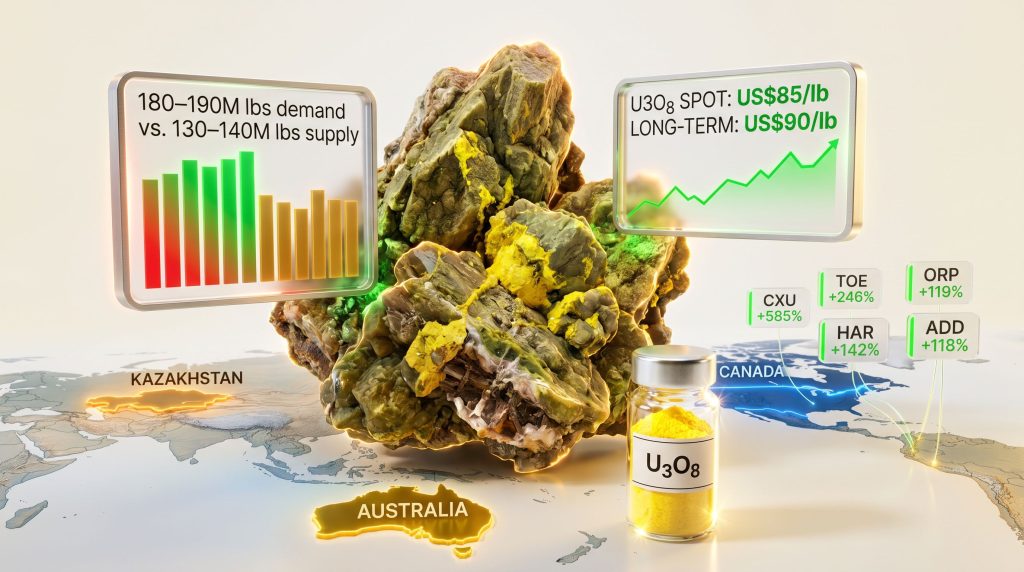
The raw numbers tell a stark story. Global reactor demand currently sits in the range of 180 to 190 million pounds of U3O8 per year, while primary mine production delivers only 130 to 140 million pounds annually. That is a structural gap of between 40 and 60 million pounds that must be sourced from somewhere other than freshly mined uranium.
For most of the past decade, that somewhere was secondary supply: utility inventory drawdowns, enrichment underfeeding, and government stockpile releases. According to World Nuclear Association data, mine output covered only approximately 74% of utility requirements in 2022, with the remainder drawn from these secondary sources. The critical development of recent years is that those sources have been systematically depleted.
The depletion timeline matters enormously for understanding price direction. Analysts tracking cumulative uranium supply-demand volatility estimate a visible deficit of approximately 31 million pounds already embedded in 2025 data, with projections pointing to a widening gap around 2030 as secondary sources approach exhaustion.
The Hidden Amplifier: Enrichment Underfeeding Reversal
One of the least appreciated dynamics in uranium markets is the role of enrichment underfeeding, and its reversal. When enrichment capacity is abundant relative to demand, enrichers can extract more U3O8 from depleted uranium tails, effectively producing additional natural uranium equivalent and reducing primary mine demand. This technical process has historically acted as a significant demand suppressant.
As Western utilities reduce their exposure to Russian enrichment services, they face two consequences simultaneously: tighter access to enrichment capacity, and a reversal of the underfeeding dynamic. Each unit of enriched uranium product now requires more natural uranium input than was the case during the underfeeding era, adding demand pressure that does not appear in simple reactor consumption statistics.
| Fuel Cycle Stage | Current Status | Market Implication |
|---|---|---|
| Mining (U3O8) | ~130-140M lbs/yr vs 180-190M demand | Confirmed structural deficit |
| Conversion (UF6) | Western capacity constrained | Higher premiums, tighter availability |
| Enrichment (SWU) | Russian services being avoided | Underfeeding reversal, rising U3O8 demand |
| Fabrication | Adequate capacity | No current bottleneck |
Why the Supply Side Cannot Simply Respond to Higher Prices
Uranium is fundamentally different from most industrial metals in terms of how quickly supply can respond to price signals. Even with spot prices above US$85/lb and long-term contract prices around US$90/lb, the development pipeline remains structurally thin. This is not a market failure; it is the logical consequence of a decade of underinvestment compounded by the technical realities of uranium mining.
Furthermore, understanding the broader uranium market dynamics helps clarify why higher prices alone cannot rapidly stimulate meaningful new supply.
The Two Giants With Operational Constraints
Kazatomprom, the Kazakhstani state enterprise that accounts for roughly 45% of global mine supply, has encountered a series of production challenges that are not easily resolved by higher uranium prices:
- Wellfield underperformance across multiple in-situ recovery operations
- Sulphuric acid supply shortages, a critical input for ISR leaching that depends on Kazakhstan's domestic industrial supply chain
- Geopolitical risk factors that introduce operational uncertainty independent of commodity pricing
Cameco, the Canadian producer that represents the other major pillar of global supply, faces its own constraints. The restart of the McArthur River operation after an extended care-and-maintenance period has proven more complex and variable than initial guidance suggested, while Cigar Lake production has shown throughput variability that limits the predictability of output forecasts.
The critical insight here is that both of the world's two largest producers face supply challenges that are not simply resolved by a higher price. This is qualitatively different from most commodity markets where higher prices reliably unlock additional output.
The Five Structural Barriers to New Mine Supply
-
Permitting timelines: Environmental and regulatory approval processes in most jurisdictions require five to ten years at minimum, with no guarantee of success.
-
Capital intensity: Uranium mines demand substantial upfront capital with extended payback periods that require sustained price confidence before investors commit.
-
Geological specificity: ISR operations require sandstone-hosted deposits with specific permeability and chemistry characteristics; conventional mining requires major infrastructure investment.
-
Workforce depletion: The uranium sector workforce contracted sharply during the post-Fukushima period and cannot be rebuilt quickly, creating a human capital constraint alongside the financial one.
-
Price signal lag: Even when developers receive a clear price signal, the time from decision to production typically spans five years or more for advanced projects.
Demand Forces That Are Rewriting the Long-Term Outlook
The supply constraints would be easier to manage if demand were static. It is not. Multiple independent demand drivers are converging simultaneously, each adding incremental pressure to an already tight balance. Consequently, current uranium market trends point to a sustained period of elevated pricing rather than a brief cyclical spike.
Nuclear energy has undergone a fundamental reassessment in major economies. The United States, United Kingdom, France, Japan, and South Korea have each made formal recommitments to nuclear power as a central element of their long-term energy strategies. China is constructing reactors at a pace no other nation approaches, with dozens of units under construction or in late-stage planning.
The emergence of artificial intelligence as a major electricity consumer has introduced a demand vector that few uranium analysts had modelled even three years ago. Hyperscale data centres require continuous, weather-independent power at a scale that intermittent renewables cannot reliably provide. Nuclear energy is increasingly identified as the only technology capable of meeting this demand profile at the scale required, leading major technology companies to pursue direct nuclear power purchase agreements for the first time.
Small modular reactors represent a further forward demand signal. While commercial SMR deployment remains several years away, the progression from theoretical concept to funded development programmes with regulatory submissions in multiple jurisdictions is creating a credible forward demand expectation that utilities are beginning to factor into contracting decisions.
Financial Markets and Geopolitics: Two Underappreciated Price Drivers
Physical Uranium Funds and the Spot Market Transformation
The creation of physical uranium investment vehicles, most notably the Sprott Physical Uranium Trust and Yellow Cake plc, has fundamentally altered the character of the spot market. These entities purchase and hold physical uranium, removing pounds from accessible market supply. Critically, their purchasing behaviour is driven by capital inflows from investors rather than by utility procurement needs, meaning they buy regardless of spot market softness.
This has transformed the spot market from its traditional function as a utility-clearing mechanism into a structurally tighter environment where non-utility buyers can absorb significant tonnage. The practical consequence is that spot market liquidity can evaporate rapidly when multiple demand sources compete simultaneously. For a detailed examination of the spot and term price divergence playing out in real time, the data reveals a market in genuine structural transition.
The Geopolitical Risk Premium in Context
| Geopolitical Factor | Supply Chain Impact | Market Response |
|---|---|---|
| Niger political instability | Orano supply disruption risk | Premium on non-African sources |
| Russia-West tensions | Western enrichment exposure reduction | Higher natural uranium demand |
| Kazakhstan uncertainty | Kazatomprom reliability risk | Supply security premium |
| US/UK/France recommitments | Long-term demand floor rising | Accelerated utility contracting |
The shift in utility contracting behaviour deserves particular attention. For most of the post-Fukushima decade, utilities had sufficient spot market access and inventory to avoid long-term commitments at unfavourable terms. That leverage has now decisively shifted to producers. Floor prices in new contracts are materially higher than in previous cycles, volumes are larger, and multi-year supply certainty has become the priority over price optimisation.
Uranium Price Analysis: Spot, Long-Term, and Scenario Pathways
Current uranium spot prices near US$85/lb, with long-term contract prices around US$90/lb, sit well above post-Fukushima lows but below the historical highs reached during the mid-2000s supply squeeze. Importantly, current pricing is broadly consistent with the marginal cost of incentivising new mine development, suggesting the market is pricing fundamental economics rather than speculative momentum. The ongoing uranium market deficit reinforces why analysts believe elevated pricing is structurally justified rather than sentiment-driven.
| Scenario | Key Assumptions | Price Implication |
|---|---|---|
| Bull Case | Kazatomprom underperforms, SMR demand accelerates, aggressive utility contracting | US$120-150/lb by 2028-2030 |
| Base Case | Deficit persists, gradual new supply, steady contracting | US$90-110/lb sustained through 2028 |
| Bear Case | Kazatomprom full recovery, reactor delays, reduced power demand | US$60-70/lb correction possible |
Disclaimer: Price scenario projections involve significant uncertainty and should not be treated as financial advice or forecasts. Commodity markets are subject to rapid change driven by factors that cannot be fully anticipated.
The next major ASX story will hit our subscribers first
How to Evaluate ASX Uranium Stocks: The Variables That Matter
Not all ASX uranium stocks offer equivalent exposure to the uranium supply deficit narrative. The companies that have generated the strongest returns share a specific combination of characteristics that investors should understand before allocating capital.
ISR vs. Conventional Mining: Why Extraction Method Drives Valuation
In-situ recovery uranium mining involves circulating a leaching solution through a uranium-bearing sandstone aquifer via a network of injection and recovery wells, dissolving uranium in place and pumping the uranium-bearing solution to surface for processing. No open-pit excavation or underground development is required, waste rock volumes are minimal, and capital costs are typically a fraction of conventional mining operations.
| Extraction Method | Capital Cost | Environmental Footprint | Development Timeline | ASX Relevance |
|---|---|---|---|---|
| In-Situ Recovery (ISR) | Lower | Minimal surface disturbance | Faster to production | High – SA and WA projects |
| Open Pit | High | Significant | 7-12 years | Moderate |
| Underground | Very High | Moderate | 8-15 years | Lower for juniors |
ISR amenability is not universal. It requires specific geological conditions: uranium mineralisation hosted within permeable sandstone formations with appropriate groundwater chemistry and hydraulic containment. This geological specificity means that ISR potential, where identified, represents a genuine value differentiator rather than a generic positive.
The Four Variables That Separate Outperformers
-
Starting market capitalisation: Smaller base market caps amplify the percentage impact of positive newsflow, macro re-rating, and sector rotation.
-
Jurisdiction quality: Regulatory and political stability reduces timeline risk; South Australia and Western Australia carry different risk profiles than West African or Central Asian projects.
-
Extraction methodology: ISR-prospective projects command valuation premiums reflecting lower development capital requirements.
-
Catalyst pipeline: Identifiable near-term catalysts, whether drilling results, resource updates, or feasibility milestones, sustain investor attention and trading momentum.
Five ASX Uranium Stocks That Have Delivered 100%+ Returns
| ASX Code | Company | Approximate Return (12 Months) | Key Project | Extraction Type |
|---|---|---|---|---|
| CXU | Cauldron Energy | +585% | Yanrey, Western Australia | ISR-prospective |
| TOE | Toro Energy | +246% | Wiluna / Lake Maitland, WA | Conventional/ISR |
| HAR | Haranga Resources | +142% | Saraya, Senegal | Conventional |
| ORP | Orpheus Uranium | +119% | South Australia tenements | ISR-prospective |
| ADD | Adavale Resources | +118% | Lake Surprise, South Australia | ISR-prospective |
Cauldron Energy (ASX: CXU) – Return: +585%
Cauldron Energy's Yanrey Project in Western Australia has been the single most dramatic re-rating in the ASX uranium sector over the past twelve months. The project's appeal centres on a specific geological characteristic: ISR amenability inferred from a combination of drilling data, geophysical surveys, and reinterpretation of historical exploration records.
ISR amenability in Western Australia is genuinely rare. The majority of WA uranium occurrences are hosted in geological settings more suited to conventional mining. If Yanrey's ISR potential is confirmed through further drilling and permeability testing, it would represent a lower-cost development pathway than most analogous WA projects, which explains the market's highly amplified response to early-stage data.
The company also benefited from management renewal and a sharper strategic focus. With an extremely small starting market capitalisation, every piece of positive newsflow produced outsized percentage share price moves. For broader context on ASX uranium stocks performing strongly during this cycle, recent coverage highlights how sector-wide momentum has amplified individual stock moves.
Risk consideration: CXU remains a speculative early-stage exploration company. ISR potential at Yanrey is inferred, not confirmed. Investors should assess position sizing accordingly.
Toro Energy (ASX: TOE) – Return: +246%
Toro Energy occupies a more advanced position on the development spectrum than most ASX uranium juniors. The Wiluna Uranium Project, and in particular the Lake Maitland component, has progressed toward definitive feasibility study level work, providing a development credibility that pure explorers cannot match.
A project re-scoping exercise improved the economic case for development, while a gradually more constructive political environment in Western Australia reduced a key jurisdictional risk that had previously weighed on investor sentiment. The company's resource base provides scale that justifies the capital required to advance to production.
Risk consideration: DFS completion and project financing remain critical execution milestones. Political risk in WA, while reduced, remains a factor.
Haranga Resources (ASX: HAR) – Return: +142%
Haranga's Saraya Project in Senegal has delivered maiden drilling results confirming high-grade uranium mineralisation, establishing the company as a credible explorer in a region drawing increased attention following geopolitical disruptions in neighbouring Niger. The political instability in Niger raised concerns about Orano's supply chain reliability, prompting investors to reassess West African uranium exposure outside the affected country.
Risk consideration: West African exploration carries jurisdictional and logistical complexity. Resource definition remains at an early stage.
Orpheus Uranium (ASX: ORP) – Return: +119%
Orpheus listed on the ASX in 2023 with a clean capital structure and a tenement package in South Australia covering ground considered prospective for ISR uranium development. South Australia is consistently regarded as one of the most geologically and regulatorily favourable jurisdictions in Australia for uranium exploration and development.
The combination of a fresh listing with no legacy register overhang, early-stage geophysical results supporting ISR prospectivity, and strong investor appetite for new uranium names entering the market during a rising price cycle created ideal conditions for a sharp re-rating.
Risk consideration: No defined JORC resource exists. Returns to date reflect sentiment and prospectivity, not confirmed mineralisation.
Adavale Resources (ASX: ADD) – Return: +118%
Adavale offers uranium exposure through the Lake Surprise ISR-prospective project in South Australia combined with nickel exploration in Tanzania. The dual-commodity structure creates optionality across two separate commodity theses, attracting speculative interest from investors seeking maximum leverage to multiple catalysts within a single low-market-cap vehicle. Analysts tracking uranium price projections note that companies with ISR-prospective assets in stable jurisdictions are particularly well-positioned if the supply gap widens as expected.
Risk consideration: Neither the uranium nor nickel project has reached resource definition stage. The dual-commodity structure adds analytical complexity.
The Execution Phase: What the Next Stage of the Cycle Demands
The first phase of the current uranium cycle rewarded companies that offered leverage, prospectivity, and momentum in a rising price environment. The sector has been re-rated for the macro narrative. However, the incremental returns from this point forward will be determined by something more demanding: company-specific execution.
Key Milestones That Will Differentiate the Next Wave of Performers
- Conversion of geological prospectivity into JORC-compliant mineral resource estimates
- Progression from resource to scoping study, prefeasibility study, and definitive feasibility study
- Demonstration of ISR amenability through aquifer testing and pilot well programmes
- Utility offtake agreements at economics that support project financing
- Construction execution on schedule and within budget for near-term developers
Sector-Level Catalysts to Monitor
- Kazatomprom quarterly production updates as the primary indicator of global supply trajectory
- US and European utility contracting activity as a measure of demand-side urgency
- Australian state and federal policy developments affecting uranium exploration and mining approvals
- SMR programme milestones in the US, UK, and Canada
- Uranium spot and long-term price movements relative to the US$90/lb new mine incentive threshold
- ISR drilling and permeability test results from Western Australian and South Australian projects
The uranium supply deficit and ASX uranium stocks are no longer a forward-looking thesis for investors. They represent the present operational reality of a fuel market where the gap between what reactors consume and what mines produce can no longer be bridged by secondary supply. The question facing investors now is not whether the deficit is real, but which companies have the geological assets, management capability, and financial structure to turn that structural reality into shareholder value through disciplined project execution.
This article is intended for general informational purposes only and does not constitute financial advice. Past share price performance is not indicative of future returns. Uranium equities, particularly microcap and early-stage exploration companies, carry significant investment risk including the potential loss of capital. Readers should conduct their own independent research and consult a licensed financial adviser before making investment decisions.
Want to Stay Ahead of the Next Major ASX Uranium Discovery?
Discovery Alert's proprietary Discovery IQ model scans ASX announcements in real time, instantly identifying significant mineral discoveries across uranium and 30+ other commodities — turning complex data into clear, actionable insights for investors at every level. Explore how historic ASX mineral discoveries have generated exceptional returns, then begin your 14-day free trial at Discovery Alert to position yourself ahead of the market before the next major find is announced.