June 3, 2026

The Structural Fracture Hidden Inside the Nuclear Fuel Cycle
Most energy security conversations focus on the wrong variable. When analysts debate uranium shortfalls, they gravitate toward mine output, drilling results, and spot prices, treating the problem as a straightforward extraction challenge. But the deeper constraint in today's nuclear fuel landscape sits further downstream, in the enrichment infrastructure that transforms mined ore into reactor-ready fuel. Understanding this distinction is not just academic. It determines whether the global nuclear fleet can keep operating at scale, and whether the energy systems that underpin modern industrial economies remain intact.
The uranium enrichment and supply deficit is structural in nature. It has been building for decades, partially masked by secondary supply buffers that are now approaching exhaustion. Furthermore, understanding uranium supply-demand volatility is essential context for grasping why what lies ahead is a market inflection point that most conventional energy forecasts have significantly underestimated.
When big ASX news breaks, our subscribers know first
Why Enrichment Capacity Is the Real Bottleneck
From Ore to Reactor: Understanding the Fuel Chain
Uranium does not travel directly from a mine to a power plant. The nuclear fuel cycle involves multiple conversion and enrichment stages, each representing a potential chokepoint in the supply chain. Raw uranium oxide, commonly known as yellowcake, must first be converted into uranium hexafluoride gas, then fed through an enrichment process that increases the concentration of the fissile isotope U-235 from its natural level of around 0.7% to the 3-5% required for most commercial reactors.
This enrichment process is measured in separative work units (SWUs). SWU capacity is physically intensive to build, technically demanding to operate, and geographically concentrated in the hands of very few operators globally. The critical insight is this: even abundant uranium ore in the ground cannot reach a reactor without functioning enrichment capacity. A deficit at the enrichment stage is operationally equivalent to a mining deficit, but with a much longer remediation timeline.
"Even if uranium ore exists in sufficient quantity underground, the absence of adequate conversion and enrichment infrastructure can entirely prevent it from reaching an operating reactor. The uranium enrichment and supply deficit must be understood as a multi-stage problem, not a simple mining gap."
The SWU Market Under Pressure
Enrichment markets have tightened considerably over the past several years. A practice known as underfeeding, where enrichers run centrifuges at higher efficiency to extract more product per unit of natural uranium feed, provided a secondary source of enriched uranium for over a decade following the Fukushima disaster. That buffer is now shrinking as SWU markets tighten and the economics of underfeeding become less favourable. The table below illustrates how secondary supply sources have eroded across the cycle.
| Secondary Supply Source | Historical Contribution | Current Status |
|---|---|---|
| Weapons-grade downblending | Significant post-Cold War | Largely exhausted |
| Utility inventory drawdowns | Masked deficit 2011-2020 | Declining rapidly |
| Enrichment underfeeding | Grew post-Fukushima | Constrained by tighter SWU markets |
| Reprocessed uranium (RepU) | Moderate | Limited by geopolitical access |
How Geopolitical Concentration Created Systemic Risk
Russia's Dominant Role in Enrichment Services
The post-Cold War era saw a remarkable consolidation of enrichment infrastructure. Russia's state nuclear corporation, Rosatom, became the world's single largest provider of enrichment services, operating the most centrifuge capacity of any nation on earth. At its peak, Russia was supplying roughly 25-30% of all enriched uranium consumed by American utilities, and similar proportions in parts of Europe.
This dependence was not accidental. Russian enrichment services were competitively priced, technically reliable, and available at scale when Western alternatives were either decommissioned or scaled back. The Fukushima disaster in 2011 temporarily reduced global reactor demand, pushing utilities to draw down inventories and reducing urgency around supply diversification. That period of apparent market ease concealed the structural fragility accumulating beneath the surface.
The 2022 escalation of the Russia-Ukraine war fundamentally altered the risk calculus. What had previously been a commercial dependency became a geopolitical liability. US utilities that had sourced nearly half of their enriched uranium from Russian suppliers found themselves navigating a rapidly shifting regulatory and security environment.
The Legislative Response and Its Timeline Constraints
By 2024, the United States had enacted the ban on Russian uranium imports, with meaningful reductions required by 2028. The policy framework creates a hard deadline without a fully formed alternative supply structure to replace what is being phased out. The following table captures the current enrichment exposure across key consuming regions.
| Region | Current Enrichment Dependency (Russia) | 2028 Target | Key Policy Response |
|---|---|---|---|
| United States | ~20-25% | Significantly reduced | HALEU Act, domestic enrichment investment |
| European Union | Varies by country | Diversification underway | Euratom supply diversification |
| Japan | Partial | Ongoing review | Long-term utility contracting |
| United Kingdom | Low | Stable | Urenco capacity retention |
Kazakhstan adds another layer of concentration risk to the physical uranium supply chain. The two nations together control a disproportionate share of both mined output and enrichment services globally. Consequently, any disruption to this corridor creates cascading shortfalls that cannot be resolved quickly given the decade-plus timelines required to bring alternative capacity into operation.
The 15-to-18-Year Mine Development Problem
Why New Supply Cannot Arrive on Demand
Uranium mine development is among the most time-intensive processes in the mining sector. From initial exploration through to first production, a new uranium project typically requires between 15 and 18 years. This timeline reflects the combined burden of geological assessment, feasibility studies, environmental permitting, community consultation, financing, and construction. There is no shortcut mechanism that can materially compress this window under current regulatory frameworks.
This timeline creates a fundamental asymmetry between demand signals and supply response. Even if uranium prices signal urgent need today, the supply response cannot arrive until the mid-to-late 2030s for projects that have not already begun the development cycle. Projects that are closest to permitting or already in restart mode represent the fastest available response, but even these take years rather than months.
North American Resources and the Jurisdictional Question
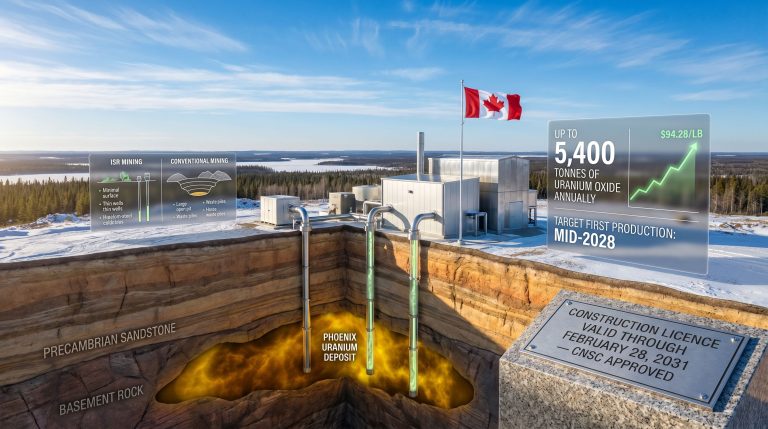
There is genuine resource potential in North America that has not yet been developed to scale. The western United States, including areas in New Mexico and other southwestern states, contains uranium deposits that have historically been underexplored relative to the region's geological prospectivity. Northern and central Canada also hosts significant uranium endowment, particularly in the Athabasca Basin, which is home to some of the highest-grade uranium deposits on earth.
However, the existence of resources does not translate automatically into production. The uranium supply challenges around jurisdictional support, permitting progress, and capital access are all determinative variables. Projects in stable, allied jurisdictions with clear regulatory pathways and existing capital market support command a meaningful premium over those that are geologically prospective but operationally distant from production.
"The premium in uranium investment does not necessarily accrue to the largest resource holders. In markets defined by long development timelines and concentrated supply chains, value migrates toward projects that are closest to production readiness in jurisdictions with established regulatory frameworks and investor access."
Demand Acceleration: AI, Data Centres, and Baseload Power
Nuclear's Non-Negotiable Role in a High-Demand Grid
Nuclear energy currently supplies approximately 20% of total electricity generation in the United States. That baseline is not simply a statistical footnote; it represents a foundational contribution to grid stability that no currently deployable alternative can replicate at the same scale and reliability profile.
The energy demand picture is shifting rapidly. The buildout of artificial intelligence infrastructure, large-scale data centres, and the accelerating electrification of transport and industrial processes is creating a step-change in baseload power requirements. These loads are continuous, high-intensity, and incompatible with the intermittency that characterises solar and wind generation. Nuclear energy, geothermal, and hydropower represent the primary baseload alternatives, but only nuclear is available at the scale and deployment density that modern energy demand growth requires.
Geothermal energy has attracted renewed investor attention, most visibly through high-profile capital events in the sector, but it remains constrained by geography and development timelines. The convergence of AI infrastructure demand with uranium enrichment and supply deficit conditions creates a feedback loop that is likely to intensify price pressure across the nuclear fuel cycle.
The HALEU Complication
Advanced reactor designs, including certain small modular reactors and next-generation military and research reactors, require high-assay low-enriched uranium (HALEU), enriched to between 5% and 20% U-235. This is significantly above conventional commercial fuel specifications and requires additional centrifuge separation work. Global HALEU production capacity is extremely limited, with only a handful of facilities globally capable of producing it. The HALEU supply bottleneck represents a specific and acute constraint on the deployment of advanced nuclear technology in the United States and allied nations.
What the Data Reveals About the Coming Supply Gap
The Contracting Signal
Utility purchasing behaviour is one of the clearest leading indicators of perceived supply stress. Long-term uranium contracting volumes have been rising as utilities move to lock in supply earlier and at longer durations than was common during the inventory drawdown era of the 2010s. Annual contracting volumes approaching 116 million pounds have been cited in industry analysis as a benchmark, but this figure still falls short of what would be needed to fully replace depleting contracts and match growing demand from reactor life extensions and new builds.
The spot price for uranium, trading in the high $80s per pound, may represent a significant undervaluation relative to the structural supply-demand picture developing across the fuel cycle. Furthermore, the uranium market dynamics point to inventory buffers that previously suppressed price signals now diminishing, and as primary production is forced to carry a greater share of reactor requirements, pricing pressure is likely to intensify.
Scenario Analysis: Demand Growth and Deficit Timing
| Scenario | Demand Growth Driver | Projected Deficit Onset | Price Pressure Indicator |
|---|---|---|---|
| Base Case | Existing reactor fleet only | Early 2030s | Moderate upward pressure |
| Moderate Growth | New builds and life extensions | Late 2020s | Significant upward pressure |
| High Growth | AI/data centre demand surge and HALEU | Mid-to-late 2020s | Acute shortage risk |
World Nuclear Association modelling under various demand growth assumptions consistently points to a supply shortfall emerging in the early-to-mid 2030s at the latest. Under higher-demand scenarios incorporating accelerated reactor build programmes and AI-driven electricity growth, the deficit timeline moves materially forward.
The next major ASX story will hit our subscribers first
Frequently Asked Questions: Uranium Enrichment and the Supply Deficit
What is uranium enrichment and why does it matter for energy supply?
Uranium enrichment is the industrial process that increases the concentration of the fissile isotope U-235 in uranium hexafluoride gas. Natural uranium contains only about 0.7% U-235, far below the 3-5% required for commercial power reactor fuel. Without enrichment capacity, mined uranium cannot be converted into usable reactor fuel regardless of how much ore is available.
How long does it take to bring a new uranium mine into production?
From initial exploration to first commercial production, a new uranium mine typically requires 15 to 18 years. This reflects the cumulative burden of exploration, environmental assessment, permitting, financing, and construction. Mine restarts are faster but still require years rather than months.
Why can't the world simply increase uranium mining to solve the deficit?
Mining more uranium is necessary but insufficient. The uranium enrichment and supply deficit exists at multiple points in the fuel cycle simultaneously. Even with additional ore production, insufficient conversion and enrichment capacity prevents that ore from reaching reactors. Both mining and enrichment infrastructure must be expanded in parallel, and both face long lead times.
What is HALEU and why is it harder to produce than standard enriched uranium?
HALEU, or high-assay low-enriched uranium, is enriched to between 5% and 20% U-235, compared to the 3-5% used in conventional commercial reactors. Producing HALEU requires additional centrifuge separation work and specialised facilities that are currently extremely limited in number globally. It is required for several advanced reactor and small modular reactor designs.
What happens if enrichment capacity remains insufficient as reactor demand grows?
Insufficient enrichment capacity translates directly into fuel shortages for operating reactors. Utilities facing fuel supply gaps must reduce output or seek spot market supplies at elevated prices. In a severe scenario, reactor shutdowns would displace significant baseload generation, forcing replacement by fossil fuels and undermining both energy security and decarbonisation commitments.
The Road to 2035: Can the Fuel Cycle Close the Gap in Time?
Identifying the Binding Constraint
The nuclear fuel cycle faces simultaneous challenges at the mining, conversion, and enrichment stages. Of these, enrichment may be the hardest to solve. New centrifuge enrichment capacity is capital-intensive, technically demanding, and subject to stringent non-proliferation oversight that adds regulatory complexity not present in conventional industrial development. Building meaningful new enrichment capacity in allied Western nations requires coordinated policy commitment, long-term off-take agreements from utilities, and patient capital willing to accept decade-scale payback horizons.
The Investment Implications
For investors navigating this landscape, several frameworks are worth considering. In addition, the latest uranium market trends further reinforce the urgency of these investment considerations:
-
Proximity to production is a key value driver in uranium equities; projects close to permitting in stable jurisdictions carry disproportionate optionality relative to earlier-stage assets.
-
Integrated fuel cycle exposure, meaning companies with both uranium resource assets and processing capabilities, may capture value at multiple points as the deficit deepens across the chain.
-
Junior uranium explorers with actual geological data and active permitting processes represent asymmetric risk profiles in a market where the supply response timeline is structurally long.
-
Uranium as a hard asset sits alongside copper and silver as a commodity where the deficit is structural rather than cyclical, with demand growth underpinned by energy transition, AI infrastructure, and defence policy across allied nations.
The parallel with rare earth supply chains is instructive. In markets where geographic concentration of production creates systemic fragility, the investment premium migrates from volume producers to those positioned to supply from allied, stable jurisdictions with clear regulatory pathways. That dynamic, well established in copper and rare earths, is now increasingly applicable to uranium enrichment services and the fuel cycle more broadly. As noted by analysts at Crux Investor, the structural deficit is already present and inventory drawdowns cannot fill the gap indefinitely.
"The uranium enrichment and supply deficit is not a future risk waiting to materialise. It is a structural condition already reshaping utility contracting behaviour, legislative frameworks, and capital allocation across the nuclear fuel sector. The depletion of secondary supply buffers, the geopolitical fragility of existing enrichment supply chains, and the long lead times inherent in building new capacity collectively indicate that the market is approaching an inflection point. How rapidly governments and industry respond to the enrichment bottleneck, not merely the mining gap, will determine whether nuclear energy can fulfil its role as the anchor of a reliable, low-carbon baseload electricity system through the 2030s and beyond."
This article is for informational and educational purposes only and does not constitute investment advice or a solicitation to buy or sell any securities. References to price forecasts, supply-demand scenarios, and market projections involve forward-looking statements subject to significant uncertainty. Readers should conduct their own research and consult a licensed financial adviser before making any investment decisions.
Want to Catch the Next Major Uranium Discovery Before the Market Does?
Discovery Alert's proprietary Discovery IQ model delivers real-time ASX alerts on significant mineral discoveries — including uranium — turning complex geological data into actionable investment insights the moment they are announced. Explore how historic discoveries have generated substantial returns on Discovery Alert's dedicated discoveries page, and begin your 14-day free trial today to position yourself ahead of the market.