June 3, 2026
The Supply Gap That Nuclear Power Cannot Afford to Ignore
Global nuclear capacity is expanding at a pace not seen since the 1970s. Reactor restarts in Japan, new builds across Asia and Europe, and a wave of small modular reactor development in North America are collectively tightening uranium supply at a moment when Western producers are still recovering from a decade of underinvestment. Against this backdrop, every new mine approval carries weight well beyond its individual output projections. The question facing uranium markets is not whether demand will grow, but whether supply can keep pace with ambitions already locked into national energy strategies.
It is within this context that the Wheeler River uranium project approval carries particular significance. Canada's regulatory clearance of the first in situ recovery mining operation in the country's history represents more than a single project moving forward. It signals a structural shift in how Canada approaches uranium extraction, introduces a new extraction methodology into one of the world's most productive uranium provinces, and adds a potential 5,400 tonnes of uranium oxide annually to a supply chain that urgently needs new, reliable sources.
When big ASX news breaks, our subscribers know first
Understanding the Phoenix Deposit and the Wheeler River Project
Situated in the Athabasca Basin of northern Saskatchewan, approximately 600 kilometres north of Saskatoon, the Wheeler River project is centred on the Phoenix uranium deposit. The Athabasca Basin is globally recognised as one of the premier uranium-producing regions on Earth, home to high-grade operations including Cameco's Cigar Lake and McArthur River mines, which have historically supplied a substantial share of the world's primary uranium output.
What makes Phoenix unusual, even within the Athabasca Basin's impressive geological context, is the combination of its grade and its structural geometry. The Phoenix deposit is a high-grade unconformity-type uranium deposit, a style of mineralisation characteristic of the basin where uranium concentrates along or near the contact between the Athabasca sandstone and the underlying basement rocks. However, unlike most Athabasca deposits that require conventional underground mining methods due to the structural complexity of the ore, Phoenix has been evaluated as suitable for in situ recovery because of its specific hydrogeological characteristics.
What Makes the Phoenix Deposit Geologically Suited to ISR?
In situ recovery mining requires specific conditions that are not universally present across uranium deposits. The ore body must exhibit sufficient permeability to allow solution flow through the mineralised zone, adequate containment to prevent uncontrolled migration of the leaching solution, and hydrochemical stability that allows the uranium to be brought into solution efficiently.
The Phoenix deposit satisfies these criteria in ways that other Athabasca Basin deposits do not. Its geometry, depth, and the nature of the host rock are considered compatible with ISR methodology, which is precisely why Toronto-based Denison Mines Corp. pursued this extraction approach rather than the conventional underground methods used at neighbouring operations. The decision to use ISR at Wheeler River is not simply a preference for a newer technology. It reflects a detailed geological and engineering assessment that concluded ISR was both technically feasible and economically superior for this specific ore body.
How ISR Mining Works and Why Canada's First Approval Matters
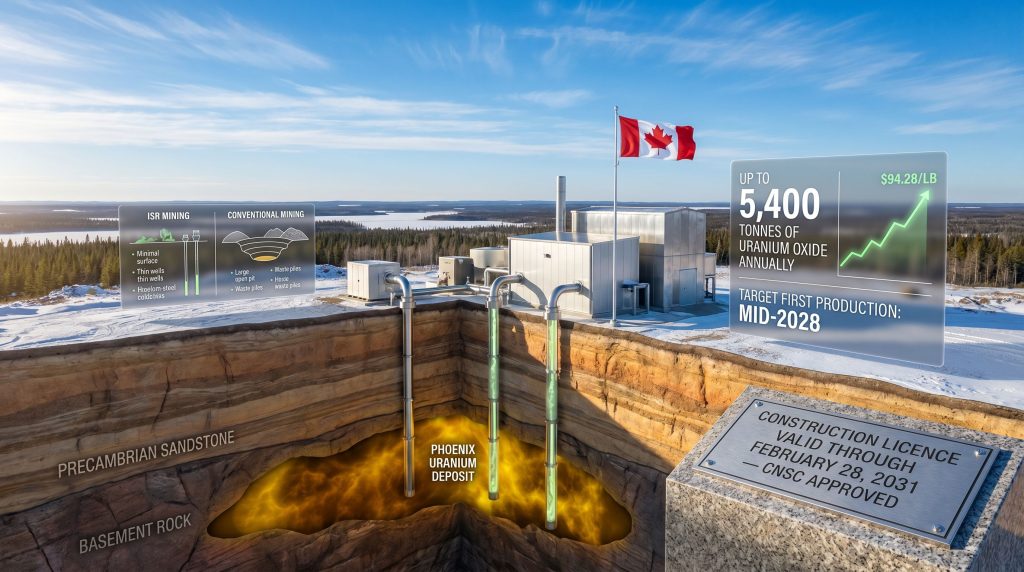
In situ recovery extracts uranium by circulating a carefully engineered solution through the ore body underground, dissolving uranium in place and then pumping the uranium-bearing fluid to the surface for processing, without ever physically excavating the rock.
This approach differs fundamentally from conventional mining in both its environmental footprint and its capital intensity. Where underground mines require shaft sinking, tunnel development, ventilation infrastructure, and large-scale waste rock management, ISR operations involve well networks, surface processing facilities, and ongoing fluid management. The surface disturbance is far smaller, waste rock generation is negligible, and construction timelines are typically shorter.
ISR vs. Conventional Underground Uranium Mining: A Comparative View
| Feature | ISR Mining | Conventional Underground Mining |
|---|---|---|
| Surface Disturbance | Minimal | Significant |
| Waste Rock Generation | Very Low | High |
| Water Management Complexity | Moderate | High |
| Construction Timeline | Shorter | Longer |
| Regulatory Precedent in Canada | First-ever approval | Established history |
| Capital Intensity | Generally Lower | Generally Higher |
While ISR is well established in other uranium-producing nations, particularly Kazakhstan (which produces the majority of global uranium via ISR), and has been used in the United States and Australia, it had never previously received construction approval for large-scale application in Canada. The Wheeler River uranium project approval is therefore genuinely historic from a regulatory standpoint, not merely notable, representing the first time the Canadian Nuclear Safety Commission (CNSC) has authorised this extraction methodology at commercial scale. Furthermore, global uranium reserves distribution means Canada's Athabasca Basin remains strategically critical for Western supply chains.
The Regulatory Architecture Behind the Approval
The CNSC issued a site preparation and construction licence to Denison Mines Corp. following the completion of a federal environmental assessment. This licence authorises site preparation and construction activities and remains valid through February 28, 2031. The provincial regulatory approvals necessary for the project had already been secured prior to the federal decision, meaning the CNSC decision represented the final clearance in a multi-jurisdictional process. According to Denison's official announcement, this milestone marks the culmination of years of regulatory engagement across multiple government bodies.
The Wheeler River uranium project approval is considered the first large-scale Canadian uranium mine to receive construction authorisation in more than two decades, reflecting the comprehensive scope and duration of regulatory scrutiny applied throughout the process.
However, investors and market observers should understand a critical distinction embedded in Canada's two-stage licensing framework. The construction licence is exactly what it describes: authorisation to build. Before any uranium can be produced and sold, Denison must apply for and receive a separate operating licence. That additional regulatory gate will require its own review process, including technical submissions, public consultation, and CNSC assessment. This means the Wheeler River project remains subject to a further layer of regulatory approval before production commences.
The Two-Stage Canadian Licensing Framework
-
Stage One: Site Preparation and Construction Licence – Authorises physical construction of mine and processing infrastructure. Currently held, valid to February 28, 2031.
-
Stage Two: Operating Licence – Required before uranium extraction can begin. Subject to separate CNSC review, public comment periods, and technical evaluation. Not yet applied for.
This framework is standard within Canadian nuclear regulation and reflects the CNSC's approach of applying phased scrutiny to nuclear-related facilities, ensuring each transition from development to operation receives dedicated assessment.
Wheeler River Project Snapshot
| Parameter | Detail |
|---|---|
| Location | Athabasca Basin, northern Saskatchewan, Canada |
| Distance from Saskatoon | Approximately 600 km north |
| Primary Deposit | Phoenix uranium deposit |
| Mining Method | In situ recovery (ISR) |
| Potential Annual Production | Up to 5,400 tonnes of uranium oxide |
| Projected Mine Life | Up to 15 years (subject to operating licence) |
| Target First Production | Mid-2028 |
| Construction Licence Expiry | February 28, 2031 |
| Operator | Denison Mines Corp. (headquartered in Toronto) |
Where Uranium Prices Stand and Why Timing Matters
The Wheeler River uranium project approval arrives at a moment of genuine tension in uranium markets. According to data from uranium fuel provider Cameco, the end-of-January 2026 spot price reached $94.28 per pound, the highest level recorded since February 2024 when prices touched $95.00 per pound. Throughout 2025, spot prices traversed a wide range, from a low of $64.23 per pound at the end of March to a high of $82.63 per pound at the end of September. Indeed, uranium supply-demand volatility has been a defining characteristic of the sector throughout this period.
Futures markets were already reflecting improved sentiment before the construction licence announcement. On January 5, 2026, Trading Economics posted uranium futures at approximately $82.00 per pound, at that point a two-month high, signalling that the market was repricing upward even before this catalytic regulatory development.
What the Numbers Signal for Project Economics
At spot prices above $90 per pound, Wheeler River's economics appear robust under most modelling scenarios. The ISR methodology provides a natural cost advantage relative to comparable underground operations, given lower capital expenditure requirements and reduced operating complexity. A sustained price environment in the $90-plus range strengthens the financial case for project financing and long-term offtake arrangements.
The risk scenario runs in the other direction. If uranium prices were to correct meaningfully below $70 per pound, project economics would come under pressure and could influence both financing timelines and the pace at which Denison pursues its operating licence application. This price sensitivity is not unique to Wheeler River but is characteristic of any mining project where the margin between cost of production and prevailing commodity price determines commercial viability. Consequently, understanding uranium market dynamics is essential context for evaluating any new project approval.
The next major ASX story will hit our subscribers first
Scenario Analysis: Pathways to and Away from Mid-2028 Production
| Scenario | Likely Outcome |
|---|---|
| Operating licence granted on schedule | First production achievable by mid-2028 |
| Regulatory delays in operating licence review | Production timeline pushed to 2029 or beyond |
| Sustained uranium price above $90/lb | Strong project economics; financing confidence elevated |
| Uranium price correction below $70/lb | Potential project deferral or financing challenges |
| Construction complications in remote terrain | Cost overruns; possible licence extension required |
The Broader Supply Chain Context
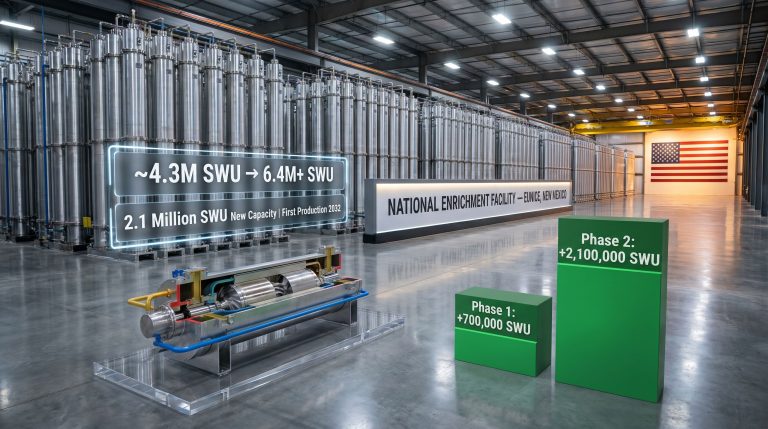
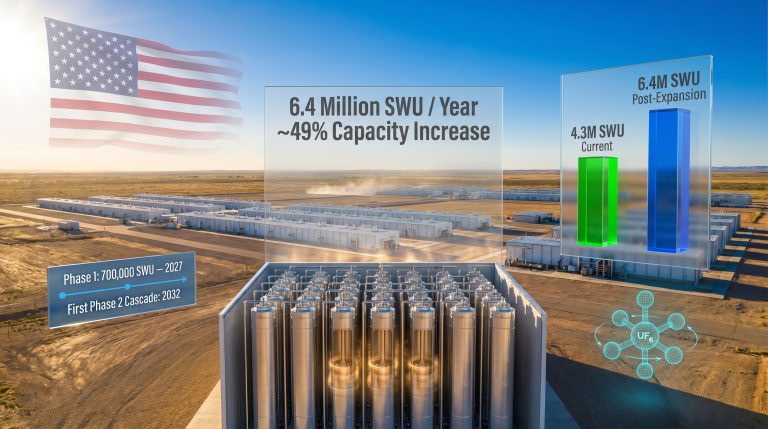
The Wheeler River approval does not exist in isolation. Western nuclear fuel supply chains are undergoing rapid reconstruction across multiple segments simultaneously. In the United States, the Department of Energy awarded $2.7 billion across three enrichment services companies in early 2026, while BWXT Technologies opened a new centrifuge manufacturing facility in Oak Ridge, Tennessee, and X-energy subsidiary TRISO-X received the first-ever Part 70 HALEU fuel fabrication licence from the Nuclear Regulatory Commission. Urenco announced plans to add 2.1 million separative work units of additional enrichment capacity at its New Mexico facility.
These developments collectively reflect an urgent recognition that Western nations face structural vulnerabilities in their nuclear fuel supply chains, particularly following the disruption of Russian supply relationships. Canada's Athabasca Basin, as one of the few jurisdictions capable of producing large volumes of uranium from politically stable, rule-of-law environments, sits at the strategic centre of this reconstruction effort. In addition, uranium supply challenges facing the sector make every new approved project increasingly significant.
Wheeler River's potential annual output of up to 5,400 tonnes of uranium oxide would represent a meaningful addition to available Western supply, particularly when viewed against the context of tightening global mine production and growing reactor demand. It is worth noting, however, that this figure represents a maximum scenario contingent on both operating licence approval and successful construction and commissioning within the projected timeline.
The ISR Precedent and Its Implications for Future Canadian Projects
Perhaps the most consequential aspect of the Wheeler River uranium project approval is not what it enables for this specific project, but what it signals for the broader Canadian uranium sector. By working through the full regulatory assessment process for ISR methodology, the CNSC has now developed institutional familiarity and technical frameworks for evaluating this extraction approach. Details of the full environmental assessment process are publicly available through the federal impact assessment record for the project.
For other uranium developers holding Athabasca Basin deposits that may share geological characteristics compatible with ISR, this precedent lowers the informational uncertainty around regulatory pathways. While each future application would need to satisfy the CNSC on its own merits, the existence of an approved ISR operation in Canada changes the landscape for how developers and regulators will approach similar proposals.
This is a nuanced but important point for the uranium investment community. The Wheeler River approval is simultaneously a project-specific milestone and a sector-wide regulatory development. It validates a methodology that could, in principle, unlock uranium resources that were previously considered sub-economic under conventional underground mining assumptions.
Remaining Risks and the Road to First Production
Investors and analysts should weigh several risks that remain material even following the construction licence approval.
- Operating licence uncertainty: The second regulatory stage is not a formality. It will involve substantive technical review and public engagement, and its timeline is not guaranteed.
- Remote construction environment: The site is located in a challenging subarctic environment approximately 600 kilometres from Saskatoon. Logistics, weather, and infrastructure limitations can materially affect construction schedules and costs.
- Uranium price sensitivity: The project's commercial rationale is partly dependent on prevailing uranium prices remaining supportive through the construction period and into early production years.
- ISR performance in practice: While ISR is proven globally, its application in the specific geological context of the Athabasca Basin at commercial scale has no precedent in Canada. Actual recovery rates, fluid management performance, and operational behaviour will only be confirmed once the operation is running.
- Financing execution: Moving from approval to construction requires mobilising significant capital. The terms and structure of project financing will influence both the pace and the risk profile of construction execution.
This article contains forward-looking information regarding project timelines, production estimates, and market conditions. All such information involves inherent uncertainty and should not be construed as financial advice. Readers should conduct independent research and seek professional guidance before making investment decisions.
Frequently Asked Questions About the Wheeler River Uranium Project Approval
What regulatory body approved the Wheeler River project?
The Canadian Nuclear Safety Commission issued the site preparation and construction licence following completion of a federal environmental assessment.
Is Wheeler River approved to begin mining uranium immediately?
No. The construction licence authorises site preparation and building of infrastructure. A separate operating licence must be obtained before uranium extraction can begin.
What makes ISR mining different from traditional uranium extraction?
ISR dissolves uranium in place underground using a circulated solution and recovers the uranium-bearing fluid at the surface, eliminating the need for physical excavation or large-scale underground tunnelling.
How much uranium could Wheeler River produce annually?
The project has a potential annual output of up to 5,400 tonnes of uranium oxide, subject to successful construction and operating licence approval.
When is first production expected at Wheeler River?
Denison Mines Corp. has indicated a target of mid-2028, contingent on receiving an operating licence and completing construction on schedule.
Why has it been more than 20 years since Canada approved a large uranium mine?
The approval process for large-scale uranium mines in Canada involves multi-year federal environmental assessments and multi-jurisdictional provincial reviews, creating extended timelines that reflect the depth of scrutiny applied to nuclear-related facilities.
What is the Phoenix uranium deposit?
Phoenix is a high-grade unconformity-type uranium deposit located within the Wheeler River project area in the Athabasca Basin, and it is the primary target of the proposed ISR operation.
Where exactly is the Wheeler River project located?
The project is situated in the Athabasca Basin in northern Saskatchewan, approximately 600 kilometres north of Saskatoon, in one of the world's most concentrated uranium-producing regions.
Want to Stay Ahead of the Next Major Uranium Discovery?
Discovery Alert's proprietary Discovery IQ model scans ASX announcements in real time, instantly identifying significant mineral discoveries — including uranium — and delivering actionable alerts before the broader market can react. Explore historic discoveries and their returns to see why early positioning matters, then start your 14-day free trial at Discovery Alert to ensure you're never on the wrong side of a sector-defining announcement.