June 2, 2026
The Quiet Vulnerability Beneath America's Nuclear Baseload
Reliable baseload electricity has a hidden dependency that rarely surfaces in public energy debates. For decades, the uranium enrichment step of the nuclear fuel cycle has represented one of the most geographically concentrated and geopolitically exposed bottlenecks in the entire US energy system. While solar panels, wind turbines, and battery storage have commanded the spotlight in energy security conversations, a far less visible but arguably more consequential gap has been widening: the United States has had just one commercial uranium enrichment facility operating within its borders. A single plant. A single point of failure for roughly 20% of the nation's electricity supply.
That structural vulnerability is now being addressed at a scale not seen in the American nuclear fuel cycle in decades. Urenco's announcement of a multi-billion-dollar investment to expand the Urenco new US enrichment plant capacity at its National Enrichment Facility in Eunice, New Mexico represents far more than a corporate capital expenditure decision. It is a recalibration of where the US nuclear fuel chain begins and ends, and how much of it will remain under domestic control through the 2030s and beyond.
When big ASX news breaks, our subscribers know first
Understanding the Only Commercial Enrichment Site in the United States
The National Enrichment Facility's Place in US Nuclear Infrastructure
The National Enrichment Facility in Eunice, New Mexico holds a distinction that most Americans are entirely unaware of: it is the only operating commercial uranium enrichment facility in the country. Without this single site in the Chihuahuan Desert of southeastern New Mexico, US utilities would have no domestic source of enriched uranium for their reactor fleets.
The facility's origins are themselves a milestone in US nuclear regulatory history. When construction commenced in 2006, it was the first new nuclear project in the United States in nearly 30 years, and the first ever to receive a combined construction and operating licence from the US Nuclear Regulatory Commission. This regulatory precedent was significant because it streamlined the approval pathway that had previously required separate licensing stages, reducing years of regulatory uncertainty that had historically deterred nuclear infrastructure investment.
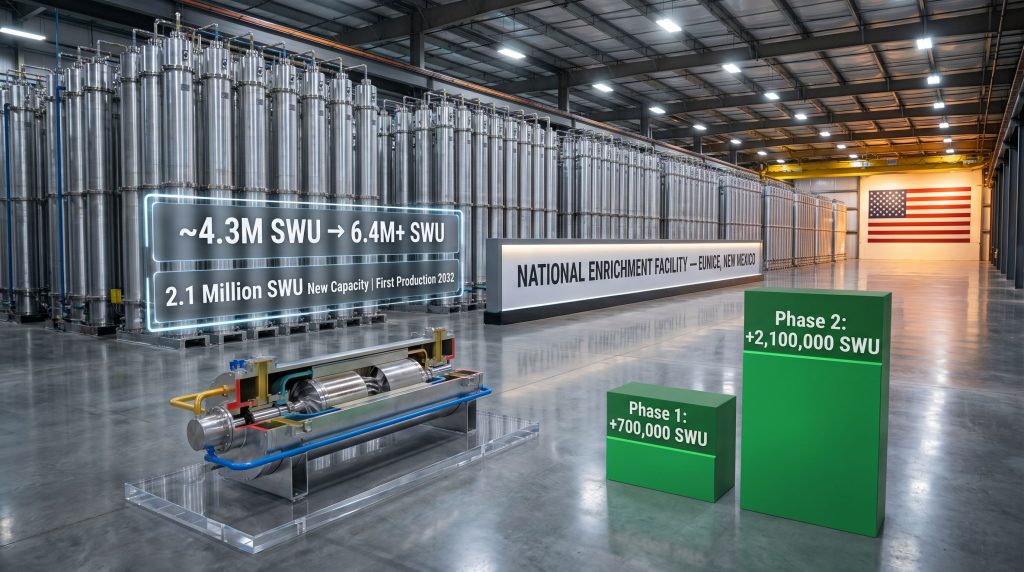
Enriched uranium production at the site began in June 2010, and the facility has since grown to encompass 64 centrifuge cascades producing approximately 4.3 million Separative Work Units (SWU) per year. At that output level, the facility meets roughly one-third of annual US commercial demand for enrichment services. Urenco has invested approximately USD 5 billion in this facility since its inception, and an ongoing expansion project is already adding 700,000 SWU of additional capacity, scheduled for completion in 2027.
Why a Single-Site Enrichment Base Is a Strategic Liability
The concentration of all US commercial enrichment capability at one location creates compounding risks that extend well beyond routine operational contingencies. A significant unplanned outage, a natural disaster, or a sustained regulatory disruption at Eunice would immediately affect the fuel supply security of every nuclear utility in the country that relies on domestic enrichment services.
This single-facility vulnerability was brought into sharper focus when the United States moved to restrict imports of Russian-origin enriched uranium. The us ban on Russian uranium imports significantly impacted the broader enrichment market, as Rosatom, Russia's state nuclear corporation, had historically served a substantial share of global enrichment demand, including meaningful portions of US utility contracts. When geopolitical tensions made that supply relationship untenable, US utilities seeking to diversify faced a tight global enrichment market where Western capacity was simultaneously being pursued by European customers executing their own Russian supply substitution strategies.
The result was a structural market imbalance that highlighted just how thinly provisioned domestic enrichment infrastructure had become relative to the strategic importance of the output it produces. Nuclear power generating close to 20% of US electricity while relying on a geographically concentrated enrichment base created energy security risks that energy planners had long identified as unacceptable but had struggled to address through policy alone.
Understanding Separative Work Units: The Metric That Defines Enrichment Scale
What a SWU Actually Measures
To appreciate the significance of Urenco's expansion, it helps to understand the unit of measurement that defines enrichment capacity. A Separative Work Unit is the standard global measure of the energy and mechanical effort required to separate uranium-235 from the far more abundant uranium-238 during the enrichment process. It quantifies the thermodynamic work performed by centrifuges to increase the concentration of the fissile U-235 isotope from its natural abundance of approximately 0.7% to the levels required for reactor fuel.
Producing one kilogram of enriched uranium at typical reactor fuel enrichment levels requires somewhere between 4 and 8 SWU depending on the target enrichment level and the tails assay selected. This means that the Eunice facility's current output of 4.3 million SWU annually translates to hundreds of tonnes of enriched uranium product capable of fuelling dozens of large commercial reactors.
Higher SWU capacity directly translates to greater volumes of low-enriched uranium available for reactor fuel fabrication, making it the critical variable in planning both near-term fuel supply adequacy and long-term strategic reserve development.
How 700,000 SWU and 2.1 Million SWU Translate Into Real-World Fuel Impact
The Urenco new US enrichment plant capacity expansion unfolds in two distinct phases, each with measurably different implications for domestic fuel security:
| Expansion Phase | SWU Added | Capacity Impact | Timeline |
|---|---|---|---|
| Near-term expansion (Phase 1) | 700,000 SWU | ~16% capacity increase | Complete by 2027 |
| New plant construction (Phase 2) | 2,100,000 SWU | ~49% capacity increase | 2029 construction, 2032 first production |
| Combined incremental growth | 2,800,000 SWU | ~65% total capacity uplift | 2025 to 2036 |
| Post-expansion annual capacity | ~6.4+ million SWU | Materially higher share of US demand | From 2036 onward |
The scale of Phase 2 is particularly significant. Adding 2.1 million SWU to an existing base of approximately 4.3 million SWU represents the largest single capacity addition to US commercial enrichment infrastructure in decades. For context, a large 1,000 megawatt commercial light water reactor requires roughly 100,000 to 150,000 SWU of enrichment services annually. The Phase 2 addition alone could theoretically supply the annual enrichment needs of 14 to 21 additional large reactors.
From LEU to HALEU: The Enrichment Continuum
Understanding SWU also illuminates why today's LEU infrastructure investments are inseparable from tomorrow's advanced reactor ambitions. Low-enriched uranium used in conventional light water reactors is typically enriched to between 3% and 5% U-235 content. High-assay low-enriched uranium (HALEU), required by many advanced reactor designs planned for deployment in the 2030s, is enriched to between 5% and 20% U-235.
Critically, HALEU is not produced independently of LEU infrastructure. In most production pathways, LEU serves as the input feedstock that is further enriched to reach HALEU-grade concentrations. This means that expanding LEU production capacity is a necessary precondition for any credible domestic HALEU supply strategy. Without sufficient LEU throughput at the front end, the HALEU production pathway faces a structural bottleneck regardless of how much secondary enrichment capacity exists.
The Architecture of the New Plant: Technology, Scale, and Timeline
Gas Centrifuge Technology and Its Advantages
The new plant will deploy Urenco's proven gas-centrifuge enrichment technology, the same approach that has powered the existing 64-cascade operation at Eunice since 2010. Gas centrifuge technology replaced earlier gaseous diffusion methods as the global standard for commercial enrichment due to its dramatically superior energy efficiency: centrifuge plants consume approximately 50 times less electricity per SWU produced compared to gaseous diffusion, fundamentally altering the economics of enrichment operations.
The decision to apply established centrifuge technology rather than pursuing newer experimental approaches reflects a deliberate risk management posture. With construction commencing in 2029 and a targeted first-production milestone in 2032, the project timeline is already ambitious given nuclear construction lead times. Using proven centrifuge cascade configurations reduces the execution risk profile that has historically plagued large nuclear infrastructure projects attempting to commercialise novel technologies at scale.
Cascade Architecture and the 24-Cascade Build-Out
The new plant will be installed in up to 24 cascades of centrifuges, complementing the existing 64 cascades already operating at the site. This phased cascade installation structure provides operational flexibility that is unique to centrifuge-based enrichment technology: each cascade can begin producing LEU as soon as it is commissioned, allowing revenue generation to commence well before the full 24-cascade build-out is complete.
The first cascades are targeted to begin producing low-enriched uranium in 2032, with additional cascades progressively coming online through to 2036. Furthermore, this graduated ramp-up profile means the facility will be contributing to US fuel supply security throughout the construction phase, rather than requiring complete build-out before any output is realised.
| Metric | Current Status | Post-Expansion (2036 Target) |
|---|---|---|
| Annual enrichment capacity | ~4.3 million SWU | ~6.4+ million SWU |
| Active centrifuge cascades | 64 | Up to 88 (estimated) |
| Share of US commercial demand served | ~33% | Materially higher |
| Employees at New Mexico site | 500+ | 570+ (long-term operations) |
| Cumulative Urenco investment | ~USD 5 billion | USD 5 billion + new multi-billion commitment |
Federal Investment and the Domestic Enrichment Policy Landscape
The USD 2.7 Billion Task Order Programme
The US government has been simultaneously pursuing a parallel track to expand domestic enrichment services, directing USD 2.7 billion in task orders to three companies to provide enrichment services for both LEU and HALEU, explicitly framed as a strategy to transition the country away from foreign sources of uranium and diversify its domestic fuel supply.
The three recipients of these task orders were:
- General Matter – selected for enrichment service provision
- American Centrifuge Operating – selected for enrichment service provision
- Orano Federal Services – selected for enrichment service provision
A separate USD 28 million award was directed toward Global Laser Enrichment to continue advancing next-generation uranium enrichment technology. This award reflects a deliberate policy of maintaining investment across multiple technology pathways, ensuring that centrifuge-based scale-up in the near term does not foreclose options for potentially more efficient enrichment methods in future decades.
These government task orders represent policy alignment with private capital deployment, but it is important to note that the Urenco expansion announced in June 2026 is a privately funded multi-billion-dollar commitment by Urenco Global, not a recipient of these specific federal task orders.
Orano's Project IKE: A Competing Domestic Facility Under NRC Review
Orano Federal Services has filed for a construction and operating licence for Project IKE, a centrifuge enrichment plant proposed for construction in Tennessee. As of June 2026, this application is currently undergoing review by the US Nuclear Regulatory Commission. Project IKE represents a potential second domestic commercial enrichment facility that would further reduce the single-site vulnerability that currently characterises US enrichment infrastructure.
The emergence of multiple domestic enrichment projects simultaneously reflects a broader recognition that the US nuclear fuel cycle requires structural diversification, not merely incremental additions to existing capacity. A two-facility or multi-facility domestic enrichment base would provide redundancy that a single Eunice-dependent system cannot.
Urenco's Global Expansion: The US Plant Within a Broader Strategic Programme
A 4.6 Million SWU Global Programme Across Allied Nations
The Urenco new US enrichment plant capacity expansion does not exist in isolation. It forms part of a coordinated global programme by UK-headquartered Urenco Global to install 4.6 million new SWU of enrichment capacity across facilities in the United States, the Netherlands, and Germany over the next decade.
| Site | Country | Role in Global Programme |
|---|---|---|
| National Enrichment Facility, Eunice | USA | 2.1 million SWU new plant (LEU + HALEU feedstock) |
| Almelo facility | Netherlands | Part of 4.6 million SWU global programme |
| Gronau facility | Germany | Part of 4.6 million SWU global programme |
| Capenhurst facility | United Kingdom | Commercial HALEU facility (first in Europe) |
This multi-site strategy distributes enrichment capacity across allied nations with stable regulatory environments and longstanding nuclear industry expertise. From an energy security perspective, the geographic diversification across four NATO-aligned countries with distinct political and regulatory frameworks provides a degree of supply chain resilience that no single-nation strategy could replicate.
The Capenhurst HALEU Facility: Europe's First Commercial High-Assay Plant
Urenco is also constructing a commercial HALEU facility at its Capenhurst site in the United Kingdom, which will be the first commercial HALEU enrichment plant in Europe. This facility is being developed with joint funding from the UK Government, positioning the UK as an early mover in the advanced nuclear fuel market. The Capenhurst development signals that HALEU supply infrastructure is being built now, ahead of the deployment of advanced reactors that will require it, which is the correct sequencing given the extended lead times involved in nuclear fuel cycle infrastructure development.
The next major ASX story will hit our subscribers first
HALEU and the Advanced Reactor Pipeline: Why Enrichment Infrastructure Determines Deployment Timelines
Advanced Reactor Designs and Their Fuel Requirements
Many of the most commercially promising advanced reactor designs that are currently in various stages of licensing and development in the United States require HALEU as their primary fuel. The higher enrichment levels in HALEU enable these reactors to achieve superior fuel utilisation efficiency, longer refuelling cycles, and more compact core designs than are achievable with standard LEU. Consequently, the uranium market dynamics surrounding HALEU supply are becoming increasingly central to advanced reactor deployment planning.
Technologies that depend on HALEU include several leading advanced reactor designs across multiple coolant types:
- Molten salt reactors requiring high-assay fuel to maintain criticality with certain moderator configurations
- High-temperature gas-cooled reactors using TRISO fuel particles that require enrichment above standard LEU levels
- Fast spectrum reactors designed for higher burn-up and reduced waste generation
- Microreactors intended for remote locations, defence installations, and industrial applications
The Production Sequencing Challenge
One of the least widely understood aspects of HALEU supply is that producing it requires an available LEU feedstock stream at scale. This creates an important sequencing dependency: HALEU production capacity cannot be fully utilised without corresponding LEU production at the front end of the process. Expanding LEU capacity at Eunice to 6.4 million or more SWU annually therefore has direct implications for how much HALEU could eventually be produced domestically.
A plausible scenario for the mid-2030s involves 10 to 15 advanced reactors requiring HALEU entering initial operation in the United States. Meeting that demand domestically would require LEU feedstock availability that depends directly on the enrichment capacity decisions being made today. Urenco's 2032 first-production target at the expanded Eunice facility positions the site to serve both markets simultaneously.
Disclaimer: Advanced reactor deployment projections involve significant uncertainty. Regulatory timelines, technology readiness, and capital availability each represent independent variables that could materially alter the pace at which HALEU demand emerges. The scenario described above represents a plausible pathway, not a guaranteed outcome.
Economic and Workforce Impact: New Mexico and the Broader US Economy
The Oxford Economics Assessment
An independent economic assessment conducted by Oxford Economics and published in late 2025 found that the operations of Urenco USA contributed more than USD 360 million to the US economy in 2024-2025. This figure encompasses direct employment income, supplier relationships, and the broader economic multiplier effects generated by the facility's ongoing operations in southeastern New Mexico. Indeed, the uranium supply-demand volatility that has characterised recent years has only served to underscore how critical this domestic economic contribution is to overall fuel chain stability.
Job Creation: Construction Phase and Long-Term Operations
The employment profile of the expansion spans two distinct phases with different characteristics:
| Employment Category | Estimated Jobs | Timeline |
|---|---|---|
| Peak construction workforce | 300 to 600 | During construction phase, 2029 to approximately 2034 |
| Long-term operational additions | 70 | Post-2032, ongoing |
| Existing site workforce | 500+ | Current ongoing operations |
| Total long-term site workforce | 570+ | From full build-out onward |
The construction employment range of 300 to 600 peak workers reflects the uncertainty inherent in a project whose construction schedule extends through 2036. Peak employment will vary depending on the pace of cascade installation and the degree to which construction activities overlap across multiple phases of the build-out.
New Mexico's position as the host state for America's only commercial enrichment facility makes the Eunice site an increasingly important anchor of the regional industrial economy. The long-term operational employment additions, while modest in absolute numbers relative to the construction phase, represent highly skilled, well-compensated positions in technical, engineering, and operational disciplines that are scarce in regional labour markets.
How Urenco's Expansion Compares to Other Domestic Enrichment Initiatives
Centrifuge vs. Laser Enrichment: Two Technology Pathways
The domestic enrichment landscape is developing along two distinct technology pathways that are likely to coexist rather than compete directly. The USD 28 million federal award to Global Laser Enrichment signals ongoing government interest in laser-based uranium enrichment technology, which theoretically offers significant energy efficiency advantages over centrifuge approaches but has not yet been demonstrated at commercial scale.
Laser enrichment, based on the SILEX process originally developed in Australia, selectively ionises uranium-235 atoms using precisely tuned laser frequencies, allowing separation at far lower energy cost than mechanical centrifuge systems. However, the technology remains at a pre-commercial development stage, and the path to commercial deployment involves substantial technical and regulatory hurdles that are likely to take a decade or more to fully resolve.
Centrifuge-based expansion by Urenco and others therefore represents the near-to-medium term solution, while laser enrichment may represent a longer-term technology disruption that could reshape the economics of the industry in future decades. In addition, uranium market trends suggest growing investor interest in both technology pathways as the sector continues to mature.
Comparing the Principal US Enrichment Capacity Initiatives
| Initiative | Technology | Capacity Added | Location | Timeline | Status |
|---|---|---|---|---|---|
| Urenco USA Phase 1 | Gas centrifuge | 700,000 SWU | Eunice, NM | Complete by 2027 | In progress |
| Urenco USA Phase 2 (new plant) | Gas centrifuge | 2,100,000 SWU | Eunice, NM | Construction 2029, first LEU 2032 | Announced |
| Orano Project IKE | Gas centrifuge | Not yet specified | Tennessee | Under NRC review | Licensing phase |
| Global Laser Enrichment | Laser (SILEX) | Not yet specified | TBC | Pre-commercial | Development |
Frequently Asked Questions: Urenco New US Enrichment Plant Capacity
When Will Urenco's New US Enrichment Plant Begin Production?
Construction on the new plant commences in 2029, with the first centrifuge cascades targeted to begin producing low-enriched uranium in 2032. Additional cascades will be progressively installed and brought online through to 2036, when the full 24-cascade build-out is expected to be complete. For further context on recent enrichment milestones at the site, the ANS has published detailed coverage of Urenco USA's progress.
Where Is the National Enrichment Facility Located?
The National Enrichment Facility is situated in Eunice, New Mexico, in the southeastern part of the state. It is currently the only operating commercial uranium enrichment site in the United States.
How Much New Enrichment Capacity Will the Expansion Add?
The new plant will contribute 2.1 million SWU of additional annual enrichment capacity, representing a near-50% increase over the site's current output of approximately 4.3 million SWU per year.
What Is the Difference Between LEU and HALEU?
Low-enriched uranium contains uranium-235 enriched to below 5% and is the standard fuel for conventional light water reactors that currently generate nearly 20% of US electricity. High-assay low-enriched uranium is enriched to between 5% and 20% U-235 and is required by many advanced reactor designs planned for commercial deployment in the 2030s.
How Much Has Urenco Already Invested in the New Mexico Facility?
Urenco's cumulative investment in the National Enrichment Facility since construction began in 2006 is approximately USD 5 billion. The new expansion represents an additional multi-billion-dollar capital commitment on top of that historical investment.
What Share of US Enrichment Demand Does Urenco Currently Serve?
The Eunice facility's current annual output of approximately 4.3 million SWU is sufficient to meet close to one-third of annual US commercial demand for enrichment services. The expanded facility is expected to serve a materially higher proportion of that demand once fully operational.
Key Takeaways: What the Urenco Expansion Signals for US Nuclear Fuel Strategy
The Urenco new US enrichment plant capacity expansion carries implications that extend well beyond a single company's capital allocation decision. Considered in its full strategic context, the announcement reflects several converging forces reshaping the US nuclear fuel cycle:
- The 2.1 million SWU expansion is the largest single capacity addition to US commercial enrichment infrastructure in decades, with construction starting in 2029 and first LEU production in 2032
- The expansion directly reduces dependence on foreign enrichment services by materially increasing the share of US commercial demand that can be met domestically
- LEU produced at the expanded facility will serve as essential feedstock for future HALEU production, creating a direct pathway from today's infrastructure investment to tomorrow's advanced reactor deployment
- Urenco's broader global programme targets 4.6 million SWU of new enrichment capacity across the United States, the Netherlands, and Germany, distributing supply chain risk across multiple allied-nation jurisdictions
- Federal task orders totalling USD 2.7 billion directed at domestic enrichment services reflect the strength of policy alignment with private capital deployment in this sector
- The Oxford Economics assessment confirming USD 360 million in economic contribution in 2024-2025 demonstrates that the existing facility already delivers substantial economic value to New Mexico and the broader US economy
- The build-out to 88 estimated cascades from the current 64 represents a structural transformation of the site's productive capacity, not an incremental adjustment
This article is intended for informational purposes only and does not constitute financial or investment advice. All timelines, capacity figures, and investment amounts referenced are drawn from publicly available company announcements and industry sources. Forward-looking statements involve inherent uncertainty, and actual outcomes may differ materially from projections. Readers should conduct their own due diligence before making any investment or commercial decisions related to the nuclear fuel cycle or uranium enrichment sector.
Want to Track ASX Uranium Discoveries as Nuclear Fuel Demand Accelerates?
As enrichment capacity expands and the uranium fuel cycle undergoes structural transformation, significant mineral discoveries on the ASX represent compelling opportunities for investors positioned to act quickly. Discovery Alert's proprietary Discovery IQ model delivers real-time alerts the moment significant ASX uranium and mineral discoveries are announced, turning complex geological data into actionable insights — explore the historic returns major discoveries have generated and begin your 14-day free trial to gain a market-leading edge.