May 16, 2026
Advanced Offshore Engineering Capabilities Drive Modern LNG Production
The evolution of deep-water energy extraction has reached unprecedented sophistication, with floating production systems now operating in ocean depths exceeding 900 meters. These technological advances represent decades of engineering refinement, enabling access to previously unreachable hydrocarbon reserves while maintaining operational safety standards. The integration of modular construction techniques with advanced subsea infrastructure creates possibilities for large-scale energy projects in challenging marine environments.
Modern semi-submersible platforms demonstrate remarkable engineering capabilities, combining hull stability with processing efficiency to extract natural gas from seabed formations hundreds of kilometers from shore. This technical framework enables energy companies to develop resources that would have been economically unfeasible using conventional offshore approaches.
When big ASX news breaks, our subscribers know first
The Engineering Foundation of Deep-Water Operations
Technical Specifications and Infrastructure Requirements
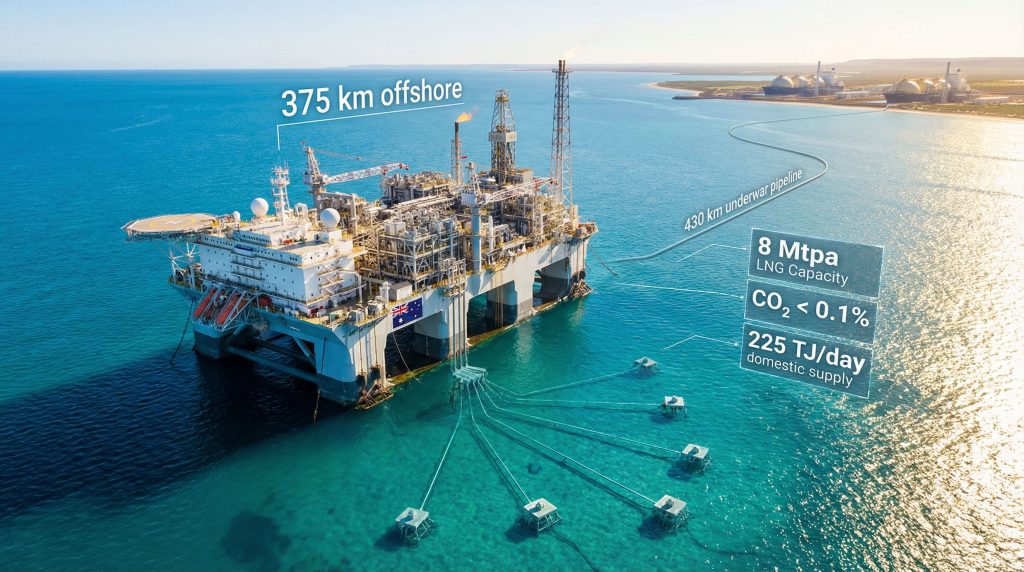
The Woodside Scarborough Energy Project represents a paradigm shift in offshore gas extraction methodologies. Operating in water depths ranging from 900 to 950 meters, the project utilizes cutting-edge floating production unit technology positioned 375 kilometers offshore Western Australia's coast. The engineering complexity of this undertaking demonstrates the sophisticated technical capabilities now available for deep-water energy development.
| Technical Parameter | Specification |
|---|---|
| Operational Water Depth | 900-950 meters |
| Distance from Coastline | 375 kilometers |
| Pipeline Infrastructure Length | 430 kilometers |
| Initial Production Wells | 8 wells (expandable to 13) |
| Combined LNG Production Capacity | Up to 8 Mtpa |
Floating Production Unit Architecture
The project's floating production unit represents advanced maritime engineering, utilizing modular construction techniques where hull and topsides components undergo separate manufacturing processes before integration in Australian waters. Furthermore, this approach enables complex deep-water operations while maintaining construction quality control and operational efficiency standards.
Recent operational milestones indicate significant progress toward full commissioning. According to Woodside's quarterly reporting, the Scarborough Energy Project achieved 94% completion by the end of 2025, with the floating production unit successfully arriving at the field location and hook-up activities commencing. Acting CEO Liz Westcott confirmed the project remains on budget and targeting first LNG cargo delivery in Q4 2026.
Pipeline and Subsea Infrastructure Systems
Saipem's trunkline installation connects the offshore floating production unit to onshore processing facilities through a comprehensive pipeline system. Specialized rock placement sourced from Mt Regal Quarry provides essential seabed stabilization and coastal protection infrastructure, ensuring long-term operational integrity of the subsea systems.
Low-Carbon Reservoir Characteristics and Market Positioning
Natural Gas Composition Advantages
The Scarborough gas field demonstrates exceptional environmental credentials through naturally occurring low carbon dioxide concentrations below 0.1% in the reservoir composition. This characteristic positions the resource among the cleanest natural gas sources globally, creating significant competitive advantages in increasingly carbon-conscious Asian energy markets.
The low-carbon profile results from geological formation processes rather than artificial treatment, providing inherent environmental benefits without additional processing costs. Consequently, this natural advantage becomes increasingly valuable as regional energy buyers implement stricter emissions standards and seek cleaner fossil fuel alternatives during energy transition insights.
Domestic Energy Security Integration
Beyond export capabilities, the project delivers substantial domestic energy supply, providing up to 225 terajoules daily for Western Australia's local energy market. This domestic component strengthens regional energy security while supporting the state's industrial operations and economic development objectives.
The dual-purpose approach of serving both export and domestic markets demonstrates strategic resource utilization, maximizing economic value while contributing to Australia's energy independence goals. However, this strategy also aligns with broader US natural gas forecasts that emphasise the importance of diversified energy portfolios.
Dual-Train Processing Strategy and Capacity Expansion
Train 1 Optimisation and Train 2 Development Framework
The project's processing strategy involves comprehensive modifications to existing Pluto Train 1 facilities, expanding operational capacity to 3 Mtpa, while simultaneously constructing an entirely new Train 2 facility capable of approximately 5 Mtpa production. This dual-train approach enables staged development and risk mitigation through phased operational startup procedures.
Operational performance data indicates strong reliability metrics for existing infrastructure. Pluto LNG achieved 100% operational reliability during the second half of 2025, according to Woodside's operational reporting, suggesting robust performance foundations for the expanded facility complex.
Joint Venture Structure and Ownership Distribution
| Entity | Scarborough JV Stake | Pluto Train Ownership |
|---|---|---|
| Woodside Energy | 74.9% | 90% (Train 1), 51% (Train 2) |
| JERA | 15.1% | Strategic partner stake |
| LNG Japan | 10% | Minority partner position |
This ownership structure reflects strategic partnerships with major Asian energy companies, providing secure off-take arrangements while sharing development risks and technical expertise across international energy sector participants.
Infrastructure Innovations Enabling Deep-Water Processing
Modular Construction and Integration Methodology
The floating production unit construction utilizes advanced modular techniques, with hull components and processing topsides manufactured separately in specialised Chinese facilities before transportation and integration in Australian waters. For instance, this approach enables quality control optimisation while managing complex logistics for large-scale offshore infrastructure development.
The successful arrival of the floating production unit at the field location marks a critical engineering milestone, demonstrating the viability of modular construction approaches for deep-water energy projects. Hook-up activities represent the final integration phase before commissioning and operational startup procedures.
Subsea Infrastructure and Control Systems
Advanced subsea infrastructure connects multiple production wells through manifold systems and flowlines to the floating production unit. The initial eight-well configuration provides foundation capacity with expansion potential to thirteen wells, enabling production optimisation and reserves maximisation throughout the project's operational lifespan.
Perth-based Integrated Remote Operations Centre (IROC) construction enables centralised monitoring and control of offshore operations, representing advanced digital integration in LNG production management. This remote operations capability enhances safety protocols while optimising operational efficiency through real-time monitoring and automated control systems, reflecting broader data-driven operations trends across resource industries.
Strategic Role in Australia's Energy Transition
Positioning Within Asian Energy Markets
The Woodside Scarborough Energy Project low carbon intensity profile aligns strategically with North Asian markets' evolving demand for cleaner fossil fuel alternatives during energy transition periods. This positioning creates sustainable commercial advantages as regional economies implement increasingly stringent emissions standards while maintaining energy security requirements.
Long-term supply agreements with Asian partners demonstrate market confidence in the project's environmental credentials and reliable production capabilities. In addition, the combination of natural low-carbon characteristics and advanced processing efficiency creates premium product positioning in competitive regional LNG markets.
Economic Impact and Regional Development Contributions
| Economic Contribution Category | Projected Impact Scale |
|---|---|
| Direct/Indirect Tax Revenue | Over AUS$50 billion |
| Employment Generation | Thousands during construction |
| Regional Economic Development | Pilbara-focused growth |
| Skills and Training Programs | Specialised technical development |
Note: Economic impact projections involve estimates based on project scale and duration. Actual outcomes may vary depending on market conditions, operational performance, and regulatory changes over the project lifecycle.
The substantial economic contributions extend beyond direct project activities to encompass regional supply chain development, specialised workforce training programs, and infrastructure improvements supporting broader Pilbara region economic growth.
The next major ASX story will hit our subscribers first
Operational Milestones and Technical Progress
What Is the 2026 Commissioning Timeline?
Recent infrastructure achievements mark critical progress toward operational startup targets. Federal environmental approvals have established regulatory pathways for commissioning activities, while physical infrastructure completion rates demonstrate strong project execution capabilities.
The floating production unit's successful field arrival represents a major engineering achievement, given the complexity of transporting and positioning large-scale offshore infrastructure in deep-water marine environments. Subsequently, hook-up activities involve connecting subsea systems and conducting comprehensive testing procedures before operational startup.
Integration with Regional Energy Infrastructure
Scarborough's connection to existing Pluto facilities demonstrates efficient capital utilisation principles while creating operational synergies with established infrastructure systems. This integration approach reduces overall development costs while leveraging proven operational capabilities and maintenance protocols.
The project's design enables potential future integration with additional Carnarvon Basin developments, creating a regional energy hub capable of supporting multiple production sources through shared infrastructure systems. This approach reflects broader industry evolution trends toward integrated resource development strategies.
Risk Management and Operational Safety Protocols
Environmental Compliance and Marine Ecosystem Protection
Comprehensive environmental management systems address marine ecosystem protection requirements while ensuring regulatory compliance throughout all project phases. These protocols encompass seabed impact monitoring, marine wildlife protection measures, and water quality maintenance standards.
Ongoing environmental monitoring programs track ecosystem responses to offshore activities, providing data for adaptive management strategies and regulatory compliance verification. The low-carbon reservoir characteristics reduce environmental impact concerns associated with CO2 emissions and processing waste streams, contributing to decarbonisation benefits across the energy sector.
Deep-Water Operations Safety Framework
Offshore operations in 900+ meter water depths require specialised safety systems, emergency response capabilities, and weather management protocols to ensure continuous safe operations. Advanced forecasting systems enable proactive responses to challenging offshore conditions while maintaining operational continuity.
Emergency response protocols encompass vessel evacuation procedures, subsea system shutdown capabilities, and coordination with regional maritime safety authorities. Regular safety training and simulation exercises maintain workforce preparedness for various emergency scenarios.
Future Expansion Potential and Development Outlook
Well Development Progression and Reserve Optimisation
The initial eight-well production configuration establishes operational foundations while maintaining expansion capabilities to thirteen wells based on reservoir performance and market demand conditions. This phased development approach enables production optimisation and reserves maximisation strategies throughout the project's operational timeline.
Advanced reservoir management techniques optimise production rates while maintaining long-term field productivity. Digital monitoring systems provide real-time reservoir data enabling adaptive production strategies and enhanced recovery methodologies.
Technology Transfer and Industry Development
Advanced offshore engineering capabilities developed through the Woodside Scarborough Energy Project create significant knowledge transfer opportunities for Australia's broader energy sector. Technical expertise gained in deep-water operations, modular construction, and remote operations management enhances domestic industry capabilities for future projects.
The project demonstrates Australian energy sector capacity for managing complex international energy developments while maintaining operational excellence and environmental compliance standards. This technical foundation supports future offshore energy projects and strengthens Australia's position in global LNG markets.
Integration with Regional Energy Infrastructure Development
Strategic positioning within the Carnarvon Basin creates opportunities for future field developments and infrastructure sharing arrangements. The established processing facilities and pipeline systems provide foundation infrastructure for potential additional production sources, creating regional energy development synergies.
Long-term regional development planning considers potential hydrogen production capabilities and renewable energy integration opportunities, positioning the infrastructure for future energy transition requirements while maintaining current operational objectives. Furthermore, regulatory frameworks continue evolving to support these integrated development approaches.
Disclaimer: This analysis contains forward-looking statements regarding project timelines, production capacity, and economic impacts. Actual results may differ materially due to technical challenges, market conditions, regulatory changes, or unforeseen operational factors. Investment and operational decisions should consider comprehensive due diligence and professional advice.
Ready to Capitalise on Major Energy Infrastructure Developments?
Discovery Alert's proprietary Discovery IQ model delivers real-time alerts on significant ASX mineral and energy discoveries, instantly empowering subscribers to identify actionable opportunities ahead of the broader market. Begin your 14-day free trial today and secure your market-leading advantage in Australia's evolving resource sector.