August 9, 2026
The Governance Failure Behind Africa's Most Costly Resource Leak
Across sub-Saharan Africa, the story of mineral wealth that never translates into public prosperity is disturbingly common. But Nigeria's situation stands apart, not because its geology is exceptional, though it is, but because the distance between what the ground holds and what the treasury receives is among the widest on the continent. Understanding why requires looking past the surface-level narrative of corruption and examining the structural machinery that makes value disappear between extraction and export.
The illegal mineral trade in Nigeria is not simply a law enforcement problem. It is a sophisticated, multi-layered economic system with its own pricing mechanisms, logistics networks, financial instruments, and institutional enablers. Dismantling it requires understanding how each component functions and why conventional enforcement has consistently failed to contain it.
When big ASX news breaks, our subscribers know first
A Mineral Endowment That Generates Almost No Formal Wealth
Nigeria sits atop deposits of at least 44 commercially viable minerals, including gold, lithium, iron ore, limestone, and a range of gemstones. The geological profile is genuinely diverse, spanning sedimentary basins, crystalline basement complexes, and younger volcanic formations that together create conditions for metallic, industrial, and energy mineral deposits across different regions of the country.
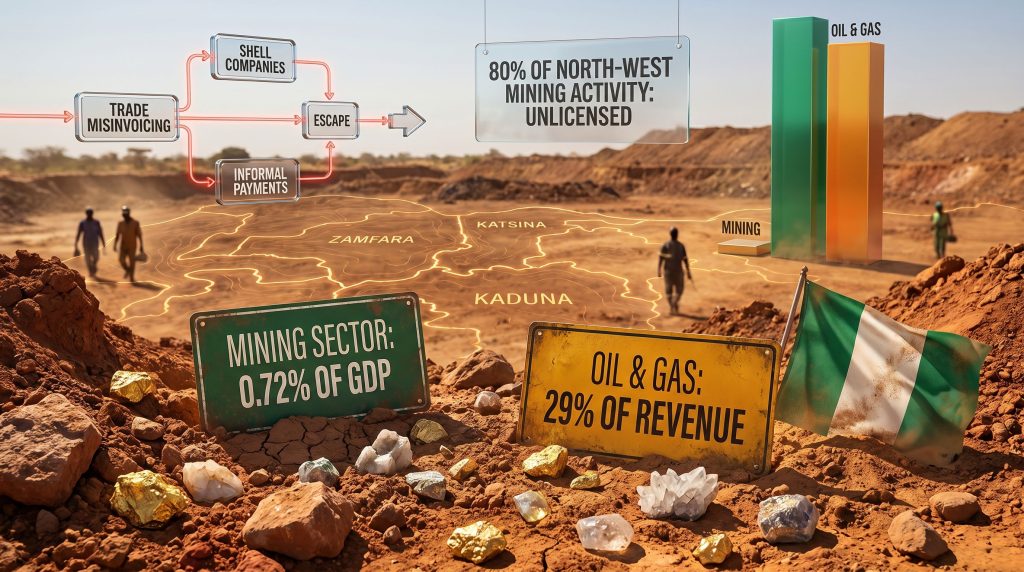
Yet in 2023, the formal mining sector contributed just 0.72% of GDP, 0.28% of government revenue, and 0.75% of total exports. Total formal sector output was estimated at approximately N401 billion, a figure that independent analysts and government watchdogs alike regard as a dramatic undercount of actual extraction activity.
The contrast with oil and gas is stark:
| Indicator | Mining Sector (2023) | Oil and Gas Sector (2023) |
|---|---|---|
| Share of GDP | 0.72% | ~6-8% |
| Share of Government Revenue | 0.28% | 29% |
| Share of Total Exports | 0.75% | 82% |
This divergence is not explained by geology. Nigeria's non-oil mineral reserves are substantial by any international benchmark. The gap between endowment and contribution reflects, almost entirely, how the sector is governed, monitored, and exploited.
Four Channels Through Which Value Disappears
The illegal mineral trade in Nigeria operates through four interconnected mechanisms, each reinforcing the others and collectively making the sector nearly impossible to monitor through conventional regulatory tools.
-
Commercial manipulation involves the systematic undervaluation of minerals at the point of sale and documentation. Grades are misrepresented, weights are manipulated, and pricing is negotiated informally to ensure that declared export values bear little resemblance to actual market value.
-
Unlicensed extraction is pervasive. More than 70% of all mining activity in Nigeria is classified as artisanal and small-scale, with the majority of these operations functioning entirely outside legal frameworks. These sites are geographically dispersed, socially embedded in local communities, and structurally resistant to top-down enforcement.
-
Institutional corruption creates the enabling environment. Licensing authorities, customs officials, and regulatory personnel are documented participants in the system, either through bribery, facilitated access, or deliberate non-enforcement. Weak oversight and illegal mining continue to drive illicit financial flows that undermine Nigeria's broader fiscal stability.
-
Cross-border smuggling networks provide the exit infrastructure. Nigeria's land borders with Niger, Benin, Cameroon, and Chad are extensive and porous, and maritime routes offer additional channels for moving unregistered mineral shipments out of the country without generating official export records.
The convergence of these four channels creates a system where illegal extraction, fraudulent documentation, corrupt facilitation, and cross-border movement operate as an integrated supply chain, not as separate criminal acts.
The North-West Crisis: Where Illegal Mining Meets Armed Conflict
The geographic concentration of Nigeria's illegal mining problem is most acute in the North-West, particularly in Zamfara, Katsina, and Kaduna states. Estimates suggest that as much as 80% of mining activity in this region is conducted without legal authorisation, a figure that surged significantly between 2022 and 2024 as banditry and terrorism expanded their territorial reach.
What distinguishes the North-West situation from other illegal mining contexts globally is the degree to which armed groups have moved from taxing mining operations to directly controlling them. Criminal networks, particularly in Zamfara, have assumed operational authority over mine sites, determining who extracts, what volumes are processed, and how proceeds are distributed. This transformation of illegal mining from an opportunistic economic activity into a revenue stream for organised armed groups has direct implications for regional security.
Conflict monitoring data records at least 33 violent incidents linked to illegal mining activity between January 2019 and April 2025, resulting in more than 218 confirmed deaths. These figures almost certainly undercount actual violence, given the reporting challenges in areas with limited state presence.
The federal government's decision to impose a mining ban in Zamfara as a security intervention was ultimately reversed in December 2024. Authorities determined that prohibition had not curtailed illegal activity and had, in some documented cases, strengthened criminal control over sites by removing legitimate operators from the field. This outcome reflects a broader lesson from resource governance globally: prohibition without parallel structural reform tends to consolidate, rather than disrupt, illicit economies.
The Foreign Actor Problem: Pricing Power, Shell Structures, and Export Fraud
One of the most operationally significant findings in NEITI's joint reporting with the Africa Network for Environment and Economic Justice (ANEEJ) concerns the role of foreign commercial networks in sustaining the illegal mineral trade in Nigeria. Chinese-linked commercial actors are cited as particularly prominent in pricing arrangements conducted directly at mine sites, bypassing formal commodity channels entirely. Furthermore, Chinese mining operations have been directly linked to conflict and human rights abuses across multiple Nigerian states.
This direct engagement at the point of extraction gives foreign buyers significant structural advantages:
- They set reference prices in informal markets, which then anchor declared export values at artificially low levels.
- They establish purchasing arrangements outside the banking system, eliminating auditable transaction records.
- They coordinate export logistics through channels that circumvent regulatory oversight at ports of departure.
The beneficial ownership problem amplifies this further. Foreign entities routinely establish shell companies under Nigerian corporate law and engage local proxies to acquire mining licences and permits on their behalf. This structure is designed specifically to enable trade misinvoicing, a financial crime where the declared value of an export shipment is deliberately understated, allowing the difference between real and declared value to be captured offshore by the exporting entity.
How Trade Misinvoicing Works in the Nigerian Mining Context
Trade misinvoicing is technically sophisticated and institutionally difficult to detect. The process typically unfolds across five stages:
- Minerals are extracted at a mine site, legally or otherwise, with no independent volume or grade verification.
- Documentation is prepared reflecting manipulated weights, grades, or mineral classifications that reduce apparent value.
- Export declarations are filed with customs authorities using these falsified figures, generating a paper trail that appears compliant.
- The shipment arrives at the destination country, where it is received and processed at actual market value.
- The difference between declared and actual value, which can be substantial for high-grade gold or lithium, flows to the exporting entity through offshore accounts or informal remittance structures.
Detecting this requires bilateral reconciliation of export records in Nigeria against import records in destination countries. This level of data-sharing between Nigeria and its primary mineral trading partners remains underdeveloped, making systematic detection operationally difficult.
Artisanal Mining as the System's Weakest Regulatory Link
The scale of artisanal and small-scale mining (ASM) in Nigeria is both its most important development opportunity and its most significant governance vulnerability. With more than 70% of mining activity concentrated in this segment, any enforcement or formalisation strategy that does not directly address ASM is addressing a minority of the problem.
ASM sites function as entry points through which illegally extracted ore is blended with legally registered material, a technique sometimes called ore laundering. Once illegal mineral content is mixed with documented production, traceability collapses. The resulting blended material can be exported with apparent legal cover, generating no separation between legitimate and illicit value chains.
This blending problem is not unique to Nigeria. It has been documented in gold supply chains across West Africa, and in cobalt and coltan networks in Central Africa. Consequently, Congo's resource governance challenges offer a parallel lesson in how blending and provenance obscurity become entrenched without mandatory traceability systems. What makes Nigeria's situation particularly acute is the absence of any mandatory mineral traceability system at commercial-scale operations, leaving the blending mechanism structurally unaddressed.
The next major ASX story will hit our subscribers first
Nigeria's Critical Mineral Exposure in Global Supply Chains
Nigeria's deposits include lithium, a mineral with rapidly escalating strategic importance as battery technology demand grows across electric vehicle manufacturing and grid-scale energy storage. Understanding how lithium mining works is essential context for appreciating why Nigeria's unlicensed lithium extraction is so difficult to regulate and trace across international supply chains.
Lithium extracted illegally in Nigeria does not disappear from global supply chains. It enters them through trading intermediaries who aggregate material from multiple sources, obscuring provenance before the mineral reaches processing facilities in Asia. End-use manufacturers in Europe, North America, and Asia who source processed lithium compounds may be unknowingly downstream of material linked to illegal extraction or conflict financing.
This provenance blindness is a systemic vulnerability in critical mineral supply chains globally, and Nigeria represents one of its most acute current expressions. Furthermore, rising critical minerals demand driven by the global energy transition is intensifying pressure on source nations to resolve governance failures before they become embedded in strategic supply chains. The international dimension also extends to the smuggling architecture itself, with Nigerian mineral smuggling routes connecting to broader West African illicit trade corridors.
Enforcement: What Has Been Tried and Why It Has Fallen Short
Nigeria's Mining Marshals programme represents the most visible formal enforcement response. The unit has grown to approximately 2,670 officers and has recorded:
- More than 327 illegal miners arrested across mining regions.
- 98 mining sites recovered from unlicensed operators.
These numbers, while not insignificant, are disproportionate to the scale of the challenge. An enforcement unit of under 3,000 officers attempting to regulate an ASM sector that accounts for more than 70% of national mining activity, operating across conflict-affected terrain in multiple states, faces a structural capacity deficit that personnel numbers alone cannot bridge.
The May 2025 conviction of four foreign nationals in Plateau State, each receiving a 20-year prison sentence with asset forfeiture, was widely noted as a landmark outcome. It is, however, characterised by governance watchdogs as an exceptional enforcement event rather than evidence of systemic deterrence. The rarity of such outcomes is itself a signal about the normalised impunity in which the illegal mineral trade in Nigeria operates.
Nigeria's Financial Intelligence Unit (NFIU) has formally classified illegal mining as an emerging threat to both economic integrity and national security, a classification that carries regulatory implications for financial institutions monitoring suspicious transactions connected to mineral trading activity.
Policy Gaps Sustaining the Illicit Economy
| Policy Gap | Impact on Illegal Trade |
|---|---|
| Weak beneficial ownership disclosure | Enables shell company licence laundering |
| Limited cross-border data sharing | Facilitates undetected trade misinvoicing |
| Insufficient ASM formalisation pathways | Keeps over 70% of miners outside regulatory reach |
| Underfunded enforcement in conflict zones | Cedes site control to armed groups |
| No mandatory mineral traceability system | Allows blending of legal and illegal ore at scale |
What Structural Reform Would Actually Require
Closing the illicit economy around Nigeria's minerals is a tractable problem, but only if reform targets the structural enablers rather than their symptoms. In addition, considerations around strategic mineral security demonstrate that nations which fail to formalise their mining sectors risk exclusion from emerging strategic supply-chain partnerships. Five systemic interventions stand out as foundational:
-
Mandatory beneficial ownership registries covering all mining licence holders, with real-time public disclosure requirements that prevent proxy ownership from obscuring foreign control.
-
Bilateral trade data reconciliation agreements with key mineral importing nations, enabling systematic cross-referencing of Nigerian export declarations against destination country import records to identify misinvoicing discrepancies.
-
Accessible formalisation frameworks for ASM operators, designed with compliance costs and administrative barriers calibrated to the economic realities of small-scale miners rather than the capacities of commercial operators.
-
Mineral traceability technology at the point of extraction, including chain-of-custody systems capable of preventing the ore blending that currently launders illegal material into formal supply chains.
-
Conflict-sensitive enforcement architecture that distinguishes between security operations and mining regulation in banditry-affected zones, preventing the two from becoming entangled in ways that cede further site control to armed groups.
The benchmark for success is measurable: a mining sector whose GDP contribution rises from 0.72% toward 3-5% within a decade would represent a fiscal and developmental transformation with compounding benefits across public finance, employment, and regional stability.
However, achieving this trajectory also requires Nigeria to position itself credibly within critical minerals trade frameworks that increasingly demand provenance transparency and governance accountability from source nations.
Frequently Asked Questions: Illegal Mineral Trade in Nigeria
Which minerals are most affected by illegal trade in Nigeria?
Gold and lithium are the most prominently documented minerals in Nigeria's illegal trade networks, alongside gemstones and industrial minerals. The country's geological endowment spans at least 44 commercially viable mineral types, many subject to unlicensed extraction.
How much does the illegal mineral trade cost Nigeria?
Precise aggregated figures remain difficult to establish given the clandestine nature of the activity. The structural indicator is that the formal sector contributed just 0.72% of GDP in 2023 despite a vast mineral endowment, with formal output estimated at approximately N401 billion. The gap between that figure and the sector's true potential represents the combined fiscal cost of illegal extraction, tax evasion, and illicit financial flows.
Which Nigerian regions have the highest concentrations of illegal mining?
North-West Nigeria, particularly Zamfara, Katsina, and Kaduna states, has the highest documented concentration, with up to 80% of extraction in the region estimated to be unlicensed.
What is trade misinvoicing in the context of mineral exports?
Trade misinvoicing involves deliberately understating the value, volume, or grade of a mineral export shipment so that the difference between the declared and actual value can be captured offshore without generating taxable revenue or formal foreign exchange receipts. It is identified as the primary financial mechanism driving illicit flows in Nigeria's mining sector.
What enforcement actions has Nigeria taken?
Nigeria has deployed a Mining Marshals enforcement unit of approximately 2,670 officers, resulting in more than 327 arrests and the recovery of 98 mining sites. The May 2025 conviction of four foreign nationals in Plateau State, sentenced to 20 years each, represents a significant but isolated enforcement milestone.
Disclaimer: This article is intended for informational purposes only and does not constitute financial, legal, or investment advice. Statistics and figures are drawn from publicly available reporting, including NEITI audit data and associated civil society publications. Readers should consult primary sources for official data. Forward-looking assessments reflect analytical interpretation and involve inherent uncertainty.
Want to Track the Next Major Mineral Discovery Before the Market Does?
Discovery Alert's proprietary Discovery IQ model delivers real-time alerts on significant ASX mineral discoveries, transforming complex geological data into actionable investment insights for both short-term traders and long-term investors — explore the historic returns major discoveries have generated and begin your 14-day free trial at Discovery Alert to position yourself ahead of the market.