May 16, 2026
South Africa's Coal Infrastructure at a Crossroads: Why Mine Development Still Matters in 2026
The global energy transition narrative tends to focus on what is being built rather than what must be carefully maintained. Solar farms, wind corridors, and battery storage projects dominate headlines, yet for grid operators managing real-time electricity demand across a developing economy, the less glamorous reality is that existing baseload generation infrastructure cannot simply be switched off while renewables scale up. South Africa understands this tension more acutely than most. Years of electricity shortages have demonstrated that grid stability is not an abstract policy goal but a daily operational requirement with direct consequences for industrial output, employment, and economic growth.
It is within this context that Exxaro opens new Mine 1 at Matla, a development that carries significance well beyond a single infrastructure milestone. The project is, in many respects, a case study in how legacy energy assets must be actively managed, not merely tolerated, during a protracted and complex transition away from fossil fuels. Furthermore, the broader coal supply challenges facing the region make this development particularly timely.
When big ASX news breaks, our subscribers know first
Understanding the Matla Coal Complex and Its Role in Grid Stability
Why Proximity to the Power Station Is a Strategic Advantage
Not all coal supply chains are created equal. South Africa's coal logistics network relies heavily on rail infrastructure that has faced well-documented operational challenges, including congestion, equipment failures, and underinvestment. For power stations dependent on third-party logistics, disruptions to coal delivery can translate rapidly into generation shortfalls.
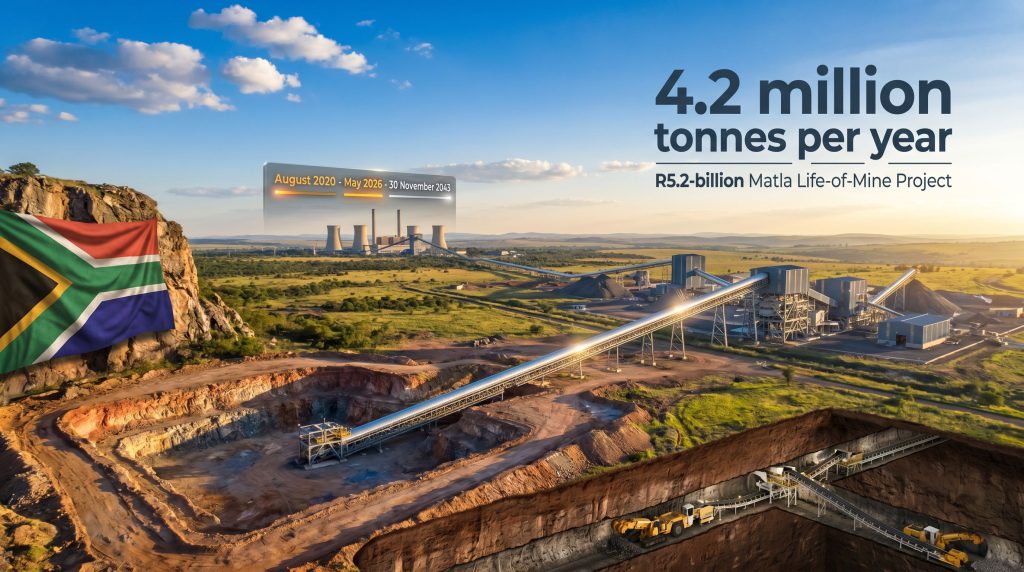
Matla is structured differently. The mine operates in direct physical proximity to Matla Power Station, with coal moving via a dedicated overland conveyor system rather than road or rail. This mine-to-station architecture effectively removes an entire category of supply chain risk. When coal leaves the mine, it arrives at the power station through a controlled, continuous system rather than depending on the wider logistics environment.
This arrangement reflects a broader principle that infrastructure planners sometimes underestimate: the last mile of a supply chain often carries the highest risk. By collapsing that last mile into a controlled conveyor link, the Matla complex achieves a degree of supply reliability that many other South African power stations cannot match. The ongoing South Africa mining decline in other sectors makes this kind of operational resilience all the more valuable.
The Scale of Matla's Contribution
To appreciate why Exxaro opens new Mine 1 at Matla matters, it helps to understand the Matla complex's position within South Africa's power generation system. The historical output capacity of the complex sits at approximately 14 million tonnes per annum (Mtpa), making it one of the higher-volume dedicated mine-to-station operations in the country. Matla Power Station itself is a six-unit, coal-fired facility in Mpumalanga, the province that hosts the majority of South Africa's coal-fired generating capacity.
The addition of the new Mine 1, designed to contribute approximately 4.2 million tonnes of coal per year, is therefore not a marginal increment. It represents a meaningful restoration of production capacity to a complex that had been constrained by the closure of the original Mine 1 entry point on safety grounds.
The Engineering Challenge Behind the New Mine 1
Relocation Rather Than Greenfield Development
One of the more technically nuanced aspects of this project is that it is not a new mine in the conventional sense. The original Mine 1 entry infrastructure was closed because of safety concerns related to the physical condition of the access point, not because the underlying coal reserves had been exhausted. The coal was still there. The challenge was re-engineering safe and efficient access to it.
This distinction matters for several reasons. First, it means the geological risk profile of the project is materially lower than a greenfield development, since the coal seams are known and characterised. Second, it means the primary engineering challenge was logistics and infrastructure design rather than resource definition. The project team had to construct an entirely new access portal, develop the underground conveyor infrastructure, and build the surface handling and processing facilities, all while maintaining production continuity elsewhere in the complex.
Key Infrastructure Delivered Under the MLOMP
The Matla Life-of-Mine Project (MLOMP), valued at R5.2-billion in total, encompasses a range of coordinated infrastructure elements:
| Infrastructure Component | Function |
|---|---|
| New Box Cut | Engineered access portal into the original Mine 1 working area |
| Tunnel Development Silo Feed Conveyor | Underground materials handling for continuous operations |
| Overland Conveyor System | Connects mine output directly to the crushing and handling plant |
| Crushing and Handling Plant | Integrated into Eskom's existing conveyor network |
| New Surface Support Complex | Operational and workforce support infrastructure |
| Shortwall Replacement Equipment | Updated mining machinery replacing legacy shortwall systems |
The shortwall replacement component is particularly noteworthy from a technical perspective. Shortwall mining is a method suited to specific seam geometries and involves a shorter working face than longwall mining, typically in the range of 50 to 150 metres, with hydraulic roof support systems. Introducing updated shortwall equipment improves extraction efficiency and reduces the frequency of equipment-related downtime, both of which have direct implications for meeting the contracted annual tonnage obligations.
Project Execution: Timeline and Delivery
The Mine 1 relocation project commenced in August 2020, a period that coincided with the operational disruptions of the global pandemic, making its execution across a multi-year cycle a genuine logistical and workforce management challenge. The project was originally targeted for completion in the second half of 2025, with the official opening taking place in May 2026. Exxaro's executive leadership confirmed the project was delivered to scope and within budget, which for a R5.2-billion underground infrastructure programme is a meaningful outcome.
Multi-year underground mine development projects face compounding risks that surface construction does not. Geological variability, ground control challenges, ventilation management, and workforce continuity across a five-plus-year cycle all create execution complexity that makes on-scope, on-budget delivery genuinely difficult to achieve.
The Cost-Plus Structure: Who Bears the Financial Risk?
How Cost-Plus Mining Arrangements Work
The financial architecture underpinning the Matla operation is a cost-plus contractual model, and understanding it is essential to interpreting both the project's economics and the incentive structures driving decision-making.
Under a cost-plus arrangement:
- The purchasing party, in this case Eskom, assumes responsibility for covering the mine's operational costs
- The mining company, Exxaro, operates the mine and manages day-to-day production
- Coal is supplied at the lowest achievable fuel cost rather than at a market-determined price
- Capital expenditure, including the MLOMP investment, is funded through this cost-recovery mechanism
- The structure removes commodity price risk from the mining operator's P&L
This model is relatively uncommon in global mining. Most coal operations sell output at prevailing market prices, exposing the mine operator to price volatility. At Matla, however, the risk transfer runs in the opposite direction: Eskom carries the cost exposure, while Exxaro carries the execution risk of actually delivering the contracted tonnes.
What This Means for Interpreting the R5.2-Billion Capital Figure
Because the MLOMP operates within a cost-plus framework, the R5.2-billion capital programme is ultimately a cost that flows through Eskom's primary energy procurement budget rather than Exxaro's capital expenditure in the conventional investor sense. This is an important distinction for analysts and investors evaluating Exxaro's capital allocation discipline. The company is executing a complex, large-scale infrastructure project, but the financial exposure sits primarily with the counterparty rather than on Exxaro's own balance sheet.
The New Coal Supply Agreement: 17 Years of Contracted Certainty
Terms and Strategic Framing of the CSA
Exxaro and Eskom formalised a new Coal Supply Agreement (CSA) effective from 1 April 2026, with a term running to 30 November 2043. At approximately 17 years in duration, this is a long-dated contractual commitment by the standards of any commodity supply agreement, let alone one signed in an era of active energy transition policy.
The agreement was structured within Eskom's Cost Optimisation and Revenue Enhancement programme, an internal initiative targeting efficiencies across primary energy procurement. Eskom's Group Chief Executive Dan Marokane noted that the new contract structure was specifically designed to drive efficiency in how primary energy costs are managed, framing it as a cost discipline measure rather than simply a supply security arrangement.
Reading the 2043 End Date Through an Energy Transition Lens
South Africa's Integrated Resource Plan has outlined a phased retirement schedule for ageing coal-fired power stations, with many units expected to reach end-of-life in the 2030s and 2040s. The CSA's 2043 terminus aligns broadly with Matla Power Station's anticipated operational lifespan, creating a coherent match between mine life extension and generation asset retirement.
This alignment is strategically deliberate. It avoids the scenario of stranded mine infrastructure outlasting its off-take market, while also providing the investment certainty required to justify the MLOMP capital programme. From a planning perspective, it is a relatively well-structured approach to managing a legacy fossil fuel asset within a defined transition horizon. In addition, the broader energy transition in mining across South Africa means that decisions such as this one carry implications well beyond a single operation.
The Parallel MoU on Emissions Reduction
In 2025, Exxaro and Eskom formalised a Memorandum of Understanding to collaborate on emissions reduction, carbon capture technologies, and responsible just energy transition initiatives. The simultaneous existence of a 17-year coal supply agreement and a decarbonisation MoU reflects the pragmatic complexity of South Africa's energy position.
South Africa cannot afford to simply close coal assets before viable alternatives are operational at sufficient scale. The challenge is not choosing between coal and renewables, but managing the sequencing of the transition in a way that keeps the lights on while the grid evolves.
Operational Context: 365 Days Without Load Shedding
Eskom's Group Chief Executive highlighted a milestone that would have seemed improbable to many South Africans just a few years ago: 365 consecutive days of uninterrupted electricity supply, the longest loadshedding-free period in recent national history. The opening of Mine 1 at Matla coincided with this milestone being marked, and Marokane specifically identified reliable coal supply from operations such as Matla as a critical enabler of that operational consistency.
This framing carries important implications for how the Matla investment should be understood:
- Coal supply reliability is not a background variable in grid management but an active determinant of generation output
- Dedicated mine-to-station supply chains reduce the number of failure points between fuel source and turbine
- As South Africa's transmission grid undergoes decongestion to accommodate renewables penetration, the baseload stability provided by proximate coal supply operations becomes more, not less, important during the transition window
The next major ASX story will hit our subscribers first
Exxaro's Broader Strategic Position: Managing a Defined Horizon
Workforce and Community Footprint
The Matla complex employs more than 2,500 workers and contractors, making it one of the larger single-site employers in Mpumalanga's mining sector. This workforce dimension adds a social and political layer to decisions about the complex's operational life. In a region where mining employment is a primary economic driver, the extension of Matla's operational life through the MLOMP carries community significance that extends well beyond energy supply metrics.
The Managed Decline Model in Practice
Exxaro's approach to Matla exemplifies what industry practitioners describe as a managed decline model for legacy coal assets: extending productive life responsibly within a defined timeline, maximising remaining value, and building the operational and contractual frameworks within which an eventual transition can be executed without abrupt economic dislocation.
This is distinct from both premature closure, which strands value and displaces workers without adequate transition support, and indefinite extension, which resists the broader decarbonisation trajectory. Consequently, Exxaro's renewable energy strategy runs in parallel with this coal commitment, demonstrating a dual-track approach to the energy shift. The R5.2-billion MLOMP commitment, bounded by a 2043 CSA end date, reflects a calculated middle path that also mirrors trends in mining decarbonisation in Africa more broadly.
Key Metrics at a Glance
| Metric | Detail |
|---|---|
| Total MLOMP Investment | R5.2-billion |
| New Mine 1 Annual Output | ~4.2 million tonnes per year |
| Total Complex Output Capacity | ~14 Mtpa (historical) |
| Workforce | 2,500+ workers and contractors |
| CSA Effective Date | 1 April 2026 |
| CSA Expiry | 30 November 2043 |
| Contract Duration | ~17 years |
| Project Commencement | August 2020 |
| Official Opening | May 2026 |
| Mine Structure | Cost-plus (Eskom-funded) |
Frequently Asked Questions
What distinguishes the new Mine 1 from the original?
The original Mine 1 access infrastructure was closed on safety grounds, not because the underlying reserves were depleted. The new Mine 1 represents a fully re-engineered access solution, including a new box cut, underground conveyor systems, and surface processing infrastructure, designed to unlock coal that remained physically present but inaccessible under the previous configuration.
Why is the cost-plus structure significant for Eskom?
Under cost-plus arrangements, Eskom directly funds the mine's operating and capital costs in exchange for coal supply at the lowest achievable fuel price. This removes market price risk from the equation but places cost discipline obligations on both parties. For Eskom, the structure is integrated into its broader cost optimisation programme targeting primary energy procurement efficiency.
What mining methods does Matla use?
The Matla complex uses a combination of continuous mining and shortwall mining techniques. Shortwall mining involves a working face typically between 50 and 150 metres in length supported by hydraulic roof supports, suited to the seam geometry of the Mpumalanga coalfields. The MLOMP included a shortwall equipment replacement programme to improve extraction rates and reduce operational downtime.
How does the 2043 CSA align with South Africa's energy transition plans?
The 2043 end date broadly corresponds with Matla Power Station's anticipated operational lifespan under South Africa's phased coal fleet retirement schedule. This alignment was deliberate, ensuring the mine's extended life matches the generation asset's planned horizon and avoids creating stranded infrastructure on either side of the supply chain.
Disclaimer: This article is intended for informational purposes only and does not constitute financial advice. Forward-looking statements regarding energy transition timelines, production volumes, and contractual arrangements are based on publicly available information and are subject to change. Readers should conduct independent research before making investment decisions.
Want to Track the Next Major ASX Mineral Discovery Before the Market Moves?
Discovery Alert's proprietary Discovery IQ model scans ASX announcements in real time, instantly identifying significant mineral discoveries and turning complex data into actionable investment insights — explore the historic returns major discoveries have generated and begin your 14-day free trial at Discovery Alert to position yourself ahead of the broader market.