June 4, 2026
Advanced Pneumatic Recovery Systems Transforming Complex Ore Processing
Modern mineral processing facilities face unprecedented challenges as ore bodies become increasingly complex and grade qualities continue to decline across global mining operations. The technological response to these pressures has driven significant innovation in flotation recovery systems, particularly in pneumatic flotation technologies that can efficiently separate valuable minerals from increasingly difficult gangue materials. Understanding the operational mechanics and strategic advantages of advanced flotation systems has become essential for mining operations seeking to maintain profitability while processing lower-grade, more complex ore compositions. Furthermore, the Metso Concorde Cell flotation technology represents a breakthrough in addressing these complex processing challenges.
When big ASX news breaks, our subscribers know first
Revolutionary Pneumatic Flotation Mechanics
The Metso Concorde Cell flotation technology represents a fundamental advancement in pneumatic mineral recovery systems, utilising forced-air pneumatic mechanisms to achieve superior particle separation performance. This technology operates through high-velocity slurry acceleration combined with precise sonic speed throat velocity parameters, creating optimal conditions for fine particle flotation that conventional systems struggle to achieve.
The core engineering principle centres on pressurised air injection systems that generate controlled turbulence patterns within vertical blast tube configurations. These systems create impingement bowl vortex ring formations that dramatically improve particle collision rates and attachment efficiency between mineral particles and air bubbles. The technology achieves faster flotation kinetics through sonic shockwave generation principles that accelerate the natural flotation process significantly beyond traditional agitated flotation capabilities.
Key operational specifications include:
• Throat velocity optimisation for sonic speed achievement
• Tank pressure differential management across processing zones
• Shockwave intensity calibration for varying ore compositions
• Multiple-pass particle collection zone optimisation protocols
The pneumatic system design eliminates many mechanical components found in conventional flotation cells, reducing maintenance requirements whilst improving operational reliability. This simplified mechanical configuration allows for more consistent performance across varying ore feed conditions and reduces the risk of mechanical failure during critical production periods. In addition, these advancements align with broader industry innovation trends shaping modern mineral processing.
Particle Size Recovery Performance Advantages
Traditional flotation technologies face significant limitations when processing fine and ultra-fine particles, typically showing dramatically reduced recovery rates for particles smaller than 10 microns. The Metso Concorde Cell flotation technology addresses these limitations through specialised pneumatic mechanisms that deliver exceptional recovery rates of fine and ultra-fine particles compared to conventional flotation systems.
The technology achieves superior performance through controlled bubble formation and size distribution optimisation. Unlike mechanical flotation cells that rely on impeller agitation, the pneumatic system creates more uniform bubble sizes with improved particle attachment characteristics. This results in enhanced flotation kinetics for particles that would typically report to tailings in conventional processing circuits.
Energy Efficiency and Operational Benefits
One of the most significant advantages of pneumatic flotation systems lies in their reduced energy consumption per tonne of material processed. The elimination of mechanical agitation systems dramatically reduces power requirements whilst maintaining superior recovery performance. This energy efficiency translates directly to reduced operational costs and improved environmental performance metrics.
The standalone operation capability of Concorde Cell systems provides additional operational flexibility, allowing mining operations to implement flotation circuits with reduced plant footprint requirements. This design advantage becomes particularly valuable in brownfield expansion projects where space constraints limit traditional flotation cell installations. However, these benefits extend beyond individual operations to support data-driven operations across the industry.
Strategic Applications in Copper Processing
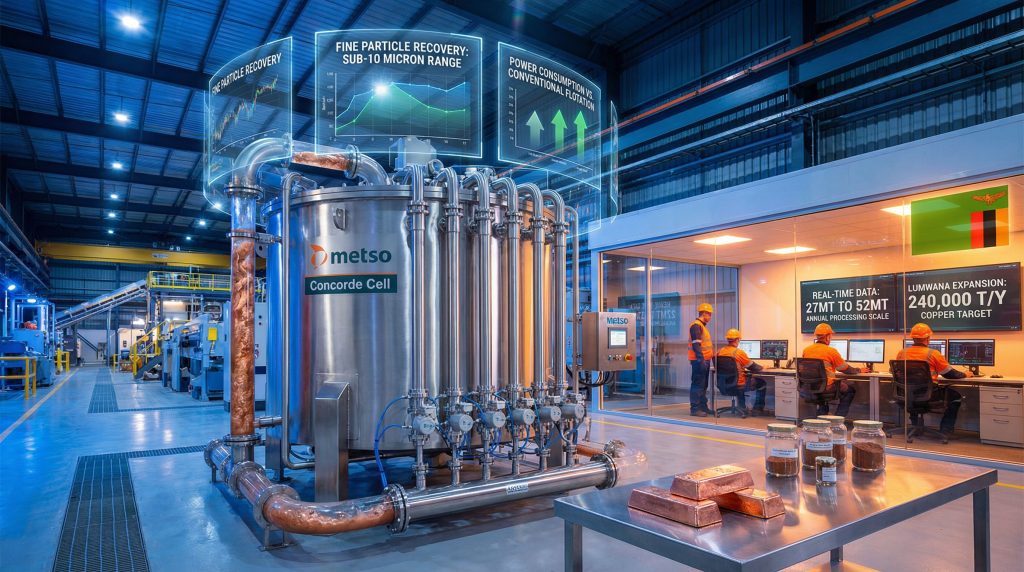
The Lumwana expansion project in Zambia demonstrates the practical implementation of advanced flotation cell technology in large-scale copper operations. Barrick Gold selected the Metso Concorde Cell flotation technology for integration with TankCell technology, creating a hybrid flotation circuit designed to optimise processing performance across varying ore compositions.
Lumwana Project Technical Specifications
| Project Parameter | Current Operations | Expanded Operations |
|---|---|---|
| Plant Throughput | 27 Mt annually | 52 Mt annually |
| Copper Production Target | N/A | 240,000 tonnes/year |
| Commissioning Timeline | Operational | Second half 2027 |
| Technology Integration | TankCell only | Concorde Cell + TankCell |
The expansion strategy involves doubling throughput by twinning the existing process circuit, followed by significant increases in mining volumes. This approach allows for uninterrupted copper delivery throughout the expansion whilst commissioning new processing equipment. The phased implementation reduces operational risk and maintains production continuity during the transition period.
The project positions Lumwana as one of the world's major copper mines whilst contributing significantly to Zambia's copper industry revival. The integration strategy represents a reliable and highly effective approach to flowsheet optimisation, particularly for operations processing complex orebody compositions. Furthermore, this development demonstrates the decarbonisation benefits achievable through energy-efficient processing technologies.
Multi-Metal Recovery Capabilities
Advanced pneumatic flotation systems demonstrate superior performance across multiple commodity types, extending beyond copper processing to include molybdenum, nickel laterite processing, gold recovery from refractory ores, and platinum group metals concentration. The technology's ability to handle polymetallic ore separation challenges makes it particularly valuable for operations processing mixed mineral systems.
The selective flotation capabilities become crucial when processing difficult-to-treat ore bodies where conventional flotation struggles with gangue mineral interference. The improved particle size recovery range allows operations to capture value from fine mineral particles that would otherwise report to tailings streams. For instance, enhanced flotation technology research continues to validate these performance advantages.
Complex Ore Processing Advantages
Modern mining operations increasingly encounter ore bodies with challenging metallurgical characteristics, including:
• Polymetallic ore compositions requiring selective separation
• Fine-grained mineral associations difficult to liberate
• Gangue mineral interference affecting concentrate quality
• Variable feed grade consistency impacting recovery optimisation
The improved concentrate-grade consistency achieved through pneumatic flotation technology helps operations maintain product quality specifications whilst processing increasingly variable ore feed compositions. This consistency becomes particularly important for operations with long-term offtake agreements requiring specific concentrate grade parameters.
Installation and Integration Methodologies
The integration of Concorde Cell technology with existing processing circuits requires careful consideration of flow sheet optimisation strategies and space requirements. The tandem operation approach demonstrated at Lumwana provides a proven methodology for incorporating advanced flotation technology without disrupting existing operations.
Plant Design Considerations
Successful implementation requires comprehensive evaluation of:
• Existing circuit integration compatibility
• Flow sheet optimisation potential
• Space requirements and layout modifications
• Utility infrastructure capacity
The modular design characteristics of pneumatic flotation systems provide flexibility in plant layout optimisation, often requiring less space than equivalent conventional flotation capacity. This advantage becomes particularly valuable in brownfield expansion projects where existing infrastructure constraints limit traditional flotation cell installations. Additionally, these integration strategies complement AI in mining technology developments across operational processes.
The next major ASX story will hit our subscribers first
Performance Monitoring and Optimisation
Advanced flotation systems require sophisticated monitoring and control systems to optimise performance across varying ore feed conditions. Real-time recovery rate tracking, concentrate grade consistency measurement, and process efficiency indicators become essential for maximising technology benefits.
Operational Parameter Optimisation
Key performance monitoring focuses include:
• Recovery rate consistency across particle size ranges
• Concentrate grade stability during feed variations
• Energy consumption per unit of recovery achieved
• Reagent consumption optimisation opportunities
Predictive maintenance scheduling becomes particularly important for pneumatic systems, where consistent air flow and pressure maintenance directly impact flotation performance. Advanced monitoring systems can identify performance degradation before significant recovery losses occur.
Global Technology Deployment Trends
The adoption of advanced pneumatic flotation technology reflects broader industry trends toward processing increasingly complex ore bodies with improved energy efficiency. Multiple flotation projects worldwide have implemented Concorde Cell technology, demonstrating the growing recognition of pneumatic flotation advantages.
The technology deployment pattern indicates particular value in operations processing:
• Complex sulphide ore compositions
• Fine-grained mineral associations
• Variable grade ore bodies requiring consistent recovery
• Operations with energy efficiency priorities
Moreover, these trends align with insights shared at various innovation expo insights highlighting the future of mineral processing technologies.
Economic Evaluation Framework
Mining companies evaluating advanced flotation technology implementation must consider multiple economic factors beyond initial capital investment. The evaluation framework should incorporate expected recovery improvements, operational cost reductions, and strategic positioning advantages in mineral markets.
Investment Decision Criteria
Critical evaluation factors include:
• Ore body complexity assessment and recovery improvement potential
• Existing plant integration feasibility and modification costs
• Energy efficiency improvements and long-term operational savings
• Competitive advantage quantification in commodity markets
Investment Consideration: Advanced flotation technology adoption represents a strategic positioning decision for complex ore processing, with payback periods typically influenced by commodity price cycles and operational efficiency improvements.
The financial analysis must consider the technology's ability to maintain consistent recovery performance across varying ore feed conditions, providing operational stability that becomes particularly valuable during challenging market conditions.
Future Technology Development Trajectories
The evolution of pneumatic flotation technology continues advancing toward enhanced automation, artificial intelligence integration, and improved environmental performance metrics. These developments align with broader mining industry trends toward sustainable processing technologies and reduced operational environmental impact.
Innovation Focus Areas
Anticipated technological improvements include:
• Enhanced shockwave generation mechanisms for improved fine particle recovery
• Automated process control integration reducing operational complexity
• Artificial intelligence optimisation systems for real-time parameter adjustment
• Environmental impact reduction through improved energy efficiency
Strategic Implementation Guidelines
Successful implementation of advanced flotation technology requires comprehensive technical assessment combined with strategic market positioning considerations. Operations must evaluate their specific ore characteristics, existing infrastructure capabilities, and long-term production objectives when considering technology adoption.
The demonstrated success at Lumwana provides a practical framework for other operations considering similar technology integration. The tandem operation approach allows for gradual implementation whilst maintaining operational continuity and reducing implementation risk.
Risk Management Considerations
Implementation risk mitigation strategies should address:
• Technology performance validation through pilot testing
• Integration complexity management and phased implementation
• Operational continuity maintenance during commissioning
• Long-term maintenance and support infrastructure development
The strategic advantages of advanced flotation technology extend beyond immediate operational improvements to include competitive positioning for processing increasingly complex ore bodies that conventional technology cannot efficiently handle.
Disclaimer: This analysis is based on publicly available information and technical specifications. Actual performance results may vary depending on specific ore characteristics, operational parameters, and site-specific conditions. Investment decisions should be based on comprehensive technical evaluation and professional engineering assessment.
Ready to Invest in the Next Major Mineral Discovery?
Discovery Alert instantly alerts investors to significant ASX mineral discoveries using its proprietary Discovery IQ model, turning complex mineral data into actionable insights. Understand why historic discoveries can generate substantial returns by visiting Discovery Alert's dedicated discoveries page, showcasing proven examples of exceptional outcomes from major mineral finds.