May 20, 2026
Advanced Sensor Integration Transforms Earthmoving Equipment Performance
Modern excavation operations face unprecedented pressure to maximise productivity whilst reducing operational costs and environmental impact. Traditional earthmoving relies heavily on operator skill and intuition, creating significant variability in performance across job sites. Advanced sensor technologies and artificial intelligence systems now offer pathways to optimise excavation cycles, reduce fuel consumption, and accelerate operator training timelines. Furthermore, Dig Robotics technology in excavation represents a significant advancement in this field.
The construction and mining industries collectively represent over $116 billion in annual equipment expenditure globally, with excavators accounting for approximately 20-25% of heavy equipment capital investment. As environmental regulations tighten and skilled operator shortages intensify across developed economies, technology-assisted earthmoving systems provide critical competitive advantages for contractors and mining operations.
When big ASX news breaks, our subscribers know first
Understanding Core Technology Integration in Modern Excavation Systems
Contemporary excavation enhancement systems rely on three fundamental technology pillars that work in coordination to optimise machine performance. Computer vision systems track bucket positioning and movement patterns in real-time, providing continuous feedback on excavation efficiency. These visual recognition algorithms analyse bucket trajectory, depth precision, and material loading patterns to identify optimisation opportunities.
Kinematic analysis represents the second critical component, calculating optimal movement paths and hydraulic pressure sequences. This technology processes real-time data on soil conditions, equipment positioning, and operational parameters to recommend adjustments that minimise energy waste and maximise material movement per cycle.
Environmental adaptation capabilities enable systems to recognise varying material properties and adjust operational parameters accordingly. Advanced sensors differentiate between soil types, rock hardness, and moisture conditions, automatically modifying hydraulic pressure and movement speeds to maintain optimal performance across diverse excavation conditions. Moreover, these advancements align with broader mining industry evolution trends.
LiDAR Integration and 3D Mapping Capabilities
Light Detection and Ranging technology creates precise three-dimensional maps of excavation sites, enabling operators to visualise underground utilities, planned excavation depths, and material boundaries. LiDAR sensors mounted on excavation equipment provide centimetre-level accuracy for depth measurement and grade control.
These mapping systems generate digital twins of job sites, allowing for precise material volume calculations and excavation progress tracking. Real-time LiDAR data enables immediate detection of over-excavation or deviation from planned depths, reducing material waste and rework requirements. Consequently, this technology complements 3D geological modelling applications in mining operations.
According to the Construction Industry Institute, precision excavation technologies can reduce material waste by 15-20% compared to traditional manual methods, whilst improving grade accuracy by up to 85% in controlled testing environments.
Performance Enhancement Through Data-Driven Optimisation
Advanced excavation systems achieve measurable performance improvements through continuous analysis of operational data. Cycle time optimisation focuses on reducing the duration between material pickup and deposit, with systems monitoring bucket fill percentages and identifying inefficient movement patterns.
Industry benchmark data from the Bureau of Labor Statistics indicates that equipment utilisation improvements in construction typically range from 15-18% when technology optimisation is properly implemented. These gains result from reduced idle time, optimised hydraulic sequences, and improved operator decision-making support.
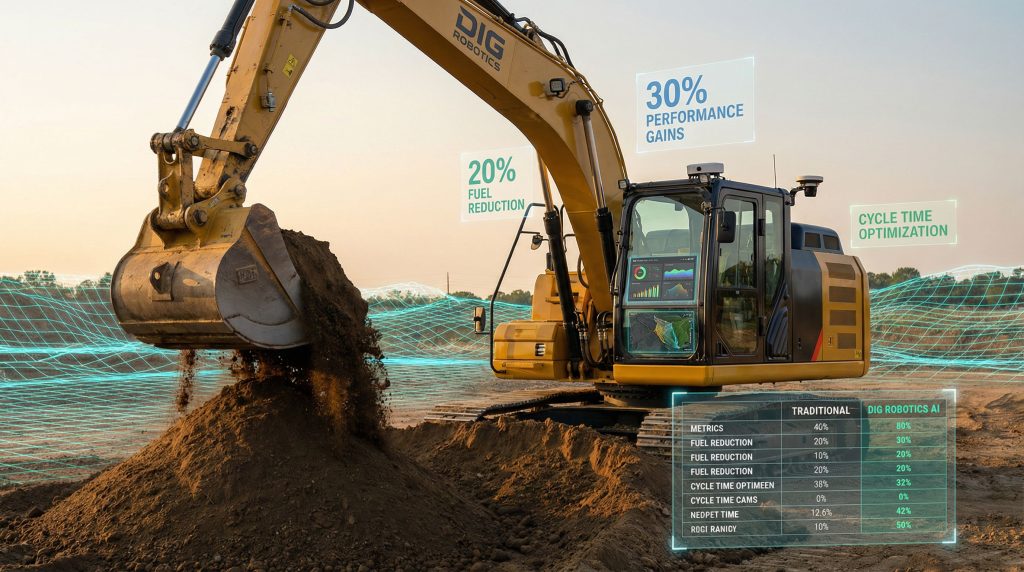
Fuel efficiency represents a primary cost reduction mechanism, with optimised hydraulic system management reducing unnecessary pressure cycling and engine strain. Parker Hannifin Corporation research on hydraulic system efficiency demonstrates that load-sensing hydraulic systems can reduce energy consumption by 20-25% in mobile equipment applications through proportional control valve optimisation.
Measuring Excavation Performance Improvements
| Performance Metric | Traditional Operation | Technology-Enhanced | Typical Improvement Range |
|---|---|---|---|
| Cycle Time Efficiency | Variable by operator | Consistently optimised | 10-25% reduction |
| Bucket Fill Accuracy | 70-85% average | 85-95% average | 15-20% improvement |
| Fuel Consumption | Baseline operation | Optimised hydraulics | 15-25% reduction |
| Grade Precision | ±5cm typical | ±2cm achievable | 60-70% improvement |
Cost-benefit analysis for technology integration depends heavily on operational scale and fuel pricing. High-volume operations with $50,000+ monthly fuel costs typically achieve payback periods of 12-18 months, whilst smaller operations may require 24-36 months for full return on investment.
Installation and Equipment Integration Processes
Modern excavation enhancement systems offer retrofit capabilities for existing equipment fleets, eliminating the need for complete equipment replacement. Modular sensor packages can be installed on excavators from major manufacturers including Caterpillar, Komatsu, Volvo, Hitachi, and Liebherr, though compatibility verification is essential before implementation.
Installation timelines vary based on equipment complexity and fleet size. Single-machine installations typically require 1-2 days for hardware mounting and software configuration, whilst fleet-wide deployments may extend over several weeks to minimise operational disruption. For instance, companies like Dig Robotics specialise in providing comprehensive installation support.
Hardware Components and System Requirements
- Primary sensors: LiDAR units, hydraulic pressure monitors, GPS positioning systems
- Computing hardware: Industrial-grade processors capable of real-time data analysis
- Display systems: Operator interface screens with touch-capable displays
- Communication modules: Wireless connectivity for data transmission and software updates
Training requirements represent a significant consideration for successful implementation. Equipment manufacturer data suggests traditional excavator certification requires 2-6 weeks depending on operator experience and equipment complexity. Technology-enhanced systems typically add 1-2 weeks to initial training timelines, though long-term proficiency development may accelerate through guided feedback systems.
Operator Guidance and Training Enhancement Systems
Human-computer interface design plays a crucial role in technology adoption and effectiveness. In-cabin displays provide real-time performance metrics, visual feedback on bucket positioning, and comparative analysis against optimal operational patterns. These interfaces must balance information delivery with operator attention demands to avoid cognitive overload during complex excavation tasks.
Gamification elements encourage optimal performance through achievement tracking and skill progression indicators. Educational technology research by Deterding et al. in CHI 2011 demonstrates that well-designed gamification systems can improve skill acquisition, though effectiveness varies significantly based on implementation quality and user motivation.
Learning Algorithm Development and Adaptation
Machine learning systems analyse operator behaviour patterns to identify individual improvement opportunities. These algorithms track decision-making patterns, response times, and operational preferences to provide personalised guidance recommendations. This approach mirrors AI mill drive optimization strategies in processing operations.
Progressive difficulty adjustment helps operators develop skills systematically, beginning with basic optimisation suggestions and advancing to complex multi-variable optimisation scenarios. Long-term tracking enables measurement of skill development and identification of training gaps that require additional attention.
According to the U.S. Bureau of Labor Statistics, traditional heavy equipment operator apprenticeships average 3-4 years for mastery development, whilst assisted training systems may reduce this timeline through accelerated feedback and structured skill progression.
Comparative Analysis: Human Augmentation vs Full Automation
The excavation industry faces a fundamental choice between operator assistance technologies and fully autonomous systems. Human-augmentation approaches maintain operator involvement whilst providing real-time optimisation guidance, offering immediate implementation benefits without extensive regulatory approval processes.
Autonomous excavation systems remain largely in development phases, though autonomous haul trucks have achieved operational status in mining applications. Caterpillar AutoMine and Komatsu AutoHaul systems demonstrate successful autonomous vehicle deployment, but excavation presents additional complexity challenges related to material variability and precision requirements.
Regulatory and Safety Considerations
Operator-assisted systems face fewer regulatory hurdles than fully autonomous equipment. The International Organization for Standardization ISO 12100:2023 standard provides frameworks for machinery safety in assisted operation modes, whilst autonomous equipment requires additional certification processes that vary significantly by jurisdiction.
Insurance and liability implications also differ substantially between assistance and automation approaches. Society of Automotive Engineers standards development through the J3016 series addresses autonomous equipment classification, but implementation timelines remain uncertain for excavation applications.
Equipment augmentation systems represent a transitional technology toward fuller automation, providing immediate productivity benefits whilst preparing operators and organisations for future autonomous integration.
The next major ASX story will hit our subscribers first
Industry-Specific Implementation Strategies
Mining operations present optimal conditions for technology-enhanced excavation systems due to high material volumes and consistent operational patterns. The global mining equipment market reached $48.5 billion in 2023 with projected growth of 5.2% CAGR through 2030, according to Grand View Research analysis.
Excavators represent approximately 15-20% of total mining equipment capital expenditure, based on SNL Metals & Mining data from S&P Global industry reports. High-volume mining operations with consistent material types achieve the fastest return on investment from efficiency improvements. Additionally, these technologies support decarbonisation benefits in mining operations.
Construction and Infrastructure Applications
The U.S. construction equipment market totalled $68.2 billion in 2024, with heavy excavators accounting for 25-30% of earthmoving equipment utilisation, according to the Associated Equipment Distributors. Construction applications benefit particularly from grade precision improvements and reduced rework requirements.
Infrastructure development projects worldwide require approximately $2.59 trillion annually as estimated by the World Economic Forum's Infrastructure Investment Gap Report. Excavation typically represents 8-12% of infrastructure project costs, making efficiency improvements highly valuable for project economics.
European Union Stage V Off-Road Equipment Emissions Standards under Directive 2016/1628 increasingly incentivise fuel efficiency improvements, creating regulatory drivers for technology adoption beyond pure economic considerations.
ROI Calculations Across Industry Segments
- Mining operations: Payback periods of 8-15 months for high-volume material handling
- Large construction projects: 12-24 months depending on fuel costs and equipment utilisation
- Infrastructure development: 15-30 months with additional benefits from reduced environmental compliance costs
- Quarry operations: 10-20 months based on consistent operational patterns and material uniformity
Future Technology Development Trajectories
Dig Robotics technology in excavation continues evolving rapidly as artificial intelligence integration in construction equipment expands. McKinsey & Company analysis projects the AI-assisted construction equipment market will grow from $12.4 billion in 2023 to $28.7 billion by 2030, representing an 18.1% compound annual growth rate.
Autonomous mining equipment adoption reached 14% of new equipment purchases in 2024 and is projected to achieve 35-40% adoption by 2030, according to the World Economic Forum's Future of Mining Report. This progression indicates accelerating acceptance of automated systems in controlled operational environments.
Cloud-Based Fleet Management Integration
Construction fleet telematics adoption currently stands at 32% of large equipment operators as of 2024, with Association of Equipment Manufacturers surveys projecting 60-65% adoption by 2027. Cloud platforms enable cross-jobsite resource allocation optimisation and performance benchmarking across equipment fleets.
Predictive maintenance capabilities represent a significant value driver, integrating Internet of Things sensors with machine learning algorithms to forecast component failure patterns. This proactive approach reduces unplanned downtime and optimises maintenance scheduling to minimise operational disruption.
Industry Transformation Drivers
Skilled operator shortages in developed economies create compelling business cases for assistance technologies. The World Economic Forum's Future of Jobs Report documents projected heavy equipment operator shortages across major construction and mining markets, accelerating technology adoption timelines.
Environmental compliance requirements continue tightening globally, with emissions regulations in North America, Europe, and Australia incentivising fuel efficiency improvements. Technology systems that demonstrably reduce fuel consumption and emissions provide regulatory compliance benefits beyond direct cost savings.
Technical Implementation Considerations
Weather performance represents a critical factor for outdoor excavation applications. LiDAR systems function effectively in rain and light snow conditions but experience performance degradation in heavy fog or dust storms, according to SICK, Inc. technical documentation on environmental operating limits.
System maintenance requirements vary by technology complexity and environmental conditions. Typical sensor-based equipment requires calibration every 6-12 months and software updates on quarterly schedules to maintain optimal performance standards.
Equipment Transfer and Portability
Modular system designs enable transfer between different machines, though recalibration is necessary for each new equipment installation. This flexibility provides value for rental equipment operators and contractors managing diverse equipment fleets across multiple projects.
Cloud-based software management allows remote system updates and performance monitoring, reducing maintenance downtime and enabling rapid deployment of system improvements across equipment fleets. For instance, advanced excavation solutions offer these comprehensive capabilities.
Investment Strategy and Market Positioning
Technology adoption in excavation equipment follows predictable patterns based on operational scale and competitive pressures. Early adopters typically include large mining operations, major construction contractors, and equipment rental companies seeking competitive differentiation.
Financial analysis indicates that operations with monthly equipment operating costs exceeding $25,000 achieve the most favourable return profiles from efficiency technology investments. Smaller operators may benefit from rental or leasing arrangements that reduce upfront capital requirements.
Market Positioning Benefits
- Competitive differentiation through superior project completion timelines
- Environmental compliance advantages in regulated markets
- Insurance premium reductions for demonstrated safety and efficiency improvements
- Operator retention benefits through enhanced job satisfaction and reduced physical strain
The excavation technology landscape continues evolving rapidly, with human-augmentation systems providing immediate productivity benefits whilst preparing organisations for eventual autonomous integration. Furthermore, Dig Robotics technology in excavation demonstrates that success requires careful evaluation of operational requirements, technology compatibility, and long-term strategic objectives to maximise return on investment whilst positioning for future industry developments.
Disclaimer: Performance improvements and return on investment calculations vary significantly based on specific operational conditions, equipment types, and implementation quality. Prospective users should conduct thorough pilot testing and financial analysis before committing to full-scale deployment of excavation enhancement technologies.
Ready to Capitalise on Mining Technology Breakthroughs?
Discovery Alert's proprietary Discovery IQ model delivers real-time alerts on significant ASX mineral discoveries, including breakthrough technologies transforming the mining sector like advanced sensor integration and AI-driven excavation systems. Explore how major mineral discoveries have historically generated substantial returns for investors who positioned themselves early, then begin your 14-day free trial today to gain immediate market advantages on tomorrow's mining technology leaders.