May 20, 2026
The Growing Demand for Mine-Wide Digital Integration
The mining industry's relationship with technology has never followed a straight line. Decades of investment in best-of-breed software produced a landscape where geological modelling tools, scheduling platforms, fleet management systems, and shift execution software each excelled in isolation, yet rarely communicated with one another. The result was an operational architecture that forced highly skilled engineers and planners to spend significant portions of their working week manually reconciling data between systems rather than extracting insight from it.
This structural inefficiency has become increasingly difficult to justify as commodity price pressures intensify, ESG obligations deepen, and the technical complexity of modern orebodies grows. The industry's response has been a decisive shift away from siloed point solutions toward integrated digital platforms — and data-driven mining operations are now at the centre of this transformation. Epiroc integrated digital mine planning solutions, launched under the PLAN portfolio, mark one of the most comprehensive responses yet to this structural industry challenge.
When big ASX news breaks, our subscribers know first
Why Disconnected Planning Tools Create Compounding Operational Risk
Understanding why integration matters requires understanding how fragmentation fails. A typical mid-tier mining operation might use one platform for geological block modelling, a second for long-term mine scheduling, a third for short-term planning, and a separate system for shift management and execution tracking. Each transition between these systems involves a data export, format conversion, manual review, and re-import process that introduces both time delays and error potential.
The cumulative effect of these handovers is significant. When geological interpretations change, that update must travel through multiple systems before reaching the shift supervisor who needs to act on it. In the time it takes for this information to propagate manually through disconnected tools, equipment may already be extracting material based on outdated assumptions about grade distribution or resource boundaries.
In practice, mines operating with disconnected planning environments often experience what industry professionals describe as strategic drift, where the actual extraction sequence gradually deviates from the intended mine plan due to unreconciled data discrepancies accumulating across systems over time.
The financial consequences of this drift are rarely captured in a single line item, which is precisely why the problem persists. Instead, the costs materialise as suboptimal ore blending decisions, unnecessary re-handling of material, grade variability in mill feed, and avoidable equipment repositioning. When compounded across a full operating year, these inefficiencies represent a meaningful drag on site profitability, even when each individual incident appears minor in isolation.
The Shift Toward Unified Digital Ecosystems
The industry's response to these challenges has accelerated considerably over the past five years. Rather than pursuing incremental improvements to individual software tools, major mining technology providers have begun consolidating their digital portfolios into integrated platforms. This trend mirrors broader enterprise software evolution seen in manufacturing and logistics sectors, where the transition from point solutions to unified platforms delivered measurable gains in operational coherence and decision-making speed.
Furthermore, mining automation trends have reinforced the urgency of this shift, as automated systems depend on consistent, real-time data flows that siloed architectures simply cannot support. Mines typically run equipment from multiple original equipment manufacturers, use legacy digital infrastructure that predates modern API standards, and operate across jurisdictions with different data governance requirements. Any genuinely interoperable platform must navigate this complexity without requiring complete replacement of existing systems.
Epiroc's PLAN Portfolio: Architecture and Design Philosophy
Epiroc's approach to this challenge is built around a deliberate acquisition and integration strategy that has been years in development. Rather than attempting to build a comprehensive mine planning platform from scratch, Epiroc pursued a targeted acquisition strategy designed to bring proven domain expertise and established software capabilities under a unified technical architecture.
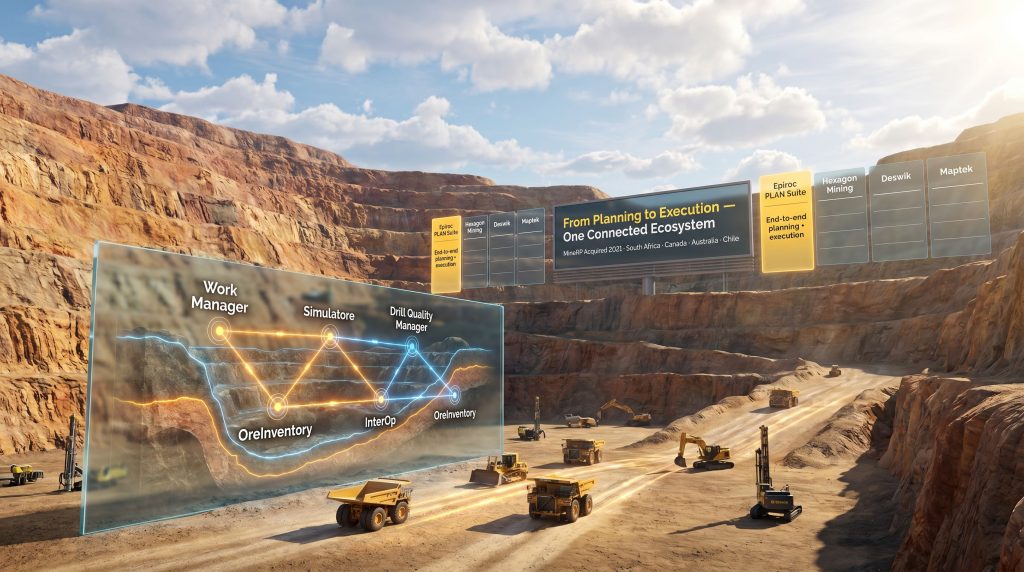
The PLAN portfolio is the outcome of this strategy. It is not a single monolithic application but rather a purpose-built ecosystem of five interoperable modules, each addressing a distinct stage of the mine planning and execution workflow while sharing a common data environment. This architectural approach allows individual modules to deliver standalone value while progressively unlocking greater capability when deployed together.
The five solutions are:
- Work Manager — Connects shift planning to real-time operational feedback, enabling supervisors to see planned versus actual progress and adjust assignments dynamically.
- Simulatore — Provides scenario modelling and optimisation capabilities for complex mine environments, enabling planners to evaluate multiple scheduling strategies before committing resources.
- Drill Quality Manager — Manages precision drilling data and quality assurance workflows, ensuring that blast design inputs accurately reflect actual drill performance.
- InterOp — Functions as the connective layer across the entire suite, standardising data flows between planning, geology, survey, and operations to eliminate manual handovers.
- OreInventory — The newest addition to the portfolio, launched as an entirely new product rather than an acquisition, focusing on resource tracking and material characterisation throughout the extraction process.
The MineRP Acquisition: Building Domain Knowledge at Scale
The intellectual foundation of Epiroc's planning platform rests substantially on the acquisition of MineRP in 2021. MineRP was not a peripheral software vendor. It was a specialist digital mining company with established operations across four continents, maintaining offices in South Africa, Canada, Australia, and Chile. This geographic footprint gave Epiroc immediate access to deep regional expertise across some of the world's most demanding and technically complex mining jurisdictions.
| Strategic Element | Detail |
|---|---|
| Acquisition Year | 2021 |
| MineRP Office Locations | South Africa, Canada, Australia, Chile |
| Core Contribution | Integrated mine planning, execution, and optimisation domain knowledge |
| Integration Status | Complete, consolidated under PLAN suite |
| New Product Developed | OreInventory (built entirely new, not acquired) |
| Total Modules in Suite | Five purpose-built planning solutions |
The four-year integration process between the MineRP acquisition and the global launch of the PLAN suite reflects the complexity of consolidating specialist software capabilities into a coherent, scalable platform. This timeline also indicates that Epiroc did not rush to market. Instead, the company invested in genuinely completing the integration work before commercialising the unified platform — a distinction that carries operational significance for mine operators evaluating whether the system's interoperability claims will hold up under real-world conditions.
The development of OreInventory as an entirely new product, rather than an adapted acquisition, deserves particular attention. Building a new module from within an integrated architecture rather than retrofitting an acquired tool suggests that the development team had sufficient technical confidence in the underlying platform to engineer new capabilities natively.
InterOp: The Connective Tissue of the PLAN Ecosystem
Of the five modules in the PLAN suite, InterOp occupies a structurally distinct position. While the other four solutions each address specific functional domains, InterOp's purpose is architectural. It is designed to standardise and automate the data flows that would otherwise require manual intervention at every transition point between planning, geology, survey, and operations.
To understand why this matters operationally, consider a scenario common to many large open-cut mines:
A mine running equipment from three different OEMs uses separate geological, scheduling, and fleet management platforms. Each morning, planning and survey teams must manually export data from geological systems, reformat it for the scheduling platform, and reconcile the results with overnight fleet management logs before the day shift supervisor can receive an accurate operational picture. This reconciliation process can consume two to three hours of skilled staff time before the shift has meaningfully begun.
InterOp addresses this problem by creating a unified data environment where geological updates, schedule changes, and equipment status are continuously synchronised without requiring manual export-import cycles. The practical outcome is that shift-level decisions can be based on current, reconciled data rather than information that is hours or days old by the time it reaches operational teams.
What a Single Source of Truth Delivers Operationally
The concept of a single source of truth is well-established in enterprise software but has historically been difficult to implement in mining due to the heterogeneous nature of mine technology environments. The challenge is not merely technical — it also involves organisational alignment between geology, planning, survey, and operations departments that have traditionally operated with significant functional independence.
When data consistency is established across these functions, the downstream benefits extend beyond reduced reconciliation time:
- Grade control decisions become more reliable because geological updates reach the blending team before, rather than after, extraction decisions are made.
- Schedule adherence improves because supervisors can see real-time deviations from planned sequences and respond before minor variances compound into significant plan departures.
- Environmental compliance reporting becomes more straightforward because material characterisation data and actual extraction records exist in the same system.
- Capital allocation decisions benefit from more accurate short-term production forecasts grounded in actual geological conditions rather than scheduled assumptions.
Full Capability Coverage Across the Mine Planning Lifecycle
The PLAN suite's combined capabilities span the complete mine planning workflow from initial spatial design through to shift-level execution and performance reporting. In addition, advances in 3D geological modelling have raised the bar for what integrated platforms must deliver in terms of spatial accuracy and data richness.
| Capability Domain | Coverage |
|---|---|
| CAD-based mine design and volumetrics | Included |
| Long, medium, and short-term scheduling | Integrated across all horizons |
| Shift-level work management | Real-time feedback loops |
| Drill quality monitoring | Data assurance and precision tracking |
| Cross-system interoperability | Mixed OEM fleets and legacy platforms |
| Ore inventory and material tracking | New capability via OreInventory |
| Scenario modelling and optimisation | Via Simulatore |
| Reporting and visualisation dashboards | Operational intelligence output |
| Geological and survey data integration | Unified environment via InterOp |
This breadth of coverage is strategically important. Mines that deploy only one or two modules from the suite receive functional value in those specific domains. However, the full system value emerges when multiple modules share the same data environment, allowing the output of one function to become the validated input for the next without manual mediation.
The next major ASX story will hit our subscribers first
How Epiroc's Approach Compares in the Broader Market
The digital mine planning software market includes several established players, each with distinct strengths and market positioning. Understanding where Epiroc's PLAN suite sits within this landscape helps mine operators make informed technology decisions.
| Platform | Core Strength | Interoperability Focus | Execution-Layer Integration |
|---|---|---|---|
| Epiroc PLAN Suite | End-to-end planning plus execution | High, designed for mixed fleets and legacy systems | Strong, shift-level feedback loops |
| Hexagon Mining | Spatial intelligence and fleet management | Moderate | Moderate |
| Deswik | Underground scheduling depth | Moderate | Limited |
| Maptek | Geological modelling and long-term resource planning | Moderate | Limited |
Disclaimer: The competitor positioning outlined above is based on publicly available product descriptions and market positioning statements. It does not represent a formal independent technical audit of any platform's capabilities. Prospective buyers should conduct their own technical evaluation before making procurement decisions.
Epiroc's primary differentiator in this competitive context is not dominance in any single technical domain but rather the breadth of its integration across multiple domains and its explicit design for interoperability with non-Epiroc equipment and legacy systems. Furthermore, mining efficiency gains delivered by AI-adjacent platforms have raised operator expectations for what integrated software should reliably deliver.
Where some competitors have built platforms delivering deep functionality within a proprietary ecosystem, Epiroc's stated approach prioritises reducing barriers to adoption for mines that have already invested in existing infrastructure. A platform that integrates with existing systems rather than replacing them lowers the adoption threshold significantly and reduces implementation risk.
OreInventory: The Platform's Newest Capability
The launch of OreInventory represents a distinct development milestone within the PLAN suite. Unlike the other four modules, which were developed through the consolidation of acquired software capabilities, OreInventory was built entirely from within Epiroc's integrated platform architecture. This distinction matters for technical buyers because it indicates that the module was designed with the PLAN suite's data model as its native foundation.
In functional terms, OreInventory addresses the challenge of tracking resource material and characterising its properties as it moves through the extraction process. Accurate material characterisation from the point of extraction through to processing has long been a challenge in mining, particularly for operations managing complex orebodies with significant grade variability. When this information is managed in a system that shares data with planning and scheduling tools, the operational benefits extend into better-informed blending decisions, reduced processing variability, and more accurate reconciliation between geological models and actual production outcomes.
Productivity, Safety, and Sustainability Dimensions
Epiroc's integrated digital mine planning solutions target improvements across three interconnected outcome domains:
Productivity benefits from reduced time spent on manual reconciliation, faster response to geological changes, and improved schedule adherence through real-time feedback between planning and execution systems.
Safety outcomes improve when shift supervisors have access to current, accurate information about where equipment is operating relative to planned positions, geological hazard zones, and active development headings. Data latency in mine environments is not merely an operational inconvenience — in certain contexts, it carries genuine safety implications.
Sustainability performance connects to the platform's material characterisation and grade control capabilities. When ore and waste are more accurately identified and tracked, mines extract the intended resource more precisely, reducing both unnecessary waste movement and the energy consumption associated with processing off-grade material.
Who Benefits Most From Integrated Mine Planning Platforms
The PLAN suite's capabilities are most immediately applicable to operations with specific characteristics:
- Large-scale open-cut or underground operations where the volume and complexity of planning data creates substantial reconciliation burdens under siloed architectures.
- Mines running mixed OEM equipment fleets where no single vendor's proprietary ecosystem covers the full operational environment.
- Operations with established digital infrastructure that cannot be replaced wholesale but needs integration with modern planning and execution tools.
- Sites where the gap between long-term strategic planning and daily shift execution has been identified as a material operational risk or efficiency constraint.
Frequently Asked Questions
What is included in Epiroc's PLAN suite?
The PLAN suite contains five modules: Work Manager, Simulatore, Drill Quality Manager, InterOp, and OreInventory. Together they cover mine drafting, scheduling, shift management, drill quality assurance, cross-system interoperability, and ore inventory tracking. Epiroc's mine planning digital solutions page provides further technical detail on each module's specifications.
How does OreInventory differ from existing planning tools?
OreInventory was developed as an entirely new product within the PLAN suite's native architecture, focused specifically on resource tracking and material characterisation throughout the extraction process. It was not adapted from an acquired product.
Can the platform integrate with non-Epiroc equipment and third-party systems?
InterOp is specifically designed to support mixed OEM fleets and legacy digital infrastructure, making integration with non-Epiroc equipment and existing third-party systems a core design objective rather than an afterthought.
What is the difference between mine planning software and mine execution software?
Mine planning software addresses the design, scheduling, and optimisation of extraction sequences across different time horizons. Execution software manages the actual deployment of people and equipment against those plans at the shift level. Epiroc's PLAN suite is designed to bridge both domains within a single connected workflow. Innovations in drilling and blasting AI, for instance, illustrate how execution-layer data is increasingly informing upstream planning decisions.
What was MineRP and why did its acquisition matter?
MineRP was a specialist digital mining company with operations in South Africa, Canada, Australia, and Chile, acquired by Epiroc in 2021. It provided deep domain knowledge in integrated mine planning, execution, and optimisation that formed a foundational component of the PLAN suite.
What This Launch Signals for the Mining Technology Industry
The global launch of Epiroc integrated digital mine planning solutions marks more than a product announcement. It represents the completion of a multi-year consolidation strategy and signals Epiroc's intent to compete across the full mine planning and execution technology stack rather than occupying a narrower equipment-adjacent software niche.
For mine operators, the most significant implication is the availability of a platform explicitly designed for the operational reality most mines already inhabit: heterogeneous equipment fleets, legacy digital systems, and departmental workflows that have historically operated with functional independence. A platform engineered around this reality, rather than assuming a clean-slate technology environment, has materially different adoption economics than one that requires wholesale infrastructure replacement.
The broader industry trend this launch reflects is the convergence of planning and execution within unified digital environments. This convergence is not merely a product marketing concept — it reflects a fundamental shift in how mine management decisions are made, validated, and acted upon. As this shift accelerates, the mines that establish reliable data continuity between geological interpretation and shift-level execution will be structurally better positioned to respond to grade variability, equipment disruptions, and market conditions than those still managing these functions through disconnected systems and manual reconciliation.
This article is intended for informational and educational purposes. It does not constitute financial or investment advice. Forward-looking statements about platform capabilities and industry trends reflect current assessments and are subject to change as technology evolves and market conditions shift.
Want to Discover the Next Major ASX Mining Breakthrough Before the Market Does?
While integrated digital platforms are reshaping how mines operate and extract value from the ground, Discovery Alert's proprietary Discovery IQ model delivers real-time alerts the moment significant mineral discoveries are announced on the ASX — translating complex geological data into actionable investment insights for both short-term traders and long-term investors. Explore Discovery Alert's discoveries page to see the historic returns that major mineral discoveries have generated, and begin your 14-day free trial to position yourself ahead of the broader market.