June 25, 2026
The Technical Case for Brownfield Polymetallic Restarts in Established Mining Districts
The economics of mine restarts are rarely straightforward, yet within the broader landscape of global base metals supply, brownfield operations in mature mining districts consistently demonstrate advantages that greenfield projects simply cannot replicate on short timelines. Existing pit shells, proven mineralisation, preserved infrastructure, and accessible skilled labour pools combine to create a structural capital efficiency gap that widens further when commodity markets tighten. Understanding this dynamic is essential context for evaluating the Broken Hill Mines Pinnacles mine restart, which entered active operations in May 2026 after a five-year suspension rooted not in resource depletion, but in pandemic-era logistics.
When big ASX news breaks, our subscribers know first
The Broken Hill Orefield: One of Australia's Most Enduring Polymetallic Provinces
Few mining districts anywhere in the world match the Broken Hill Orefield for geological continuity and operational heritage. Stretching across far-western New South Wales, the orefield has delivered silver, lead, and zinc continuously for well over a century, shaping not only Australia's metals export profile but also global understanding of Broken Hill Type (BHT) ore deposits. BHT deposits are a specific geological classification characterised by stratiform, metamorphosed sulfide mineralisation hosted within granulite-facies metamorphic terranes. They tend to exhibit exceptional lateral continuity and, critically, the kind of polymetallic grade combinations that generate multiple revenue streams per tonne of ore processed. Understanding polymetallic mining importance helps explain why such districts attract sustained capital interest.
The Pinnacles deposit sits within this belt, positioned with access to the region's established road and rail connectivity, and within reasonable haulage distance of the Rasp processing plant. This proximity is not a minor logistical footnote. In polymetallic district economics, trucking distance between pit and plant is a material line item in operating cost models. The Broken Hill region's infrastructure density means Pinnacles ore reaches processing infrastructure without the capital burden of haul road construction or extended haulage cycles that define many remote Australian operations.
What the Grade Profile Reveals About Pinnacles' Commercial Potential
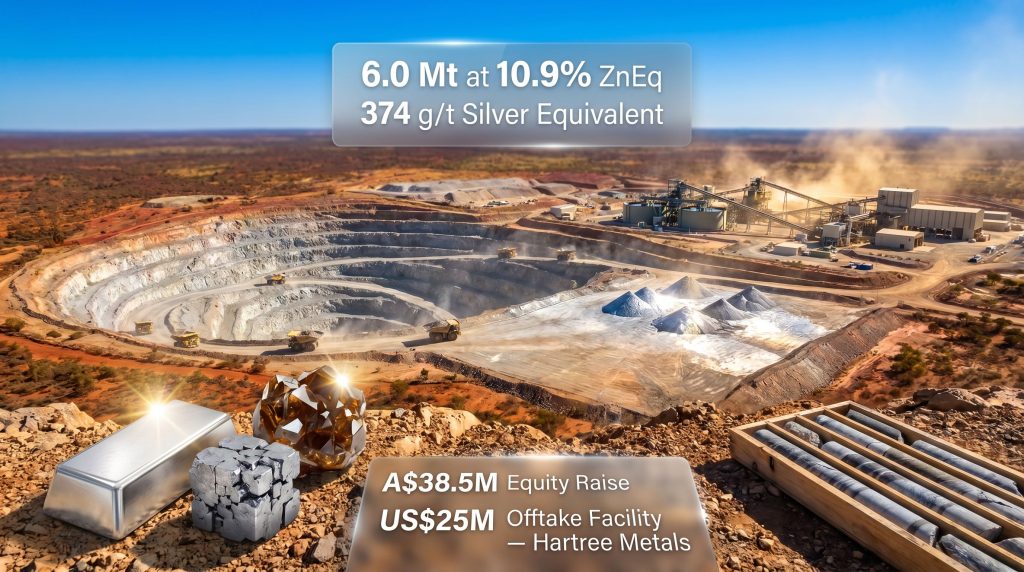
Grade is the single most important driver of mine economics in base metals operations, and the Pinnacles deposit carries metrics that place it firmly in the upper tier of comparable polymetallic assets in Australia. The historical Mineral Resource Estimate stands at 6 million tonnes at 13.5% zinc equivalent (ZnEq) and 374 grams per tonne silver equivalent. A JORC-compliant estimate of 6.0 million tonnes at 10.9% ZnEq has also been reported, reflecting standard adjustments in resource classification methodology between historical and JORC-2012 frameworks.
To contextualise these numbers, the average zinc equivalent grade at producing Australian zinc mines typically sits below 8% ZnEq. A deposit reporting grades in the range of 10.9% to 13.5% ZnEq occupies a materially different cost position on the global zinc cost curve, particularly when silver credits are factored into net smelter return calculations. Silver's industrial demand is frequently underappreciated by generalist investors, yet at 374 grams per tonne silver equivalent, the Pinnacles resource carries a meaningful precious metals byproduct credit that can substantially reduce net zinc and lead production costs on a per-tonne basis.
A deposit's zinc equivalent grade bundles the economic value of all contained metals into a single comparable figure, accounting for relative commodity prices, metallurgical recoveries, and smelter terms. At grades above 10% ZnEq, a project can remain profitable across a wide range of zinc price cycles, providing inherent downside protection.
Why the 2021 Suspension Created a Stranded Ore Opportunity Rather Than a Resource Problem
The Broken Hill Mines Pinnacles mine restart is unusual in one specific respect: the cessation of operations in 2021 was not triggered by falling commodity prices, geotechnical failure, resource exhaustion, or processing plant issues. Operations were placed on care and maintenance as a direct consequence of COVID-19 logistical disruptions that made contractor mobilisation and ore transport unviable under pandemic restrictions.
This distinction matters enormously from a restart economics perspective. When a mine suspends due to resource or technical problems, recommencement requires resolving the underlying constraint, often at considerable cost. When suspension results purely from external logistics, however, the ore remains in place, the pit shell is preserved, and the question becomes simply one of remobilising contractors and clearing the run-of-mine (ROM) pad. BHM has confirmed that up to 50,000 tonnes of high-grade silver-lead-zinc ore sit at the base of the existing open pit, halted in place rather than extracted when operations ceased. That tonnage represents near-term, low-strip ore feed requiring minimal additional development capital to access.
The Care-and-Maintenance Distinction: Infrastructure Preservation During Suspension
Care-and-maintenance status in Australian mining practice is a formally managed operational posture, not passive abandonment. Mining companies maintaining assets in this state typically continue pit dewatering, conduct regular structural inspections, preserve processing plant components, and retain critical site personnel. The cost of care and maintenance over five years is significant, but it is considerably less than the cost of recommissioning a decommissioned asset or building processing infrastructure from scratch. BHM's decision to maintain Pinnacles through the suspension period directly contributed to the relatively short restart timeline now being demonstrated. You can find further detail on the early works underway for near-term mining at Pinnacles in BHM's official announcements.
The Rasp Plant as a Multi-Feed Processing Hub: Why Spare Capacity Changes the Equation
One of the more technically significant aspects of the Broken Hill Mines Pinnacles mine restart is how it integrates into a broader processing strategy centred on BHM's Rasp plant. With a nameplate capacity of 750,000 tonnes per annum, the Rasp facility represents substantial fixed processing infrastructure, and fixed costs in mineral processing are most efficiently diluted by maximising throughput.
BHM's current ore feed configuration uses Western Min ore as its established long-term source. The strategic logic of adding both Main Lode and Pinnacles as supplementary feeds addresses a fundamental mining economics principle: a processing plant operating below nameplate capacity generates suboptimal fixed-cost absorption. Each additional tonne of ore fed through an already-permitted plant with existing tailings management, reagent supply contracts, and operator familiarity effectively improves unit economics across the entire operation.
| Factor | Brownfield Restart (Pinnacles) | Greenfield Development |
|---|---|---|
| Existing infrastructure | Available | Must be built |
| Known resource base | JORC-compliant | Variable |
| Permitting pathway | Existing approvals framework | Longer lead time |
| Capital intensity | Lower | Higher |
| Exploration upside | Moderate to High | High |
| Time to first production | Months | Years |
Restart Sequencing: Three Phases Designed Around Capital Efficiency
The operational architecture of the Pinnacles restart follows a sequencing logic common to well-managed polymetallic brownfield restarts:
-
Phase 1: Extract the ~50,000 tonnes of high-grade ore already identified at the base of the existing open pit, generating early cash flow from minimal incremental capital.
-
Phase 2: Expand the open-pit footprint into the Consols South, Fishers, Rope Shaft, and Junction zones, targeting existing high-grade resources confirmed through shallow drilling programs conducted over the past 12 months.
-
Phase 3: Assess and potentially develop underground operations targeting what BHM describes as very high-grade ore, potentially functioning as a premium-grade supplement to the Rasp plant's feed mix.
The current operational status as of May 2026:
| Restart Milestone | Typical Timeline | Pinnacles Status (May 2026) |
|---|---|---|
| Contractor mobilisation | 4 to 12 weeks | Complete |
| ROM pad clearing | 2 to 6 weeks | Underway |
| Open-pit mining commencement | 6 to 16 weeks post-mobilisation | Active |
| Processing plant ramp-up | Concurrent with ore feed | Progressive ramp-up |
| Underground feasibility assessment | Parallel workstream | In assessment |
Drilling Results and the MRE Update: Where Resource Growth Potential Sits
Over the past 12 months, BHM has released significant high-grade silver-lead-zinc intercepts across the Pinnacles open-pit footprint. The drilling programs targeting Consols South, Fishers, Rope Shaft, and Junction zones serve a dual purpose: confirming grade continuity to support pit expansion planning, and converting inferred resources into higher confidence indicated or measured categories ahead of the scheduled MRE update. Furthermore, interpreting drill results correctly is essential for understanding what these intercepts mean for future resource classification.
The upcoming Pinnacles MRE update, targeted for late calendar year 2026, will incorporate all drilling completed by BHM since acquiring the project. For investors, this update represents a potential re-rating event if resource tonnage increases materially, if grade improves relative to the existing JORC estimate, or if resource classification upgrades reduce the technical risk discount applied to inferred material.
In polymetallic resource estimation, the relationship between resource confidence category and market valuation is non-linear. An upgrade from inferred to indicated status often triggers a disproportionate market rerating because institutional investors and lenders apply significantly lower risk discounts to indicated and measured resources when assessing project financing or mine planning scenarios.
Underground Potential: The High-Grade Optionality Case
The underground assessment running parallel to open-pit operations adds a layer of optionality that distinguishes Pinnacles from a straightforward pit restart. In BHT deposit geology, high-grade mineralisation frequently extends at depth beyond the economic limits of open-pit mining. Underground development at Broken Hill-style deposits typically targets ore lenses with grades materially above the open-pit resource average, which is why BHM characterises the underground potential as carrying very high-grade characteristics.
If the underground assessment confirms viable development pathways, the resulting ore feed to the Rasp plant would carry a higher revenue-per-tonne profile than open-pit ore, potentially improving concentrate quality metrics relevant to smelter offtake terms. A completed definitive feasibility study for any underground scenario would be a key milestone in this regard.
Financial Architecture: Equity, Offtake Financing, and Market Positioning
The capital structure supporting the Broken Hill Mines Pinnacles mine restart reflects a hybrid funding approach increasingly favoured in mid-tier base metals development. BHM completed an A$38.5 million equity raise to fund accelerated development across both Rasp and Pinnacles, while simultaneously arranging a US$25 million concentrate offtake financing facility with Hartree Metals.
The offtake-linked financing structure is particularly instructive. By linking capital provision to concentrate sales, BHM aligns the interests of its financing partner directly with production outcomes rather than purely financial covenants. This structure reduces the risk of covenant breach during ramp-up periods, when production volumes and cash flows are inherently variable.
At the time of the restart announcement, BHM's market capitalisation stood at A$237.6 million, with shares trading at 74.5 cents, down marginally on the day. Contextualising this market cap against the combined resource base across Rasp, Main Lode, and Pinnacles requires investors to consider the aggregate throughput potential of the 750,000 tpa Rasp facility operating across multiple ore feeds at Broken Hill-style grades.
This article contains forward-looking statements and financial analysis based on publicly available information. It does not constitute investment advice. Past performance is not indicative of future results. Readers should conduct their own due diligence and consult a qualified financial adviser before making investment decisions.
The next major ASX story will hit our subscribers first
Silver, Lead, and Zinc Supply Chains: Why Brownfield Restarts Attract Offtake Interest
The broader commodity context amplifies the strategic case for the Pinnacles restart. Silver supply deficits have created structural tightness driven by growing industrial demand in photovoltaics, electronics, and emerging electrical applications, alongside flat primary silver mine supply growth globally. Lead and zinc concentrate markets serving Asia-Pacific smelters remain sensitive to supply disruptions from major producing jurisdictions, creating a premium on reliable, high-grade Australian concentrate supply.
Broken Hill's infrastructure advantages extend beyond processing. The region has established road and rail connections to port, a skilled labour pool with multigenerational mining expertise, and existing environmental approvals frameworks that compress the permitting timeline for brownfield expansions compared with greenfield projects in undeveloped regions. Consequently, BHM's Pinnacles project page outlines how these structural advantages have been central to the restart investment thesis from the outset.
Key Milestones and Risk Factors to Track
For those monitoring the Broken Hill Mines Pinnacles mine restart, the following near-term and medium-term catalysts are worth tracking:
Near-term operational catalysts:
- Completion of ROM pad clearing and transition to sustained ore extraction
- First Pinnacles ore delivery to the Rasp processing plant
- Assay results from ongoing drilling across Consols South, Fishers, Rope Shaft, and Junction zones
Medium-term strategic milestones:
- Release of the updated Pinnacles MRE in late CY2026
- Completion of underground development assessment and potential proceed decision
- Progressive ramp-up of Rasp plant throughput toward 750,000 tpa across all three ore feeds
Risk factors warranting monitoring:
- Concentrate price volatility across silver, lead, and zinc markets
- Geotechnical conditions encountered during open-pit expansion into previously unexcavated zones
- Contractor performance and regional supply chain reliability in far-western NSW
- Timing and market reception of the MRE update relative to investor expectations
- Broader base metals market conditions affecting concentrate offtake economics
Frequently Asked Questions: Broken Hill Mines Pinnacles Mine Restart
When Did Pinnacles Last Operate Before the 2026 Restart?
Mining at Pinnacles was suspended in 2021 when the operation entered care-and-maintenance status following COVID-19 logistical disruptions. The 2026 restart marks the first active mining at the site in approximately five years.
What Is the Current Pinnacles Mineral Resource Estimate?
The historical Pinnacles MRE stands at 6 million tonnes at 13.5% zinc equivalent and 374 grams per tonne silver equivalent. A JORC-compliant figure of 6.0 Mt at 10.9% ZnEq has also been reported. An updated MRE incorporating recent BHM drilling is targeted for release in late CY2026.
How Will Pinnacles Ore Be Processed?
Pinnacles ore will be directed to BHM's Rasp processing plant, which has a nameplate capacity of 750,000 tonnes per annum. Pinnacles will serve as one of two additional ore feeds supplementing the existing Western Min supply, alongside Main Lode.
How Much Immediately Accessible Ore Exists at the Open Pit?
BHM has confirmed up to 50,000 tonnes of high-grade silver-lead-zinc ore at the base of the existing open pit. This material was left in place when operations suspended due to logistical constraints, not resource or technical limitations, making it immediately accessible upon pit recommencement.
Is Underground Mining Planned?
BHM is conducting a parallel assessment of underground development potential at Pinnacles, characterised by very high-grade ore potential. A positive outcome from this assessment could deliver a premium-grade supplementary feed stream to the Rasp plant in the near term.
What Capital Has Been Secured?
BHM has raised A$38.5 million through equity and arranged a US$25 million concentrate offtake financing facility with Hartree Metals to fund accelerated development across both Rasp and Pinnacles.
Want to Track the Next Major ASX Mineral Discovery Before the Market Does?
Discovery Alert's proprietary Discovery IQ model delivers real-time alerts on significant ASX mineral discoveries across silver, zinc, lead, and beyond — instantly translating complex mineralisation data into actionable investment insights for traders and long-term investors alike. Explore how historic discoveries have generated extraordinary returns on Discovery Alert's dedicated discoveries page, and begin your 14-day free trial today to position yourself ahead of the broader market.