June 16, 2026
The Hidden Complexity of Going Digital in an Industry Built on Rock
Few industrial sectors carry as much physical complexity as mining. Before a single byte of data flows through a connected sensor network, a mine must contend with kilometre-deep shafts, corrosive atmospheres, explosive environments, seismic instability, and the logistical reality of operating in locations where the nearest fibre optic cable may be hundreds of kilometres away. This physical reality is why mining digital transformation challenges cannot be resolved by borrowing frameworks from retail, finance, or even manufacturing. The mine site is not a factory floor. It is a dynamic geological system, and that distinction changes everything about how digital technology must be designed, deployed, and sustained.
Understanding why digitisation in mining is so difficult requires looking beyond the technology itself and examining the structural conditions that shape every investment decision, every implementation attempt, and every failure.
When big ASX news breaks, our subscribers know first
Why Mining Cannot Simply Import Digital Models From Other Industries
Digital transformation in sectors like logistics or retail succeeded partly because the physical environment is controlled, predictable, and standardised. A warehouse in Ohio and a warehouse in Hamburg share enough operational DNA that software built for one can be adapted for the other with relatively modest customisation.
Mining offers no such luxury. Each ore body has a unique geometry, mineralogy, depth profile, and geotechnical character. The extraction method at a block cave copper mine in Chile bears little operational resemblance to an open-pit iron ore operation in Western Australia or an underground gold mine in Ontario. The operational spectrum stretches from remote-sensing geology and drill-hole data interpretation at the exploration stage all the way through crushing, flotation, smelting, refining, and concentrate logistics.
Deploying a meaningful digital layer across that entire spectrum is not a single project. It is a portfolio of interconnected projects, each with its own technical requirements, data standards, and integration dependencies. Furthermore, data-driven mining operations must contend with legacy infrastructure that compounds this challenge significantly.
Many operating mines were designed and built in eras when programmable logic controllers communicated over proprietary protocols that were never intended to talk to modern cloud platforms. Retrofitting connectivity onto systems that were engineered for isolation is technically demanding and expensive, and the risk of introducing instability into safety-critical control systems creates a powerful incentive to leave things as they are.
What Are the Biggest Mining Digital Transformation Challenges Today?
Connectivity and Infrastructure Deficits at Remote Sites
Geographic isolation in mining is simultaneously a physical and a data problem. Without reliable, high-bandwidth connectivity, the entire premise of real-time monitoring, cloud-based analytics, and autonomous equipment coordination collapses. Intermittent power, bandwidth constraints measured in kilobits rather than megabits, and temperature extremes that degrade hardware performance all create conditions where even well-funded digital programs stall at the proof-of-concept stage.
IoT sensors generating continuous equipment telemetry, LiDAR-equipped autonomous mobile robots mapping underground passages in three dimensions, and predictive maintenance in mining platforms ingesting vibration signatures from rotating equipment all share one common dependency: they need data to move reliably and quickly. When that pipeline breaks down, the value proposition breaks with it.
Cybersecurity Exposure as Connectivity Grows
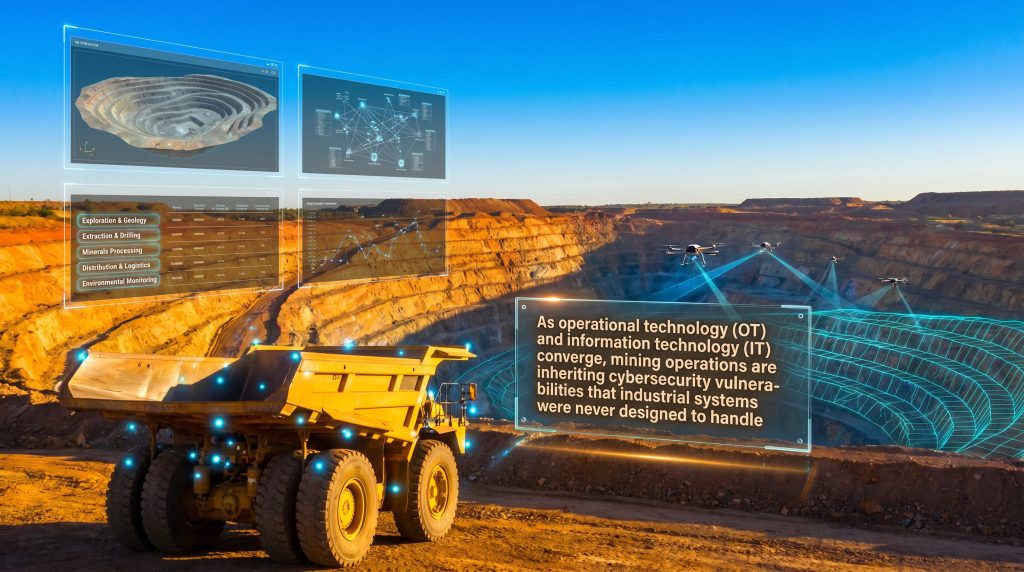
Every sensor added to a mining network is a potential entry point for a threat actor. As operational technology (OT) systems that control physical equipment converge with information technology (IT) networks, the attack surface of a modern mine expands dramatically.
As operational technology and information technology converge, mining operations inherit cybersecurity vulnerabilities that industrial control systems were simply never designed to handle.
The consequences of a successful intrusion are not limited to data theft. A cyberattack on a ventilation management system, a haul truck dispatch platform, or a tailings dam monitoring network carries direct safety and environmental implications. Regulatory expectations around OT cybersecurity are tightening across major mining jurisdictions, adding compliance obligations that many operators, particularly mid-tier companies, are not yet equipped to meet.
Capital Requirements and Return on Investment Uncertainty
The cost architecture of a mining digital transformation programme is layered and cumulative. Consider the components involved:
- Hardware: Sensors, edge computing devices, communication infrastructure, and ruggedised endpoints designed for industrial environments.
- Software platforms: Process historians, analytics engines, autonomous system controllers, and digital twin environments.
- Integration services: Middleware to connect legacy OT systems with modern IT platforms, often requiring bespoke engineering.
- Data infrastructure: Storage, processing capacity, and cybersecurity architecture to govern the resulting data flows.
- Ongoing upgrades: Technology refresh cycles, software licensing, and the continuous cost of maintaining connectivity in remote environments.
For a major diversified miner with a multi-billion-dollar balance sheet, this investment profile is manageable. For a mid-tier operator running a single asset, the capital commitment can represent a significant proportion of annual discretionary spending, with payback timelines that often extend beyond three to five years and remain difficult to model with precision before deployment.
The OT-IT Integration Gap
Operational technology systems were designed for reliability, determinism, and isolation. Information technology systems were designed for connectivity, flexibility, and rapid iteration. These design philosophies are not naturally compatible, and the legacy of decades of separate evolution means that many mine sites still rely on manual data extraction, spreadsheet-based reporting, and human-mediated translation between operational systems and management dashboards.
The practical consequence is a fragmented data environment where production, maintenance, geology, and environmental monitoring data sit in disconnected silos. Decision-makers working without integrated data visibility are, in effect, navigating with an incomplete map. Blind spots accumulate across the value chain, slowing responses to emerging problems and obscuring optimisation opportunities that would be obvious if the data were unified.
Workforce Skills Shortages and Cultural Resistance
Mining competes directly with technology companies, financial services, and consulting firms for the same pool of data scientists, automation engineers, and machine learning specialists. The competition is uneven. Silicon Valley compensation structures and remote-work flexibility are difficult for an industry whose core operations require physical presence in isolated locations.
Cultural resistance adds a further dimension. Mining organisations have historically promoted from within technical and operational disciplines where experience on the ground carries deep institutional authority. Introducing digital specialists whose expertise is largely invisible to traditional operational managers can create friction that no technology platform is capable of resolving on its own. The retraining of existing workforces is equally important, as upskilling a veteran mine engineer to interpret dashboards often delivers faster organisational uptake than hiring externally.
The Strategy-to-Execution Gap
Perhaps the most underappreciated of all mining digital transformation challenges is the distance between a well-articulated digital roadmap and measurable operational progress. Many companies have invested heavily in strategy documentation, vendor selection processes, and pilot programme design, only to find that deployment at scale encounters site-specific conditions that generic enterprise platforms were not built to accommodate.
The cumulative effect of stalled projects is transformation fatigue, where operational staff become sceptical of digital initiatives because previous commitments produced limited results. Rebuilding internal trust after a failed implementation is considerably harder than getting the first deployment right.
How Digital Maturity Varies Across the Mining Value Chain
The distribution of digital investment across the mining value chain is uneven in ways that carry significant implications for value creation.
| Value Chain Stage | Digital Maturity Level | Key Gap |
|---|---|---|
| Exploration and Geology | Moderate | Data integration and 3D geological modelling |
| Extraction and Drilling | High (investment focus) | Autonomous systems deployment at scale |
| Minerals Processing and Refining | Low to Moderate | Real-time process optimisation and control |
| Distribution and Logistics | Moderate | Supply chain visibility and predictive planning |
| Environmental Monitoring | Emerging | Continuous emissions and water quality tracking |
Processing and refining operations represent the most under-digitised segment of the value chain, and arguably the segment with the greatest untapped potential. Flotation circuits, leaching columns, and smelter control systems operate under conditions where marginal improvements in recovery rates translate directly into significant revenue outcomes. Yet the sensors, advanced process control systems, and real-time analytics platforms that could unlock those improvements have seen comparatively limited deployment compared to mining automation technologies such as autonomous haulage and drill guidance systems.
The Global Landscape: Regional Variation in Digital Readiness
| Region | Primary Driver | Key Challenge |
|---|---|---|
| Australia | Autonomous haulage and safety technology | Remote connectivity and skills availability |
| North America | Cybersecurity and ESG compliance | Legacy system integration and capital allocation |
| Latin America | Cost reduction and productivity | Infrastructure investment and workforce capability |
| Africa | Resource efficiency | Connectivity and regulatory uncertainty |
| Asia-Pacific | Scale and deployment speed | Data governance and technology localisation |
Australia has emerged as a global leader in autonomous haulage deployment, with major iron ore operators running fleets of driverless trucks across Pilbara operations. However, the same remote geography that makes autonomy attractive also constrains connectivity, and the skills pipeline outside major metropolitan centres remains tight.
Sustainability as a Digital Accelerator
Carbon intensity reduction targets, Scope 3 emissions reporting obligations, and investor-driven ESG disclosure requirements are creating a powerful external pressure that is accelerating digital adoption in areas that would otherwise lag. Emissions monitoring, water consumption tracking, and tailings management surveillance all require the kind of continuous, real-time data infrastructure that serves as a foundation layer for broader digital transformation.
Digital twins, in particular, are proving valuable as simulation environments for testing ventilation strategies, modelling geotechnical risk scenarios, and evaluating process changes before committing to physical implementation. An operation that deploys a digital twin for emissions compliance purposes finds itself with an infrastructure asset that can be extended into production planning, equipment maintenance scheduling, and energy management at relatively low incremental cost.
The next major ASX story will hit our subscribers first
Proven Strategies for Overcoming the Barriers
Infrastructure Through Collaboration
No single mid-tier operator can economically solve remote connectivity in isolation. Shared digital infrastructure across mining corridors, co-investment in satellite broadband infrastructure, and coordinated power supply improvements create the connectivity foundation that individual site-level investments cannot achieve alone.
Piloting With Discipline
Small-scale proof-of-concept projects reduce financial exposure while generating the site-specific evidence base needed to build organisational confidence. The critical design principle is ensuring that pilots are structured to produce transferable, measurable results rather than demonstrations that cannot be scaled without fundamental redesign.
Federated Data Architecture
Moving beyond siloed data environments requires deliberate investment in data governance frameworks that define quality standards, access controls, and integration protocols. A federated data architecture allows disparate operational systems to share structured data without requiring a single monolithic platform, making it considerably more adaptable to the multi-system reality of operating mines.
Tailored Implementation Over Generic Enterprise Platforms
Mining-specific digital solutions consistently outperform generic enterprise platforms precisely because they are engineered for the physical constraints, data characteristics, and safety requirements of the mine environment. Phased roadmaps with clearly defined milestones help sustain momentum and prevent the initiative fatigue that derails so many well-intentioned programmes.
Technologies Reshaping the Digital Mine
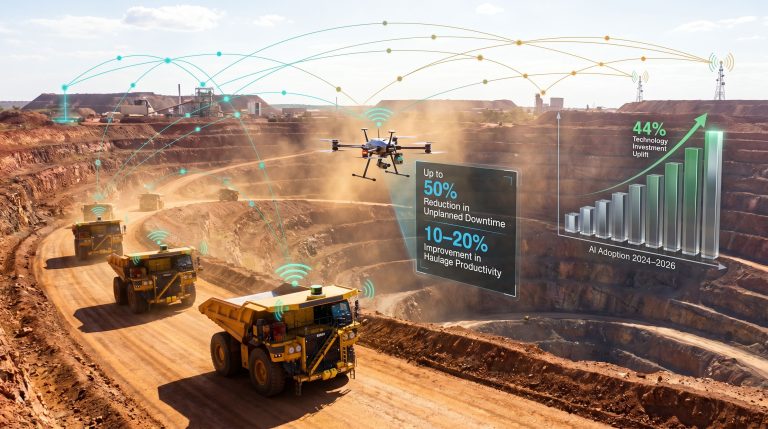
Autonomous systems have moved well beyond pilot status in some jurisdictions, with autonomous haulage, AI in drilling and blasting, and LiDAR-equipped inspection robots demonstrating measurable productivity and safety improvements. Autonomous Mobile Robots (AMRs) are particularly valuable in hazardous environments where human access is unsafe, including flooded passages, unstable ground conditions, and high-dust atmospheres. Unlike earlier Autonomous Guided Vehicles that required fixed navigation infrastructure such as magnetic strips or embedded cables, modern AMRs use onboard mapping and sensor fusion to navigate dynamically. This adaptability is critical in mining environments where the physical layout changes continuously as extraction proceeds.
Artificial intelligence and machine learning applications are advancing from descriptive analytics toward prescriptive recommendations, moving operations from understanding what happened to receiving specific guidance on what to do next. Ore grade prediction, equipment fault detection, and production scheduling optimisation are among the highest-value applications currently in commercial deployment. However, AI adoption is fundamentally dependent on data quality. Poorly governed, inconsistent data produces unreliable model outputs, and unreliable outputs erode operational confidence faster than no system at all.
Digital twins create virtual replicas of physical mining systems that can be updated in real time and used to test operational scenarios without physical risk or production interruption. Applications span ventilation network optimisation, geotechnical monitoring, and concentrate production planning.
IoT sensor networks form the foundational data layer upon which all higher-order analytics depend. Managing the cybersecurity exposure, data volume, and interoperability challenges of large-scale sensor deployments requires deliberate standards governance, particularly in multi-vendor environments where proprietary data formats can fragment rather than unify operational visibility. According to research published by ABB on digital transformation in mining, integrated digital ecosystems that span the full value chain are increasingly critical to unlocking sustained productivity gains.
Key Indicators: Quantifying What Is at Stake
| Challenge Category | Industry Impact Indicator |
|---|---|
| Connectivity gaps | Real-time monitoring constrained at the majority of remote global mine sites |
| Cybersecurity incidents | Rising frequency of OT-targeted attacks across industrial infrastructure sectors |
| Skills shortages | Demand for data and automation specialists outpacing supply in mining regions |
| Digital ROI uncertainty | Primary barrier cited by mid-tier operators deferring technology investment |
| Processing digitisation lag | Significant unrealised value creation opportunity in downstream operations |
Frequently Asked Questions
What is the single biggest obstacle to digital transformation in mining?
The convergence of remote physical environments with legacy operational technology creates a structural barrier that does not exist in most other industries. Connectivity and OT-IT integration together represent the foundational constraint from which most other challenges flow.
How long does it typically take to see ROI from digital investments in mining?
Payback periods vary widely by application. Predictive maintenance programmes can deliver measurable reductions in unplanned downtime within twelve to eighteen months of deployment. Broader transformation initiatives that span multiple value chain stages typically operate on three to five year ROI timelines, with returns that are difficult to model precisely at the outset.
Can smaller mining operations realistically pursue digital transformation?
Yes, but the strategy must match the resource base. Targeted investments in high-impact, lower-cost applications such as condition monitoring on critical equipment or connected environmental sensors deliver meaningful returns without requiring enterprise-scale capital commitments. Participation in industry consortia that co-fund pilot programmes is one mechanism that materially reduces the entry cost.
How does cybersecurity risk in mining differ from other industries?
The convergence of OT and IT in mining creates a risk profile where a successful intrusion can have direct physical consequences, including equipment damage, environmental incidents, and safety hazards for workers. This distinguishes mining cybersecurity from purely informational risk and places it in a different regulatory and operational category.
What role does sustainability play in accelerating mining digitisation?
Sustainability obligations are functioning as an accelerator by creating external mandates for continuous environmental monitoring and reporting. The data infrastructure built to satisfy these obligations becomes a platform for broader operational optimisation, creating compounding returns on the initial investment.
The Collaborative Imperative
No individual operator, regardless of scale, can resolve the systemic barriers to mining digital transformation challenges through independent action alone. Shared technology standards that enable interoperability between vendor systems, data-sharing frameworks that allow industry-level benchmarking and collective problem-solving, and long-term partnerships with technology providers who understand the physical realities of mine operations are all conditions for sector-wide progress.
Technology providers that position themselves as long-term strategic partners rather than transactional vendors are consistently more effective in mining contexts. The implementation complexity and the site-specific customisation requirements of mine-grade digital systems make the relationship between operator and technology partner a critical determinant of deployment success. Deloitte's perspective on digital transformation in the mining industry further reinforces that sustained leadership commitment and clearly defined governance structures are among the most reliable predictors of successful implementation.
Navigating the Digital Frontier With Realism
The organisations most likely to succeed in mining digital transformation share several characteristics. They treat digital capability as an ongoing operational discipline rather than a discrete project with a defined end state. They invest in data governance infrastructure before deploying analytics platforms, recognising that data quality is a prerequisite rather than a byproduct of digital adoption.
They build internal digital champions from within their operational teams rather than relying exclusively on external specialists. Furthermore, they structure their transformation programmes around four durable pillars: infrastructure (connectivity and power reliability), people (skills development and cultural alignment), data (governance, quality, and architecture), and governance (accountability structures and milestone management).
The physical complexity of mining is not going to diminish. Ore bodies are getting deeper, grades are declining, and water and energy constraints are tightening. These structural trends make the productivity and efficiency gains that digital technology can deliver more valuable with each passing year. The challenge is closing the distance between what the technology can deliver and what the operating environment will actually allow.
Want to Know Which ASX Mining Companies Are Navigating This Digital Frontier?
As the mining sector grapples with the complexity of digital transformation — from OT-IT integration to autonomous systems deployment — the companies achieving genuine operational breakthroughs are often the same ones making significant mineral discoveries. Discovery Alert's proprietary Discovery IQ model delivers real-time alerts on significant ASX mineral discoveries, turning complex data into actionable investment insights the moment they hit the market — start your 14-day free trial today, or explore historic discoveries and the returns they generated to understand what early positioning can mean for your portfolio.