May 20, 2026
The Industrial Backbone Behind Six Decades of Global Steel Supply
Few commodity supply chains have shaped the modern industrial world as quietly and consistently as the movement of iron ore from Western Australia's red interior to the blast furnaces of Asia. Long before climate commitments, critical mineral strategies, and supply chain diversification became boardroom priorities, a single trade route was already doing the heavy lifting of civilisation — loading iron-rich rock onto bulk carriers and sending it north across the Indian Ocean by the hundreds of millions of tonnes per year.
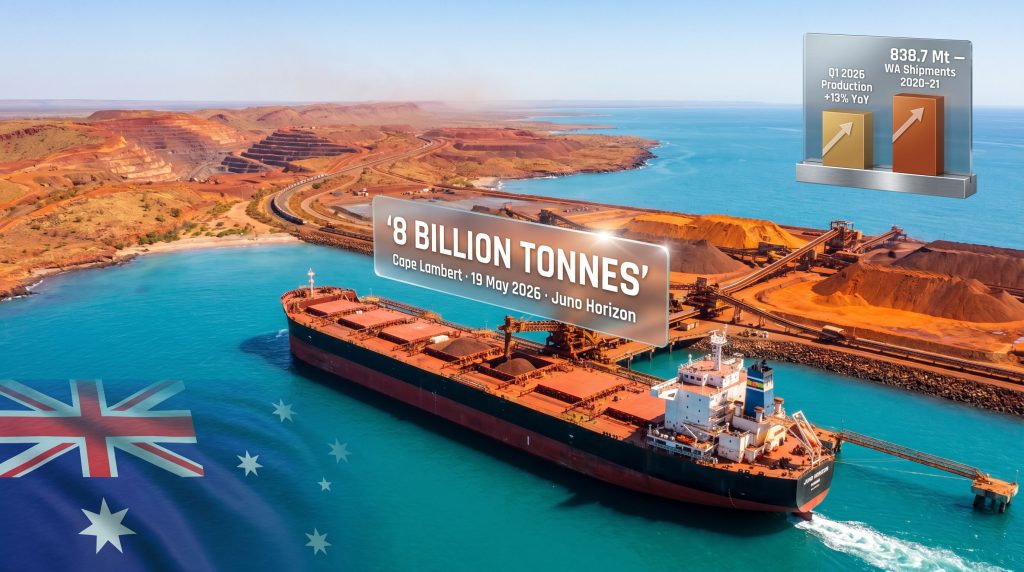
That supply architecture, built incrementally over six decades, has now crossed a threshold that few industrial operations in human history have reached. Rio Pilbara iron ore exports hit 8 billion tonnes as of 19 May 2026, when the vessel Juno Horizon departed Cape Lambert port in Western Australia bound for Nippon Steel in Japan. The figure is staggering in any frame of reference, and its implications extend well beyond a single company's operational ledger.
When big ASX news breaks, our subscribers know first
Why 8 Billion Tonnes Reframes How We Think About Industrial Scale
Numbers of this magnitude resist easy comprehension, so context is essential. The global steel industry produces roughly 1.9 billion tonnes of crude steel annually. Rio Tinto's cumulative Pilbara export total therefore represents the equivalent of multiple decades of the entire world's raw steel output, measured in ore terms.
Put differently, every tonne of steel produced globally in a given year requires roughly 1.6 tonnes of iron ore as feedstock, meaning the Pilbara's 8-billion-tonne export record has contributed the raw material foundation for an almost incalculable volume of bridges, buildings, vehicles, ships, and industrial machinery across Asia and beyond. According to Business Wire, this milestone underscores the extraordinary scale of what Rio Tinto has built in Western Australia.
Milestone Snapshot
- Cumulative exports: 8 billion tonnes of iron ore
- Milestone vessel: Juno Horizon, departed 19 May 2026
- Departure port: Cape Lambert, Western Australia
- Destination: Nippon Steel, Japan
- Operational span: 60 years (first shipment: 1966)
The milestone also arrives against a backdrop of genuine operational momentum. In the first quarter of 2026, Rio Tinto recorded its second-highest Q1 Pilbara iron ore production result since 2018, with output rising 13% year-on-year. That performance signals that the system is not coasting on legacy infrastructure but actively expanding its productive capacity.
The Geological Foundation That Made the Pilbara Irreplaceable
Banded Iron Formations and the Ancient Origins of Australian Iron Ore
Understanding why the Pilbara dominates global iron ore supply requires a brief detour into deep geological time. The ore bodies of Western Australia's Hamersley Basin are classified as banded iron formations (BIFs), sedimentary sequences deposited approximately 2.5 billion years ago during the Archaean and Palaeoproterozoic eras.
These ancient formations represent one of the most iron-concentrated geological environments on Earth, created when early ocean chemistry and primitive microbial life combined to precipitate iron oxide layers across vast seafloors. Over geological time, supergene enrichment processes upgraded the original BIF material, concentrating iron content and producing the high-grade hematite ore bodies that define Pilbara mining today.
Hematite ore typically grades between 57% and 62% iron (Fe), with some deposits pushing higher. This grade profile is commercially critical because higher-grade ore reduces the energy required in downstream steelmaking and lowers the volume of waste slag generated per tonne of steel produced. The iron ore market and deposits of the Pilbara are, furthermore, unlike almost anything else found on the planet.
How the Pilbara Compares to Competing Global Iron Ore Regions
| Iron Ore Region | Country | Key Characteristic |
|---|---|---|
| Pilbara | Australia | World's largest export hub; established hematite deposits |
| Carajás | Brazil | Highest average grades globally (~67% Fe) |
| Sishen | South Africa | Large reserves constrained by logistics infrastructure |
| Labrador Trough | Canada | Cold-climate operations with elevated cost structures |
| Simandou | Guinea | Major undeveloped deposit; long infrastructure development timeline |
What separates the Pilbara from competing provinces is not simply ore grade but the convergence of grade consistency, deposit scale, port proximity, and an already-built logistics network that took decades and hundreds of billions of dollars to construct. Replicating this system elsewhere is a generational undertaking, which is why emerging competitors like Simandou in Guinea remain longer-dated threats rather than near-term disruptors. Australia's iron ore advantages over these competing regions, consequently, remain considerable.
The Integrated System Behind 60 Years of Continuous Output
More Than a Mine: An Industrial Network at Continental Scale
Rio Tinto's Pilbara operations cannot be understood as a collection of individual mine sites. They function as a tightly integrated industrial system spanning some of the most remote terrain in Australia. The key components include:
- Multiple open-cut mining operations across the Hamersley Range and surrounding geological provinces
- Approximately 1,700 kilometres of privately owned, heavy-haul railway — one of the most tonnage-intensive rail networks anywhere on Earth
- Two major export port terminals at Cape Lambert and Dampier on Western Australia's Pilbara coast
- A Remote Operations Centre (ROC) based in Perth, enabling real-time mine and rail management from more than 1,500 kilometres away
- AutoHaul, the world's first fully autonomous long-distance heavy-haul rail system, which operates across the entire network
- Autonomous haulage systems (AHS) deployed across multiple mine sites, reducing human operator requirements and improving safety outcomes
Key Operational Milestones Across Six Decades
| Year | Milestone |
|---|---|
| 1966 | First iron ore shipment departs Western Australia for Japan |
| 2000s | Pilbara expansion accelerates driven by China's steel demand surge |
| 2018 | Benchmark Q1 production record established |
| Q1 2026 | Second-highest Q1 Pilbara production on record, up 13% year-on-year |
| 19 May 2026 | Juno Horizon departs Cape Lambert carrying the 8-billionth cumulative tonne |
The Automation Edge: A Competitive Moat Built in Software and Steel
A dimension of the Pilbara operation that receives less public attention than raw tonnage figures is the sophistication of its automation infrastructure. AutoHaul operates trains averaging over 2.4 kilometres in length across a network where human-driven trains once required crews to manage multiple handover points.
The shift to full autonomy has compressed cycle times, improved scheduling consistency, and reduced the operational risks associated with driver fatigue on one of the most relentless railway systems on the planet. Equally significant is the deployment of autonomous haulage trucks across mine sites. These vehicles operate around the clock without shift constraints, feeding ore to crushers and conveyors in sequences optimised by algorithms rather than human scheduling. The operational efficiency gains from this technology layer are not merely incremental; they represent a structural cost advantage that competitors in higher-cost or less-automated jurisdictions cannot easily replicate.
The Australia–Japan Iron Ore Partnership: A Relationship That Shaped the Indo-Pacific
The 1966 Trade Agreement That Changed Both Economies
The fact that the 8-billion-tonne milestone shipment was bound for Nippon Steel in Japan is not incidental. Japan was the original destination for Pilbara iron ore, and the bilateral trade relationship established in the 1960s became one of the most economically consequential commodity partnerships in modern history.
Post-war Japan required massive volumes of steel to rebuild its industrial base and sustain the export manufacturing economy that would make it the world's second-largest economy by the 1970s. Australia, recognising the scale of this demand, negotiated long-term offtake agreements that provided Japanese steelmakers with reliable, cost-competitive iron ore while giving Australian miners the contractual certainty needed to justify enormous upfront infrastructure investment.
This commercial framework, involving long-term bilateral offtake agreements underpinned by government-level trade diplomacy, became the template that later informed China's own resource procurement strategies with Australian and other global producers.
Why the Japan Relationship Remains Strategically Relevant Today
- Japan remains a top-tier buyer of Australian iron ore, providing export market diversification beyond China
- Japanese steelmakers are global leaders in developing hydrogen-based direct reduced iron (DRI) technology, which has significant implications for the grade specifications of future iron ore demand
- The six-decade Australia–Japan resource relationship has expanded into LNG, hydrogen, and critical minerals, reinforcing bilateral economic interdependence at a time of broader geopolitical realignment
Iron Ore and the Australian Economy: A Dependency With Measurable Consequences
The Fiscal Architecture Built on Iron Ore Revenues
Iron ore consistently holds the position of Australia's single largest export commodity by value. The revenue flows generated by Pilbara operations touch virtually every layer of the Australian fiscal system:
| Metric | Data Point |
|---|---|
| 2013 export volume | ~300 million tonnes |
| 2013 export value | ~AUD $30 billion |
| 2020-21 WA iron ore shipments | 838.7 million tonnes |
| Rio Tinto Q1 2026 production growth | 13% year-on-year |
| Cumulative Rio Tinto Pilbara exports (to May 2026) | 8 billion tonnes |
Royalty receipts from iron ore production represent a material share of the Western Australian state government's annual revenue. During periods of elevated iron ore prices, WA has generated budget surpluses that are structurally exceptional by the standards of state finances globally. Conversely, sustained price declines, as experienced during phases of Chinese property sector contraction, compress both royalty revenues and the broader investment environment for the mining sector.
The Iron Ore–Australian Dollar Relationship
Currency markets have long treated the Australian dollar as a de facto proxy for iron ore price sentiment. This relationship reflects the commodity's outsized contribution to national export earnings and the sensitivity of the current account to iron ore price movements. For investors, this creates an interesting dynamic: the AUD/USD exchange rate frequently moves ahead of official production or shipment data as traders price in forward expectations about the iron ore demand outlook and Pilbara output.
The next major ASX story will hit our subscribers first
Geopolitical Dimensions: The Strategic Weight of Pilbara Dominance
China's Structural Dependence and the Limits of Diversification
China is both the world's dominant steel producer and the largest buyer of Pilbara iron ore by a considerable margin. This creates a supply dependency that Chinese policymakers have sought to reduce through strategic investment in alternative sources, most prominently the Simandou project in Guinea, which hosts one of the largest undeveloped high-grade iron ore deposits anywhere on the planet.
However, replicating Pilbara supply reliability at Simandou faces formidable structural obstacles:
- Infrastructure gap: Simandou requires a new trans-Guinea railway of approximately 650 kilometres and port construction from scratch
- Cost structure: Capital expenditure requirements and ongoing logistics costs in Guinea are substantially higher than in the already-built Pilbara
- Timeline: Even with accelerated development, Simandou ramp-up timelines extend well into the 2030s before volumes approach scale
- Governance risk: Operating in a frontier mining jurisdiction introduces political and regulatory uncertainty that the Pilbara, as a mature and stable province, does not carry
The practical implication is that Chinese steel mills cannot meaningfully reduce their Pilbara exposure within the next decade, regardless of strategic intent. Supply security from Western Australia is not optional in the near term; it is structural.
The China steel and iron ore market continues to evolve, however, and understanding those shifts remains essential for any serious analysis of long-term Pilbara demand.
The Decarbonisation Challenge: Diesel, Scale, and the Green Iron Opportunity
The Energy Footprint of the World's Largest Iron Ore System
Rio Tinto's Pilbara operations consume approximately 1.6 billion litres of diesel annually, with roughly two-thirds of that consumption occurring within the Pilbara itself. At this scale, decarbonisation is not an incremental operational adjustment; it is a fundamental engineering and commercial challenge that requires redesigning fuel systems across trains, haul trucks, and fixed plant infrastructure simultaneously.
Pathways Being Explored Across the Pilbara System
- Transition of heavy haulage fleet from diesel to battery-electric and hydrogen-compatible powertrains
- Deployment of large-scale renewable energy generation to power fixed mine and port infrastructure
- Exploration of green iron production at origin, which could produce direct reduced iron (DRI) grade pellets or lump products more suited to low-emission steelmaking pathways
- Collaborative development with Japanese and European steelmaking customers on hydrogen DRI supply chain design, where high-grade, low-impurity iron ore is a prerequisite
Why Ore Quality Becomes More Important in a Green Steel World
This is one of the less widely understood dynamics in the iron ore market: the green steel transition does not treat all iron ore equally. Hydrogen-based DRI processes are significantly more sensitive to ore grade and impurity levels than traditional blast furnace steelmaking. Specifically:
- Silica, alumina, and phosphorus content must be tightly controlled in DRI-grade feedstock
- Higher iron content (ideally above 65% Fe) reduces hydrogen consumption per tonne of steel produced
- The Pilbara's hematite ore, while not universally the highest grade globally, offers consistent quality and low deleterious element profiles that position it competitively for DRI applications
This creates a nuanced long-term demand picture: even as overall Chinese iron ore demand moderates due to structural shifts in its construction sector, the premium attached to high-grade, DRI-suitable ore is likely to increase, potentially benefiting Pilbara producers relative to suppliers of lower-grade material.
Benchmarking the Pilbara Against Global Iron Ore Majors
| Producer | Key Iron Ore Region | Annual Production Capacity (approx.) |
|---|---|---|
| Rio Tinto (ASX: RIO) | Pilbara, WA | ~330-340 Mtpa |
| BHP (ASX: BHP) | Pilbara, WA | ~280-290 Mtpa |
| Fortescue (ASX: FMG) | Pilbara, WA | ~190-200 Mtpa |
| Vale | Carajás, Brazil | ~310-320 Mtpa |
The collective output of Rio Tinto, BHP, and Fortescue from a single Australian region exceeds the annual production capacity of the entire Brazilian iron ore sector. This concentration is without parallel in any other major commodity, and it means that Western Australia's regulatory environment, weather events, and infrastructure performance have direct and measurable consequences for global steel prices. It is worth noting, for instance, that Rio Tinto recently suffered a $1.1 billion export hit from cyclones, illustrating how exposed even the most sophisticated logistics network can be to extreme weather.
What the Next Decade Holds for Pilbara Iron Ore
Three Structural Forces That Will Define the Industry's Next Chapter
1. The Green Steel Grade Premium
As decarbonisation pressures reshape steelmaking economics, demand for high-grade iron ore suited to hydrogen-based DRI processing is expected to grow disproportionately. This favours Pilbara producers who can demonstrate consistent grade profiles and low impurity levels, potentially allowing premium pricing even in a softer overall demand environment.
2. China's Construction Sector Structural Reset
China's residential property sector, which historically drove enormous volumes of steel consumption, is undergoing a multi-year contraction that is unlikely to fully reverse. This moderates the overall iron ore demand trajectory, even as green steel pathways introduce new quality-driven demand signals from other industrial sectors.
3. Emerging West African Competition
Simandou's eventual development will add meaningful supply to global markets, most likely in the second half of the 2030s. The project's ore grades are exceptionally high, which makes it a genuine long-term competitive consideration for Pilbara producers. However, the infrastructure construction timeline, cost overhang, and governance complexity mean this competitive pressure remains years away from materialising at scale.
Frequently Asked Questions
How much iron ore has Rio Tinto exported from the Pilbara in total?
As of 19 May 2026, cumulative exports from Rio Tinto's Pilbara operations have reached 8 billion tonnes since the company's first shipment in 1966. Rio Pilbara iron ore exports hit 8 billion tonnes, marking one of the most significant milestones in modern mining history.
Which vessel carried the 8-billionth tonne of Pilbara iron ore?
The milestone was marked by the departure of the bulk carrier Juno Horizon from Cape Lambert port in Western Australia.
Who received the milestone shipment?
The cargo was destined for Nippon Steel in Japan, continuing a bilateral trade relationship that dates to Rio Tinto's inaugural Pilbara shipment 60 years earlier.
Why does green steel transition matter for iron ore grades?
Hydrogen-based direct reduction ironmaking requires higher-grade, lower-impurity feedstock than conventional blast furnace steelmaking. This makes ore grade increasingly important as a commercial differentiator in the years ahead.
How much diesel does the Pilbara operation consume annually?
Rio Tinto's Pilbara operations are estimated to consume approximately 1.6 billion litres of diesel per year, with roughly two-thirds of that total used within the Pilbara region itself.
What is Rio Tinto's annual Pilbara production capacity?
Rio Tinto's Pilbara system operates at approximately 330 to 340 million tonnes per annum, making it the largest single iron ore export system in the world.
This article contains references to production forecasts, market projections, and structural demand trends. These forward-looking elements involve inherent uncertainty and should not be construed as financial advice. Readers are encouraged to conduct independent research and consult qualified financial professionals before making investment decisions.
Want to Stay Ahead of the Next Major ASX Mineral Discovery?
Discovery Alert's proprietary Discovery IQ model delivers real-time alerts on significant ASX mineral discoveries — instantly translating complex data across 30+ commodities into clear, actionable investment insights for both short-term traders and long-term investors. Explore Discovery Alert's dedicated discoveries page to see how historic mineral discoveries have generated substantial returns, and begin your 14-day free trial today to position yourself ahead of the broader market.