May 20, 2026
Small-Scale LNG and the Industrial Decarbonisation Puzzle
Across the global energy landscape, one of the most persistent challenges facing industrial operators is not a shortage of cleaner fuel options — it is the logistical gap between where those fuels are produced and where they are actually needed. Pipeline gas reaches cities and industrial corridors. Renewables are steadily penetrating grid-connected power systems. But for geographically dispersed, energy-intensive operations that move frequently and consume fuel continuously, the transition away from diesel remains largely unsolved. This is the operational reality facing oilfield drilling contractors across the Middle East, and it is precisely the problem that the National Gas mini-LNG project in Oman is designed to address.
When big ASX news breaks, our subscribers know first
Oman's Structural Energy Paradox
Oman presents a genuinely unusual profile within the global gas economy. The Sultanate operates mature LNG export infrastructure and ships liquefied natural gas to buyers across Asia and Europe. However, domestically, its industrial heartland — particularly the oilfield drilling sector — has continued to burn diesel at scale, with no structured domestic LNG supply chain to serve it.
This is not a minor inefficiency. Diesel combustion at remote rig sites generates substantial carbon emissions, exposes operators to fuel price volatility, and creates compounding operational costs that accumulate across large rig fleets over time. For a country that has committed to achieving net-zero carbon emissions by 2040, one of the most ambitious decarbonisation timelines among GCC nations, the persistence of diesel dependency in a high-consumption industrial sector represents a genuine strategic liability.
The oilfield services industry poses a specific decarbonisation challenge that conventional solutions struggle to resolve. Operations are scattered across geographically remote locations. Drilling rigs relocate regularly between well sites. Grid electrification is simply not viable for mobile assets operating in desert terrain. These constraints make LNG — with its high energy density, transportability in cryogenic containers, and meaningfully lower carbon profile compared to diesel — a technically compelling pathway that warrants serious commercial evaluation. The LNG supply outlook for the region further reinforces the case for pursuing structured domestic distribution models.
What the National Gas Mini-LNG Project Actually Involves
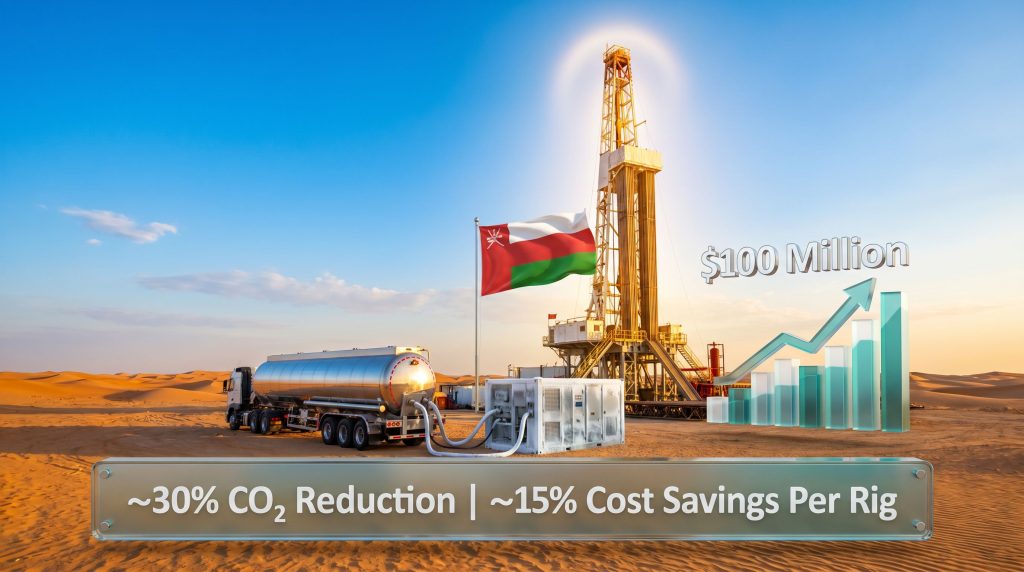
National Gas Company, currently one of Oman's leading LPG distributors and operators of synthetic natural gas systems, is pursuing a proposed investment of approximately $100 million in a small-scale LNG production facility within the Sultanate. The company formalised its intent by signing a Memorandum of Understanding with Abraj Energy Services at the Oman Petroleum and Energy Show in May 2026, establishing the framework for a structured pilot programme.
The project parameters, as currently understood, are as follows:
| Project Parameter | Detail |
|---|---|
| Estimated Capital Investment | ~$100 million |
| Feedgas Source | OQ (Oman's integrated energy company) |
| Primary Off-Taker | Abraj Energy Services |
| Initial Target Market | ~85 drilling rigs |
| Conversion Model | Diesel-to-dual-fuel (LNG/diesel) |
| Projected CO₂ Reduction | ~30% per rig |
| Projected Operating Cost Reduction | ~15% per rig |
| Current Phase | Non-binding pilot feasibility study |
The commercial logic centres on converting diesel-powered generators at active rig sites to dual-fuel systems that run primarily on LNG. Rather than replacing existing generator infrastructure entirely, the approach involves retrofitting existing equipment to accept both fuels, with LNG serving as the primary energy source and diesel retained as a contingency backup.
The Mobile Supply Chain: A Technical Distinction
What separates this proposal from most comparable small-scale LNG initiatives globally is its full mobility requirement. Unlike LNG installations serving fixed industrial sites or stationary mine facilities, the National Gas model must accommodate a supply chain that moves with its customers. Drilling rigs regularly relocate between well sites, sometimes multiple times per year, meaning the entire delivery and regasification infrastructure must be deployable and recoverable on comparable timescales.
The proposed logistics architecture operates across four stages:
- Centralised liquefaction at a dedicated small-scale plant, drawing feedgas from OQ's network
- Cryogenic road transport via insulated tankers capable of maintaining LNG at approximately -162°C during transit
- Portable regasification at each active rig site using mobile vaporisation units
- Dual-fuel combustion in retrofitted generators supplying power to drilling operations
This end-to-end mobile configuration has very limited direct precedent in the GCC oilfield context, giving the project a genuine first-mover dimension within the region. Furthermore, the remote energy design principles applied in comparable sectors offer useful reference points for resolving the logistical complexity involved.
The Stakeholder Architecture: Who Needs This to Work
National Gas Company: Diversifying Beyond LPG
For National Gas, the strategic significance of the National Gas mini-LNG project in Oman extends well beyond the immediate revenue opportunity. The company's existing portfolio is concentrated in LPG distribution and SNG systems — markets facing long-term structural headwinds as Oman's broader energy mix evolves toward cleaner fuels. Successfully establishing a domestic LNG production and distribution capability would:
- Open access to a higher-margin industrial energy segment
- Establish first-mover positioning in Oman's nascent domestic LNG market
- Create a scalable distribution platform applicable beyond oilfield services to remote communities, industrial facilities, and mining operations
- Support a credible corporate repositioning from LPG specialist to integrated gas solutions provider
Abraj Energy Services: The Demand Anchor
Abraj Energy Services brings critical commercial weight to the arrangement. As an operator controlling approximately half of Oman's active drilling rig market, Abraj represents the concentrated, predictable demand base that any small-scale LNG producer requires to justify the capital commitment of building a liquefaction plant. Without an anchor off-taker of this scale, the demand risk for a $100 million infrastructure investment would be very difficult to underwrite.
From Abraj's perspective, the calculus is equally compelling. A projected 15% reduction in per-rig operating costs is meaningful across a large fleet, directly improving margin performance. Simultaneously, a demonstrable 30% reduction in CO₂ emissions per rig supports ESG reporting obligations and may increasingly influence contract awards from oil companies that are themselves under emissions reduction pressure. In addition, the broader decarbonisation benefits observed across comparable industrial transitions suggest these savings could compound meaningfully over time.
OQ and the IGC: The Upstream and Regulatory Enablers
OQ, as the anticipated feedgas supplier, gains a new domestic monetisation channel for gas volumes that would otherwise flow entirely through export infrastructure. The Integrated Gas Company (IGC), meanwhile, holds a critical regulatory function: pricing approval from the IGC has been identified as a prerequisite for the project advancing beyond the pilot phase. This single regulatory milestone is arguably the most consequential near-term determinant of whether the full investment proceeds.
Critical dependency: IGC pricing clearance will establish whether the commercial arithmetic supporting the LNG supply arrangement actually holds at scale. Until this approval is secured, the project's financial viability cannot be confirmed.
What the Pilot Programme Is Designed to Determine
The MoU does not commit either party to constructing the LNG plant. It authorises a structured pilot designed to generate empirical performance data across four evaluation dimensions before any binding investment decision is made:
- Technical feasibility — Whether dual-fuel conversion integrates reliably with existing rig generator configurations under Omani field conditions
- Operational performance — Whether LNG delivers consistent energy output across the variable load demands of an active drilling operation
- Safety parameters — Whether cryogenic LNG handling, storage, and regasification procedures meet the safety standards applicable to live drilling environments
- Commercial viability — Whether the projected cost savings materialise at prevailing gas prices and realistic logistics costs
The pilot outcome will directly determine whether the go/no-go decision on the $100 million plant investment can be supported with sufficient confidence. Key performance thresholds include achieving approximately 30% CO₂ reduction versus diesel baseline, delivering operating cost savings near the 15% target, and completing the pilot period without material safety incidents.
Small-Scale LNG in a Global Context
The National Gas mini-LNG project in Oman is taking shape within a broader international trend toward industrial mini-LNG as a pragmatic decarbonisation tool. Across multiple sectors and geographies, liquefied natural gas has demonstrated commercial viability in situations where pipeline gas is unavailable and full electrification remains economically or technically impractical. Consequently, the energy transition solutions being developed in Oman reflect a growing global pattern of industrial operators seeking workable alternatives to diesel dependency.
| Region | Application | Maturity |
|---|---|---|
| China | LNG heavy trucking fleet | Commercially mature |
| Australia | Remote mine site power generation | Operational at multiple sites |
| Europe | LNG marine bunkering | Rapid growth phase |
| Latin America | Industrial off-grid power | Expanding |
| Oman (proposed) | Mobile oilfield rig fuel | Pilot phase |
The Omani model introduces a layer of complexity absent from most of these comparable cases. Mine-site LNG installations serve fixed locations. Ship bunkering facilities operate at permanent ports. The National Gas proposal must deliver LNG to assets that physically relocate on variable schedules across a desert operating environment. This mobility-first design requirement, if successfully resolved through the pilot, could provide a replicable blueprint for other GCC oilfield operators confronting the same structural challenge.
The next major ASX story will hit our subscribers first
Risk Factors and Scenarios Worth Monitoring
Investor and analyst note: The MoU between National Gas and Abraj Energy Services is explicitly non-binding. No commitment to deploy the $100 million capital investment or construct the LNG facility has been made by either party at this stage. All projections regarding cost savings and emissions reductions are estimates derived from the proposed conversion model and have not yet been validated through operational data.
The key risk dimensions span regulatory, commercial, and technical categories:
- IGC pricing: An unfavourable or delayed pricing determination could undermine the commercial case before construction even begins
- Pilot performance: Technical difficulties or safety incidents during the pilot phase could delay or terminate the full project
- Capital access: Financing $100 million for a first-of-kind domestic LNG facility in Oman will require robust offtake commitments and lender confidence in the mobile logistics model
- Customer concentration: Dependence on a single primary off-taker creates vulnerability if Abraj's rig fleet contracts or the relationship changes
- Diesel price dynamics: A sustained decline in diesel prices would compress the cost-saving rationale that underpins the conversion case
Scenario analysis across these variables produces a range of plausible outcomes, from full plant construction following a successful pilot and IGC approval, through extended feasibility delays, to restructured project scope or abandonment if commercial terms cannot be secured.
The Longer Infrastructure Horizon
If the National Gas mini-LNG project reaches commercial operation, its significance would extend considerably beyond oilfield fuel substitution. The construction of a domestic LNG liquefaction facility, combined with a mobile cryogenic distribution network, would for the first time give Oman the foundational logistics infrastructure required to supply LNG across a much wider range of industrial and community applications. The electrification and decarbonisation pathways being pursued in adjacent industries demonstrate how this kind of infrastructure investment can unlock broader systemic change.
Potential downstream applications of an established domestic LNG distribution capability include:
- Industrial manufacturing clusters located beyond the reach of Oman's existing gas pipeline grid
- Remote population centres currently reliant on diesel or LPG for power and thermal energy
- Mining operations in geographically isolated regions, where Oman LNG infrastructure experience could offer valuable operational insights
- Power generation facilities requiring a cleaner transition fuel ahead of renewable energy buildout
This broader potential transforms what might appear to be a niche oilfield fuel substitution programme into the potential foundation of Oman's first structured domestic LNG market. Such a development would carry lasting implications for the Sultanate's energy infrastructure, industrial competitiveness, and decarbonisation trajectory well beyond the 2040 horizon.
Want to Track the Next Major Energy Transition Opportunity on the ASX?
Discovery Alert's proprietary Discovery IQ model delivers real-time alerts on significant ASX mineral and energy discoveries, instantly cutting through complex market data to surface actionable opportunities — explore historic discoveries that have generated substantial returns and begin your 14-day free trial at Discovery Alert to position yourself ahead of the broader market.