May 20, 2026
When Wildlife Law Meets the Carbon Economy: The Regulatory Forces Reshaping Australian Coal Approvals
Environmental law in Australia is undergoing a quiet but consequential transformation. For decades, conservation challenges to resource projects were fought on narrow, site-specific grounds: a particular wetland, a specific watercourse, a discrete parcel of remnant vegetation. Today, koalas and climate change challenge Hail Creek expansion proceedings in ways that fuse biodiversity protection with climate accountability into a single, compounding regulatory argument. The proceedings before the Queensland Land Court over Glencore's Hail Creek Eastern Margin Extension are among the clearest expressions of this shift, and the outcome could redefine what resource project approval looks like in Australia for years to come.
When big ASX news breaks, our subscribers know first
Understanding the Hail Creek Eastern Margin Extension
Glencore's Hail Creek open-cut coal mine sits within Queensland's Bowen Basin, one of the most productive metallurgical coal regions on the planet. The Eastern Margin Extension is a proposed expansion designed to access additional coal reserves along the mine's eastern boundary, extending operational life through to 2038. Achieving that timeline requires clearing native vegetation across a substantial footprint, a process that has triggered formal objection proceedings in the Queensland Land Court.
The Mackay Conservation Group (MCG) is the primary objector, and the grounds it has advanced are notable for their dual structure. Rather than relying on a single environmental argument, the MCG has woven together two distinct but mutually reinforcing challenges:
- Threatened species harm arising from the proposed clearing of koala habitat within the expansion zone
- Climate incompatibility, arguing that approving new coal extraction contradicts Australia's binding commitments under the Paris Agreement
This integrated approach reflects a maturing in conservation legal strategy that has been building across Australian and international jurisdictions over the past decade.
The Koala Survey Findings: What the Drone Data Revealed
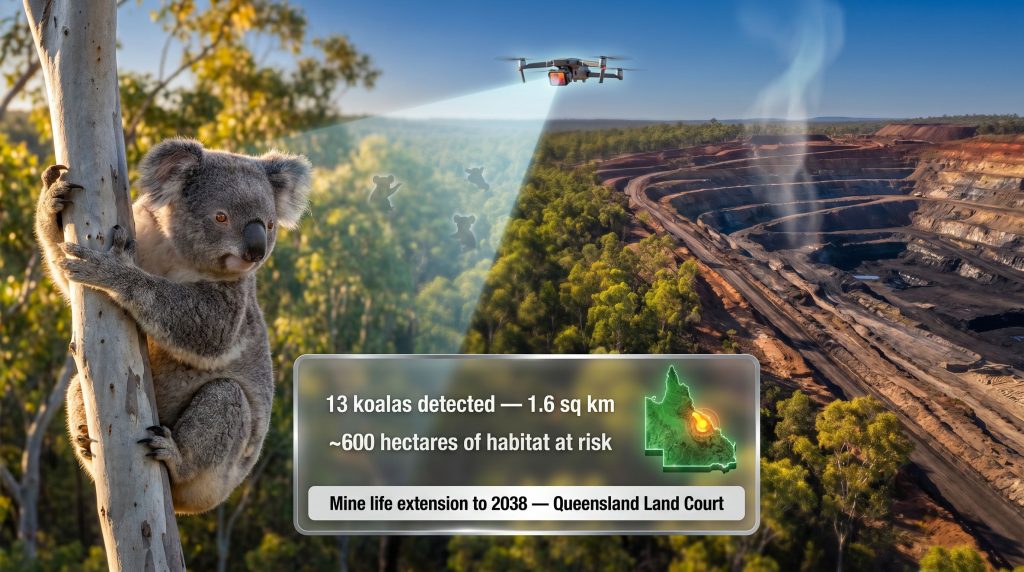
At the centre of the biodiversity argument sits a striking piece of field evidence. Drone-based nocturnal wildlife surveys reportedly detected 13 koalas within approximately 1.6 square kilometres of the proposed clearing zone in a single survey event. Conservation ecologists describe this population density as potentially of national significance, and it is not difficult to understand why. Furthermore, nocturnal drone surveys using thermal imaging technology are now considered among the most reliable methods for detecting arboreal mammals in dense vegetation, and a detection rate of this magnitude within such a compact area is exceptional by any reasonable wildlife monitoring benchmark.
| Survey Metric | Recorded Figure |
|---|---|
| Koalas detected in single nocturnal drone survey | 13 individuals |
| Area surveyed during detection event | ~1.6 sq km |
| Total koala habitat at risk from clearing | ~600 hectares |
| Proposed extension of mine operational life | Through to 2038 |
The ecological significance extends beyond raw numbers. Koalas are what biologists classify as obligate habitat specialists, meaning their survival depends on the presence of specific eucalyptus species for both nutrition and shelter. Unlike more generalist mammals, they cannot easily relocate to alternative vegetation types when their habitat is removed.
Population fragmentation — where clearing divides a connected breeding group into isolated sub-populations — is particularly dangerous because it interrupts genetic exchange, reduces breeding success, and accelerates local extinction risk over multiple generations. Consequently, wildlife translocation programs and habitat offset arrangements, tools that mining proponents frequently propose as mitigation measures, are widely regarded by conservation ecologists as inadequate substitutes for intact habitat retention.
Why the Koala's Federal Status Changes the Legal Calculus
The koala was listed as endangered under Australia's Environment Protection and Biodiversity Conservation Act 1999 (EPBC Act) in February 2022, an uplisting from its previous vulnerable status across much of its range. This classification carries significant legal consequences. Under the EPBC Act, any action likely to have a significant impact on a listed threatened species requires federal environmental approval, irrespective of whether state-level approval processes are already underway.
The drone survey findings — showing a koala population of potentially national significance within the direct clearing footprint — substantially strengthen the argument that the Hail Creek expansion meets the threshold for triggering federal assessment obligations. The MCG has separately called on Australia's federal Environment Minister to pause new coal project assessments in the region pending more comprehensive population surveys, adding a federal dimension to what began as a state-level proceeding.
The Climate Argument: How Emissions Become a Legal Obstacle
The second pillar of the MCG's challenge is analytically more complex but strategically just as important. Conservation groups are advancing what might be described as a biodiversity-climate feedback argument, structured around two interlocking claims.
The first is relatively straightforward: ongoing coal extraction and the combustion of that coal by end users generates greenhouse gas emissions that are inconsistent with Australia's Paris Agreement obligations, and approving new extraction capacity deepens that inconsistency. In addition, the broader coal supply challenges facing the industry make this argument increasingly difficult for regulators to dismiss.
The second claim is more sophisticated. Climate change is not simply a future threat to koalas; it is an active and intensifying pressure on their habitat quality right now. Increasing temperatures, extended drought periods, and more frequent and severe bushfire events are already degrading eucalyptus canopy health across eastern Australia.
Koalas are physiologically vulnerable to heat stress, and the bushfire seasons of 2019–20 were estimated to have killed or displaced tens of thousands of animals across New South Wales and Queensland alone. By approving additional coal extraction, the argument runs, regulators would be accelerating the very climatic pressures that make the species' recovery increasingly difficult. This is precisely why koalas and climate change challenge Hail Creek expansion in such a legally intertwined manner.
This framing is legally significant because it binds the climate question directly to the species protection question, making it harder for decision-makers to treat them as separate considerations.
The Methane Dimension: An Underreported Risk Factor
One dimension of the climate challenge that receives less public attention is the question of fugitive methane emissions from coal mining operations. Methane carries a global warming potential approximately 80 times greater than carbon dioxide over a 20-year timeframe according to the Intergovernmental Panel on Climate Change, and is released during the coal extraction process through a mechanism known as coal seam degassing.
Some environmental researchers and advocacy groups have raised concerns that fugitive methane emissions from operations in the Bowen Basin may be systematically underreported in national greenhouse gas inventories compiled under the National Greenhouse and Energy Reporting (NGER) framework. If this concern has merit, it would mean that the true climate cost of operations like Hail Creek is materially higher than official figures suggest.
"Methane emissions from coal mines represent one of the most significant and least precisely measured sources of greenhouse gas in the Australian resources sector. Improved measurement methodologies, including satellite-based atmospheric monitoring, are beginning to generate data that challenges emissions estimates derived from conventional activity-based calculation methods."
This emerging measurement gap is likely to attract increasing regulatory scrutiny, both within Land Court proceedings and at the federal level under NGER reporting obligations.
The Regulatory Framework: Multiple Layers of Legal Exposure
What makes the Hail Creek challenge structurally significant is the number of distinct regulatory frameworks it engages simultaneously. Understanding the mining permitting realities that underpin these proceedings helps contextualise the scale of legal exposure facing the proponent.
| Regulatory Framework | Relevance to the Hail Creek Proceedings |
|---|---|
| EPBC Act 1999 (Federal) | Koala listed as endangered; significant impact on habitat triggers federal approval requirement |
| Queensland Land Court Act | Primary venue for conservation group objections to mining lease applications |
| Paris Agreement Obligations | Cited by objectors as structurally incompatible with new coal extraction approvals |
| National Greenhouse and Energy Reporting (NGER) Act | Relevant to questions of methane emissions accuracy and completeness |
| Queensland Nature Conservation Act | State-level threatened species protections applicable to koala habitat within Queensland |
| Kunming-Montreal Global Biodiversity Framework (2022) | Australia's commitment to protecting 30% of land areas by 2030 bears on clearing approvals |
The Queensland Land Court has, through earlier proceedings involving other Queensland coal projects, already established that climate change constitutes a legitimate consideration in resource project approval decisions. This precedent is directly applicable to the Hail Creek proceedings and means the climate argument is not a speculative legal novelty — it is an established ground of review. Broader efforts toward mining permit reform in other jurisdictions further illustrate how these approval frameworks are evolving globally.
How Conservation Groups Use the Land Court as a Strategic Tool
It is worth understanding the Land Court's role not just as a legal venue but as a strategic instrument. Conservation groups have learned that formal objection proceedings serve multiple functions beyond the immediate legal outcome:
- They force detailed environmental data onto the public record, including wildlife survey results that might otherwise remain internal documents
- They generate evidentiary foundations that can support subsequent federal review requests or judicial review applications
- They create reputational and ESG pressure on proponents and their institutional investors
- They establish legal precedents that progressively raise the evidentiary bar for future approvals across the sector
Even in cases where the proponent ultimately secures approval, heavily conditioned decisions can impose operational constraints, additional monitoring obligations, and offset requirements that materially affect project economics.
What the Hail Creek Case Signals for the Broader Coal Sector
The Hail Creek proceedings are a leading indicator of where Australian resource project approvals are heading. Several structural trends are converging to make this style of integrated biodiversity-climate challenge both more common and more legally potent, compounding existing coal supply challenges already facing the sector.
Scenario 1: The expansion is approved with limited conditions. This outcome would signal that existing habitat offset frameworks and environmental management plans are sufficient to satisfy threatened species obligations even in the presence of high-density koala populations. Conservation groups would almost certainly escalate to the Planning and Environment Court or pursue federal judicial review. The ESG implications for Glencore among institutional investors with net-zero portfolio mandates would intensify.
Scenario 2: The expansion is refused or heavily conditioned. This outcome would establish that combined biodiversity-climate arguments can succeed in Australian resource proceedings, creating a precedent with sector-wide implications. It would likely accelerate the adoption of pre-lodgement drone wildlife surveys as industry standard practice across Queensland, and could prompt legislative review of how methane emissions from coal mines are quantified under the NGER framework.
Scenario 3: A negotiated outcome with enhanced conditions. The most commercially pragmatic pathway may involve Glencore accepting additional monitoring obligations, expanded offset commitments, and potentially third-party methane emissions verification in exchange for approval. This would not resolve the underlying legal tensions but would defer them.
Disclaimer: The scenario projections above represent analytical frameworks for understanding potential regulatory outcomes and do not constitute financial advice or predictions regarding the commercial prospects of any entity. Investors should conduct independent due diligence.
The next major ASX story will hit our subscribers first
The International Context: Australia Is Not Alone in This Trajectory
The regulatory dynamics playing out at Hail Creek are part of a global pattern. Courts and regulators in the Netherlands, the United Kingdom, and several United States jurisdictions have progressively accepted climate impact as a material consideration in resource project approvals over the past decade. The Dutch Urgenda ruling, the UK Supreme Court's Scope 3 emissions decision regarding the Jackdaw gas field, and a growing body of Australian climate litigation all reflect the same underlying structural shift: the separation between environmental law and climate law is collapsing.
Australia's ratification of the Kunming-Montreal Global Biodiversity Framework in 2022 — which commits signatories to protecting 30% of terrestrial and marine areas by 2030 — adds another layer of international obligation that domestic approval decisions must increasingly account for. These dynamics are further compounded by Australia's resource export challenges, which place additional pressure on both government and industry to navigate competing economic and environmental imperatives.
For mining companies operating in Australia, the lesson from Hail Creek is not that coal projects are impossible to approve. It is that the evidentiary burden, the legal complexity, and the reputational exposure associated with approvals in ecologically sensitive areas are increasing in ways that are structurally irreversible. Pre-lodgement wildlife surveys using drone thermal imaging, independent methane emissions auditing, and integrated biodiversity-climate impact assessments are transitioning from optional risk management tools to practical necessities for any resource project involving native vegetation clearing.
However, the koalas and climate change challenge Hail Creek expansion presents goes beyond a single mine. As mining's geopolitical landscape continues to shift, the intersection of species protection law and climate accountability is becoming a defining feature of resource governance across the region. The koalas detected in that 1.6 square kilometre survey area may ultimately prove to be more consequential to the future of the Hail Creek expansion than any coal price forecast or reserve estimate. In the evolving landscape of Australian resource regulation, that is precisely the point.
Want to Stay Ahead of ASX Mineral Discoveries Navigating Complex Regulatory Landscapes?
Discovery Alert's proprietary Discovery IQ model delivers real-time alerts on significant ASX mineral discoveries, instantly translating complex mineral data into actionable investment insights — ideal for investors tracking how shifting regulatory frameworks are reshaping resource project economics. Explore historic discoveries and their market-defining returns, then begin your 14-day free trial at Discovery Alert to position yourself ahead of the broader market.