June 23, 2026
Advanced Sensor Networks Drive Mining Automation Revolution
Modern mining operations increasingly depend on sophisticated sensor architectures to maintain competitive advantages in global commodity markets. The Komatsu autonomous haul truck revolutionises traditional extraction processes through AI in mining automation and advanced positioning technologies. While traditional mining relied heavily on human operators making split-second decisions in challenging environments, contemporary autonomous systems integrate multiple technological layers to deliver consistent operational performance across diverse geological conditions.
The evolution from manual to automated haulage represents more than simple technological substitution. It fundamentally restructures how mining companies approach production planning, workforce deployment, and capital allocation strategies. Understanding these transformation patterns provides crucial insights for investors analyzing mining industry evolution and equipment manufacturers positioning for future market opportunities.
When big ASX news breaks, our subscribers know first
Core Technologies Enabling Autonomous Mining Operations
Autonomous haulage systems integrate multiple technological components working in coordinated fashion to replace human decision-making capabilities. These systems must process real-time environmental data while maintaining precise navigation accuracy across changing operational conditions. Furthermore, data-driven operations enable continuous optimisation of fleet performance and route planning.
Primary System Architecture Components:
- High-precision GPS navigation providing centimeter-level positioning accuracy across mine sites
- Multi-spectrum obstacle detection arrays incorporating radar, LiDAR, and camera systems
- Vehicle control integration units managing throttle, steering, and braking responses
- Mesh communication networks enabling real-time fleet coordination and traffic management
- Machine learning processing capabilities for route optimization and predictive maintenance scheduling
Safety Integration Protocols
The technological foundation includes multiple redundancy layers designed to prevent operational failures. Automatic emergency stopping activates when obstacles appear within predetermined safety zones, while redundant sensor systems provide backup detection capabilities if primary systems experience malfunctions.
Remote monitoring infrastructures allow human operators to oversee autonomous fleets from centralised control facilities, maintaining supervisory authority over automated decision-making processes. Geofenced operational boundaries prevent vehicles from operating outside designated areas, creating additional safety margins around human work zones. In addition, these protocols contribute to boosting autonomous safety across mining operations globally.
Komatsu's Market Leadership Position Through FrontRunner Platform
The FrontRunner Autonomous Haulage System represents the mining industry's longest-running commercial autonomous platform, having launched initial operations in 2008. This extended operational history provides Komatsu with substantial competitive advantages through accumulated performance data and refined system capabilities.
Verified Deployment Metrics:
| Performance Indicator | Verified Figure | Source |
|---|---|---|
| Total autonomous trucks commissioned | 1,000 units | Metal Tech News, April 21, 2026 |
| Cumulative material moved | 11.5 billion metric tons | Metal Tech News, April 21, 2026 |
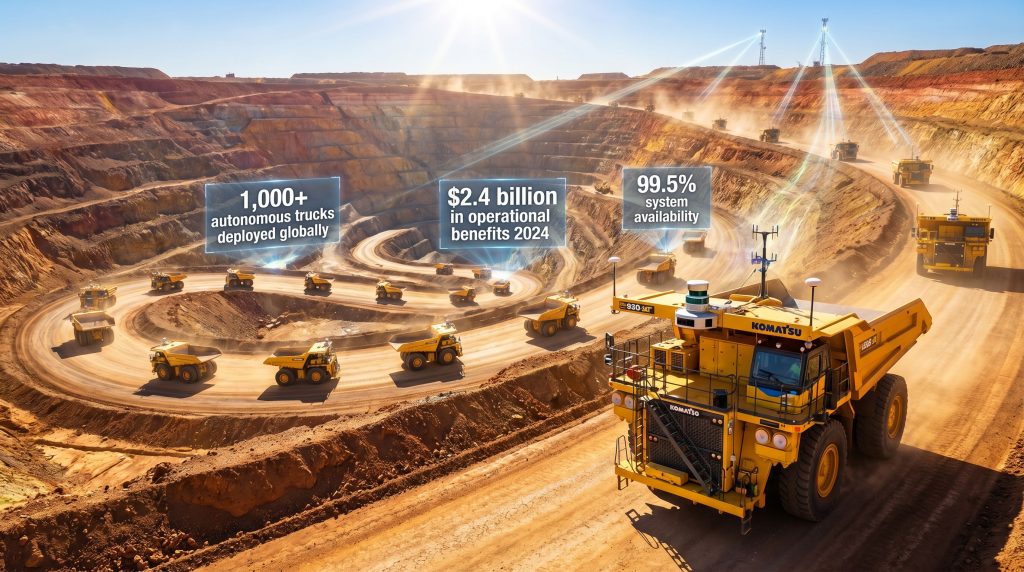
| Economic benefits delivered (2024) | $2.4 billion | Metal Tech News, April 21, 2026 |
| Komatsu 930E models deployed | 500+ units | Metal Tech News, April 21, 2026 |
| Latest deployment capacity | 290 metric tons per load | Metal Tech News, April 21, 2026 |
Technology Platform Evolution
Komatsu's 930E platform represents the company's most widely deployed Komatsu autonomous haul truck configuration across global mining operations. The latest 930E-5AT variant demonstrates ultra-class electric-drive capabilities, supporting 290 metric tons per load while maintaining autonomous navigation precision.
Peter Salditt, president of Komatsu's Mining Business Division and CEO of Komatsu Mining Corporation, emphasised that reaching 1,000 autonomous trucks reflects nearly two decades of innovation and collaboration with mining customers focused on creating operational value.
Recent deployment at Barrick's Nevada Gold Mines represents Komatsu's strategic expansion into gold mining operations, demonstrating platform adaptability across different commodity extraction processes.
Strategic Mining Applications and Operational Suitability
Autonomous haulage technology delivers optimal performance in specific operational environments where consistent material movement patterns align with technological capabilities. Understanding these suitability factors helps mining companies evaluate deployment opportunities and potential return on investment scenarios.
Optimal Operational Characteristics:
- Large-scale open-pit configurations with established haul road networks supporting predictable traffic patterns
- Continuous production requirements demanding 24/7 material movement without operational interruptions
- Remote geographical locations where recruiting and retaining qualified operators presents ongoing challenges
- High-volume extraction sites where production consistency directly impacts profitability margins
Geographic Deployment Distribution
FrontRunner systems currently operate across four major mining regions: North America, South America, Australia, and Europe. This geographic diversity demonstrates platform adaptability to varying regulatory frameworks, geological conditions, and operational requirements.
Mark Hill, Barrick Gold President and CEO, noted that FrontRunner implementation at Nevada Gold Mines has elevated both workforce quality and production goal achievement. The system enables transitioning operators away from haulage activities toward safer, more skilled roles while supporting energy efficiency improvements and environmental footprint reduction.
Economic Impact Analysis and Financial Performance
Autonomous haulage systems generate economic benefits through multiple operational improvement categories. The $2.4 billion in benefits delivered during 2024 encompasses safety performance gains, asset utilisation improvements, energy efficiency optimisation, and emissions performance enhancement. Similarly, AI mill optimization contributes to overall operational efficiency improvements.
Direct Economic Benefit Categories:
- Safety cost avoidance through reduced accident rates and insurance claims
- Asset utilisation optimisation enabling higher equipment availability and productivity
- Energy efficiency gains from optimised driving patterns and reduced fuel consumption
- Emissions performance improvements supporting environmental compliance and carbon reduction targets
Operational Productivity Enhancements
Autonomous systems enable continuous operations without shift changes, meal breaks, or operator fatigue considerations. This operational consistency supports more predictable production planning and improved customer delivery commitments.
Predictable cycle times allow mining companies to develop more accurate production forecasts, while optimised route efficiency minimises unnecessary travel distances and reduces overall fuel consumption patterns.
Implementation Challenges and Strategic Solutions
Deploying autonomous haulage systems requires addressing multiple technical, regulatory, and organisational considerations. Mining companies must navigate complex integration processes while maintaining existing production commitments throughout transition periods.
Technical Integration Requirements:
- Infrastructure development including communication networks and maintenance facilities
- System integration with existing mine management and production planning software
- Fleet transition planning balancing autonomous and human-operated equipment during deployment phases
- Workforce development programmes preparing employees for technology oversight and maintenance roles
Regulatory Compliance Considerations
Mining authority approvals require demonstrating autonomous system safety performance meeting or exceeding established industry standards. Emergency response procedures must address potential autonomous system failures while maintaining worker safety protocols.
Insurance coverage adaptations become necessary as traditional policies may not adequately address unmanned vehicle operations and associated liability considerations.
The next major ASX story will hit our subscribers first
Next-Generation Autonomous Technology Development
Komatsu advances next-generation autonomous mining equipment through software-defined vehicle strategies built around unified vehicle and autonomy platforms. This architectural approach enables future mining machines to evolve over time while adapting to site-specific operational conditions.
Software-Defined Vehicle Strategy
Future autonomous platforms will support over-the-air updates enabling continuous capability enhancement without requiring physical equipment modifications. This approach reduces total cost of ownership while extending equipment operational lifespans through software-based improvements.
Unified autonomy systems will integrate multiple equipment types within coordinated fleet management frameworks, optimising material flow patterns across entire mining operations rather than individual vehicle efficiency.
Expanding Equipment Applications:
- Autonomous water trucks for dust suppression and road maintenance activities
- Remote-operated bulldozers supporting material handling and infrastructure development
- Integrated fleet coordination managing multiple autonomous vehicle types through centralised control systems
- Predictive maintenance integration reducing unplanned equipment failures through advanced analytics
Global Deployment Patterns and Regional Analysis
Autonomous haulage deployment varies significantly across global mining regions based on regulatory frameworks, infrastructure development, and operational requirements. Understanding these regional patterns provides insights into future expansion opportunities and technology adoption trends.
Regional Deployment Characteristics:
| Region | Primary Commodities | Implementation Drivers | Key Advantages |
|---|---|---|---|
| Australia | Iron ore, coal | Labour shortage mitigation | Established mining infrastructure |
| North America | Copper, gold | Safety performance enhancement | Advanced technology adoption frameworks |
| South America | Copper, iron ore | Production consistency requirements | Large-scale open-pit suitability |
| Europe | Various minerals | Environmental compliance support | Regulatory leadership development |
Performance Benchmarking Insights
Leading Komatsu autonomous haul truck units achieve over 100,000 autonomous operating hours individually, demonstrating technology maturity and operational reliability. System availability exceeds 99% during optimal operating conditions, supporting consistent production planning requirements.
Zero fatalities have been recorded in autonomous haulage operational zones since commercial deployment began, representing significant safety performance improvements compared to human-operated equivalent operations.
Strategic Drivers for Autonomous Technology Adoption
Mining companies accelerate autonomous haulage adoption driven by multiple strategic considerations extending beyond simple cost reduction objectives. These drivers reflect fundamental changes in mining industry competitive dynamics and operational requirements.
Primary Strategic Motivations:
- Workforce availability challenges in remote mining locations where recruiting qualified operators becomes increasingly difficult
- Safety performance requirements removing human workers from hazardous operational environments
- Operational consistency demands supporting predictable production commitments to customers
- Environmental performance objectives through optimised fuel consumption and reduced emissions
Competitive Advantage Development
Production consistency enables mining companies to develop more reliable customer delivery commitments, supporting premium pricing opportunities during commodity market volatility. Scalability potential allows rapid production increases during favourable commodity price cycles without proportional workforce expansion requirements.
Technology differentiation attracts investment capital and strategic partnership opportunities, while future-proofing operations against evolving industry standards and regulatory requirements.
Operational Integration and Workforce Transformation
Successful autonomous haulage implementation requires comprehensive organisational change management addressing workforce transitions, operational procedure modifications, and performance measurement updates. These integration challenges extend beyond pure technology deployment considerations.
Workforce Evolution Patterns
Operator roles evolve from direct equipment operation toward system monitoring, maintenance coordination, and exception handling responsibilities. This transition requires extensive retraining programmes while maintaining existing operational commitments during deployment phases.
Cultural adaptation strategies must address technology-resistant attitudes within traditional mining communities while demonstrating tangible benefits for worker safety and career development opportunities.
Performance Measurement Adaptations
Traditional productivity metrics focusing on individual operator performance become replaced by fleet-level efficiency measurements and system availability indicators. Production planning processes incorporate autonomous fleet capabilities while maintaining flexibility for manual intervention during exceptional circumstances.
Maintenance scheduling optimisation leverages predictive analytics capabilities inherent in autonomous systems, reducing unplanned downtime while extending equipment operational lifespans through consistent operating parameters.
Please note that autonomous haulage technology deployment involves inherent risks including technical system failures, regulatory changes, and workforce transition challenges. Mining companies should conduct comprehensive feasibility studies and risk assessments before committing to autonomous system implementations. Performance projections are based on historical data and may not reflect future operational conditions or technological developments.
Looking to Position Your Portfolio for Mining Technology Transformation?
Discovery Alert's proprietary Discovery IQ model delivers real-time alerts on significant ASX mineral discoveries, including companies advancing autonomous mining technologies and next-generation extraction processes. Subscribers receive instant insights into actionable trading and investment opportunities across the mining automation sector, ensuring quick and informed decisions ahead of broader market recognition. Begin your 14-day free trial today to gain a market-leading edge in identifying tomorrow's mining technology leaders.