June 23, 2026
The Resource-Rich Trap: Why Venezuela's Investment Story Defies Simple Narratives
Across the history of emerging markets, few patterns repeat as reliably as the resource-rich trap: a nation holding extraordinary natural wealth that remains structurally inaccessible to productive capital because the institutional architecture required to unlock it has either collapsed or never fully formed. Venezuela represents perhaps the most extreme version of this dynamic in the Western Hemisphere today. Its hydrocarbon reserves are the largest on the planet by official estimates, its mineral endowment spans gold, copper, coltan, diamonds, and rare earth elements, and its hydroelectric infrastructure anchors one of the region's most significant power generation assets. Yet none of this translates automatically into investable opportunity.
The question of Venezuela foreign investment before the end of the Trump administration sits at the intersection of geopolitics, macroeconomic fragility, legal uncertainty, and sectoral readiness. Understanding it requires disaggregating each of these dimensions rather than collapsing them into a single headline narrative.
When big ASX news breaks, our subscribers know first
The Macroeconomic Scorecard: Reading the Numbers Honestly
Six months after the departure of Nicolás Maduro from office, Venezuela's macroeconomic data paints a picture that is fundamentally at odds with early optimism. When the political transition began, the initial market response was encouraging: the parallel exchange rate fell sharply, and some analysts projected that economic normalisation would follow quickly. The subsequent data has not validated that interpretation.
According to analysis published by BNamericas in June 2026, the official exchange rate moved from 301 bolivars per US dollar in January to 587 bolivars by May, representing a depreciation of approximately 95% in under five months. The parallel market rate had reached approximately 800 bolivars per dollar, signalling persistent dual-market distortion that creates serious complications for multinational treasury operations.
The broader monetary picture compounds the concern:
| Indicator | Data Point | Investor Implication |
|---|---|---|
| Official exchange rate shift (Jan–May 2026) | 301 to 587 bolivars/USD (~95% depreciation) | Return projections become unreliable within months |
| Parallel market rate | ~800 bolivars/USD | Dual-market distortion persists |
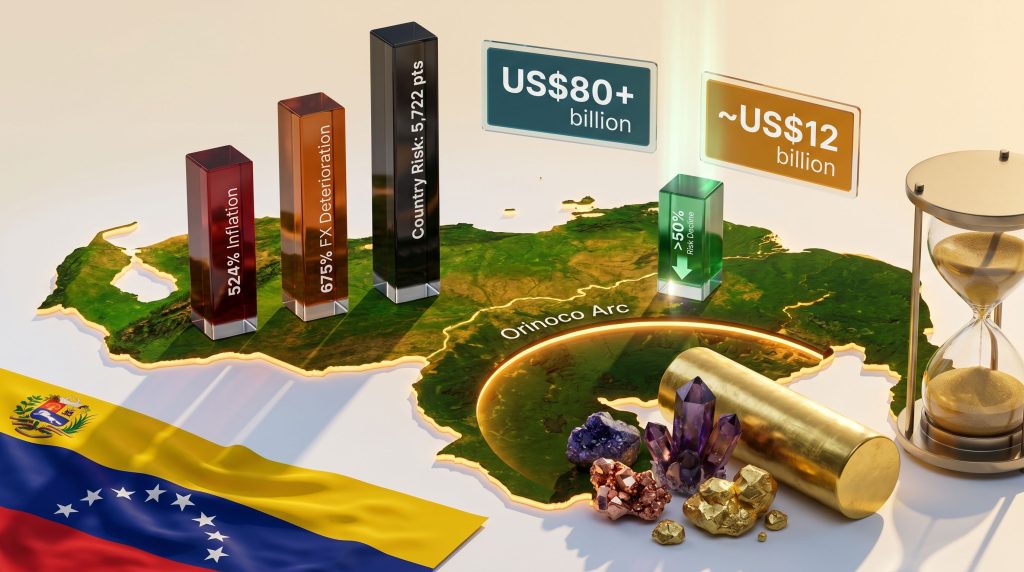
| Annual inflation rate | ~524% | Contract values and real asset pricing erode continuously |
| Monetary liquidity growth (year-on-year) | ~629% | Unsustainable fiscal expansion signalled |
| Exchange rate annual deterioration | ~675% | Profit repatriation becomes structurally unpredictable |
| Country risk index (May 2026) | 5,722 points | Highest sovereign risk in Latin America |
| Country risk improvement since February 2026 | ~29% decline from 8,116 points | Directionally positive, structurally insufficient |
| Country risk improvement year-to-date | Over 50% decline | Encouraging trend, not yet an institutional mandate threshold |
Why Improving Risk Metrics Do Not Yet Translate Into Capital Flows
A critical distinction that sophisticated investors must understand is the difference between a declining country risk index and a country risk index that has crossed the threshold required for institutional capital mandates. Many institutional funds, pension vehicles, and development finance institutions operate under compliance frameworks that exclude jurisdictions above a defined sovereign risk ceiling. Venezuela at 5,722 points remains far above the range where most compliance departments can authorise new exposure.
Compounding this is Venezuela's continued presence on high-risk financial monitoring lists maintained by international bodies. This status creates transactional friction even when political sentiment improves: correspondent banks apply enhanced due diligence requirements, international payment systems route transactions through additional compliance layers, and legal counsel in third-country jurisdictions often advises clients to avoid contractual exposure to Venezuelan counterparties regardless of the underlying commercial logic.
Investor Framework: The gap between a country's risk trajectory and its investable status is not linear. A country risk index declining from 8,000 to 5,700 may generate positive news coverage while still leaving the jurisdiction well outside the parameters of any institutional investment mandate.
How U.S. Sanctions Architecture Shaped the Investment Baseline From 2017 Onward
A fundamental error in much of the current analysis of Venezuela's investment opportunity is the conflation of two entirely distinct periods of U.S. policy. The Trump administration's 2026 re-engagement posture bears no resemblance to the sanctions escalation that characterised 2017 through 2021. Treating these as a single coherent policy arc produces dangerous miscalculations for any capital allocator. Furthermore, US policy on PDVSA has shifted considerably across administrations, making historical comparisons particularly complex.
The sanctions escalation timeline unfolded in clear stages:
-
2017: Initial financial market restrictions targeting PDVSA debt transactions, preventing U.S. entities from participating in new Venezuelan government or PDVSA bond issuances.
-
January 2019: OFAC formally designated PDVSA, blocking all U.S.-sourced income flows to the state oil company and effectively severing Venezuela's primary revenue conduit from U.S. dollar liquidity.
-
August 2019: Executive orders imposed a comprehensive block on all Venezuelan government property and interests within U.S. jurisdiction, extending the sanctions architecture into a near-total embargo.
-
By January 2021: Venezuela had been classified as effectively uninvestable by the full spectrum of major institutional capital allocators. The combination of the sanctions framework and Venezuela's own legal requirements for foreign operators created a dual compliance barrier of exceptional severity.
Venezuelan law mandates that PDVSA retain a minimum 50% equity stake in any joint venture covering oil exploration, production, or transportation. For U.S. companies, partnering with a sanctioned state entity while simultaneously complying with OFAC requirements was legally impossible for any operation beyond the narrowly licensed exceptions. Chevron remained the sole significant U.S. energy operator in Venezuela throughout this period, operating under a specific and heavily restricted licence that permitted only limited maintenance activities rather than new investment.
The expropriation legacy amplified this deterrent. ConocoPhillips, whose Venezuelan assets were nationalised under Hugo Chávez, has pursued international arbitration claims valued at approximately US$12 billion for well over a decade. According to the Council on Foreign Relations, this figure has become a reference benchmark for how the market prices historical expropriation risk in Venezuela and continues to shape investor psychology in 2026.
Sectoral Opportunities: Where the Capital Requirement Is Real and Enormous
Setting aside the macroeconomic and legal constraints for a moment, Venezuela's sectoral investment requirements are genuinely extraordinary in scale. The opportunity is not hypothetical; the capital need is structural, measurable, and in many cases urgent.
Energy Infrastructure: The Largest Single Capital Requirement
Venezuela's electricity system has deteriorated to a condition that imposes severe economic costs on every productive sector. In the interior of the country, power outages lasting between eight and ten hours per day are a routine operational reality for businesses and households alike. The rehabilitation and modernisation of the transmission network and maintenance infrastructure is estimated to require more than US$80 billion in capital investment, according to sectoral analysis reported by BNamericas.
The Venezuela power crisis has placed the Guri hydroelectric dam at the centre of any credible recovery plan. As one of the largest hydroelectric facilities in the world by installed capacity, Guri represents an anchor point for any grid reconstruction programme. Its continued operation provides a foundation upon which a broader rehabilitation programme could be built, however the surrounding transmission and distribution infrastructure requires fundamental reconstruction rather than incremental maintenance.
Natural gas processing and fuel pipeline rehabilitation represent additional capital verticals within the energy sector, each capable of absorbing multi-billion-dollar investment programmes independently.
Oil and Gas: Rehabilitation Over Greenfield
Venezuela's crude oil production has collapsed from a peak exceeding 3 million barrels per day to a fraction of that capacity. The investment thesis here is not about discovering new resources; it is about restoring operational capacity above known reserves that already exist. This distinction matters enormously for how capital expenditure programmes are structured and evaluated.
The 50% PDVSA joint venture requirement remains in force, which means that any foreign operator entering this sector must structure equity arrangements around a state partner that carries significant operational, financial, and reputational complexity. This does not make the opportunity unworkable, but it shapes the deal structure and risk profile in ways that require specialist legal and commercial expertise.
Critical Minerals and the Orinoco Arc
Venezuela's Orinoco Mining Arc is one of the most resource-rich and least formally developed mineral territories in Latin America. Confirmed resources include gold, copper, coltan, diamonds, and rare earth elements. The growing critical minerals demand from Western economies seeking to reduce dependence on Chinese rare earth processing capacity has consequently placed the Orinoco Arc under renewed strategic scrutiny.
The Venezuelan Armed Forces have conducted what have been described as clean-up operations in Bolívar state, which some analysts interpret as a precursor to formalising mining concession frameworks in areas previously dominated by illegal extraction. However, the environmental legacy of years of unregulated artisanal and illegal mining in the Orinoco Arc is substantial. Transitioning workers who currently operate outside formal regulatory frameworks into licensed operations requires training programmes, legal restructuring, environmental remediation planning, and the development of enforcement capacity that does not yet exist at scale.
Investor Caution: International mining companies have expressed interest in the Orinoco Arc, but the absence of formal tender processes, combined with unresolved environmental liabilities from illegal extraction, means that physical capital deployment remains a medium-term prospect. The gap between expressed interest and barges unloading extraction equipment is considerably wider than market commentary often suggests.
Infrastructure, Water, and Transit: The Underappreciated Capital Sink
Beyond the headline sectors of oil and mining, Venezuela carries an enormous rehabilitation requirement across urban and civil infrastructure:
- Metro and rail systems: Existing metro networks in major urban centres require significant capital for restoration; unfinished rail corridor projects represent greenfield-equivalent opportunities.
- Drinking water and wastewater treatment: Treatment plant rehabilitation is an urgent public health requirement across major population centres, representing a less glamorous but financially substantial investment category.
- Highway and road networks: Foundational infrastructure for any economic recovery, with supply chain normalisation dependent on restoring road connectivity across the country's diverse geography.
- Tourism infrastructure: Structurally underdeveloped relative to Venezuela's natural and cultural endowment, representing a genuine greenfield opportunity that would become accessible under conditions of political stability.
The Three-Phase Framework: Roadmap or Aspiration?
The Trump administration has publicly articulated a three-phase model for Venezuela's transition: stabilisation, economic growth, and political transition. Each phase is supposed to build the conditions required for the next. The difficulty is that six months into the post-Maduro period, measurable progress against Phase 2 and Phase 3 milestones remains difficult to verify independently.
The administrative structure in Caracas has undergone cabinet reshuffles and personnel changes, but these have been characterised more as organisational continuations than structural transformations. The National Assembly remains dominated by the incumbent political forces that operated under the previous government. New laws have been passed targeting investment facilitation across energy, mining, and infrastructure sectors, but legislative activity and institutional enforcement capacity are different things entirely.
| Dimension | Current Status | Investor Requirement |
|---|---|---|
| Legislative reform | Active: multiple new laws passed | Necessary but insufficient on its own |
| Judicial independence | Structurally compromised | Critical for contract enforcement |
| Expropriation compensation | Unresolved: major claims outstanding | Required before large-scale commitment |
| International arbitration compliance | Inconsistent track record | Threshold condition for institutional capital |
| Environmental regulatory framework | Underdeveloped, especially in mining | Required for ESG-compliant capital |
The Sustainability Problem
The central concern that serious investors raise is not whether Venezuela is reforming today; it is whether those reforms will survive the transition to a post-Trump U.S. administration. The Trump administration's geopolitical engagement with Venezuela's transition is widely perceived as the primary external guarantor of reform momentum. When that sponsorship expires, the durability of legal protections for foreign assets becomes genuinely uncertain.
ConocoPhillips' approximately US$12 billion in unresolved compensation claims from past asset confiscations serves as the defining benchmark for how this risk is priced. Every new foreign investor considering capital deployment in Venezuela is implicitly asking whether they could find themselves in an equivalent position a decade from now. Without a structured framework for resolving existing expropriation claims, the message sent to prospective investors is that the legal system does not yet provide the guarantees that large-scale, multi-decade capital commitments require. In this respect, strategic minerals deals negotiated elsewhere offer a contrasting model of how geopolitical frameworks can provide durable legal scaffolding for capital deployment.
What Would Genuine Political Transition Actually Unlock?
Analysing the scenarios with appropriate rigour means distinguishing between the current constrained environment and a hypothetical post-transition baseline.
Under current conditions, investor interest is significant but capital deployment is minimal. A credible, internationally recognised political transition that produced durable legal guarantees would activate a fundamentally different dynamic. Country risk compression toward the 1,500 to 2,500 point range seen in comparable post-transition economies would shift Venezuela from a compliance-excluded jurisdiction to one that institutional investors could actively consider.
The resource endowment that would underpin this investment surge is genuinely exceptional. Venezuela holds:
- The world's largest proven crude oil reserves by official estimates
- One of Latin America's largest undeveloped critical mineral territories in the Orinoco Arc
- A world-class hydroelectric asset in the Guri dam
- Substantial arable land and agricultural potential that has been almost entirely neglected
- Tourism assets ranging from Caribbean coastline to Andean terrain to Amazonian biodiversity
Post-transition investment acceleration in comparable resource-rich emerging markets has historically followed a pattern of rapid initial capital inflow into the highest-return sectors, typically hydrocarbons and mining, followed by a secondary wave of infrastructure and services investment as macroeconomic conditions normalise. Venezuela's case could follow a similar trajectory, but only if three conditions are met before the current political window closes. Indeed, broader mining geopolitics suggest that the window for securing strategic resource agreements is narrowing globally, adding further urgency to the Venezuelan timeline.
The next major ASX story will hit our subscribers first
Three Conditions That Must Converge
Based on a comprehensive reading of current economic indicators, legal frameworks, and geopolitical dynamics, the following conditions represent the minimum threshold requirements for meaningful Venezuela foreign investment before the end of the Trump administration to materialise:
-
Political transition consolidation: A credible governance change that produces durable, internationally recognised legal guarantees extending beyond the tenure of any single U.S. administration.
-
Expropriation liability resolution: A structured and transparent framework addressing outstanding international arbitration claims, beginning with high-profile cases that serve as benchmarks for the entire investor community.
-
Macroeconomic stabilisation: Sustained reduction in inflation toward double-digit annual rates, convergence of the official and parallel exchange rates, and removal from high-risk financial monitoring classifications that currently restrict correspondent banking access.
Macroeconomic signals that would indicate Venezuela is approaching investment readiness include annual inflation declining below 100% on a sustained basis, a country risk index falling below 3,000 points, official and parallel exchange rates converging within a meaningful range, and the resolution of at least one major international expropriation arbitration claim through a recognised international process. As the BBC has reported, the pace at which these conditions materialise will ultimately determine whether the current political window translates into lasting economic change.
Strategic Assessment: Venezuela's resource endowment is not in question. The analytical challenge is whether the political and legal infrastructure can be sufficiently entrenched before the Trump administration's sponsorship of the transition expires. That question, as of mid-2026, does not yet have a definitive answer. Investors should treat the current environment as a monitoring phase rather than a deployment phase, with the exception of highly specialised operators who can structure operations within the narrow compliance windows that currently exist.
Disclaimer: This article is intended for informational purposes only and does not constitute financial or investment advice. Forward-looking statements involve significant uncertainty. Investors should conduct independent due diligence and seek qualified professional advice before making any capital allocation decisions related to Venezuela or any other emerging market jurisdiction. All statistics cited are sourced from publicly available reporting as of mid-2026 and are subject to change.
Want to Stay Ahead of the Next Major Mineral Discovery Before the Broader Market Notices?
While Venezuela's resource story remains a monitoring phase for most capital allocators, actionable mineral discovery opportunities continue to emerge across the ASX right now — and Discovery Alert's proprietary Discovery IQ model delivers real-time alerts the moment significant discoveries are announced, turning complex geological data into clear, immediately actionable insights. Explore what historic discoveries have returned for early investors on Discovery Alert's dedicated discoveries page, and begin your 14-day free trial today to position yourself ahead of the market.