June 23, 2026
The Quiet Revolution Reshaping How America Completes Its Gas Wells
Hydraulic fracturing has always been fuel-hungry. For decades, the completion phase of a shale well's life meant convoys of diesel trucks, thundering combustion engines, and a logistical operation that rivalled a small military campaign. That model is now under sustained pressure from multiple directions simultaneously: volatile diesel prices, tightening emissions scrutiny, ESG-driven capital allocation, and the steady maturation of electric fracturing technology. The convergence of these forces is pushing basin-by-basin adoption of electrified completions at a pace that would have seemed speculative just five years ago.
The Seneca and Evolution e-frac agreement in Appalachia, announced in June 2026, sits squarely within this broader transformation. However, understanding why it matters requires more than reading the headline. It requires examining the technical architecture behind the deal, the structural advantages Appalachia offers for this technology, and what a three-year commitment signals about where the completion services industry is heading.
When big ASX news breaks, our subscribers know first
Understanding the Partnership: What Was Actually Agreed
A Three-Year Framework Built Around Infrastructure Integration
At its core, the Seneca and Evolution e-frac agreement in Appalachia is a multi-year operational commitment structured around a specific technical thesis: that Seneca's existing natural gas production and gathering infrastructure can serve as the fuel backbone for Evolution's electric fracturing fleet, creating a closed-loop efficiency system that neither party could achieve independently.
Under the agreement, Evolution Well Services will deploy its electric fracturing technology, field gas conditioning capabilities, and power generation systems across Seneca's Appalachian acreage. Seneca, as the exploration and production arm of National Fuel Gas Company and one of the largest natural gas producers operating in the Appalachian Basin, provides the raw material that powers the entire system: field-produced natural gas that, once conditioned, replaces the diesel traditionally required for high-pressure hydraulic fracturing operations.
Three-year service agreements in the completion sector are not standard practice in a capital-disciplined environment where operators typically prefer flexibility. A commitment of this length signals genuine confidence in both the economic thesis and the technology's operational maturity. Furthermore, it suggests that both parties have stress-tested the fuel logistics model against real-world Appalachian operating conditions rather than controlled pilot scenarios.
How Electric Fracturing Actually Works in a Gas Basin
From Wellsite Gas to High-Pressure Pump: The Technical Chain
Electric fracturing replaces the diesel-combustion engines of a conventional frac fleet with electric motors, which are driven by onsite power generation rather than a direct-drive mechanical connection to a fuel source. In a gas-rich basin like Appalachia, that power generation can be fuelled by natural gas produced at or near the wellsite itself, creating a fundamentally different cost and emissions structure compared to trucking diesel to remote locations.
The process involves several steps that are easy to underestimate in complexity:
- Raw wellsite gas is drawn from Seneca's production infrastructure and gathering system.
- Gas conditioning equipment processes the raw stream to remove impurities, liquids, and contaminants that would otherwise damage turbines or generators.
- The conditioned gas fuels onsite generators that produce electrical power.
- That electrical power drives Evolution's high-pressure electric pumps, which push fracturing fluid into the formation at the pressures required to create and propagate fractures in Marcellus and Utica shale rock.
- Real-time operational data captured during each fracturing stage feeds back into completion design decisions for subsequent stages.
Gas conditioning is often the least-discussed component of e-frac operations, yet it is technically critical. Raw Appalachian gas, particularly from deep Utica wells, can carry a complex mixture of heavier hydrocarbons, water vapour, and trace contaminants. Inadequate conditioning creates equipment reliability problems that erode the uptime advantages e-frac is supposed to deliver. Evolution's in-house conditioning capability is therefore not peripheral to the partnership; it is structurally essential.
Why Appalachia Is Technically Suited to This Model
Not every basin offers equally favourable conditions for gas-powered e-frac. The economic and operational case depends heavily on whether a producer has the midstream infrastructure to supply conditioned gas reliably to a moving frac spread. Appalachia, particularly within Seneca's acreage footprint, has a critical advantage here. In addition, natural gas price trends in 2025 have reinforced the financial logic of reducing diesel dependency in favour of field gas-powered operations.
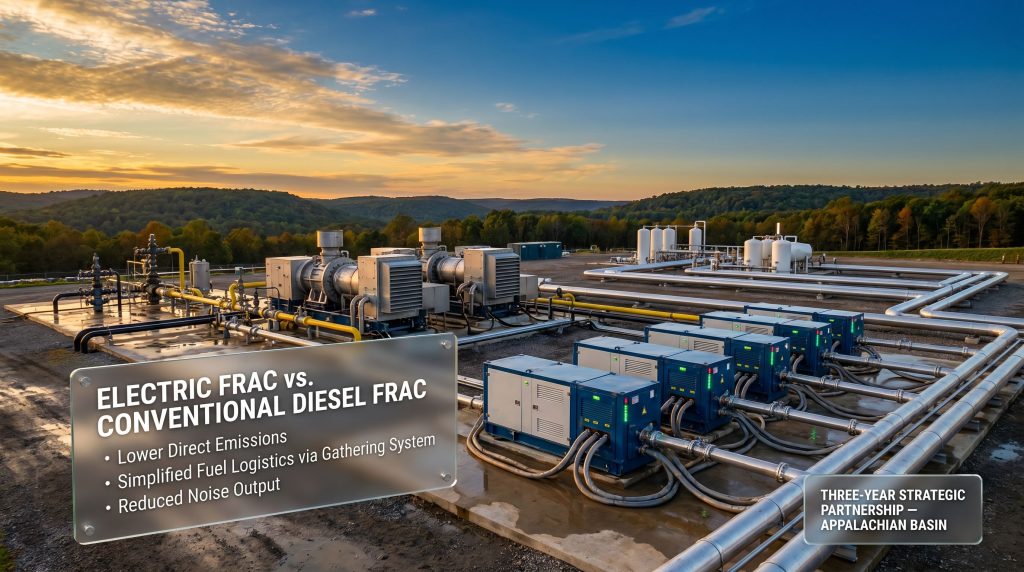
| Feature | Conventional Diesel Frac | Electric Frac (Field Gas-Powered) |
|---|---|---|
| Primary Fuel Source | Diesel (trucked in) | On-site natural gas |
| Emissions Profile | Higher NOx, particulate matter | Lower direct combustion emissions |
| Fuel Logistics | Complex, weather-dependent | Simplified via gathering system |
| Noise Output | High (engine combustion) | Reduced (electric motors) |
| Real-Time Data Integration | Limited | High (stage-by-stage optimisation) |
| Total Cost of Ownership | Higher over multi-well programs | Lower with infrastructure in place |
Seneca's gathering system integration is the structural differentiator that makes this model work at scale in Appalachia. Basins without equivalent midstream buildout face significantly higher barriers to gas-powered e-frac adoption because the fuel supply chain must be constructed from scratch or simulated using compressed natural gas trailers, which reduces the cost advantage.
The Efficiency and Cost Case: Why This Makes Economic Sense
Deconstructing the Total Cost of Ownership Argument
The economic argument for the Seneca-Evolution model operates across several cost dimensions simultaneously, which is part of why it is difficult to evaluate using single-variable comparisons.
- Diesel elimination: Diesel represents a major variable cost in conventional completion operations. By substituting field gas, Seneca removes exposure to diesel price volatility, which has historically been one of the most unpredictable cost line items in completion budgets. The US natural gas forecast for 2025 and beyond further supports the case for locking in field gas as a structurally lower-cost fuel source.
- Logistics simplification: Fewer diesel truck movements reduce road wear costs, driver requirements, traffic management complexity, and the safety risks associated with high-volume truck traffic near active well sites.
- Equipment uptime: Electric drive systems have fewer moving parts subject to thermal stress and mechanical wear compared to diesel combustion engines. Industry experience with electric frac fleets in the Permian Basin and Haynesville Shale suggests meaningfully higher uptime percentages, which translates directly to faster completion rates per well pad.
- Engineered completion quality: Evolution's integration of real-time data monitoring allows fracture geometry and fluid placement to be adjusted on a stage-by-stage basis rather than following a fixed design. This is a qualitatively different approach to completion engineering that has demonstrated improvements in initial production rates and estimated ultimate recovery in comparable deployments.
The total cost of ownership calculation for e-frac in an infrastructure-rich basin like Appalachia is structurally more favourable than headline equipment cost comparisons suggest. The fuel substitution, logistics reduction, and productivity gains compound across a multi-well program in ways that justify a three-year commitment.
The ESG Dimension: Emissions Reduction as Operational Outcome
What Actually Changes in the Emissions Profile
Electrified completions reduce direct emissions from the completion phase of a well's lifecycle by substituting cleaner-burning natural gas for diesel and eliminating the combustion emissions associated with diesel transportation to site. The primary measurable reductions include lower CO2, NOx, and particulate matter emissions per well completed.
Noise reduction is a secondary but operationally significant outcome. Electric motors operate at substantially lower decibel levels than diesel combustion engines, which matters in Appalachian communities where well sites often exist in closer proximity to residential areas than in western U.S. basins.
For Seneca specifically, operating as the E&P segment of National Fuel Gas Company, emissions performance feeds directly into the broader corporate ESG reporting framework. National Fuel Gas is a vertically integrated energy company with utility operations that face regulatory scrutiny on emissions across multiple business segments. Consequently, completion-phase emissions reductions have relevance beyond the E&P division alone.
What E-Frac Adoption Means for Investor and Regulatory Positioning
Institutional capital allocation toward upstream operators has become increasingly sensitive to emissions intensity metrics. Completion operations have historically been among the highest-intensity phases of a well's lifecycle from a direct emissions standpoint. Operators that demonstrably reduce completion-phase emissions gain a measurable advantage in capital access discussions with ESG-screened investment mandates.
This is not a speculative projection. Multiple large institutional investors managing energy sector portfolios have published criteria that explicitly reference operational emissions intensity as a factor in upstream equity selection. Furthermore, the mining decarbonisation benefits documented across adjacent extractive industries provide a useful parallel for understanding how emissions-reduction commitments translate into tangible financial outcomes for energy producers.
The Broader E-Frac Adoption Trajectory Across U.S. Shale
From Permian Pilots to Appalachian Scale
Electric fracturing technology gained its earliest commercial traction in the Permian Basin, where the scale of completion operations and the availability of pipeline gas created conditions for early economic viability. From there, adoption has expanded progressively into other major basins, including the Haynesville Shale in Louisiana and increasingly into Appalachia.
The adoption curve has been shaped by several converging forces:
- Sustained diesel price volatility following global supply disruptions in 2022 and beyond accelerated the economic case for fuel substitution.
- Emissions regulations at state and federal levels have tightened requirements for completion operations in several producing states.
- ESG capital requirements have made emissions intensity a hard constraint rather than a soft preference for many publicly traded operators.
- Operational performance data from early e-frac deployments has accumulated to the point where the technology's reliability claims can be evaluated against field results rather than vendor projections.
Appalachia presents a distinctive operating environment compared to western U.S. basins. Terrain complexity, higher population density near producing areas, more complex regulatory environments at the state level, and established midstream infrastructure all create a different risk-reward profile for technology adoption. The Seneca-Evolution partnership is notable precisely because it addresses these Appalachian-specific conditions rather than simply transplanting a Permian-developed model.
The next major ASX story will hit our subscribers first
Who Are the Companies Behind This Agreement?
Seneca Resources: Vertically Integrated Appalachian Scale
Seneca Resources operates as the exploration and production subsidiary within National Fuel Gas Company's vertically integrated corporate structure, which spans upstream production, midstream gathering and transportation, and downstream utility operations. This integration is not incidental to the e-frac partnership; it is foundational to it.
The gathering infrastructure that makes gas-powered e-frac economically viable in Appalachia exists because Seneca operates within a system that has invested in midstream assets across its producing acreage for decades. As one of the largest natural gas producers in the Appalachian Basin, Seneca's operational scale means that efficiency improvements in completion technology compound across a large number of wells per year.
Evolution Well Services: Patent-Protected Technology Stack
Evolution Well Services has positioned itself as a specialist in electric hydraulic fracturing technology, with proprietary patent-protected systems covering both the e-frac equipment itself and the gas conditioning and power generation capabilities that enable field gas-powered operations. This in-house integration across the full technology stack is a meaningful competitive differentiator.
Operators adopting e-frac through providers that source components from multiple third parties face integration and reliability risks that a vertically developed system reduces. Evolution's service model combines equipment deployment with real-time data analytics and engineered completion design, which positions the company closer to a completion engineering partner than a pure equipment rental provider. Indeed, data-driven mining operations across the broader resources sector demonstrate that this kind of integrated data capability consistently delivers measurable performance advantages at scale.
Frequently Asked Questions: Seneca and Evolution E-Frac Agreement
What is the duration of the agreement and what does it cover?
The Seneca and Evolution e-frac agreement in Appalachia is structured as a three-year strategic partnership covering the deployment of electric fracturing technology, field gas conditioning services, and power generation capabilities across Seneca's Appalachian operations.
How does field gas power an electric frac fleet in practice?
Gas produced from Seneca's wellsite operations is processed through conditioning equipment to remove contaminants, then used to fuel onsite power generators. Those generators drive the electric motors in Evolution's fracturing pumps, replacing the diesel combustion engines used in conventional completion fleets.
Is electric fracturing more expensive upfront than conventional diesel frac?
Equipment and infrastructure costs for e-frac systems are generally higher on a per-unit basis than conventional diesel equipment. However, the total cost of ownership across a multi-well completion programme is typically lower when fuel substitution savings, logistics cost reductions, and improved uptime are factored into the calculation.
What makes Appalachia particularly suited to this model?
Seneca's established gathering and midstream infrastructure provides a reliable field gas supply chain that eliminates the need to truck compressed natural gas to sites. This structural advantage meaningfully improves the economics of gas-powered e-frac relative to operators in less developed midstream environments. For instance, energy solutions in mining demonstrate a comparable pattern where existing infrastructure dramatically improves the viability of cleaner energy alternatives.
What This Partnership Signals for Appalachian Gas Development
A Replicable Template, Not a One-Off Deal
The strategic architecture of the Seneca and Evolution e-frac agreement in Appalachia is worth examining not just for what it means to the two companies involved, but for the broader template it establishes. Gas-powered e-frac in Appalachia requires three converging elements: mature midstream infrastructure, a technology provider with integrated gas conditioning capabilities, and an operator willing to commit to the model at sufficient scale to realise compounding efficiency gains.
Not every Appalachian operator can replicate Seneca's midstream integration advantage immediately. However, as gathering infrastructure continues to mature across the basin's most active development areas, the barrier to adoption for other producers diminishes over time.
The Seneca-Evolution partnership demonstrates that electrified completions in Appalachia are no longer a theoretical proposition. The three-year structure, the field gas fuel model, and the integration of real-time completion data represent a mature operational framework that other infrastructure-rich operators in the basin can study and adapt.
Disclaimer: This article is for informational purposes only and does not constitute financial or investment advice. Forward-looking statements regarding technology adoption, cost outcomes, and operational performance are based on available industry data and should not be taken as guarantees of future results. Readers should conduct independent research before making investment or operational decisions.
Want To Stay Ahead Of The Next Major ASX Mineral Discovery?
Discovery Alert's proprietary Discovery IQ model delivers real-time alerts the moment significant mineral discoveries are announced on the ASX, transforming complex exploration data into actionable investment insights — explore historic discovery returns on the Discovery Alert discoveries page to see what's possible, then start your 14-day free trial at Discovery Alert to position yourself ahead of the broader market.