
June 22, 2026
The Junior Gold Lag: Why 2026 May Be the Most Consequential Year for Discovery-Stage Investors
Every major gold bull market follows a predictable transmission sequence. Spot prices move first, rewarding holders of physical metal. Producing majors re-rate next, as their cash flows expand against relatively fixed operating costs. Mid-tier producers follow, and only after that does capital begin flowing aggressively into the junior exploration tier, where leverage to gold prices is highest but liquidity and execution risk demand careful selection. That lag, historically running anywhere from twelve to twenty-four months behind spot price moves, means investors who do their homework early, before the crowd arrives, tend to capture the most asymmetric returns.
It is precisely this dynamic that makes the CA Mining Cameron Lake gold project worth examining in detail right now, at a moment when the gold price outlook is arguably as structurally supportive as it has been in decades, and when the northwestern Ontario district surrounding the project is being actively consolidated by well-capitalised industry participants.
When big ASX news breaks, our subscribers know first
Northwestern Ontario: The $9.5 Billion Signal the Market Is Still Pricing In
Regional M&A Activity and What It Tells Sophisticated Investors
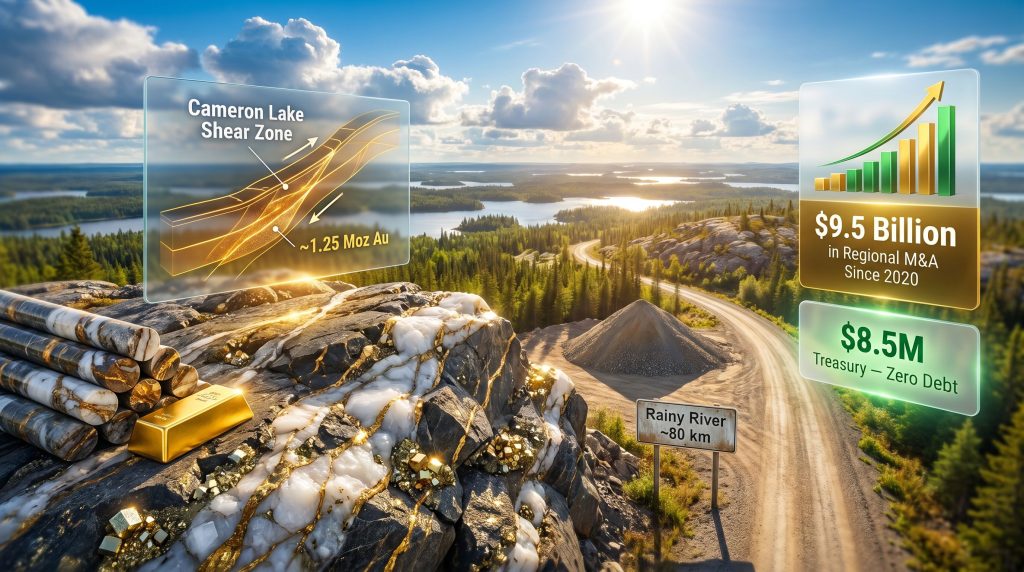
Junior explorers do not operate in a vacuum. One of the most reliable leading indicators of a district's long-term value is the behaviour of better-resourced companies in the same geography. Since 2020, the broader northwestern Ontario region surrounding the Cameron Lake project has been the site of approximately $9.5 billion in merger and acquisition activity, according to management commentary from CA Mining's leadership team. While investors should conduct their own verification of this figure against publicly available transaction records, the directional signal is clear: major and mid-tier producers have been systematically accumulating gold ounces in this region, and at scale.
This consolidation trend matters for junior companies like CA Mining for two interconnected reasons. First, it validates the geological prospectivity of the district at a level that exploration results alone cannot easily achieve. Second, it creates the conditions for optionality — specifically the possibility that a well-positioned land package with a defined resource base could become attractive to an acquirer whose own exploration pipeline is thinning. Furthermore, the gold M&A activity occurring across comparable greenstone belt districts reinforces the strategic logic of early positioning.
The Cameron Lake Shear Zone: Structural Architecture of a District-Scale System
Gold deposits in the Archean greenstone belts of Ontario are typically controlled by long-lived structural corridors, and the Cameron Lake Shear Zone is the principal geological control governing mineralisation at this project. Gold is hosted predominantly within mafic volcanic rocks and expressed through three distinct mineralisation styles, each with different implications for resource continuity and extraction planning:
- Shear-zone hosted gold: Structurally predictable along strike, offering the highest degree of confidence in resource continuity modelling
- Quartz-sulphide veining: Indicative of active hydrothermal fluid pathways during the original mineralising event, often associated with zones of elevated grade
- Quartz-breccia zones: Potential hosts for high-grade pods within the broader lower-grade envelope, representing meaningful upside in any future resource expansion drilling
Grab sample results from the broader district have returned grades of up to 9.18 g/t Au from sheared mafic volcanic material, with porphyry target samples grading 1.9 g/t Au, providing a geological basis for continued exploration beyond the currently defined resource footprint.
Geographic Logistics: The 80 km Advantage
The project is located approximately 80 kilometres southeast of Kenora, a positioning that is significant not merely for road access but for its proximity to existing processing infrastructure. Distance to mill is one of the most frequently underestimated variables in junior gold project economics. At roughly 80 km to the south lies the Rainy River Mine, recently acquired by Core Mining, a facility whose operational transition from open-pit to underground mining over the coming years is expected to create meaningful available mill capacity.
What CA Mining Controls and Why the Corporate Structure Matters
The Cameron Lake Project: A 55,000-Hectare District Land Package
The CA Mining Cameron Lake gold project encompasses approximately 55,000 hectares in northwestern Ontario, incorporating the Cameron Gold Deposit, the West Cedartree area, and multiple additional exploration targets. The project carries a history of roughly 40 years of exploration activity across multiple corporate owners, meaning a substantial base of geological knowledge, mapping, trenching, geophysics, and drilling data has already been accumulated. For additional historical context on the West Cameron gold project, publicly available technical documentation outlines much of this prior work.
| Milestone | Year | Detail |
|---|---|---|
| Initial exploration activity begins | Pre-1985 | Approximately 40 years of documented work |
| Project under First Mining stewardship | Pre-2025 | Extended exploration and resource definition |
| Seva Mining Corp. formation announced | Late 2025 | Acquisition agreement for 100% interest |
| Sale formally closed | March 2026 | Transfer to Seva Mining completed |
| CA Mining / Fury Group active positioning | 2025-2026 | District-scale engagement underway |
The Fury Group: An Accelerator, Not Just a Sponsor
The distinction between a corporate sponsor and a genuine operational accelerator matters enormously at the junior exploration stage. CA Mining's connection to the Fury Group places it within an ecosystem that includes approximately 45 on-site engineers in Vancouver, in-house geologists specialising in Canadian mineral systems, and corporate development specialists with a track record spanning nearly 300 companies built over 38 years. The CEO of CA Mining has described the setup as analogous to a technology accelerator model, adapted specifically for the mining sector, where access to second opinions, technical challenge resolution, and capital markets preparation is available without the cost of building those capabilities independently.
This infrastructure context is not cosmetic. When a junior company needs to move quickly on a direct shipping ore arrangement, having experienced engineering and logistics personnel available down the corridor rather than contracted at arm's length represents a genuine operational advantage.
Key advisors associated with the broader Fury Group ecosystem include:
| Advisor / Partner | Role | Relevance |
|---|---|---|
| Frank Giustra | Fury Group founder | Strategic capital network and precious metals thesis |
| Rob McLeod | CEO, Cambria Gold | Multigenerational BC mining family; operational depth |
| Ryan Waymark | Engineer, Fury Group partner | Technical oversight across portfolio |
| Ryan Brown | VP, CA Mining | Lead engineer on Contango/Muncho DSO project in Alaska |
Ryan Brown's background is particularly relevant to execution confidence. His direct involvement in developing the DSO model at the Contango/Muncho project in Alaska provides CA Mining with institutional knowledge of how to navigate exactly the kind of capital-light, stockpile-to-mill pathway the company is now pursuing at Cameron Lake.
The 1.25 Million Ounce Resource: Context, Classification, and Growth Potential
Reading a Mineral Resource Estimate Correctly
The Cameron Gold Deposit carries a reported mineral resource of approximately 1.25 million ounces of gold, encompassing both open-pit and underground resource categories. Understanding how to interpret a mineral resource estimate correctly is one of the most important skills for investors evaluating junior mining companies, as misreading this classification is among the most common analytical errors in the sector.
A mineral resource is a concentration of naturally occurring material with reasonable prospects for eventual economic extraction. It is explicitly not a mineral reserve, which requires demonstrated economic viability under a feasibility study. Treating resource estimates as confirmed mineable tonnage is one of the most common errors in junior mining investment analysis.
That said, 1.25 million ounces represents a substantial starting point for a company at this stage of development. The resource encompasses:
- Open-pit resources: Shallower material with lower extraction cost profiles, more accessible for near-term development planning
- Underground resources: Higher-grade potential at depth, providing longer-term production optionality as the project matures
- Exploration upside: The broader 55,000-hectare land position and existing geological data suggest that strike extensions and untested targets offer meaningful potential for resource growth beyond the current estimate
For context, most junior gold companies considered acquisition targets by mid-tier producers carry resources in the 0.5 to 2.0 million ounce range. Cameron Lake sits in the middle of that band with the added advantage of a long geological history that has delineated but not exhausted the system.
The DSO Strategy: Revenue Before the Mill Gets Built
Why Direct Shipping Ore Changes the Junior Gold Investment Calculus
The conventional junior gold development pathway requires a company to move through resource definition, preliminary economic assessment, prefeasibility study, feasibility study, permitting, financing, and construction before a single dollar of revenue is generated. This process routinely takes a decade and consumes hundreds of millions in capital, most of which is raised through successive equity dilution.
The direct shipping ore model disrupts this sequence in a fundamental way. Rather than constructing a mill, the operator extracts ore and transports it to an existing processing facility, paying a tolling fee and receiving proceeds against the recovered metal. The capital requirements are a fraction of conventional development, the timeline from ore extraction to revenue can be measured in months rather than years, and the company's treasury is preserved for exploration rather than infrastructure construction.
The Historic Stockpile: A Proof-of-Concept Asset Already in Hand
One of the more compelling near-term catalysts for the CA Mining Cameron Lake gold project is the existence of a historic surface stockpile requiring no additional extraction work. Key characteristics include:
- Approximately 12,000 to 13,000 cubic metres of stockpiled ore already on surface
- Average grade of approximately 3.5 g/t Au, a grade that is economically attractive at current gold prices
- No mining equipment, blasting, or further extraction required to access the material
- Serves as an immediate proof-of-concept for the broader DSO thesis at the project
At a gold price of approximately USD $2,800 per ounce, which represents the approximate range at the time of writing, the economics of processing this stockpile are highly attractive, with meaningful margin even after tolling fees and transportation costs.
Processing Partners: The North-South Corridor Analysis
| Potential Processing Partner | Direction | Approximate Distance | Current Status |
|---|---|---|---|
| West Red Lake Gold (Fury Group affiliate) | North | Greater distance | Active group dialogue |
| Rainy River Mine (Core Mining) | South | ~80 km | Early-stage engagement |
The Rainy River option warrants particular attention. As the operation transitions from open-pit to underground mining over the next few years, the feed rate into its existing mill infrastructure is expected to decrease, creating available capacity that a DSO arrangement could fill. For Core Mining, accepting toll-milling agreements from nearby junior companies represents incremental revenue with minimal additional capital outlay. For CA Mining, it represents a path to revenue generation without building any processing infrastructure of its own. Moreover, the Cameron Gold Project technical report provides detailed geological and engineering context that underpins the viability of these processing scenarios.
Financial Position: Why $8.5 Million and Zero Debt Is More Significant Than It Sounds
Treasury Strength in the Context of Junior Mining Capital Cycles
Many early-stage junior gold companies carry debt on their balance sheets, often the legacy of exploration campaigns conducted during periods of suppressed gold prices when equity financing was difficult to secure. CA Mining enters its active exploration and DSO execution phase with approximately $8.5 million in treasury and no debt, a combination that is genuinely uncommon among companies at this stage. In addition, the broader junior mining investment landscape confirms how rare this financial position is relative to peers currently seeking capital.
The practical implications of this financial position are significant:
- The company is not subject to debt service costs that would otherwise constrain exploration spending
- Management retains full flexibility to deploy capital toward the highest-priority activities, whether exploration drilling, DSO logistics, or strategic acquisitions
- Any future equity raise is not driven by financial distress but by growth acceleration, which typically results in better terms and lower dilution for existing shareholders
The CEO has explicitly framed the company's acquisition strategy as opportunistic, noting that assets available at current valuations represent compelling value ahead of what management expects to be a continued gold price lift through 2026 and into 2027.
The next major ASX story will hit our subscribers first
The Macro Gold Market: Why the Structural Case Has Not Yet Fully Transmitted to Juniors
Central Bank Demand as the Structural Floor
The World Gold Council has documented a sustained acceleration in central bank gold purchases, with institutions in Poland, China, Turkey, and broader BRICS-aligned economies significantly increasing their gold holdings as hedges against counterparty risk, currency volatility, and geopolitical uncertainty. This buying is not speculative in character. It reflects sovereign-level decisions to reduce dependence on dollar-denominated reserve assets, and those decisions are unlikely to reverse on short timescales. Consequently, central bank gold demand is increasingly recognised as one of the most durable structural supports beneath the current gold price environment.
When central banks across multiple geopolitical blocs simultaneously increase gold allocations, they are effectively establishing a structural demand floor beneath the spot price. This changes the risk profile of gold-exposed equities in a meaningful way, particularly for projects whose economics are sensitive to price assumptions.
The Undeployed Capital Thesis: Family Offices and Institutional Restructuring
An insight drawn from CA Mining's leadership is worth examining carefully. Based on direct conversations at conferences and in private settings with family offices and major financial institutions, management has observed that a substantial volume of capital is being structured for deployment into precious metals and critical minerals but has not yet entered the market. The distinction between capital being structured and capital being deployed is important for timing purposes: it suggests that the demand surge the sector anticipates has not yet fully arrived, meaning current valuations in the junior space may still reflect pre-surge pricing.
The transmission sequence for gold price gains through the equity value chain follows a consistent historical pattern:
Gold Spot Price Rises → Major Miners Re-rate → Mid-Tier Producers Re-rate →
Junior Explorers Re-rate (lagged 12-24 months) → Advanced-Stage Juniors Outperform
For investors positioned in junior gold companies with credible near-term catalysts, this lag represents opportunity rather than risk, provided the underlying project has genuine geological and financial merit.
Benchmarking Cameron Lake Against Peer Junior Gold Projects
| Evaluation Criteria | Cameron Lake (CA Mining) | Typical Early-Stage Junior |
|---|---|---|
| Resource size | ~1.25 Moz Au | 0.5-2.0 Moz Au |
| Exploration history | ~40 years | Variable |
| Near-term revenue pathway | DSO stockpile model | Typically pre-revenue |
| Debt position | Zero | Often leveraged |
| Processing infrastructure proximity | ~80 km (Rainy River) | Often no proximate mill |
| Corporate support structure | Fury Group accelerator | Typically standalone |
| Treasury | ~$8.5 million | Variable |
The project's distinguishing characteristic relative to peers is not any single metric but the combination of a defined resource, an immediate revenue pathway through the existing stockpile, proximity to processing infrastructure, and an institutionally supported management team. Each of these attributes reduces a specific category of execution risk that commonly prevents junior gold projects from progressing beyond the exploration stage.
Key Risks Every Investor Must Evaluate
Resource Classification and Commodity Price Sensitivity
The 1.25 million ounce figure represents a mineral resource, not a mineral reserve. No feasibility study has been completed, and until one is, the economics of full-scale production remain unconfirmed. Investors should apply appropriate discounting to any production scenario modelling at this stage.
The project's economics across different gold price environments can be framed as follows:
| Gold Price Scenario | Project Viability | DSO Stockpile Economics |
|---|---|---|
| USD $2,200/oz | Moderate, margin discipline required | Viable with controlled logistics costs |
| USD $2,800/oz | Strong, current approximate range | Highly attractive margin profile |
| USD $3,200/oz+ | Exceptional, exploration upside fully justified | Transformational economics |
Additional risks include the dependency on securing a toll-milling agreement with Rainy River or an alternative processor, exploration execution risk in converting geological potential into defined resources, and broader commodity price volatility. Northwestern Ontario carries a favourable jurisdictional risk profile relative to many global alternatives, but permitting timelines and community engagement requirements remain material considerations.
Frequently Asked Questions: CA Mining and the Cameron Lake Gold Project
What is the Cameron Lake Gold Project?
The Cameron Lake Gold Project is a district-scale gold exploration and development property covering approximately 55,000 hectares in northwestern Ontario, Canada, incorporating the Cameron Gold Deposit and multiple additional exploration targets.
Who owns the Cameron Lake Gold Project in 2026?
The project is controlled by CA Mining, a company operating within the Fury Group of companies, following the completion of its acquisition from First Mining in early 2026.
What is the current gold resource estimate at Cameron Lake?
The Cameron Gold Deposit carries a reported mineral resource of approximately 1.25 million ounces of gold across open-pit and underground categories. This is a mineral resource estimate, not a mineral reserve.
What is the DSO model and how does CA Mining plan to use it?
Direct shipping ore involves transporting ore to an existing processing facility rather than constructing a mill on-site. CA Mining plans to use this model to monetise its existing surface stockpile by trucking it to a proximate processing facility, most likely the Rainy River Mine operated by Core Mining approximately 80 km to the south.
What is the historic stockpile at Cameron Lake and what is its grade?
The project hosts a historic surface stockpile of approximately 12,000 to 13,000 cubic metres of ore averaging approximately 3.5 g/t Au, left in place by a prior operator following a short-lived surface operation.
What is the Fury Group and how is it connected to CA Mining?
The Fury Group is a Vancouver-based mining company builder with a track record spanning nearly 300 companies over 38 years. It provides CA Mining with access to in-house engineering, geology, and corporate development expertise, functioning as an operational accelerator for its portfolio companies.
Why is northwestern Ontario considered a strong gold exploration address?
The region has attracted approximately $9.5 billion in merger and acquisition activity since 2020, reflecting industry-wide recognition of the area's gold endowment. It hosts multiple operating mines and advanced development projects within trucking distance of the Cameron Lake property.
Five Structural Pillars Supporting the CA Mining Investment Thesis
For investors conducting due diligence on the CA Mining Cameron Lake gold project, the investment case rests on five interconnected structural elements:
- District-scale land position with 40 years of accumulated geological knowledge and a defined 1.25 million ounce resource base providing a credible starting point for future development
- Immediate near-term revenue pathway via the DSO model applied to an existing 3.5 g/t Au surface stockpile requiring no additional extraction
- Proximate processing infrastructure at Rainy River, approximately 80 km south, with anticipated available mill capacity as that operation transitions from open-pit to underground mining
- Zero-debt, $8.5 million treasury providing financial stability and strategic flexibility through the exploration and DSO execution phase without forced dilution
- Fury Group accelerator backing delivering engineering, geological, corporate development, and capital markets infrastructure that would otherwise take years and significant capital to build independently
In an environment where gold prices are supported by sustained central bank demand, geopolitical risk premiums across multiple theatres, and a substantial volume of institutional capital being structured for deployment into precious metals, junior explorers combining defined resources with credible near-term cash flow pathways and institutional-grade management support represent a differentiated risk-reward profile. The key for prospective investors, as always, is distinguishing between projects with genuinely executable plans and those with compelling narratives but limited operational substance. The CA Mining Cameron Lake gold project presents a case that merits careful examination on both counts.
This article contains forward-looking statements and speculative analysis. It does not constitute financial or investment advice. Investors should conduct their own due diligence and consult a qualified financial adviser before making any investment decisions. Mineral resource estimates are not mineral reserves and do not have demonstrated economic viability.
Readers seeking additional perspective on junior gold exploration strategies and the broader macro case for precious metals investment may find value in content available through the Liberty and Finance YouTube channel, which regularly features interviews with executives from exploration-stage and advanced-stage mining companies across North America.
Want To Be First When The Next Major ASX Gold Discovery Hits The Market?
Discovery Alert's proprietary Discovery IQ model delivers real-time alerts the moment significant mineral discoveries are announced on the ASX, transforming complex geological data into actionable insights for investors at every level — explore Discovery Alert's discoveries page to understand the historic returns major finds have generated, then begin your 14-day free trial to position yourself ahead of the broader market.