May 22, 2026
Understanding Advanced Sensor Technologies in Resource Extraction
Industrial sorting technologies have fundamentally transformed how data-driven mining operations approach ore processing economics, particularly in environments where traditional methods face significant cost and environmental constraints. STEINERT sorting technology now enables real-time material classification at unprecedented throughput rates, creating new pathways for extracting value from previously marginal deposits.
The integration of sophisticated pneumatic separation mechanisms with intelligent detection algorithms represents a paradigm shift from chemistry-dependent processing toward physics-based material recognition. These systems analyze individual particles using multiple detection modalities simultaneously, making sorting decisions within milliseconds while maintaining industrial-scale processing volumes.
When big ASX news breaks, our subscribers know first
Multi-Sensor Detection Mechanisms Revolutionizing Material Identification
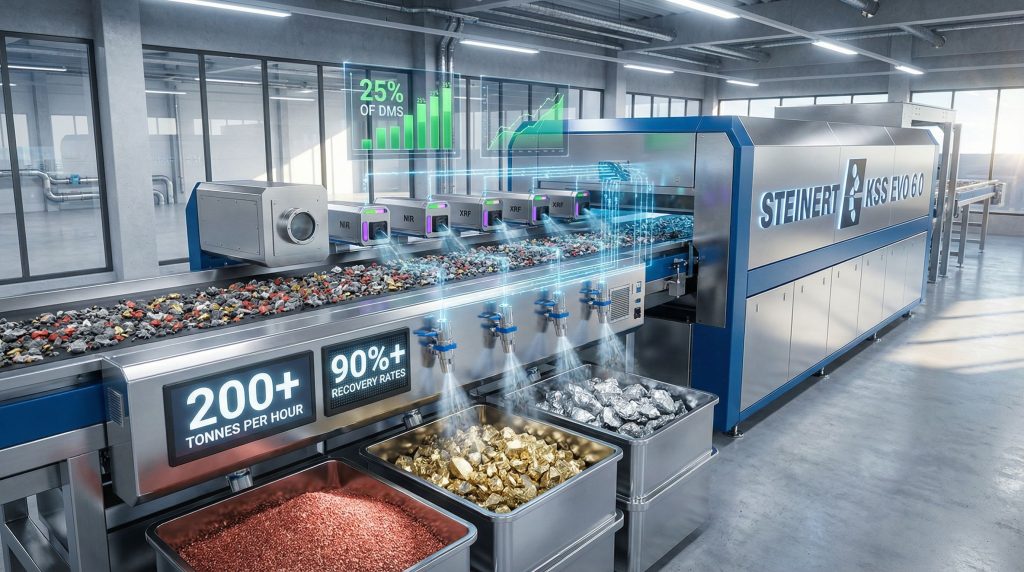
STEINERT sorting technology employs a comprehensive array of detection systems that work in concert to identify material properties with exceptional precision. The technology combines X-ray transmission capabilities for density-based analysis, X-ray fluorescence (XRF) technology for elemental composition detection, and near-infrared (NIR) sensors for molecular identification. Additional capabilities include induction sorting mechanisms for conductive material detection and 3D laser recognition systems that analyze visual properties.
The pneumatic separation process represents the physical execution of sorting decisions, utilising compressed air ejection systems to precisely deflect materials based on real-time analysis. These systems process detection data through sophisticated algorithms that can analyse individual particles at industrial throughput rates exceeding 200 tonnes per hour.
The Navachab Gold Mine in Namibia provides compelling evidence of this technology's practical effectiveness. Since implementing STEINERT sorting systems in 2016, the operation has successfully preconcentrated over 10 million tonnes of low-grade stockpile material that was previously considered uneconomical to process. This transformation demonstrates how advanced sorting can convert waste into valuable ore.
According to mine management, the detection capabilities operate at remarkable speeds, sorting material at 200 tonnes per hour while identifying particles that fall below traditional processing cut-off grades. The ability to double ore grade through pre-concentration enables profitable treatment by downstream processes that would otherwise be uneconomical.
Intelligent Declustering Technology Enhances Particle Recognition
One of the most significant technical advances in STEINERT sorting technology is the development of Intelligent Declustering capabilities. This innovation addresses a fundamental challenge in high-throughput sorting: when processing speeds increase, composite objects often get misidentified as single particles, leading to incorrect sorting decisions.
Key benefits of Intelligent Declustering include:
- Individual rock extraction from composite material clusters
- Machine learning algorithms that improve separation accuracy over time
- Real-time cluster analysis preventing misclassification errors
- Adaptive sorting parameters responding to material variations
The technology extracts individual rocks from clusters even when particles are positioned very close together, analysing each component separately. This capability makes previously mutually exclusive goals compatible: high throughput and high accuracy.
Operational Cost Analysis: STEINERT Versus Traditional Methods
The economic advantages of STEINERT sorting technology become apparent when compared to conventional processing methods. Furthermore, analysis of operational data reveals significant cost differentials across processing technologies, particularly as AI transforming mining continues to reshape industry practices.
| Processing Method | Water Requirements | Energy Consumption | Operating Costs | Throughput Capacity |
|---|---|---|---|---|
| Dense Media Separation | High | Moderate | Baseline (100%) | Standard |
| STEINERT Dry Sorting | Minimal | Low | 25% of DMS | Double |
| Flotation Processing | Very High | High | 150% of DMS | Variable |
The cost comparison demonstrates that STEINERT's sensor-based dry sorting operates at approximately one-quarter the operational costs of Dense Media Separation (DMS) while simultaneously achieving doubled throughput. This dual benefit of cost reduction and capacity enhancement represents a fundamental process efficiency improvement rather than marginal optimisation.
Performance metrics for STEINERT systems include:
- Processing capacity exceeding 200 tonnes per hour for standard configurations
- Sub-second detection rates for individual particle analysis
- Doubled ore grade recovery compared to conventional pre-concentration
- Recovery rates exceeding 90% for precious metal applications
The transition from DMS to STEINERT technology eliminates the need for dense media, reduces water consumption, and simplifies the overall processing circuit. In addition, mining operations can achieve higher throughput with lower operational complexity while maintaining or improving recovery rates.
Industry Applications Beyond Traditional Mining
STEINERT sorting technology extends beyond precious metal mining into diverse industrial applications where material separation creates value. The mining sector benefits particularly from low-grade ore upgrading, enabling marginal deposits to achieve economic viability through effective pre-concentration. This aligns with broader trends in mining industry innovation that focus on maximising resource recovery.
Primary mining applications include:
- Waste rock reduction minimising tailings volume
- Stockpile reprocessing converting previously uneconomical material
- Pre-concentration circuits reducing downstream processing costs
- Grade control improving mill feed consistency
The recycling sector represents another significant application area, though deployment data in this sector requires additional verification. Potential applications include electronic waste processing for component recovery, plastic sorting by polymer type for circular economy initiatives, and metal recovery from mixed waste streams.
The Navachab case study demonstrates practical application in low-grade gold ore processing, where the technology has processed 10 million tonnes of stockpile material over a decade. This quantifiable value creation through sorting technology deployment illustrates the potential for resource recovery in mature mining districts with substantial historical stockpiles.
Water Independence: Strategic Advantage in Resource-Constrained Environments
The water-free processing capability of STEINERT sorting technology addresses one of the mining industry's most critical operational constraints. Traditional processing methods typically require substantial water volumes for dense media separation, flotation chemistry, and material transport systems. However, this innovation also supports effective waste management solutions by reducing the need for water-intensive processing.
Environmental sustainability advantages include:
- Zero water consumption in sorting operations
- Reduced tailings dam requirements through waste minimisation
- Lower environmental permitting complexity for dry processes
- Decreased groundwater contamination risk from chemical-free separation
The strategic importance of water independence becomes particularly evident in arid and semi-arid mining regions. Namibia, where the Navachab Gold Mine operates, exemplifies a jurisdiction where water scarcity constrains traditional processing methods. The mine's continued expansion consideration reflects the long-term operational viability enabled by water-free sorting in this hydrogeologic context.
Geographic deployment benefits encompass:
- Arid region compatibility where water resources are scarce
- Remote location viability without water infrastructure requirements
- Seasonal operation flexibility independent of water availability
- Regulatory compliance advantages in water-restricted jurisdictions
Mine management emphasises that water independence plays a key role in future operations, particularly as climate change and regional water scarcity increasingly affect mining project development in water-stressed environments.
Technical Specifications of STEINERT KSS EVO 6.0 Systems
The latest generation STEINERT KSS EVO 6.0 represents significant advancement in sorting system design and functionality. The system architecture incorporates modular design principles that enable integration with existing processing circuits while maintaining operational flexibility. For instance, these advanced systems can work in conjunction with 3D geologic modelling insights to optimise material identification and sorting processes.
System architecture features include:
- Modular design integration for existing circuit compatibility
- Multi-sensor fusion capability combining detection technologies
- Automated maintenance protocols reducing downtime requirements
- Remote monitoring systems enabling predictive maintenance
Performance optimisation elements encompass:
- Adjustable belt speeds for material-specific optimisation
- Variable air pressure settings for precise ejection control
- Sensor calibration automation maintaining consistent accuracy
- Data logging capabilities for process optimisation analysis
The EVO 6.0 generation significantly improves sorting system handling, making maintenance procedures more efficient and safer for operating personnel. Regular maintenance protocols keep performance at optimal levels while reducing component wear through predictive maintenance scheduling.
The next major ASX story will hit our subscribers first
Return on Investment Calculations for Mining Operations
Mining operations evaluate STEINERT technology investments through comprehensive cost-benefit analysis that considers both direct savings and revenue enhancement factors. The economic justification extends beyond equipment costs to include operational efficiency improvements and resource recovery optimisation.
Direct cost savings analysis includes:
- Reduced processing volumes through effective pre-concentration
- Lower reagent consumption in downstream flotation circuits
- Decreased energy requirements for grinding and milling operations
- Minimised tailings management costs through waste reduction
Revenue enhancement factors encompass:
- Increased ore grade delivery to processing facilities
- Extended mine life through stockpile reprocessing
- Improved metal recovery rates generating additional revenue
- Reduced trucking costs from waste rock elimination
The Navachab example demonstrates quantifiable benefits: processing 10 million tonnes of previously uneconomical material over ten years while operating at one-quarter the costs of alternative methods. Consequently, this performance creates substantial value through both cost reduction and revenue enhancement.
Maintenance Requirements and Performance Optimisation
Optimal performance of STEINERT sorting systems requires systematic maintenance protocols that address both mechanical components and sensor calibration. The maintenance approach emphasises preventive procedures that maintain accuracy while minimising unplanned downtime.
Preventive maintenance protocols include:
- Sensor cleaning schedules maintaining detection accuracy
- Compressed air system maintenance ensuring ejection reliability
- Belt condition monitoring preventing material handling issues
- Software update procedures incorporating latest algorithms
Performance monitoring systems encompass:
- Real-time efficiency tracking identifying optimisation opportunities
- Wear component replacement scheduling minimising unplanned downtime
- Calibration verification procedures maintaining separation quality
- Throughput analysis reporting for operational optimisation
The robust design of STEINERT systems has proven durability under harsh mining conditions. The Navachab installation has withstood ten years of dusty mining environments while maintaining reliable operation, demonstrating the equipment's suitability for demanding industrial applications.
Integration with Existing Mining Processing Circuits
Successful implementation of STEINERT technology requires careful consideration of circuit design and integration requirements. The modular nature of the systems facilitates integration with existing operations while minimising production disruption during installation.
Circuit design considerations include:
- Feed preparation requirements for optimal sorting conditions
- Downstream process compatibility ensuring seamless integration
- Material handling system modifications accommodating sorted products
- Control system integration for automated operation
Implementation timeline factors encompass:
- Site preparation requirements including foundation and utilities
- Equipment installation procedures minimising production disruption
- Commissioning and testing phases ensuring optimal performance
- Operator training programs for effective system utilisation
The technology's ability to integrate with existing circuits without requiring complete processing plant redesign represents a significant advantage for mining operations seeking to upgrade capabilities without massive capital expenditure. Furthermore, leading providers such as Steinert Global offer comprehensive support throughout the implementation process.
Future Technological Developments in Sorting Capabilities
The evolution of STEINERT sorting technology continues with emerging sensor technologies and Industry 4.0 integration. Advanced detection capabilities and intelligent processing systems promise further improvements in separation accuracy and operational efficiency.
Emerging sensor technologies include:
- Hyperspectral imaging integration for enhanced material identification
- Artificial intelligence enhancement improving decision algorithms
- Quantum sensor development for ultra-precise detection capabilities
- Fusion sensor platforms combining multiple detection methods
Industry 4.0 integration encompasses:
- IoT connectivity features enabling remote monitoring and control
- Predictive analytics capabilities optimising maintenance scheduling
- Digital twin technology for virtual system optimisation
- Blockchain integration for material traceability applications
The fundamental principle that computer programs hold the key to sorting effectiveness drives continuous software development. Machine learning capabilities enable systems to adapt and improve performance over time, learning from operational data to optimise sorting decisions. Additionally, specialised sensor sorting systems continue to evolve, offering increasingly sophisticated material identification capabilities.
Disclaimer: This article contains technical analysis and performance projections based on operational data from specific mining applications. Actual performance may vary depending on ore characteristics, operational conditions, and site-specific factors. Readers should conduct independent technical and economic evaluations before making equipment investment decisions.
Ready to Identify the Next Major Mineral Discovery?
Discovery Alert's proprietary Discovery IQ model delivers real-time alerts on significant ASX mineral discoveries, instantly empowering subscribers to identify actionable opportunities ahead of the broader market. Begin your 30-day free trial today and secure your market-leading advantage by visiting Discovery Alert's main platform.