June 28, 2026
The Geology That Makes Serpentinisation Both a Nickel Story and a Hydrogen Story
Most conversations about zero-carbon hydrogen begin at the electrolyser or the steam methane reformer. They start with infrastructure, with electricity tariffs, with carbon capture efficiency curves. What they rarely start with is the rock itself. Yet for a specific class of geological formations distributed across the ancient cores of every continent on Earth, the rock is not just the host for a mining project. It is also, under the right conditions, a hydrogen reactor that has been running continuously for millions of years without any human intervention.
That geological reality sits at the centre of the Canada Nickel and GeoRedox geologic hydrogen well at Crawford programme, announced in May 2026. Understanding why the Crawford Nickel Project in Timmins, Ontario is technically appropriate for what would be the world's first stimulated geologic hydrogen well requires understanding a chemistry that most mining coverage skips entirely: serpentinisation.
When big ASX news breaks, our subscribers know first
What Serpentinisation Actually Does Underground
The Exothermic Reaction at the Heart of Geologic Hydrogen
Serpentinisation occurs when water percolates through ultramafic rock formations and contacts iron- and magnesium-rich minerals, primarily olivine and pyroxene. The reaction is exothermic and releases molecular hydrogen as a direct chemical by-product. No combustion, no electrolysis, no industrial input of any kind drives the process. The geological formation functions simultaneously as the feedstock and the reactor.
The minerals involved are not exotic. Olivine and pyroxene are among the most abundant minerals in the Earth's mantle, and ultramafic intrusions bring mantle-derived rock into the crust at depths accessible to engineered wellbores. What makes a given site technically relevant is not just the presence of these minerals in trace quantities but the concentration and continuity of ultramafic rock across a formation large enough to sustain a commercially assessable reaction rate.
The hydrogen colour spectrum is worth mapping against this backdrop:
| Production Method | Carbon Intensity | Primary Input | Infrastructure Requirement |
|---|---|---|---|
| Grey hydrogen (SMR) | High | Natural gas | Industrial plant |
| Blue hydrogen (SMR + CCS) | Medium | Natural gas + carbon capture | Industrial plant + sequestration |
| Green hydrogen (electrolysis) | Low to zero | Renewable electricity | Electrolyser + grid connection |
| Geologic hydrogen (AWE) | Zero | Ultramafic rock + water | Stimulated subsurface well |
The structural difference that separates geologic hydrogen from every other category is that the energy driving the reaction is chemical, not applied. No power grid needs to be connected. No industrial gas plant needs to be constructed. The formation itself provides the thermodynamic conditions.
Why the Same Rock That Hosts Nickel Sulphides Generates Hydrogen
There is an underappreciated geological co-location dynamic at work in ultramafic intrusions. The magmatic processes that concentrate nickel sulphide mineralisation, specifically pentlandite within ultramafic intrusive bodies, are the same processes that produce the high-iron, high-magnesium, low-silica rock chemistry required for serpentinisation. These are not two unrelated phenomena sharing the same address. They are products of the same rock-forming sequence.
Understanding nickel properties and uses helps explain why this geological convergence matters so much commercially. The conditions that make Crawford one of Canada's most significant nickel sulphide discoveries are, by the same chemistry, the conditions that make it technically appropriate for Advanced Weathering Enhancement technology. The convergence of two critical resource types within a single formation is not coincidental. It is a direct consequence of the Archean ultramafic geology that defines the Timmins Nickel District.
Archean cratons hosting equivalent ultramafic belt distributions are found across Canada, Australia, southern Africa, and Scandinavia, placing the Timmins district within a globally distributed geological context rather than as an isolated anomaly.
How GeoRedox's Advanced Weathering Enhancement Technology Works
Engineering the Subsurface Environment for Controlled Hydrogen Output
Natural geologic hydrogen seeps have been documented for decades. Mali's Bourakébougou field, serpentinite exposures in Oman's Samail ophiolite, and occurrences across the Philippines and the United States all confirm that the subsurface chemistry is real and globally distributed. What distinguishes a stimulated geologic hydrogen well from these observations is the deliberate engineering of subsurface conditions to accelerate, direct, and capture hydrogen production at a rate that can be assessed for scale-up.
GeoRedox's Advanced Weathering Enhancement process sequences that engineering as follows:
- Site characterisation – geological mapping and rock sampling to confirm ultramafic mineralogy, serpentinisation potential, and formation continuity at depth
- Well design and stimulation – engineering the subsurface environment to maximise water-rock contact surface area and optimise reaction kinetics at target depth and temperature
- Reaction initiation – introducing the conditions that accelerate the naturally occurring weathering chemistry already present in the formation
- Gas capture – collecting hydrogen output without the reservoir infrastructure that conventional subsurface extraction requires
- Output assessment – measuring flow rate, purity, and production consistency to establish a baseline sufficient for engineering scale-up modelling
The absence of a reservoir requirement is operationally significant and deserves emphasis. Conventional subsurface gas extraction depends on a permeable reservoir bounded by an impermeable cap rock that traps and accumulates the gas over geological time. AWE bypasses that entire infrastructure requirement. The reaction is initiated and captured at the wellbore, not accumulated in a structural trap. This removes what would otherwise be a material cost and geological prerequisite.
What "World's First Stimulated" Actually Means
The scientific novelty at Crawford is not the existence of geologic hydrogen. That has been known and studied for decades. The novelty is the deliberate engineering of subsurface conditions to stimulate, direct, and measure that production at a commercially assessable scale. That distinction is the technical basis for the "world's first stimulated geologic hydrogen well" designation.
Technical distinction: Passive observation of natural hydrogen seepage and active engineering of serpentinisation reaction conditions are categorically different programmes. The Crawford demonstration sits firmly in the second category, which is why its outcomes carry implications that natural seep observations do not.
The MOU Structure: Risk Allocation and What Each Party Gains
A Zero-Capital Addition to an Existing Decarbonisation Stack
The commercial logic of the Canada Nickel and GeoRedox MOU is straightforward when viewed from both sides of the transaction.
| Party | Financial Contribution | Operational Contribution |
|---|---|---|
| GeoRedox | 100% of demonstration-phase capital | Technology design and programme execution |
| Canada Nickel | Nil capital outlay | Site access, rock samples, technical expertise, planning support, data |
GeoRedox secures access to a geologically validated site that matches its technology's specific mineralogical requirements with precision. Canada Nickel, furthermore, gains exposure to a potential hydrogen production capability at zero capital cost, without diverting resources from its primary development timeline.
The MOU does not commit either party to post-demonstration capital deployment, commercial offtake agreements, or production targets. Obligations are explicitly scoped to the demonstration phase. That scoping is a risk management feature. Canada Nickel's Zero-Carbon Industrial Cluster does not require hydrogen production to advance on its existing timeline. The GeoRedox partnership adds optionality to an existing programme architecture, not a dependency.
The Decision Gates That Must Be Cleared Before Post-Demonstration Commitment
Any post-demonstration commitment would require the programme to first establish:
- Confirmation that AWE reaction initiation is achievable in Crawford's specific ultramafic formation at the required depth and temperature conditions
- Measurable hydrogen output at the wellhead with sufficient purity for processing applications
- Production rate data capable of supporting engineering assessment
- Scalability modelling derived from demonstration results
None of these determinations have been made. The demonstration programme is designed to answer these questions. Commercial hydrogen supply to NetZero Metals is a downstream outcome contingent on each gate being cleared in sequence.
How Hydrogen Completes the Emissions Equation at NetZero Metals
Addressing the Input Side, Not Just the Output Side
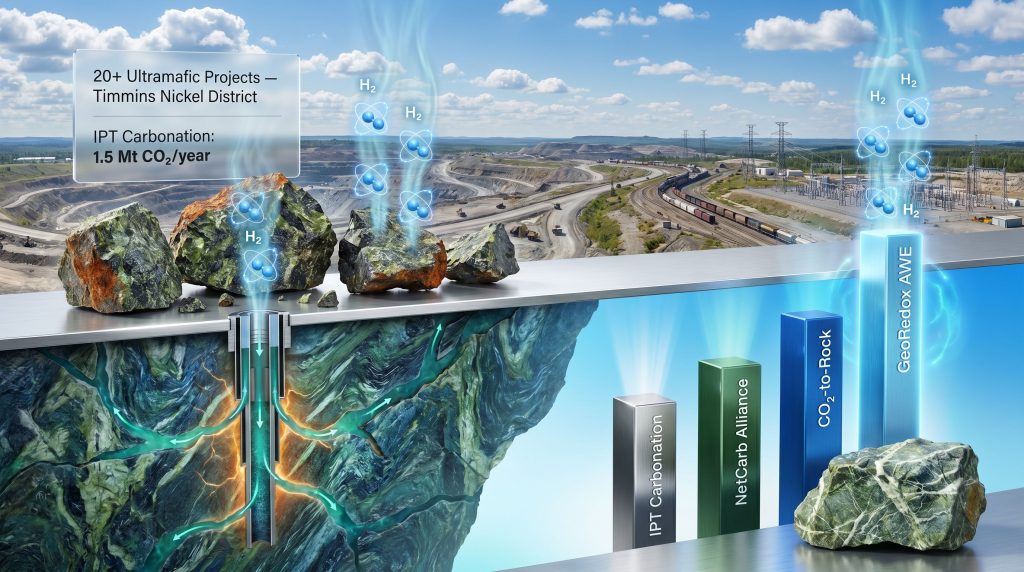
Canada Nickel had already structured a decarbonisation programme around three independent carbon pathways before the GeoRedox MOU was announced. Each addresses the output side of the cluster's emissions profile. In the broader context of critical minerals and energy transition, this integrated approach represents a significant step forward for zero-carbon metals production.
| Component | Function | Capacity Target |
|---|---|---|
| In-Process Tailings (IPT) Carbonation | Stores CO₂ in processing tailings during standard operations | 1.5 Mt CO₂/year |
| NetCarb Alliance | District-scale sequestration scale-up | 10 to 15 Mt CO₂/year |
| CO₂-to-Rock (UT Austin / US DOE) | Underground injection and mineralisation R&D | Technology development stage |
| GeoRedox AWE (pending validation) | Geologic hydrogen for processing feedstock | Subject to demonstration outcomes |
The critical analytical point is that carbon sequestration and zero-carbon feedstock are not interchangeable. A processing operation can sequester every tonne of CO₂ it produces and still embed carbon intensity into its finished products if the processing inputs, including hydrogen used as a reducing agent in nickel and stainless-steel refining, are sourced from conventional grey or blue hydrogen supply chains. Both the input and output sides of the emissions equation must be closed for a zero-carbon finished product claim to hold.
Hydrogen functions as a reducing agent in metals refining, displacing carbon-intensive reductants at the processing stage. The carbon footprint of the reducing agent is directly absorbed into the lifecycle emissions profile of the finished metal. A locally produced, zero-carbon geologic hydrogen supply would eliminate both external procurement price exposure and the indirect emissions embedded in conventionally sourced hydrogen simultaneously.
NetZero Metals: The Downstream Processing Context
NetZero Metals is Canada Nickel's downstream processing programme targeting fully integrated nickel processing, stainless-steel production, and alloy manufacturing facilities in the Timmins region. The programme is designed to support a vertically integrated North American critical minerals supply chain at a scale that currently has no equivalent in the Western hemisphere.
The processing logic that connects geologic hydrogen to this programme is direct: hydrogen is used extensively across each stage of metals refining that NetZero Metals encompasses. A locally generated supply at zero carbon intensity would reinforce the zero-carbon positioning at precisely the stage where conventional operations are most exposed, the procurement of processing feedstocks from external, carbon-intensive supply chains.
Robert Stoner, President and CEO of GeoRedox, has noted that hydrogen is used extensively across metals production, positioning the mining industry as a natural commercial target for geologic hydrogen technology. That observation describes a structural alignment, not a marginal use case. Growing critical minerals demand across global supply chains only reinforces this alignment further.
District Scale: Why One Well Has Twenty-Plus Project Implications
The Geological Uniformity That Multiplies Demonstration Value
Canada Nickel holds more than 20 projects across the Timmins Nickel District, all hosted within the same ultramafic geological formation that AWE technology is specifically designed to target. This is not a portfolio of diverse geological settings. It is a coherent geological district built on a single rock type.
A successful demonstration at Crawford would generate technical data, including reaction initiation parameters, production rate baselines, and formation response characteristics, that would be directly applicable to AWE programme design across the full project portfolio. The technical value of validation at one site compounds across a district of geologically equivalent sites.
Mark Selby, CEO of Canada Nickel, has emphasised that the ultramafic geology hosting Crawford and the more than twenty projects across the Timmins district is precisely the formation type that GeoRedox's technology is engineered to target, framing the geological footprint as structurally relevant to the partnership rather than incidentally convenient.
Beyond the Timmins district, Archean cratons hosting equivalent ultramafic belt distributions span multiple continents. Consequently, a successful AWE demonstration at Crawford would carry process chemistry implications for GeoRedox's international programme, given that serpentinisation chemistry is consistent across ultramafic formations globally regardless of jurisdiction.
The next major ASX story will hit our subscribers first
Infrastructure Position and Regulatory Context at Crawford
Why an Established Mining Camp Lowers the Demonstration Threshold
Crawford's existing infrastructure access removes a class of execution risk that would otherwise apply to a greenfield geologic hydrogen demonstration:
| Infrastructure Type | Relevance to AWE Demonstration |
|---|---|
| Road access | Equipment and materials mobilisation without greenfield construction |
| Rail access | Heavy equipment and supply logistics at commercial scale |
| Grid power | Operational power for well monitoring and programme execution |
| Water access | Required chemical input for the serpentinisation reaction |
Timmins is an established mining camp with documented permitting history, a regional skilled labour pool, and a supply chain built around industrial-scale resource operations. These baseline conditions reduce the logistical threshold for a first-of-its-kind technical programme in ways that a remote or undeveloped location could not.
From a regulatory standpoint, Crawford is included in Ontario's One Project, One Process (1P1P) framework, a provincial mechanism designed to consolidate and streamline permitting processes by reducing duplication across federal and provincial approval pathways. Crawford is also included in Canada's Major Projects Office, which coordinates regulatory review for nationally significant resource and infrastructure projects. These frameworks reduce the procedural complexity that a standalone greenfield hydrogen demonstration would typically face.
Ontario consistently ranks among the leading global mining jurisdictions for regulatory transparency and permitting predictability, providing a sovereign risk baseline directly relevant to long-duration industrial development programmes. This positions Canada Nickel and GeoRedox geologic hydrogen well at Crawford within a supportive regulatory environment that few comparable projects enjoy.
Australia's green metals leadership provides a useful international comparison point, demonstrating how favourable regulatory conditions can accelerate critical mineral project development when jurisdictional frameworks are aligned with industrial ambition.
The role of definitive feasibility studies in advancing projects through these regulatory frameworks is also worth noting, as post-demonstration outcomes at Crawford would logically feed into subsequent development assessment processes across the district portfolio.
Key Programme Metrics at a Glance
| Metric | Detail |
|---|---|
| MOU announcement date | May 20, 2026 |
| Canada Nickel capital contribution | Nil |
| GeoRedox capital contribution | 100% of demonstration costs |
| IPT Carbonation sequestration capacity | 1.5 million tonnes CO₂/year |
| NetCarb Alliance projected capacity | 10 to 15 million tonnes CO₂/year |
| Timmins district ultramafic projects (Canada Nickel) | 20+ |
| Hydrogen production mechanism | Stimulated serpentinisation via AWE technology |
| Post-demonstration commitments | None at current stage |
Frequently Asked Questions
What makes geologic hydrogen fundamentally different from green hydrogen?
Green hydrogen requires an external electricity source to drive electrolysis, splitting water molecules into hydrogen and oxygen using applied energy. Geologic hydrogen requires no external energy input. The thermodynamic driver is the exothermic chemical reaction between water and iron- or magnesium-rich minerals in ultramafic rock, a process called serpentinisation. Both are zero-carbon at the point of production, but their production mechanisms, infrastructure requirements, and cost structures are structurally different. Geologic hydrogen, if produced via AWE at scale, has the potential to undercut green hydrogen on cost because the primary energy input, the chemical potential energy stored in the rock formation, requires no purchase or generation.
Why is Crawford specifically appropriate for AWE technology rather than other geological settings?
AWE technology is engineered for ultramafic rock formations. Crawford's host geology is an Archean ultramafic intrusion with high magnesium and iron content and documented nickel sulphide mineralisation, confirming the presence of the precise mineral assemblage that drives serpentinisation chemistry. General geological hosting is not sufficient; the rock must contain the right mineral chemistry at adequate concentration and continuity. Crawford satisfies those criteria because of the same geological conditions that made it a significant nickel discovery.
What are the key technical unknowns the demonstration programme must resolve?
The demonstration phase is designed to answer questions that remain open at the current stage:
- Whether AWE reaction initiation can be achieved in Crawford's ultramafic formation at the required depth and temperature
- What hydrogen production rates and purity levels the stimulated well generates
- Whether production is sufficiently consistent to support engineering assessment for scale-up
- What the full-cycle production cost of geologic hydrogen via AWE would be at Crawford
None of these have been determined. Commercial hydrogen supply to NetZero Metals depends on each of these questions being answered satisfactorily through the demonstration programme.
What happens to Canada Nickel's development programme if the demonstration does not succeed?
The MOU is scoped entirely to the demonstration phase, and GeoRedox bears all associated capital risk. If the AWE programme does not achieve its technical objectives at Crawford, Canada Nickel's existing cluster programme, its three carbon capture and storage pathways, and its primary development timeline are unaffected. The hydrogen layer was structured as additive optionality within the Zero-Carbon Industrial Cluster architecture, not as a structural dependency.
This article contains forward-looking statements and speculative analysis regarding geologic hydrogen production, technology validation, and downstream processing applications. Demonstration outcomes have not been established. Readers should not interpret programme descriptions as confirmed production capabilities or commercial commitments. This is not financial advice.
Want To Catch the Next Major Mineral Discovery Before the Market Does?
Discovery Alert's proprietary Discovery IQ model scans ASX announcements in real time, instantly identifying high-potential mineral discoveries across nickel, critical minerals, and more than 30 other commodities — turning complex geological data into actionable investment insights. Explore how historic discoveries have generated exceptional returns or start your 14-day free trial today to position yourself ahead of the broader market.