June 29, 2026
The Geology That Built a Global Industry
Not every mineral province gets to reshape the world's industrial metabolism. The Pilbara region of Western Australia is one of the rare exceptions. Its banded iron formations, some of the oldest exposed geology on Earth dating back more than 2.5 billion years, contain iron ore deposits of extraordinary scale, consistency, and accessibility. Understanding iron ore types and deposits helps contextualise why the hematite-dominant ores found across the Pilbara, typically grading between 56 and 62 per cent iron, made them immediately attractive to Japan's post-war steel industry and kept them commercially dominant across six decades of global competition.
It is against this geological backdrop that the Rio Tinto eight billionth tonne of iron ore shipment milestone, reached in May 2026, carries its true weight. The number itself is almost too large to process in human terms. However, the systems, infrastructure, relationships, and geological understanding required to reach it tell a more instructive story about how long-duration commodity businesses actually function.
When big ASX news breaks, our subscribers know first
How Big Is Eight Billion Tonnes? Putting the Number in Real Context
The Scale Problem With Very Large Numbers
Human cognition tends to flatten very large numbers into vague impressions of bigness. Eight billion tonnes of iron ore suffers from exactly this problem. Abstract numerical scale needs physical translation to become meaningful.
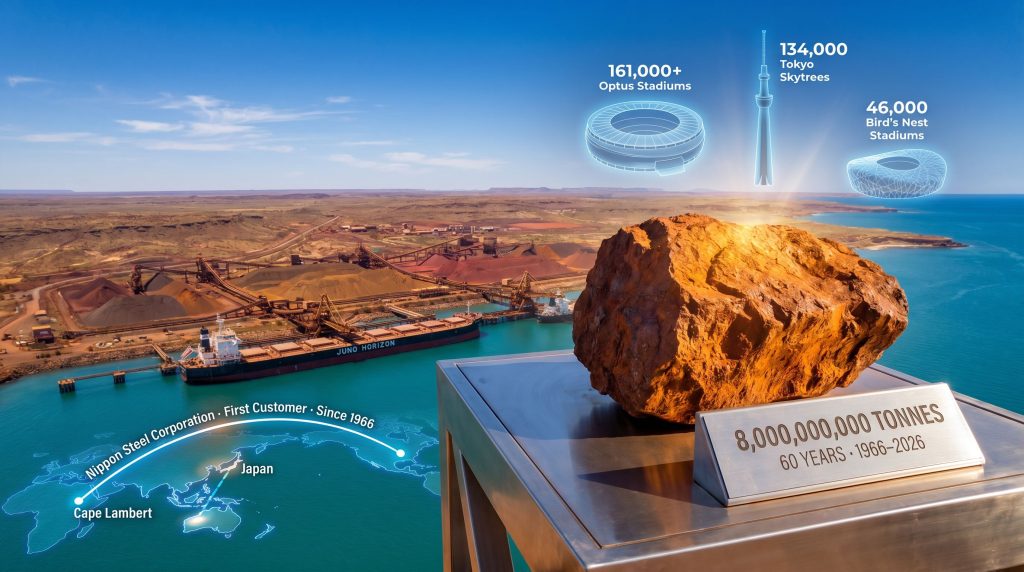
Rio Tinto's own framing provides a useful starting point. The steel output derivable from eight billion tonnes of iron ore would be sufficient to construct more than 161,000 Optus Stadiums in Perth, approximately 134,000 Tokyo Skytrees, or upwards of 46,000 Bird's Nest National Stadiums in Beijing. These equivalences are illustrative rather than engineering specifications, but they convey the cumulative industrial consequence of what the Pilbara has produced.
A more granular perspective emerges from production data. Rio Tinto's Pilbara shipments in 2022 were approximately 321 million tonnes, with guidance for subsequent years in the range of 320 to 335 million tonnes annually. At this run rate, the operation now exports more iron ore in a single year than the entire cumulative output of the first decade of operations. The acceleration curve is steep and largely irreversible given the infrastructure already committed.
Situating this within global supply is equally clarifying. The US Geological Survey estimated world iron ore production at approximately 2.6 billion tonnes in 2022, with Australia contributing roughly 38 per cent of that total and Brazil around 18 per cent. Rio Tinto's Pilbara operations alone therefore represent approximately 12 to 13 per cent of global iron ore output, and a considerably higher share of seaborne trade given that large volumes in China and other producing nations are consumed domestically rather than exported.
Why the Pilbara Outcompeted Every Other Iron Ore Province
The Pilbara's structural advantages extend well beyond ore grade. Furthermore, several factors have compounded over time to create what industry analysts describe as a logistics moat that would cost tens of billions of dollars to replicate:
- Low strip ratios across many deposits, meaning the volume of waste material removed per tonne of ore is comparatively modest, keeping operating costs structurally lower than higher-relief terrains
- Proximity to deep-water export terminals capable of accommodating Very Large Ore Carriers and Capesize vessels, which reduces per-tonne freight costs on Pacific trade routes
- Consistent ore chemistry across large contiguous deposits, which allows steel mills to maintain stable blast furnace configurations without constant chemistry adjustments
- An existing rail and port network built incrementally over six decades, representing sunk infrastructure capital that new entrants cannot easily replicate
- Geographic positioning relative to Northeast and Southeast Asian steel markets, which cuts voyage times compared to Brazilian or West African origins
Australia's iron ore advantages are consequently deeply structural. Brazil's Carajás region, operated primarily by Vale, produces high-grade ore but faces longer Pacific voyage distances. West African deposits, while substantial, remain at earlier stages of infrastructure development. The Pilbara's combination of grade, logistics, and proximity has proved difficult to displace even as global supply has diversified.
The Milestone Shipment: Operational and Symbolic Significance
Cape Lambert, Juno Horizon, and Nippon Steel
The eight billionth tonne departed Cape Lambert port on 19 May 2026 aboard the bulk carrier Juno Horizon, bound for Nippon Steel Corporation in Japan. Cape Lambert is one of two primary Rio Tinto export terminals in the Pilbara alongside Dampier, and is engineered to handle the ultra-large bulk carriers that define Pacific iron ore trade. The choice of Nippon Steel as the recipient of this milestone cargo was not coincidental.
Japan was Rio Tinto's first iron ore export customer, with the inaugural commercial shipment departing Western Australia for Japan in August 1966. That relationship, now entering its seventh decade, helped establish the long-term contract pricing model that still underpins how seaborne iron ore is bought and sold globally. Before spot markets and index-linked pricing became the norm in the early 2010s, annual benchmark negotiations between Japanese steel mills and Australian miners set the reference price for the entire seaborne market. Nippon Steel was central to that architecture.
A Timeline of Transformation
| Era | Key Operational Development |
|---|---|
| August 1966 | First iron ore shipment from Western Australia to Japan |
| 1970s to 1980s | Successive expansions of Pilbara rail corridors and port capacity |
| 1990s to 2000s | Early automation programs introduced; production capacity begins scaling substantially |
| 2010s | AutoHaul autonomous rail network commissioned; annual capacity exceeds 300 Mtpa |
| 2020s | Shipments approach and exceed 320 Mtpa; Rhodes Ridge feasibility studies advance |
| 19 May 2026 | Eight billionth cumulative tonne shipped aboard Juno Horizon |
The AutoHaul programme deserves specific mention as a milestone within the milestone. Rio Tinto's autonomous rail network, which spans roughly 1,700 kilometres across the Pilbara, became the world's largest robot train network when fully commissioned. It represents a qualitative shift in how bulk commodity logistics operate at scale, reducing crew dependency and improving scheduling precision across a network carrying tens of millions of tonnes per month.
Rio Tinto's Pilbara Footprint: Communities, Infrastructure, and Governance
Six Towns and the Human Geography of Iron Ore
The operational scale of Rio Tinto's Pilbara presence translates into a regional social infrastructure that is genuinely unusual in global mining. Six permanent towns — Karratha, Wickham, Tom Price, Paraburdoo, Pannawonica, and Dampier — exist in forms substantially shaped by six decades of iron ore investment. Five additional fly-in fly-out hub communities across Western Australia also form part of the operational workforce structure.
This community footprint creates governance obligations that extend well beyond royalty payments and environmental compliance. Housing, healthcare, education, and municipal services in these towns are structurally linked to the continued commercial viability of the underlying mining operations, creating a form of operational interdependence that makes workforce or production disruptions materially different in impact compared with more geographically dispersed industrial facilities.
Traditional Ownership: From Historical Afterthought to Core Governance Requirement
One of the most significant shifts across the sixty-year history of Pilbara iron ore has been the transformation in how Traditional Owner rights and cultural heritage obligations are integrated into operational approvals and ongoing management. In 1966, such frameworks were essentially absent from the Australian legal and regulatory landscape. By 2026, however, they are foundational.
Rio Tinto's Iron Ore CEO acknowledged the role of Traditional Owners in providing ongoing stewardship and guidance across the Pilbara, a statement that reflects both a genuine shift in corporate practice and the legal reality that future project approvals — particularly for large-scale developments such as Rhodes Ridge — will require robust engagement frameworks, cultural heritage assessments, and durable benefit-sharing arrangements with affected communities.
The Juukan Gorge destruction in 2020, which resulted in the removal of Rio Tinto's then-CEO and substantial reputational damage, fundamentally reset the industry's understanding of how heritage obligations must be managed. Any assessment of Rhodes Ridge's development pathway must consequently account for this more complex approvals environment as a structural cost and schedule factor, not simply a procedural formality.
Rhodes Ridge: The Next Generational Asset
What Makes Rhodes Ridge Strategically Significant
Among the least widely understood aspects of Rio Tinto's Pilbara position is the strategic importance of Rhodes Ridge, a large undeveloped iron ore deposit currently progressing through feasibility studies. At full build-out, Rhodes Ridge is targeted to produce approximately 100 million tonnes of high-quality iron ore per year, a volume that would make it one of the most productive single iron ore mining hubs on Earth.
The deposit's significance lies not just in its scale but in its timing. Rio Tinto's existing Pilbara mines are at varying stages of their operational lives, and without a major new production source, the company would face a gradual capacity decline as older pits approach depletion. Rhodes Ridge is, in addition, the primary mechanism by which Rio Tinto intends to sustain, and potentially grow, its targeted mid-term Pilbara capacity of 345 to 360 million tonnes per annum.
Rhodes Ridge is not simply a replacement deposit. It is the anchor asset around which Rio Tinto's Pilbara production profile will be structured for the second half of the 21st century, assuming feasibility outcomes and approval pathways support full development.
Comparing the Major Pilbara and Global Peers
| Producer | Primary Export Region | Approximate Annual Capacity |
|---|---|---|
| Rio Tinto | Pilbara, Western Australia | ~330 to 360 Mtpa |
| BHP | Pilbara, Western Australia | ~280 to 290 Mtpa |
| Fortescue | Pilbara, Western Australia | ~190 to 200 Mtpa |
| Vale | Carajás, Brazil | ~310 to 330 Mtpa |
Note: Figures are approximate and based on publicly reported production guidance. Actual output varies with operational conditions and market circumstances.
What this table obscures is the ore quality dimension. Pilbara hematite ores from established deposits typically carry iron grades of 57 to 62 per cent, while some Pilbara producers including Fortescue have historically shipped lower-grade material in the 56 to 58 per cent range. Grade matters significantly to steel mills because it directly affects blast furnace productivity and coke consumption rates. A steel mill processing higher-grade ore uses less energy and produces less slag per tonne of steel output, a factor that becomes increasingly important as carbon intensity becomes a commercial and regulatory concern for steelmakers globally.
Iron Ore Markets, Steel Demand, and the Signals Hidden in Milestone Announcements
Why Milestone Announcements Are Also Market Communications
A milestone like the Rio Tinto eight billionth tonne of iron ore shipment serves a dual function that experienced resources investors recognise. On one level it is an operational communication, confirming the continuity and scale of a core business unit. On another level it is a forward-looking investor signal, emphasising long-term demand conviction at a moment when near-term market conditions may be mixed.
Seaborne iron ore price trends are notoriously sensitive to Chinese steel production data, blast furnace utilisation rates, port inventory levels, and property sector activity. The iron ore price has experienced significant volatility over the past decade, moving between roughly US$80 and US$230 per tonne depending on the demand cycle phase. Announcements that emphasise multi-decade investment horizons and structural demand growth tend to be timed, consciously or otherwise, to counterbalance near-term price uncertainty with narrative around long-term fundamentals.
The Structural Demand Thesis: What Underpins Long-Term Pilbara Investment
Rio Tinto's long-term capital commitment to the Pilbara rests on a set of structural demand assumptions that are worth examining individually:
- Urbanisation in Asia and Africa: Southeast Asian nations including Vietnam, Indonesia, and the Philippines remain at steel intensity levels well below their peak demand phase. Sub-Saharan Africa is at an even earlier stage of infrastructure-led steel consumption growth.
- Green infrastructure buildout: Wind turbines, transmission towers, railway networks, and grid-scale energy storage facilities are all steel-intensive. The energy transition paradoxically reinforces medium-term iron ore demand even as it targets the decarbonisation of steelmaking itself.
- Decarbonisation reinvestment in developed economies: Industrial reshoring trends in North America and Europe, driven partly by policy and partly by supply chain risk reassessment, are generating new rounds of steel-intensive capital investment.
- The green steel transition timeline: Green iron production via hydrogen-based direct reduced iron and electric arc furnace steelmaking is expected to grow in share over the coming decades, but the transition is capital-intensive and unlikely to significantly displace blast furnace-based production before the mid-2030s at the earliest.
Japan's Enduring Role in a Shifting Trade Architecture
Japan's share of global steel output has declined relative to its peak as Chinese and Indian production has grown. However, its role as a producer of high-value, technically demanding steel grades means its appetite for consistently high-quality Pilbara ore remains structurally intact. Automotive, shipbuilding, and precision engineering applications require ore chemistry consistency that spot-market sourcing from multiple origins cannot always guarantee.
The Nippon Steel relationship with Rio Tinto reflects a premium placed on supply reliability that persists even in a more liquid and competitive seaborne market. Furthermore, the China steel and iron ore market presents its own evolving dynamics, with shifting domestic demand patterns continuing to influence seaborne pricing and trade flows across the broader region.
The next major ASX story will hit our subscribers first
Key Facts at a Glance
| Metric | Detail |
|---|---|
| Total iron ore shipped | 8 billion tonnes (cumulative, Pilbara) |
| Years of operation | 60 years (1966 to 2026) |
| Milestone shipment date | 19 May 2026 |
| Departure port | Cape Lambert, Western Australia |
| Receiving customer | Nippon Steel Corporation, Japan |
| Vessel name | Juno Horizon |
| Steel equivalent | 161,000+ Optus Stadiums, 134,000+ Tokyo Skytrees, 46,000+ Bird's Nest Stadiums |
| Mid-term production target | 345 to 360 Mtpa |
| Rhodes Ridge potential output | ~100 Mtpa at full build-out |
| Communities supported | 6 towns, 5 FIFO hub communities |
| Global iron ore share | ~12 to 13 per cent of world production |
Frequently Asked Questions
When did Rio Tinto ship its eight billionth tonne of iron ore?
The milestone shipment departed Cape Lambert port on 19 May 2026, carried by the bulk carrier Juno Horizon to Nippon Steel Corporation in Japan. Australian Mining reported extensively on this landmark achievement, confirming the scale of what this cumulative total represents for the broader Australian resources sector.
How long has Rio Tinto operated in the Pilbara?
Rio Tinto has been exporting iron ore from Western Australia for 60 years, with the first commercial shipment departing for Japan in August 1966.
What is the significance of Rhodes Ridge?
Rhodes Ridge is a large undeveloped Pilbara iron ore deposit currently in feasibility study. At full production it is projected to yield approximately 100 million tonnes per annum of high-quality iron ore, serving as the primary means by which Rio Tinto intends to sustain its targeted capacity of 345 to 360 Mtpa as older mines progressively reach end of life.
Why does ore grade matter in iron ore mining?
Higher iron content per tonne of ore improves blast furnace efficiency, reduces energy consumption, and lowers slag generation per tonne of steel produced. For steel mills facing carbon intensity targets, sourcing higher-grade ore is one of the more accessible operational levers available before green steelmaking infrastructure is deployed at scale.
What does the Japan-Australia iron ore relationship represent historically?
The bilateral iron ore trade corridor established in 1966 between Australia and Japan shaped the long-term contract pricing model that governed global seaborne iron ore trade for over four decades. Before index-linked spot pricing became dominant in the early 2010s, annual benchmark negotiations between Japanese mills and Australian producers effectively set reference prices for the entire market.
Disclaimer: This article contains forward-looking statements and projections related to production targets, market demand, and development timelines. These reflect current planning assumptions and publicly available guidance, and actual outcomes may differ materially. Nothing in this article constitutes financial advice. Readers should seek independent professional advice before making investment decisions.
Want to Know When the Next Major ASX Mineral Discovery Hits the Market?
Discovery Alert's proprietary Discovery IQ model delivers real-time alerts the moment significant ASX mineral discoveries are announced, turning complex data across more than 30 commodities into clear, actionable insights for traders and investors alike — explore the historic returns major discoveries have generated and begin your 14-day free trial to position yourself ahead of the broader market.