June 16, 2026
The Quiet Revolution Reshaping How the UAE Extracts Its Oil
Across the global petroleum industry, a fundamental tension has emerged between two competing imperatives: the pressure to develop new hydrocarbon resources and the increasingly compelling logic of extracting more oil from fields that already exist. In mature producing basins, the latter argument grows stronger with each passing year. When a reservoir has been producing for decades, vast quantities of oil remain trapped in place, bypassed by injection water that followed paths of least resistance rather than sweeping the reservoir uniformly.
Closing that gap between what conventional methods recover and what physically remains in the rock is the defining challenge of modern reservoir management. Furthermore, it is precisely this challenge that has elevated polymer flooding to the centre of strategic planning across the Middle East's national oil companies. Understanding the crude oil market overview helps contextualise why operators like ADNOC are urgently pursuing recovery enhancement strategies.
The ADNOC and SNF EOR development partnership, formalised at the Make it in the Emirates forum in Abu Dhabi in May 2026, represents one of the most substantive signals yet that chemical enhanced oil recovery is moving from experimental consideration to operational priority in the UAE. The collaboration encompasses technical and economic studies, field suitability assessments, and a novel focus on potential localisation of water-soluble polymer manufacturing within the UAE itself.
When big ASX news breaks, our subscribers know first
Why Conventional Recovery Methods Are Running Out of Room in Abu Dhabi's Aging Fields
The Diminishing Returns Problem in Mature Reservoirs
The UAE's onshore oil fields are largely products of discoveries made between the 1950s and 1970s. Fields like Bu Hasa, Asab, and Bab have been producing continuously for over half a century, and while their absolute production volumes remain substantial, the efficiency characteristics of their operations have deteriorated significantly over that period.
The central symptom of this maturation is rising water cut, a term referring to the proportion of produced fluid that is water rather than oil. In advanced-stage water flooding operations, water cuts can exceed 85–90%, meaning that for every barrel of oil produced, the surface facilities must handle nine or more barrels of water. The economics of this situation are deeply unfavourable, not only because of the energy and infrastructure required to handle produced water, but because the injected water has already swept the easily accessible oil.
This phenomenon, known as channelling or thief zone bypass, is the primary technical argument for polymer flooding. When water moves through a heterogeneous reservoir, it preferentially flows through the highest-permeability layers and fracture networks, leaving oil stranded in adjacent lower-permeability rock. No amount of additional water injection resolves this problem because the injected water simply continues to follow the same preferential pathways. Consequently, what is needed is a mechanism to redirect flow toward the unswept zones.
Gas Injection Limitations in the UAE Context
Gas injection, the other primary conventional pressure maintenance technique widely used in Abu Dhabi, faces its own set of constraints as fields mature. While miscible gas injection can achieve excellent oil displacement at the pore scale, its volumetric sweep efficiency suffers from gravity segregation, whereby injected gas overrides to the top of the reservoir due to density differences, leaving the lower portions unswept.
In structurally complex or highly fractured carbonate reservoirs, gas injection can also face challenges with early breakthrough through fracture systems, limiting contact time with the oil-bearing matrix. Gas availability and its alternative economic uses, particularly for power generation and export, also constrain how much gas can be dedicated to pressure maintenance in aging fields. However, these trade-offs must be weighed carefully against longer-term recovery objectives.
How UAE Reservoir Geology Shapes the Case for Polymer Flooding
Carbonate Complexity as Both Challenge and Opportunity
The geological architecture of Abu Dhabi's major oil-bearing formations presents a specific set of characteristics that make polymer flooding particularly relevant. The dominant reservoir lithology across the emirate is carbonate, encompassing both limestone and dolomite formations deposited in ancient shallow marine environments. These carbonates are characteristically heterogeneous at multiple scales, ranging from microscopic pore structure variations to macroscopic fracture networks spanning hundreds of metres laterally.
Permeability heterogeneity in UAE carbonate reservoirs is extreme by global standards. Within a single reservoir interval, permeability can vary by two to four orders of magnitude, meaning adjacent rock units may differ in their ability to transmit fluids by factors of 100 to 10,000. When water is injected into such a system, it flows rapidly through the highest-permeability intervals and barely contacts the tightest zones.
The critical insight here is that polymer flooding does not work by changing the rock itself, but by changing the fluid properties such that the injected stream becomes more responsive to permeability contrasts. A more viscous injection fluid creates a flatter, more uniform displacement front that is less prone to channelling, thereby contacting oil zones that water alone would bypass.
Temperature, Salinity, and Pressure: The Operating Environment That Defines Polymer Selection
Not all polymers behave identically under all reservoir conditions, and this is where the UAE's specific geological environment creates genuine technical complexity. Abu Dhabi's deeper onshore reservoirs exhibit temperatures ranging from roughly 80°C to above 120°C in some formations, which places significant thermal stress on conventional polyacrylamide-based polymers. At these temperatures, polymer chain hydrolysis and thermal degradation accelerate, reducing the viscosity enhancement that makes polymer flooding effective.
High formation water salinity compounds this challenge. Many UAE reservoirs contain formation brines with total dissolved solids concentrations exceeding 100,000 parts per million (ppm), and in some cases approaching 200,000 ppm. Polyacrylamide polymers are particularly sensitive to divalent cations such as calcium and magnesium, which are common in high-salinity carbonate reservoir brines and can cause polymer precipitation and viscosity loss. These conditions require either purpose-engineered polymer formulations specifically designed for high-temperature, high-salinity (HTHS) environments, or modified injection strategies that use pre-diluted low-salinity water.
The following table summarises the primary EOR methods considered in the UAE context and their relative applicability:
| EOR Method | Primary Mechanism | UAE Reservoir Suitability | Estimated Incremental Recovery |
|---|---|---|---|
| Polymer Flooding | Viscosity enhancement and sweep improvement | Moderate to High (with HTHS-grade polymers) | 5–15% OOIP |
| CO₂/Gas Injection | Miscibility and pressure maintenance | High in specific pressure/composition windows | 5–12% OOIP |
| Water Flooding | Pressure support and displacement | Widely deployed, diminishing returns in mature fields | 15–25% OOIP (cumulative) |
| Surfactant/ASP Flooding | Interfacial tension reduction and mobility control | Early research phase, complex implementation | 10–20% OOIP |
| Thermal EOR | Heat-based viscosity reduction | Low applicability in light oil UAE reservoirs | Minimal |
What Role Polymer Flooding Plays in ADNOC's Long-Term Production Strategy
EOR as a Complement to, Not Replacement for, Upstream Capital Programs
ADNOC's approach to maximising recovery from its asset base reflects a systems-level understanding of field development rather than reliance on any single technology. The operator's upstream capital programme incorporates a range of complementary strategies: extended reach drilling (ERD) to access previously undrainable reservoir sections, large-scale 3D seismic re-acquisition to refine reservoir characterisation models, and offshore electrification programmes that reduce operational emissions while enhancing reliability.
Polymer flooding fits within this integrated framework as a recovery mechanism that operates on a fundamentally different dimension to these other investments, addressing the displacement physics of the reservoir rather than the mechanical architecture of the production system. In this sense, polymer flooding is not a competitor to conventional upstream investment but a sequential enhancement that extracts incremental value from capital already deployed in reservoir infrastructure.
The ADNOC and SNF EOR development collaboration, moreover, benefits from ADNOC's long-standing commitment to expanding EOR technologies to maximise the value of its hydrocarbon resources, a principle embedded in the organisation's upstream strategy for nearly a decade.
The Six-Stage Pathway from Pilot Concept to Full-Field Commitment
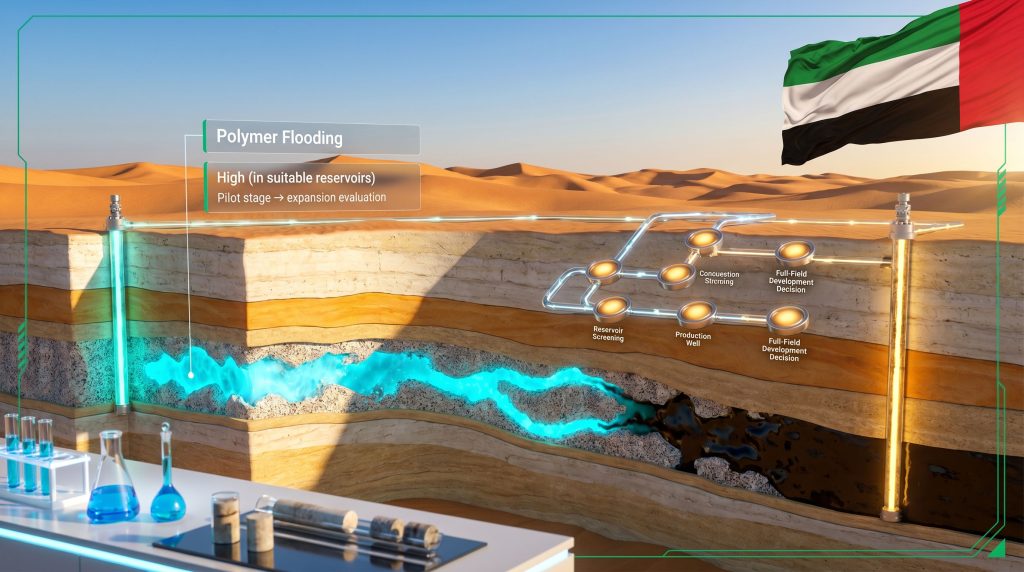
The progression from conceptual consideration to large-scale polymer flooding deployment follows a structured evaluation sequence that ADNOC and SNF are navigating jointly through their newly formalised collaboration. This pathway, while broadly consistent across the industry, requires adaptation to the specific geological and operational conditions of each target reservoir:
-
Reservoir screening and prioritisation — Systematic evaluation of the field portfolio to identify candidates where mobility ratio improvement would generate meaningful incremental recovery above the economic minimum threshold.
-
Laboratory and core-flood simulation studies — Testing of candidate polymer formulations against actual reservoir rock samples and formation brine compositions to measure viscosity retention, adsorption losses, and displacement efficiency under simulated reservoir conditions.
-
Pilot project design and execution — Designing a limited-scale injection programme with sufficient monitoring infrastructure to capture injectivity performance, polymer propagation behaviour, and production response across the target interval.
-
Technical and economic evaluation of pilot results — Rigorously assessing cost-per-barrel of incremental recovery against full-field rollout economics, including sensitivity analysis across oil price and polymer cost assumptions.
-
Environmental and water management review — Evaluating produced water treatment requirements for polymer-laden streams, assessing polymer biodegradability in the subsurface, and confirming surface facility capacity for polymer mixing and handling.
-
Full-field development decision — Sanctioning broader deployment based on the integrated technical, economic, and environmental assessment, potentially phased across multiple reservoir units to manage capital exposure.
SNF's publicly stated involvement in two UAE EOR pilot projects positions the ADNOC and SNF EOR development collaboration at approximately stage four of this framework, with technical and economic pilot evaluations informing the decision about whether those pilots justify broader field-level commitment.
The Industrial Logic Behind Localising EOR Chemical Manufacturing in the UAE
Supply Chain Vulnerability as a Strategic Risk for Large-Scale Chemical EOR
One of the less-discussed dimensions of polymer flooding economics is the logistical exposure associated with sourcing large volumes of water-soluble polymers from international suppliers. At pilot scale, polymer consumption is modest, and global supply chains can accommodate demand with manageable lead times and unit costs. However, the volumetric requirements of full-field polymer flooding operations are substantially larger.
A single large-scale flooding programme in an Abu Dhabi field could require tens of thousands of tonnes of polymer annually, creating significant supply chain dependencies and import costs that directly affect the per-barrel economics of the programme. Oil price movements further complicate the long-term cost modelling for chemical EOR projects that depend on imported inputs.
Localising water-soluble polymer production within the UAE would represent a structurally different cost model for large-scale EOR deployment, potentially reducing chemical input costs by eliminating international freight, reducing lead times, and creating greater operational flexibility in polymer concentration and formulation adjustments.
The UAE's Make it in the Emirates industrial policy framework provides the institutional context within which ADNOC and SNF's localisation discussions are occurring. This programme, focused on encouraging domestic manufacturing and reducing import dependency, creates alignment between EOR chemical supply chain development and broader national economic objectives. It is important to note, however, that this alignment represents a policy framework rather than project-specific government funding commitment.
What Polymer Manufacturing Localisation Would Actually Require
Building domestic water-soluble polymer manufacturing capability involves more than constructing a single production facility. The value chain spans feedstock sourcing, polymerisation chemistry, quality control systems, blending and formulation infrastructure, logistics integration with injection facilities, and technical services capacity to support field operations. Each of these elements requires investment in physical assets, human capital, and institutional knowledge that takes years to develop.
Precedents from other hydrocarbon-rich nations are instructive. Saudi Arabia's development of localised oilfield chemical manufacturing through entities like SABIC demonstrates that national industrial development ambitions can align successfully with oilfield operational requirements when sufficient scale and institutional commitment exist. Norway's development of a domestic oilfield technology and services sector, catalysed by policy-driven local content requirements, similarly illustrates how systematic supply chain localisation can create durable industrial capabilities that persist beyond individual project cycles.
How Global EOR Experience Informs UAE Field Applications
The 300-Project Evidence Base That SNF Brings to the Partnership
SNF's participation in more than 300 EOR projects globally represents one of the most extensive operational datasets available in the water-soluble polymer application space. This accumulated experience spans diverse geological settings, reservoir conditions, and operational environments, ranging from the shallow sandstone formations of the Daqing field in China to North Sea chalk reservoirs and Middle Eastern carbonates with their distinctive mineralogical and wettability characteristics. SNF's comprehensive EOR portfolio details the breadth of polymer applications deployed across these diverse field environments.
The Daqing field in China's Heilongjiang province remains the world's most extensively documented polymer flooding operation and provides perhaps the most compelling large-scale evidence for the technology's commercial viability. Polymer flooding programmes at Daqing have reportedly recovered incremental oil volumes measured in billions of barrels over multi-decade operational periods, demonstrating that the technology can be sustained at reservoir scale with consistent economic returns.
Key variables that global EOR project experience has identified as determinants of polymer flooding success include:
-
Mobility ratio management: Ensuring polymer viscosity is calibrated to achieve a favourable mobility ratio without over-engineering polymer concentration to levels that create injectivity problems.
-
Polymer molecular weight selection: Higher molecular weight polymers generally provide greater viscosity per unit mass but face greater mechanical degradation through pumps, perforations, and reservoir pore throats.
-
Slug design and timing: The volume and concentration of the polymer slug relative to reservoir pore volume determines both the economic investment in chemicals and the duration of sweep improvement benefit.
-
Reservoir conformance monitoring: Real-time surveillance of injection profiles and production responses enables adaptive management of the flooding programme to address unexpected channelling or bypass.
The Middle East's Growing EOR Track Record
The region's experience with advanced EOR extends beyond polymer flooding. The commissioning of the first CO₂-EOR project in the Middle East demonstrated that the operational and technical complexity of tertiary recovery methods can be successfully managed within national oil company frameworks. Furthermore, this proof-of-concept value extends beyond CO₂ injection specifically, establishing institutional confidence that advanced recovery technologies can deliver on their theoretical potential in Middle Eastern reservoir conditions.
Regional adoption of EOR technologies has accelerated as ADNOC, Saudi Aramco, Kuwait Oil Company, and Petroleum Development Oman (PDO) have each intensified focus on recovery efficiency. PDO's Marmul polymer flooding project in Oman, for instance, provides a nearby regional analogue for ADNOC to evaluate. Khalifa University's active research collaboration with SNF on EOR polymer applications adds an important academic dimension, ensuring that local scientific expertise grows in parallel with commercial deployment activity.
The next major ASX story will hit our subscribers first
Technical and Environmental Challenges of Scaling Polymer EOR in the UAE
Engineering Constraints That Must Be Addressed Before Full-Field Commitment
The technical challenges of deploying polymer flooding in UAE reservoir conditions are real and should not be minimised. The primary engineering constraints include:
-
Polymer thermal stability at elevated temperatures: Many of Abu Dhabi's producing reservoirs exceed the thermal stability thresholds of conventional partially hydrolysed polyacrylamide (HPAM) polymers. Above approximately 80–90°C, standard HPAM undergoes accelerated hydrolysis and backbone degradation that reduces viscosity retention over operationally relevant timescales.
-
High-salinity formation water compatibility: High concentrations of divalent cations in UAE formation brines can cause polymer precipitation and viscosity loss. Sulfonated copolymers and other divalent-ion-tolerant formulations can address this challenge but require precise specification against individual reservoir brine compositions.
-
Injectivity management in tight carbonate zones: Polymer solutions are inherently more viscous than water, requiring higher injection pressures. Without careful pressure management, unintended fracture creation can re-establish preferential flow paths, undermining the sweep improvement objective.
-
Surface facility capital requirements: Polymer flooding requires dedicated surface infrastructure for polymer dissolution, hydration, and quality control prior to injection, representing a significant capital addition to existing water injection facilities.
Environmental and Water Management Dimensions
The environmental considerations associated with polymer flooding are increasingly important in the context of ADNOC's publicly stated sustainability commitments. Produced water from polymer flooding operations contains dissolved polymer that must be managed carefully. Depending on the specific polymer chemistry deployed, treatment options range from oxidative degradation of the polymer prior to disposal or re-injection, to membrane separation systems that can recover and potentially recycle polymer from produced water streams.
The long-term subsurface fate of injected polymers is an area of active research. Polyacrylamide-based polymers are generally considered low-toxicity compounds in the concentrations relevant to EOR operations. However, regulatory requirements in the UAE mandate rigorous environmental impact assessment for large-scale EOR programmes, and produced water management plans must demonstrate compliance with applicable discharge and re-injection standards before full-field operations can commence. In addition, water sourcing for large-scale polymer injection requires careful integrated planning in the UAE's water-scarce environment.
How ADNOC and SNF EOR Development Fits Within the Broader UAE EOR Ecosystem
A Multi-Stakeholder Collaboration With Industrial Policy Alignment
The ADNOC-SNF collaboration is not occurring in isolation but within a richly interconnected ecosystem of technical, commercial, and institutional actors whose combined activities are shaping the trajectory of chemical EOR in the UAE. ADNOC's role as both operator and strategic decision-maker across Abu Dhabi's upstream portfolio gives it unparalleled influence over EOR deployment timelines and scale, but the company's approach reflects an openness to international technology partnerships that transfer operational expertise alongside equipment and chemicals.
SNF's decade-plus presence in the UAE market, evidenced by its participation in two domestic EOR pilot projects, provides a credibility foundation that distinguishes it from suppliers offering purely theoretical capabilities. Consequently, trade war oil prices represent an additional planning variable that ADNOC's long-term EOR economics must account for, given how trade war dynamics affect oil prices and chemical supply chain costs simultaneously.
The following table outlines the key evaluation dimensions that will determine whether ADNOC-SNF pilot projects advance to full field development:
| Evaluation Dimension | Key Assessment Questions | Minimum Threshold for Advancement |
|---|---|---|
| Technical Performance | Did polymer flooding achieve target incremental oil recovery? | Incremental recovery above economic minimum |
| Sweep Efficiency Improvement | Was bypassed oil meaningfully contacted? | Measurable reduction in unswept reservoir volume |
| Polymer Stability Under Reservoir Conditions | Did viscosity enhancement persist over the injection period? | Acceptable degradation rate versus design assumptions |
| Injectivity Performance | Were injection pressures maintained within operational limits? | No evidence of formation damage or unintended fracturing |
| Full-Field Economic Viability | Does the NPV of full-field deployment justify chemical and capital costs? | Positive NPV across a defensible range of oil price scenarios |
| Environmental Compliance | Can produced water be managed within applicable regulatory standards? | Full compliance with UAE environmental requirements |
The Signing Ceremony as a Strategic Signal
The choice of the Make it in the Emirates forum as the venue for formalising this collaboration was itself a deliberate signal. Announced by ADNOC Upstream CEO Musabbeh Al Kaabi and SNF Engineering Director Flavien Gathier, the agreement aligns the technical content of the EOR collaboration with the industrial development messaging of one of the UAE's most prominent domestic manufacturing advocacy platforms.
This framing is important because it positions ADNOC and SNF EOR development not merely as an upstream production optimisation exercise, but as a contributor to the UAE's broader economic diversification objectives. SNF's engineering director articulated the commercial rationale clearly, indicating that proximity to clients and end users in markets with long-term opportunities is central to the company's operational philosophy, and that its global portfolio of over 300 EOR projects provides a foundation of operational knowledge applicable to ADNOC's evaluation of future polymer flooding programmes.
What the Future of Polymer EOR Looks Like Across the UAE and GCC
Near-Term, Medium-Term, and Long-Term Development Trajectories
The outlook for polymer flooding across the UAE and the wider GCC reflects a technology on the cusp of transitioning from carefully monitored pilot activity to commercially significant field-level deployment. The near-term horizon through approximately 2030 will be defined by the completion and rigorous evaluation of existing pilot projects, including those in which SNF has participated. Decisions on whether to sanction the first full-field polymer flooding programmes in Abu Dhabi are likely to emerge from this evaluation period.
The medium-term outlook extending to approximately 2035 becomes more speculative but is shaped by several plausible development pathways. If pilot economics are validated at oil prices consistent with ADNOC's planning assumptions, the economic case for full-field deployment strengthens considerably. Broader deployment across multiple ADNOC-operated fields could follow, with injection volumes scaling from tens of thousands to potentially hundreds of thousands of tonnes per year. Energy transition trends in the broader sector are also reshaping how operators like ADNOC evaluate the long-term role of renewable energy solutions and decarbonisation alongside conventional EOR strategies.
Over the longer term, polymer flooding's evolution within the UAE is likely to incorporate digital reservoir management capabilities that were unavailable in earlier-generation EOR programmes. Furthermore, energy transition trends are adding pressure to maximise recovery from existing hydrocarbon assets before the economics of new field development are further complicated by shifting demand patterns. Real-time monitoring of injection profiles and machine learning-assisted identification of sweep efficiency anomalies could substantially improve performance predictability compared to the industry's historical experience base.
GCC-Wide Competitive Dynamics in Chemical EOR
The UAE is not alone in pursuing polymer flooding as a recovery enhancement strategy, and the competitive dynamics of EOR technology deployment across the GCC deserve attention. Saudi Aramco's MaxOil programme encompasses polymer and chemical EOR among its technology portfolio, though the specific deployment status of polymer flooding in Saudi fields is less publicly documented than ADNOC's pilot activity. PDO's Marmul polymer flooding project in Oman represents the most operationally mature regional precedent, having moved from pilot to commercial operation.
Kuwait Oil Company's EOR ambitions are similarly significant, with that operator managing vast carbonate reservoirs in the Burgan field complex where heterogeneity-driven sweep efficiency problems share characteristics with those in Abu Dhabi. The competitive pressure to develop local EOR technology expertise across multiple GCC operators is creating a regionally dense demand environment for polymer suppliers and technology providers, which in turn may accelerate the economic case for regional polymer manufacturing infrastructure serving multiple national oil company clients.
Frequently Asked Questions: ADNOC and SNF EOR Development in the UAE
What Is Polymer Flooding and Why Is It Used in EOR?
Polymer flooding is a chemical enhanced oil recovery technique involving the dissolution of water-soluble polymers into injection water to increase its viscosity. This viscosity increase improves the mobility ratio between the injected fluid and reservoir oil, creating a more uniform displacement front that contacts previously bypassed oil in heterogeneous reservoir formations. The result is higher volumetric sweep efficiency and greater incremental recovery compared to conventional water flooding alone.
How Many EOR Pilot Projects Are Currently Active in the UAE?
Based on publicly available information, SNF has participated in two EOR pilot projects in the UAE, with outcomes subject to ongoing technical and economic assessment. The broader UAE pilot landscape may include additional projects operated by ADNOC and its joint venture partners, though the full inventory of active pilots is not comprehensively documented in public sources.
What Is the Make It in the Emirates Programme and How Does It Relate to EOR?
Make it in the Emirates is a UAE government-led industrial development initiative designed to encourage domestic manufacturing, reduce import dependency, and develop local supply chain capabilities across strategic sectors. Its relevance to EOR lies in the potential to establish local production of water-soluble polymers that would otherwise be imported for use in ADNOC's chemical EOR programmes, aligning upstream production optimisation with broader national industrial strategy.
What Are the Main Technical Risks of Polymer Flooding in Abu Dhabi's Reservoirs?
The primary technical challenges include polymer thermal degradation at elevated reservoir temperatures, viscosity loss due to high-salinity formation water containing divalent cations, injectivity management in lower-permeability carbonate zones, and the capital requirements for surface polymer mixing and injection infrastructure. However, each of these challenges has known engineering solutions, requiring careful formulation and design work specific to each target reservoir.
How Does CO₂-EOR Differ from Polymer Flooding in the UAE Context?
CO₂-EOR achieves oil displacement through miscibility, where injected carbon dioxide becomes miscible with reservoir oil under sufficient pressure, reducing the oil's viscosity and improving its displacement characteristics. Polymer flooding, in contrast, targets sweep efficiency improvement by modifying injection fluid properties and is more broadly applicable to the heterogeneous carbonate reservoirs that characterise much of Abu Dhabi's producing portfolio, where permeability variation rather than oil viscosity is the primary recovery constraint.
Where Can I Find More Technical Information on EOR Deployment in the Middle East?
Readers interested in deeper technical context may find value in reviewing SPE-published research on chemical EOR in Middle Eastern carbonate reservoirs through the OnePetro platform, as well as ADNOC's publicly available communications on its upstream technology strategy. Academic journals including the SPE Reservoir Evaluation and Engineering Journal and the Journal of Petroleum Science and Engineering regularly publish peer-reviewed studies on polymer flooding performance in high-temperature, high-salinity environments directly relevant to UAE conditions.
Want to Know Which ASX Companies Are Quietly Capitalising on the Global EOR and Energy Transition Boom?
Discovery Alert's proprietary Discovery IQ model scans ASX announcements in real time, delivering instant alerts on significant mineral discoveries across more than 30 commodities — turning complex market data into clear, actionable opportunities for investors at every level. Explore historic discoveries and their remarkable returns on Discovery Alert's dedicated discoveries page, then begin your 14-day free trial to position yourself ahead of the broader market.