May 17, 2026
Understanding Advanced Visualization Technology in Underground Mining
The mining industry stands at a technological crossroads where traditional operational methods meet sophisticated automation systems. Underground mining environments present unique challenges that have historically limited visibility and coordination capabilities. Complex multi-level networks, narrow passages, and equipment interaction scenarios create operational bottlenecks that conventional monitoring approaches struggle to address effectively.
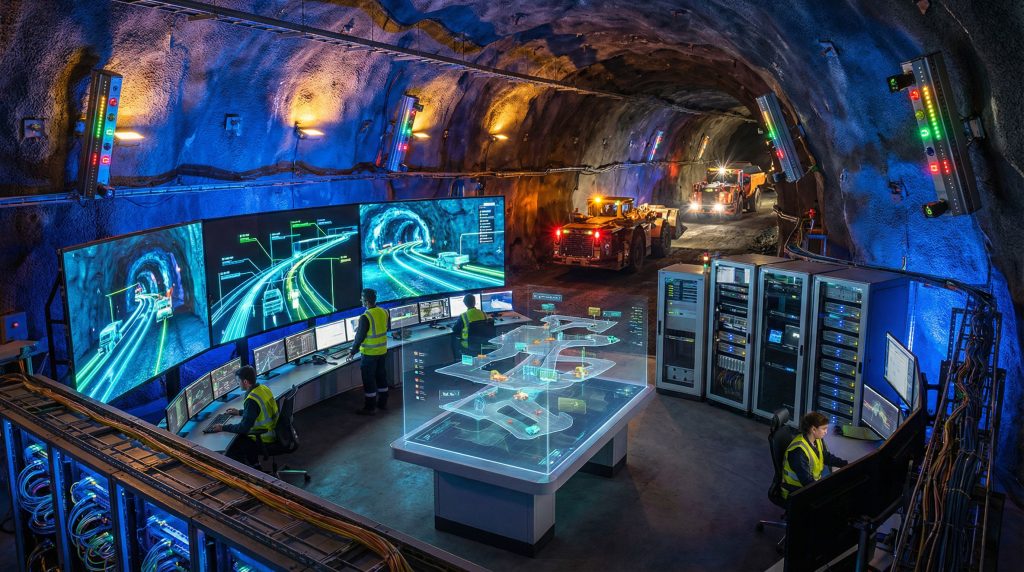
Real-time 3D visualization technology represents a fundamental shift in how mining operations achieve spatial awareness and equipment coordination. This technology integrates multiple sensor systems, positioning devices, and communication networks to create comprehensive three-dimensional representations of underground environments. Furthermore, 3D geological modelling plays a crucial role in enhancing operational planning through advanced visualization capabilities.
The foundation relies on continuous data processing capabilities that transform raw sensor inputs into actionable operational intelligence. The hardware architecture encompasses positioning sensors, communication transceivers, and edge computing units that function reliably in challenging underground conditions.
These systems must operate continuously while withstanding moisture, dust, temperature variations, and signal interference common in deep mining environments. Software components handle real-time data fusion from multiple sources, creating unified operational pictures that enable coordinated decision-making across autonomous equipment networks.
Network infrastructure requirements include robust communication protocols that maintain low-latency connections between distributed equipment and central coordination systems. The technology demands sufficient bandwidth to transmit continuous positional data while maintaining responsive control loops for safety-critical autonomous operations.
When big ASX news breaks, our subscribers know first
Beyond Traditional Monitoring: The 3D Advantage
Traditional mine monitoring systems rely predominantly on two-dimensional dashboard displays that present equipment status through separate views of different operational areas. These conventional approaches require operators to mentally reconstruct three-dimensional relationships from multiple 2D representations, creating cognitive overhead and potential coordination gaps.
Key Differences Between Monitoring Approaches:
| Traditional 2D Systems | Real-Time 3D Visualization |
|---|---|
| Separate views for each mine level | Unified multi-level representation |
| Manual mental reconstruction of spatial relationships | Direct three-dimensional awareness |
| Static dashboard updates | Dynamic real-time positioning |
| Limited traffic coordination capabilities | Intelligent routing and conflict prevention |
Three-dimensional visualization eliminates the interpretive burden by presenting equipment positions, movement paths, and spatial relationships within accurate scale representations of underground networks. This direct spatial awareness enables operators to comprehend complex multi-level interactions that would require significant mental processing when viewed through traditional 2D interfaces.
Real-time data processing distinguishes advanced 3D systems from conventional monitoring through continuous position updates and predictive analysis capabilities. While traditional systems report equipment status at discrete intervals, 3D visualization maintains persistent awareness of equipment trajectories and potential interaction scenarios.
The spatial relationship understanding provided by 3D systems becomes particularly valuable in complex underground geometries where equipment must navigate vertical transitions, intersecting passages, and constrained meeting areas. Traditional monitoring approaches struggle to convey these three-dimensional relationships effectively, while 3D visualization presents them intuitively.
Autonomous Fleet Management Enhanced by 3D Visibility
Autonomous fleet management systems gain substantial operational capabilities when integrated with real-time 3D visibility technology. Traffic orchestration in underground environments requires sophisticated coordination algorithms that account for physical constraints and equipment interactions across multiple vertical levels.
Epiroc real-time 3D visibility technology demonstrates practical application of these concepts through intelligent traffic management logic that prevents operational conflicts before they occur. The system coordinates autonomous truck movement across complex multi-level ramp systems by orchestrating meet-and-pass scenarios at predefined locations where equipment can safely navigate around each other.
Traffic Coordination Benefits:
- Elimination of deadlock scenarios in narrow passages
- Optimized routing algorithms for multi-level operations
- Proactive conflict prevention through predictive pathfinding
- Coordinated equipment scheduling across vertical mine sections
The technology addresses fundamental challenges in autonomous underground operations where traditional GPS positioning becomes unreliable and equipment must navigate confined spaces with limited maneuvering opportunities. By maintaining continuous three-dimensional awareness of all fleet positions, the system can execute sophisticated routing decisions that maximize throughput while preventing collision scenarios.
Cross-level communication protocols enable autonomous vehicles operating on different mine levels to coordinate activities through centralized decision-making systems. This capability becomes essential when equipment movements on one level affect traffic flow or resource availability on adjacent levels.
Load balancing across multiple production zones benefits from comprehensive visibility into equipment distribution and utilization patterns. The 3D visualization enables fleet management systems to identify bottlenecks and redistribute resources dynamically to maintain optimal production flow. Additionally, data-driven mining operations enhance these capabilities by providing actionable insights for operational optimization.
Safety Enhancements Through Real-Time 3D Underground Visibility
Safety improvements represent perhaps the most critical benefit of real-time 3D visualization in underground mining operations. The technology addresses fundamental safety challenges through enhanced personnel tracking, collision prevention, and emergency response coordination capabilities.
Personnel tracking systems integrated with 3D visualization provide continuous awareness of worker positions relative to autonomous equipment and hazardous operational zones. Proximity alert systems can trigger immediate warnings when personnel enter areas where autonomous vehicles are operating, preventing dangerous interactions between workers and automated equipment.
Advanced proximity detection systems utilizing 3D positioning data can reduce equipment-related incidents by proactively preventing dangerous scenarios rather than reacting to them after they occur.
Equipment collision prevention represents a primary safety mechanism enabled by comprehensive 3D visibility. By maintaining real-time awareness of all equipment positions and movement trajectories, the system can identify potential collision scenarios and execute corrective routing before dangerous situations develop.
The technology specifically addresses safety challenges in narrow underground passages where autonomous vehicles cannot pass each other safely. Traditional approaches might result in equipment meeting in areas where backing up or maneuvering around obstacles becomes difficult or impossible, creating potentially dangerous situations.
Safety Protocol Enhancements:
- Restricted area enforcement through automated geofencing
- Emergency evacuation route optimization based on real-time equipment positions
- Predictive maintenance alerts triggered by operational pattern analysis
- Integration with existing mine safety systems and protocols
Emergency response coordination benefits significantly from comprehensive 3D awareness of personnel and equipment locations. During emergency situations, response teams can access real-time information about the location of all individuals and equipment throughout the underground network, enabling more effective rescue and evacuation procedures.
Operational Efficiency Improvements Through 3D Visualization
The impact of 3D visualization technology on operational efficiency extends across multiple aspects of mining operations, from production optimization to maintenance scheduling. Real-time bottleneck identification becomes possible when operators maintain comprehensive visibility into equipment distribution and movement patterns across all mine levels.
Production optimization benefits from enhanced visibility into equipment utilization patterns and operational flow constraints. The technology enables identification of inefficient routing, equipment idle time, and coordination delays that might not be apparent through conventional monitoring approaches.
Key Performance Areas Enhanced by 3D Visibility:
| Performance Metric | 3D Visualization Benefit |
|---|---|
| Equipment Utilization | Real-time tracking of active vs. idle equipment |
| Cycle Time Optimization | Intelligent routing reduces travel time |
| Bottleneck Resolution | Proactive identification of traffic constraints |
| Maintenance Scheduling | Predictive maintenance based on usage patterns |
Shift handover procedures improve significantly when incoming personnel can access comprehensive visual representations of current operational status, equipment positions, and ongoing activities. This enhanced situational awareness reduces the time required for shift transitions and minimizes the risk of communication gaps between shifts.
Maintenance planning capabilities are enhanced through continuous monitoring of equipment operational patterns and performance indicators. The 3D visualization system can identify equipment that may be approaching maintenance intervals or exhibiting operational anomalies that warrant inspection.
Asset management benefits from comprehensive tracking of equipment lifecycle performance and utilization patterns. This data enables more accurate predictions of equipment replacement timing and helps optimize capital equipment investments based on actual operational requirements. Moreover, mining industry innovation continues to drive these advancements forward.
Technical Implementation Requirements and Challenges
Implementing 3D visualization technology in underground mining operations presents significant technical challenges that must be systematically addressed to achieve reliable operation. Infrastructure requirements encompass communication networks, power systems, environmental protection, and integration with existing mine equipment.
Underground communication networks must provide sufficient bandwidth and reliability to support continuous transmission of 3D positioning data while maintaining low-latency response times for safety-critical applications. The challenging underground environment includes signal reflection, interference, and coverage gaps that conventional surface communication systems are not designed to handle.
Primary Implementation Challenges:
- Network infrastructure deployment in confined underground spaces
- Power supply reliability for continuous operation
- Environmental protection against moisture, dust, and temperature extremes
- Integration complexity with diverse equipment types and vintages
- Cybersecurity protocols for connected autonomous systems
Power supply considerations become critical when supporting continuous operation of sensors, communication equipment, and processing systems throughout underground networks. The infrastructure must provide reliable power delivery to distributed components while maintaining safety standards for electrical systems in potentially hazardous underground environments.
Environmental protection requirements for electronic systems operating underground include resistance to moisture infiltration, dust accumulation, and temperature fluctuations. Equipment must function reliably despite exposure to conditions that can rapidly degrade conventional electronic components.
Staff training requirements represent a significant implementation consideration as personnel must develop competencies in operating and maintaining sophisticated 3D visualization systems. This includes understanding system capabilities, troubleshooting procedures, and emergency protocols when technology systems experience failures.
The next major ASX story will hit our subscribers first
What Makes Mining Operations Ideal for 3D Visibility Technology?
Certain mining operations benefit more substantially from 3D visibility technology implementation based on their operational complexity, equipment density, and safety requirements. Multi-level mine configurations with complex ramp systems represent ideal applications where the technology provides maximum operational value.
High-traffic underground environments with significant autonomous equipment activity gain considerable benefits from coordinated traffic management enabled by 3D visibility systems. Operations with frequent equipment interactions and coordination requirements see substantial improvements in operational efficiency and safety performance.
Operational Characteristics Favoring 3D Implementation:
- Complex multi-level mine geometry with numerous intersections
- High-density autonomous equipment operations
- Frequent personnel and equipment interaction scenarios
- Operations requiring precise coordination between different equipment types
- Deep mining operations with enhanced safety protocol requirements
Deep mining operations face particular challenges related to communication reliability, emergency response coordination, and equipment monitoring that 3D visibility technology can address effectively. The enhanced situational awareness becomes increasingly valuable as operational depth increases and traditional surface-based monitoring approaches become less effective.
Return on investment considerations vary significantly based on operational scale, equipment density, and existing automation infrastructure. Operations with substantial autonomous equipment investments typically achieve faster payback periods through improved equipment utilization and reduced operational conflicts.
Cost-Benefit Analysis Framework:
| Investment Category | Benefit Realization Area |
|---|---|
| Infrastructure Development | Operational Efficiency Gains |
| Equipment Integration | Safety Incident Reduction |
| Staff Training | Maintenance Optimization |
| System Maintenance | Production Throughput Improvement |
Scalability factors become important considerations for expanding mining operations that plan to increase equipment density or extend operational areas. 3D visibility systems that can accommodate growth without requiring complete infrastructure replacement provide better long-term value propositions.
Future Evolution of 3D Visualization in Underground Mining
The trajectory of 3D visualization technology in underground mining points toward increasingly sophisticated automation capabilities and integration with broader mining industry digitization initiatives. Artificial intelligence applications will enhance the predictive capabilities of 3D visualization systems by identifying operational patterns and optimizing equipment coordination algorithms automatically.
Augmented reality interfaces represent a significant development area where underground personnel can access 3D visualization data through wearable devices, providing hands-free access to equipment positions, hazard warnings, and operational status information while performing field work.
Machine learning algorithms will enable 3D visualization systems to continuously improve their operational optimization capabilities by learning from historical performance data and identifying subtle patterns that human operators might not recognize. These systems will become increasingly proactive in preventing operational issues before they impact production or safety.
Emerging Technology Integration Areas:
- Artificial intelligence for predictive operational optimization
- Augmented reality interfaces for field personnel
- Machine learning algorithms for pattern recognition and system improvement
- Integration with Industry 4.0 mining automation platforms
Future operational capabilities will include fully autonomous mine coordination where 3D visualization systems manage entire underground operations with minimal human intervention. Remote operation centers equipped with immersive 3D control interfaces will enable mining companies to manage multiple operations from centralized locations.
Predictive geological modeling integrated with real-time operational data will provide unprecedented capabilities for optimizing extraction strategies based on continuously updated geological understanding combined with real-time equipment performance data. In addition, AI in mining operations will further revolutionise these technological advancements.
Cross-mine data sharing initiatives will enable mining companies to optimize operations based on industry-wide operational intelligence, creating collaborative approaches to operational efficiency and safety improvement that benefit the entire mining sector. Enhanced real-time monitoring capabilities will support these developments through improved operational coordination.
Implementation Strategy and Best Practices
Successful implementation of 3D visualization technology requires systematic approaches that address technical, operational, and organizational challenges through phased deployment strategies. Pilot program development focusing on specific mine sections allows organizations to validate technology performance and develop operational procedures before full-scale deployment.
Gradual expansion across operational areas enables mining companies to build internal expertise while minimizing operational disruption during technology implementation. This approach allows for continuous refinement of procedures and identification of optimization opportunities before committing to comprehensive system deployment.
Phased Implementation Approach:
- Assessment Phase: Evaluate current operational needs and infrastructure requirements
- Pilot Development: Deploy limited-scope systems in representative operational areas
- Performance Validation: Measure system effectiveness and operational impact
- Gradual Expansion: Systematically extend coverage across additional mine areas
- Optimization: Refine procedures and maximize system utilization
Staff training and change management protocols must address both technical competency development and cultural adaptation to technology-enhanced operations. Personnel need training in system operation, troubleshooting procedures, and integration of 3D visualization capabilities into existing operational workflows.
Performance measurement systems should be established to track the effectiveness of 3D visibility technology implementation across safety, efficiency, and operational coordination metrics. Regular assessment enables continuous system optimization and demonstrates return on investment to stakeholders.
Technology selection criteria must consider compatibility with existing mine infrastructure, scalability for future operational expansion, and vendor support capabilities for long-term system maintenance and upgrades. Comprehensive evaluation frameworks help ensure selected systems meet both current and anticipated future operational requirements.
Strategic Value and Competitive Advantages
Real-time 3D visibility technology provides mining operations with substantial competitive advantages through improved operational efficiency, enhanced safety performance, and reduced operational costs. These benefits compound over time as organizations develop expertise in leveraging advanced visualization capabilities for operational optimization.
Operational efficiency improvements manifest through reduced equipment idle time, optimized routing algorithms, and enhanced coordination between autonomous and human-operated equipment. The cumulative effect of these improvements can significantly impact overall mine productivity and cost performance.
Safety enhancement benefits extend beyond direct incident prevention to include improved emergency response capabilities, better hazard awareness, and more effective safety training through realistic 3D visualization of potential hazard scenarios.
Competitive Advantage Areas:
- Operational efficiency optimization through intelligent coordination
- Safety performance improvement and regulatory compliance
- Cost reduction opportunities through optimized resource utilization
- Future-proofing operations for continued technological advancement
Cost reduction opportunities arise from multiple sources including reduced equipment conflicts, optimized maintenance scheduling, improved energy efficiency through route optimization, and decreased operational delays caused by coordination issues.
Future-proofing mining operations becomes increasingly important as the industry continues evolving toward greater automation and digitization. Organizations that develop competencies in 3D visualization technology position themselves advantageously for continued technological advancement and operational optimization. Consequently, sustainability transformation initiatives benefit from these technological improvements.
The strategic implementation of Epiroc real-time 3D visibility technology and similar systems represents a fundamental evolution in underground mining operations. Furthermore, autonomous truck haulage platforms demonstrate the practical applications of these technological advances. As the industry continues advancing toward greater automation and operational sophistication, three-dimensional visualization capabilities will become essential infrastructure for competitive mining operations seeking to maximize safety, efficiency, and operational coordination in increasingly complex underground environments.
Ready to Capitalise on the Next Major Mining Discovery?
Discovery Alert instantly alerts investors to significant ASX mineral discoveries using its proprietary Discovery IQ model, transforming complex mining data into actionable insights for both short-term traders and long-term investors. Discover how historic mineral discoveries have generated substantial returns and begin your 30-day free trial today to position yourself ahead of the market.