May 21, 2026
Advanced water recovery technologies represent a critical frontier where mining operations must balance resource extraction with environmental stewardship. As global water scarcity intensifies across key mining regions, traditional approaches to wastewater management face unprecedented challenges in both cost efficiency and regulatory compliance. The intersection of technological innovation and operational necessity has created fertile ground for breakthrough solutions that fundamentally reimagine how mining sites approach water resource management, particularly when considering comprehensive mining permitting insights.
What Makes Water Recovery Systems Essential for Modern Mining Operations?
Mining operations worldwide face mounting pressure from water availability constraints that directly impact project economics and operational viability. Industry analysis reveals that water management challenges now influence project timelines, operating costs, production throughput, and permitting risk across multiple mining sectors. This operational reality has transformed water recovery from an environmental consideration into a core business imperative.
The economic implications of water scarcity extend beyond simple acquisition costs. Traditional water treatment methods in mining operations typically consume between 15-25 kWh per cubic meter for thermal evaporation systems, creating substantial operational expenditures that compound over project lifecycles. These energy-intensive processes also require specialised infrastructure and corrosion-resistant materials, driving capital investments significantly higher than alternative approaches.
Regulatory frameworks across major mining jurisdictions continue tightening discharge standards while implementing stricter water rights restrictions. Mining companies must navigate increasingly complex compliance requirements that favour technologies capable of achieving zero liquid discharge or near-complete water recovery rates. This regulatory landscape has accelerated adoption timelines for innovative water management solutions, particularly as companies explore mining innovation trends that prioritise sustainability.
Traditional Limitations in Mining Water Treatment
Conventional evaporation systems face fundamental constraints when processing high-salinity mining brines. These systems typically achieve recovery rates between 85-95% but struggle with energy efficiency and maintenance requirements in harsh mining environments. The thermal processing required for traditional methods creates operational bottlenecks that limit scalability and increase long-term operational costs.
Reverse osmosis technologies, while more energy-efficient at 3-6 kWh per cubic meter, face severe limitations when processing brines exceeding 35,000 parts per million total dissolved solids. This constraint excludes reverse osmosis from many mining applications where brine concentrations reach 100,000 ppm or higher. Membrane fouling in high-contamination environments further reduces system reliability and increases maintenance intervals.
The capital expenditure profile for traditional systems creates additional barriers to implementation. Thermal evaporation systems require extensive infrastructure including specialised heat exchangers, crystallisers, and waste heat recovery systems. Installation complexity often extends implementation timelines beyond acceptable project schedules, particularly for mining operations with aggressive production targets.
When big ASX news breaks, our subscribers know first
How Does Solvent-Based Technology Transform Mining Wastewater Processing?
Innovative approaches to water extraction are revolutionising mining wastewater management through non-evaporative processing methods. Solvent-based systems utilise proprietary absorption mechanisms that operate at significantly lower energy requirements while achieving superior recovery rates across diverse brine compositions. Cetos Water technology in mining applications demonstrates this transformation through low-energy processing that enables efficient reuse of water at mine sites.
The fundamental advantage of solvent-based extraction lies in its ability to process complex wastewater regardless of dissolved solids concentration. Unlike membrane-based systems that face operational limits, solvent extraction can handle brines with unlimited salinity levels while maintaining consistent performance metrics. This capability unlocks water recovery potential in applications previously considered technically unfeasible, supporting advanced data-driven operations throughout mining facilities.
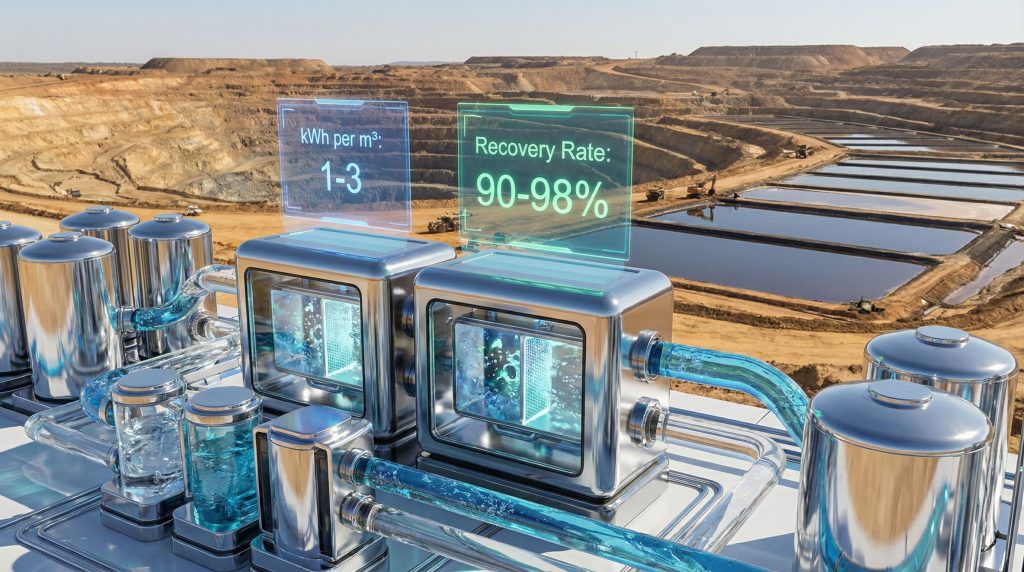
Operational performance data indicates that advanced solvent systems can achieve recovery rates between 90-98% while consuming only 1-3 kWh per cubic meter of processed water. These efficiency gains translate directly into operational cost reductions and improved project economics. The membrane-free processing approach eliminates fouling concerns and reduces maintenance requirements compared to traditional filtration systems.
Technical Advantages of Non-Evaporative Processing
Temperature-controlled regeneration cycles enable continuous operation without the thermal stress associated with conventional evaporation. This operational approach reduces equipment wear and extends system lifespans while maintaining consistent output quality. The modular design architecture supports scalable deployment from pilot installations to full-scale operations.
Integration protocols with existing tailings management infrastructure streamline implementation without requiring complete system overhauls. Mining operations can incorporate solvent-based recovery systems into current workflows while maintaining production continuity. This compatibility factor significantly reduces deployment risk and accelerates return on investment timelines.
Containerised system specifications facilitate rapid installation and commissioning at remote mining sites. Pre-configured modules can be deployed and operational within weeks rather than months, supporting aggressive project development schedules. The standardised approach also enables system relocation between mining sites as operational requirements evolve.
What Economic Benefits Drive Adoption of Advanced Water Recovery?
The economic case for advanced water recovery systems extends beyond simple operational cost savings to encompass multiple revenue streams and risk mitigation factors. Capital investment analysis reveals that modular solvent-based systems typically require 60-80% less initial investment compared to equivalent-capacity thermal evaporation installations. This cost advantage accelerates project payback periods and improves overall return on investment calculations.
Operational expenditure optimisation through automated systems reduces labour requirements while improving process reliability. Advanced control systems enable unmanned operation during extended periods, reducing staffing costs and minimising human error risks. The simplified maintenance requirements of off-the-shelf components further reduce ongoing operational expenses.
Key Economic Advantages Include:
• Reduced energy consumption lowering operational costs by 70-85%
• Automated operation reducing labour requirements significantly
• Simplified maintenance scheduling using standard industrial components
• Modular scalability enabling phased capacity expansion
• Integration compatibility minimising infrastructure modifications
Revenue generation opportunities emerge through concentrated brine processing for valuable mineral extraction. Advanced water recovery systems produce concentrated waste streams ideal for lithium, rare earth, and critical mineral recovery. These secondary revenue streams can offset water treatment costs while creating additional profit centres for mining operations, particularly when integrated with sustainable production insights that maximise resource efficiency.
Investment Return Analysis for Water Recovery Systems
Financial modelling indicates that advanced water recovery implementations typically achieve positive cash flow within 18-24 months of commissioning. The combination of reduced operational costs, regulatory compliance benefits, and potential mineral recovery revenues creates compelling investment cases across multiple mining sectors.
Zero liquid discharge implementation through advanced water recovery eliminates ongoing disposal costs and associated liability exposure. Mining companies can transform wastewater from a cost centre into a resource recovery opportunity while achieving full regulatory compliance. This operational transformation supports sustainable mining practices while improving project economics.
The risk mitigation value of water security infrastructure provides additional economic justification beyond direct cost savings. Operations with reliable water recovery capabilities face reduced exposure to supply disruptions and regulatory enforcement actions. This operational resilience translates into improved project valuations and reduced financing costs.
How Do Mining Companies Evaluate Water Technology Solutions?
Mining companies employ comprehensive evaluation frameworks when assessing water technology investments, focusing on multiple criteria that extend beyond initial capital costs. The evaluation process typically encompasses water availability projections over full mine lifecycles, regulatory compliance cost trajectories, and technology reliability in harsh operating environments.
Critical Evaluation Criteria Include:
-
Long-term water availability and supply security assessments
-
Regulatory compliance cost projections and enforcement risk analysis
-
Technology reliability and performance validation in mining applications
-
Scalability potential to match production expansion requirements
-
Integration complexity with existing operational infrastructure
The competitive evaluation process demonstrated through programs like the Future of Mining Challenge reveals industry emphasis on practical innovation over theoretical performance claims. Mining companies prioritise technologies with proven operational records and demonstrated scalability across diverse applications.
Industry stakeholders increasingly recognise that water management technologies must deliver measurable improvements in multiple operational areas simultaneously. Cost reduction alone insufficient to justify adoption; technologies must also improve regulatory compliance, reduce operational risk, and support long-term sustainability objectives.
Technology Assessment Methodologies
Pilot testing protocols enable mining companies to validate performance claims under site-specific conditions before committing to full-scale implementations. These controlled evaluations typically span 3-6 months and focus on verifying recovery rates, energy consumption, and operational reliability metrics under actual mining conditions.
Third-party validation through academic partnerships provides additional credibility for emerging technologies. The collaboration between industry challenges and institutions like the University of British Columbia's Sauder School of Business creates objective evaluation frameworks that reduce selection risk for mining companies.
Competitive assessment processes attract global technology developers and create comprehensive solution portfolios for mining company evaluation. Furthermore, the Future of Mining Challenge attracted numerous high-quality applications globally, demonstrating the international scope of innovation in mining water management.
What Innovation Trends Shape Mining Water Management Development?
Corporate innovation initiatives are fundamentally reshaping technology development timelines and adoption patterns in mining water management. Major mining companies now actively fund breakthrough technology development through structured challenge programs that accelerate commercialisation cycles. The Future of Mining Challenge represents this trend, providing US$1 million awards to promising water management technologies.
University partnerships create essential research and development acceleration platforms that bridge academic innovation with industrial application requirements. These collaborations enable rapid prototyping and validation cycles while providing access to specialised expertise and testing facilities. The partnership model reduces development risk while improving technology readiness levels.
Emerging Innovation Focus Areas:
• Multi-year challenge programmes targeting specific operational problems
• Academic-industry partnerships accelerating technology validation
• Global competition platforms attracting international innovation
• Technology showcase events facilitating stakeholder engagement
• Structured evaluation processes reducing adoption risk
The evolution from first-generation challenges focused on general innovation to targeted programmes addressing specific operational challenges reflects industry maturation in technology adoption. The progression from initial challenges launched in September 2024 to specialised water management programmes demonstrates accelerating innovation cycles.
Future Technology Development Priorities
The 2026-2027 Future of Mining Challenge will focus on technologies that reduce land impact through more efficient mining and processing methods. This evolution indicates industry recognition that water management solutions must integrate with broader sustainability objectives including land use optimisation and processing efficiency improvements, connecting closely with mine reclamation innovation strategies.
Market expansion opportunities extend beyond traditional mining applications to include industrial wastewater treatment, oil and gas produced water management, and power generation cooling water recycling. These adjacent markets provide additional revenue streams for water recovery technology developers while supporting broader commercial viability.
Technology roadmaps increasingly emphasise integration capabilities that enable comprehensive resource recovery rather than single-purpose water treatment. Future systems will likely incorporate artificial intelligence optimisation, hybrid processing technologies, and automated mineral recovery capabilities within unified platforms.
How Can Mining Operations Implement Advanced Water Recovery Systems?
Successful implementation of advanced water recovery systems requires comprehensive planning that addresses site-specific requirements, operational integration, and performance validation protocols. Mining operations must conduct detailed water analysis to determine optimal system configurations and processing parameters for their unique brine compositions and flow rates.
The implementation pathway typically progresses through three distinct phases: pilot testing (3-6 months), demonstration scale (12-18 months), and full commercial deployment. Each phase validates specific performance metrics and operational integration requirements before advancing to larger scale installations.
Pilot testing protocols focus on verifying technology performance under actual site conditions while identifying potential integration challenges. These initial installations typically process 1-5% of total water volumes while generating comprehensive performance data for scaling decisions.
Scaling from Pilot to Commercial Operations
Demonstration-scale implementations bridge the gap between pilot validation and full commercial deployment by processing 10-25% of total water volumes. This intermediate phase validates system reliability, maintenance requirements, and operational procedures before committing to complete facility integration.
Implementation Success Factors:
• Comprehensive site-specific water characterisation and flow analysis
• Phased deployment approach enabling performance validation at each stage
• Integration planning with existing water management infrastructure
• Performance monitoring systems for continuous optimisation
• Maintenance protocols developed for site-specific operating conditions
Full commercial deployment integrates water recovery systems into primary operational workflows while maintaining production continuity. Advanced control systems enable automated operation with minimal operator intervention, supporting 24/7 operation requirements typical in mining environments.
Long-term operational optimisation strategies incorporate predictive maintenance protocols and performance monitoring systems that maximise system uptime and efficiency. These approaches ensure sustained performance throughout equipment lifecycles while identifying upgrade opportunities as technology continues evolving.
The next major ASX story will hit our subscribers first
What Future Developments Will Impact Mining Water Technology?
The trajectory of mining water technology development points toward increasingly sophisticated systems that integrate multiple processing technologies within unified platforms. Next-generation solvent formulations promise enhanced selectivity for specific contaminants while improving recovery efficiency and reducing energy consumption further.
Artificial intelligence integration will enable automated optimisation of processing parameters based on real-time water chemistry analysis and operational conditions. These smart systems will continuously adjust operating parameters to maximise recovery rates while minimising energy consumption and maintenance requirements.
Hybrid system designs combining multiple recovery technologies offer potential for addressing diverse water treatment challenges within single installations. These integrated approaches may combine solvent extraction, membrane processing, and thermal treatment in optimised sequences that maximise overall system performance.
Market Evolution and Technology Convergence
The expansion of water recovery technology applications beyond mining into industrial wastewater treatment, oil and gas operations, and power generation creates larger addressable markets that support continued innovation investment. This market diversification reduces development risk while accelerating technology advancement cycles, particularly as companies like Cetos Water continue advancing sustainable water management technologies.
Technology convergence trends indicate future systems will incorporate comprehensive resource recovery capabilities including mineral extraction, water purification, and waste volume reduction within integrated platforms. This holistic approach transforms wastewater processing from cost centres into revenue-generating operations.
The emphasis on land impact reduction in future innovation challenges suggests Cetos Water technology in mining development will increasingly focus on closed-loop systems that eliminate discharge requirements while maximising resource recovery. These zero-waste approaches align with evolving regulatory requirements and sustainability objectives across global mining jurisdictions.
Investment decisions regarding water recovery technologies should consider site-specific conditions, regulatory requirements, and long-term operational objectives. Performance projections and cost estimates may vary significantly based on local conditions and specific operational requirements. Mining companies should conduct comprehensive feasibility studies before committing to technology implementations.
Ready to Capitalise on Mining Innovation Breakthroughs?
Discovery Alert's proprietary Discovery IQ model delivers real-time alerts on significant ASX mineral discoveries, instantly empowering subscribers to identify actionable opportunities in companies developing breakthrough mining technologies before the broader market catches on. Begin your 14-day free trial today at Discovery Alert and position yourself ahead of the market as mining innovation transforms the industry landscape.