August 3, 2026
The Capital Cycle Behind Open Pit Development: Understanding the Build-Before-You-Harvest Logic
In mining, the most consequential investment decisions rarely look attractive in the year they are made. Capital-intensive open pit development programs compress near-term free cash flow, inflate headline expenditure figures, and often coincide with periods of deliberately subdued production. Yet these same programs are precisely how mid-tier copper producers transform their cost structures and production profiles over a multi-year horizon. The mechanics of capitalised waste stripping, feed grade transitions, and phased mill blending strategies are poorly understood outside specialist circles, but they sit at the core of what Aeris Resources (ASX: AIS) is executing through its Aeris Resources Constellation project growth spend in FY27.
Understanding why the company is committing to a capital program of this scale, and what it is actually building toward, requires looking beyond the FY27 production guidance numbers and into the geological and operational logic underpinning the entire Tritton development sequence.
When big ASX news breaks, our subscribers know first
What the Capital Numbers Are Actually Saying
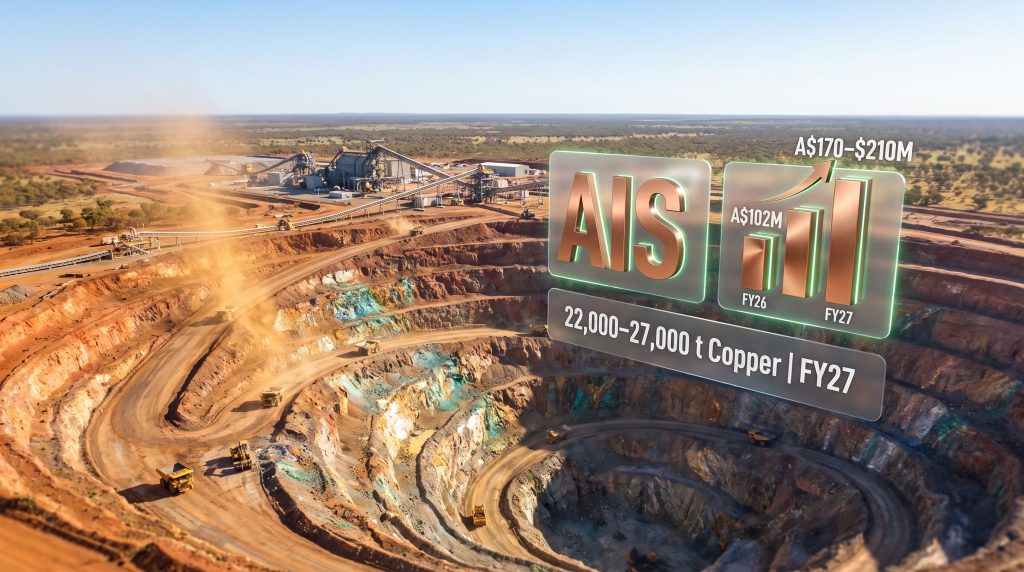
Growth and project capital at Aeris is forecast to reach $170 to $210 million in FY27, compared with $102 million deployed across FY26. That represents a year-on-year increase of between 67% and 106%, a step-change that stands out even by the standards of junior-to-mid-tier copper development cycles on the ASX. Furthermore, understanding broader copper market trends helps contextualise why Aeris is accelerating this investment at this particular point in the cycle.
The dominant driver of this escalation is construction activity and capitalised waste stripping at the Constellation open pit within the Tritton copper operations in central-west New South Wales. However, the capital story actually begins in Q4 FY26, when Aeris deliberately pulled forward A$10 to A$15 million of early-works expenditure into that quarter to cover infrastructure preparation and road works at the Constellation site. Critically, this spend sat outside FY26 guidance because it was drawn from the FY27 budget envelope, not an unplanned cost overrun.
This distinction matters for investors interpreting the capital trajectory. The pull-forward was a deliberate de-risking mechanism: by completing infrastructure groundwork before the formal FY27 construction commencement, the company created the conditions for an early Q1 FY27 construction start rather than risking a delayed entry into the critical stripping phase.
Beyond Constellation, additional Tritton growth capital will be directed toward a tailings dam lift, electrical infrastructure upgrades, and feasibility studies at the Mallee Bull prospect. Each of these components feeds into the longer-term operational sustainability of the Tritton complex rather than generating immediate production uplift.
Capital Expenditure Comparison: FY26 vs FY27
| Capital Category | FY26 | FY27 Guidance |
|---|---|---|
| Growth and Project Capital | A$102M | A$170 to A$210M |
| Early Works Pull-Forward (Q4 FY26) | A$10 to A$15M (excluded from FY26 guidance) | Captured in FY27 envelope |
| Exploration Expenditure | A$17M | A$29 to A$35M |
| Care and Maintenance (Jaguar) | A$12M | A$3 to A$4M |
The Jaguar base metals operation cost reduction from $12 million to just $3 to $4 million is equally significant. Limiting Jaguar to essential care-and-maintenance activities frees meaningful capital that can be redirected into the Constellation construction program and the exploration uplift at Tritton and Cracow, reflecting a clear internal capital hierarchy.
The Constellation Open Pit: Geological Context and Feed Grade Strategy
The Constellation deposit occupies a position within the Tritton operation footprint that makes it particularly valuable from a processing standpoint. The ore body contains both supergene copper and primary copper sulphide mineralisation, a combination that is geologically significant for how it interacts with the existing Tritton processing mill. The Constellation project has received development approval, further solidifying the operational pathway for this critical asset.
Supergene copper enrichment occurs when primary sulphide deposits near the surface are chemically altered by oxidising groundwater over geological time, concentrating copper into secondary minerals such as chalcocite and covellite. These supergene zones typically carry higher copper grades than the primary sulphide zone beneath them, making the Constellation ore body particularly attractive as a mill feed component during the early phases of open pit mining when the supergene horizon is being accessed first.
The practical consequence for Tritton's mill is a feed grade uplift that is expected to materialise progressively through the second half of FY27. By Q4 FY27, Constellation ore is expected to constitute approximately 45% of total mill feed, blended with lower-grade material from the Murrawombie open pit and underground sources including the Budgerygar and Tritton mines.
This blending strategy is standard practice in multi-source copper operations. By managing the proportion of high-grade Constellation ore entering the mill circuit, the operation can optimise copper recovery rates and reduce unit costs without overloading the processing facility with ore that exceeds its optimal throughput parameters. In addition, interpreting drill results from the resource definition program will be central to validating the grade assumptions underpinning this blending strategy.
The grade transition from H1 to H2 FY27 is not an operational setback, it is an engineered feed sequence. The first half deliberately processes lower-grade material from existing sources while Constellation waste stripping advances, before the higher-grade ore blend enters the circuit in late Q3 and builds toward full contribution in Q4.
Sulphide ore from Constellation is scheduled to reach the Tritton mill in late Q3 FY27, with the Q4 ramp-up representing the point at which the capital investment begins translating into tangible production and cost improvements. This timing dynamic creates a deliberate H2 production weighting that investors need to account for when evaluating interim production reports against full-year guidance.
FY27 Production Guidance: Flat by Design, Not by Constraint
The headline production numbers for FY27 will initially appear underwhelming given the scale of the capital being deployed.
Consolidated Group Production Targets
| Commodity | FY27 Guidance Range |
|---|---|
| Copper | 22,000 to 27,000 tonnes |
| Gold | 42,000 to 51,000 ounces |
| Silver | 130,000 to 160,000 ounces |
Copper output at Tritton is expected to fall within the 22,000 to 27,000 tonne range for the full year, broadly consistent with FY26 performance. The flat guidance should not be misread as evidence that the capital investment is failing to generate production growth, because the production improvement is a FY28 and beyond story. FY27 is the construction year in which the infrastructure enabling that improvement is being built.
The grade headwinds in H1 are structural rather than operational. The Murrawombie open pit and the Budgerygar and Tritton underground mines carry lower average copper grades than the Constellation ore body. Processing these sources in H1 while Constellation waste stripping advances is the only logical sequencing available, and it means first-half unit costs will be higher before the Constellation blend drives them down in H2.
At Cracow in Queensland, gold production is expected to decline year-on-year despite mining and processing volumes remaining broadly consistent with FY26. The decline reflects lower forecast ore grades in the current mining sequence within the deposit, a geological transition rather than a structural deterioration of the resource. Cracow's grade variability across different ore shoots within the vein system is a known characteristic of epizonal gold deposits of this style.
Exploration Strategy: Converting Inferred Resources While Hunting New Discoveries
The 71% to 106% increase in exploration expenditure from $17 million to $29 to $35 million in FY27 reflects a dual-track strategy that distinguishes Aeris from operators who treat exploration as a discretionary item to be cut when development capital peaks. These resource drilling programs are fundamental to building the long-term reserve base that will sustain operations well beyond the Constellation construction phase.
At Tritton, the exploration program has two distinct objectives running in parallel:
- Resource definition drilling targeting the conversion of the large inferred mineral resource defined during FY26 into indicated resources, a prerequisite for future ore reserve declaration and mine planning
- Surface greenfields exploration across the broader Tritton tenure package, with the stated ambition of identifying a second Constellation-style discovery to extend the long-term production pipeline
The conversion of inferred to indicated resources is a technically and statistically defined process under the JORC Code, the standard governing mineral resource reporting in Australia. Inferred resources carry higher geological uncertainty than indicated resources and cannot be included in ore reserves used for mine planning and financing purposes. Upgrading the resource classification at Tritton is therefore not simply a reporting exercise — it is a prerequisite for translating the resource inventory into bankable mine plans for future development phases.
At Cracow, the exploration program is notably more aggressive than the production guidance implies:
- Exploration spending at Cracow will increase by more than 50% year-on-year
- Drilling at the Golden Plateau project will extend beyond the 14,000 metres committed in FY26
- A third underground drill rig will be deployed to target new high-grade ore shoots within the Western Vein Field
- Sustaining capital is increasing to fund underground equipment upgrades in support of an extended operational life
The Western Vein Field at Cracow is a prospective structural corridor that has been under-drilled relative to the main mine areas. Adding a third rig specifically targeting this zone signals that Aeris believes there is meaningful high-grade potential yet to be defined within the existing mine footprint.
Risk Dimensions Investors Should Understand
The Aeris Resources Constellation project growth spend program carries several embedded risk categories that deserve clear-eyed assessment alongside the opportunity case.
Construction execution risk sits at the top of the hierarchy. A capital program of $170 to $210 million represents a significant uplift in project management complexity relative to the company's recent deployment history. Open pit development of this scale involves coordinating earthmoving contractors, blasting programs, water management infrastructure, and haul road construction simultaneously, all of which carry execution sensitivity.
Capitalised waste stripping accounting is also worth understanding. In open pit mining, the cost of removing waste rock to access ore is often capitalised to the balance sheet during the development phase rather than expensed immediately. This practice is consistent with accounting standards but means reported operating costs in early development periods may understate the true economic burden of ore access. Investors should monitor the transition from capitalised stripping to expensed stripping as Constellation moves from development into steady-state production.
Grade transition risk in H1 FY27 creates a window of elevated unit costs that may pressure operating margins if copper prices soften during that period. The H2 recovery thesis depends on Constellation ore reaching the mill on schedule in late Q3. Furthermore, cut-off grade economics will play a critical role in determining how efficiently the operation sequences ore and waste through this transition period.
Exploration conversion risk at Tritton is a technically dependent variable. The resource definition drilling campaign must deliver statistically sufficient drill spacing and grade continuity to support the reclassification of inferred material to indicated status under JORC. This is not guaranteed, and any shortfall in conversion rates would defer the reserve declaration timeline.
Jaguar optionality remains an unresolved element of the portfolio. Reducing activities to essential care-and-maintenance preserves the asset without resolving its long-term future, leaving the restart or divestment decision deferred to a period when Aeris has more capital flexibility post-Constellation construction.
The next major ASX story will hit our subscribers first
The FY28 Thesis: What Aeris Is Actually Building Toward
The strategic logic underpinning every element of the Aeris Resources Constellation project growth spend in FY27 converges on a single thesis: that the capital being deployed now will produce a materially different cost and production profile from FY28 onward. A completed definitive feasibility study process underpins the confidence with which the company is committing capital at this scale.
When Constellation ore constitutes a significant and growing proportion of mill feed, the expected improvement in feed grade should translate into higher copper recovery per tonne processed and lower unit cost of production. In copper economics, unit cost reduction through grade improvement is one of the most powerful levers available to an operator, because it does not require building additional processing capacity or expanding the workforce.
The combination of higher feed grades from Constellation, an expanded and upgraded resource inventory at Tritton, ongoing exploration potential at the Western Vein Field at Cracow, and a sharply reduced Jaguar cost burden creates the operational conditions for a considerably improved free cash flow generation profile relative to the capital-intensive FY27 period.
Whether that thesis is fully realised depends on construction execution, geological outcomes from the resource definition drilling, copper price conditions, and the timing precision of the Constellation ore transition. None of these are certainties, which is precisely why the FY27 capital commitment represents a calculated risk rather than a guaranteed outcome.
This article is intended for informational purposes only and does not constitute financial or investment advice. Readers should conduct their own due diligence and consult a licensed financial adviser before making any investment decisions. Forward-looking statements and production guidance referenced in this article are subject to material risks and uncertainties that could cause actual outcomes to differ from those projected.
Ready to Identify the Next Major ASX Copper Discovery Before the Market Does?
Discovery Alert's proprietary Discovery IQ model scans ASX announcements in real time, instantly transforming complex mineral data into actionable insights for both short-term traders and long-term investors — explore historic discoveries and their exceptional returns to understand what's possible, then begin your 14-day free trial at Discovery Alert to position yourself ahead of the next significant find.