July 31, 2026
The Geological Clock Is Running Out for the World's Copper Capital
Long before a quarterly production figure makes headlines, the forces behind it have been building for decades. In the copper mining world, there is a concept that geologists and mine planners track with quiet dread: the point at which an ore body's grade profile begins its terminal decline. Unlike a weather event or a labour dispute, ore grade degradation cannot be reversed by policy decisions, capital injections, or engineering innovation alone. It is a geological reality baked into the earth itself, and Chile is now confronting it at national scale.
Chile's weakest copper output in 19 years, recorded across the April to June 2026 period, is not a statistical anomaly. It is the measurable consequence of structural forces that have been accumulating since Chile's flagship copper operations first entered production. Understanding why this matters requires moving beyond the production numbers and examining what they reveal about the future of global copper supply at precisely the moment demand is accelerating most aggressively.
When big ASX news breaks, our subscribers know first
The Data Behind the Decline: Reading Chile's 2026 Production Numbers Correctly
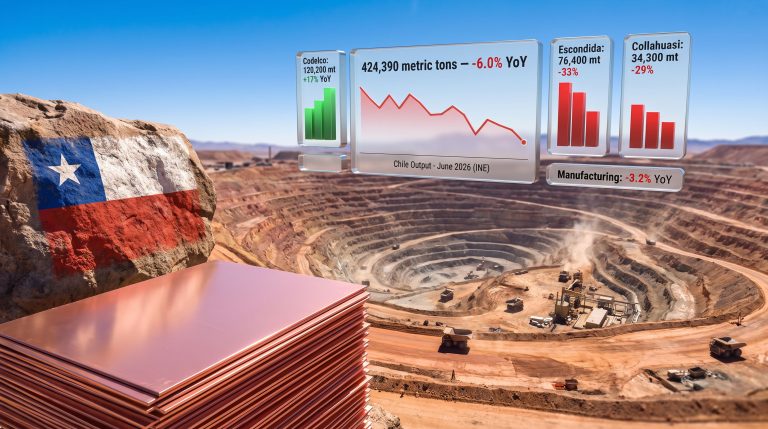
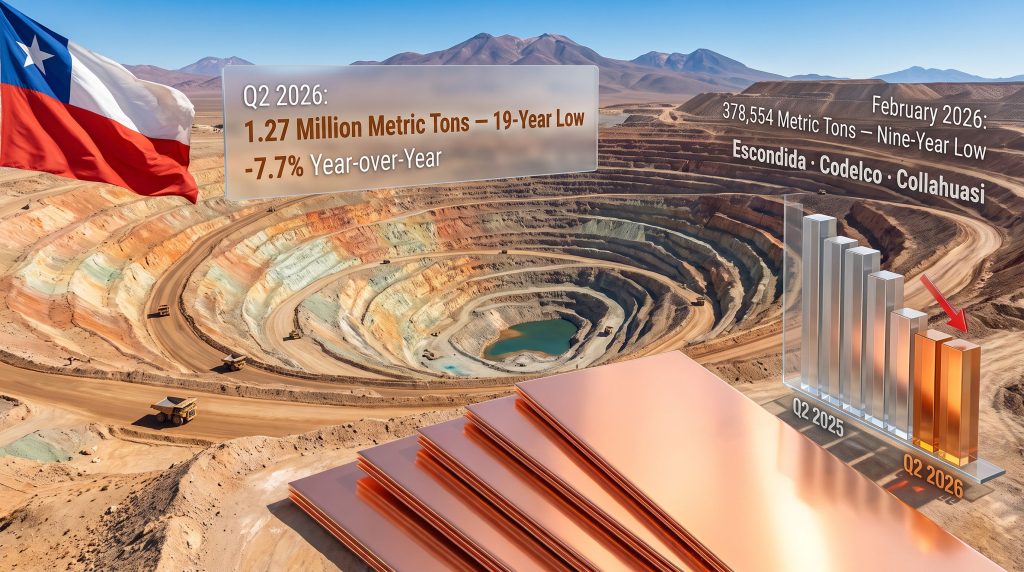
Chile's national statistics bureau published Q2 2026 copper production data on 31 July 2026, confirming output of 1.27 million metric tons across the April to June period. That figure represents a 7.7% contraction compared to Q2 2025 and marks the weakest April to June quarterly result in a data series stretching back to 2007, placing this firmly in the category of Chile's weakest copper output in 19 years.
The monthly granularity adds further weight to the picture. February 2026 recorded output of just 378,554 metric tons, the lowest single-month figure since March 2017, representing a nine-year low at the monthly level.
A surface-level reading of the data might note the 3.6% sequential improvement from Q1 to Q2 2026 as a sign of recovery. However, industry professionals understand this differently. Chile's copper production almost always improves from the first quarter to the second, driven by the seasonal stabilisation of weather conditions at open-pit operations in the Atacama and central Andean regions. Treating this rebound as structural recovery would be a significant misreading of the underlying trend.
| Metric | Value | Context |
|---|---|---|
| Q2 2026 total output | 1.27 million metric tons | Lowest Q2 since 2007 |
| Year-over-year change | -7.7% | Steepest Q2 decline in nearly two decades |
| February 2026 monthly output | 378,554 metric tons | Lowest since March 2017 |
| Q1 to Q2 2026 sequential change | +3.6% | Consistent with historical seasonal pattern |
| Chile's share of global mined copper | ~25% | Largest single national producer |
Ore Grade Decline: The Problem That Capital Cannot Fully Solve
To understand why Chile's Q2 2026 result is structurally significant rather than cyclically temporary, it helps to understand what ore grade actually means in practice and why its decline is so consequential.
Ore grade refers to the concentration of copper contained within each tonne of rock extracted from a mine. It is typically expressed as a percentage, so a grade of 1.0% Cu means that for every 1,000 kilograms of ore processed, approximately 10 kilograms of copper is recoverable. When that grade falls to 0.5% Cu, the same processing throughput yields only half the copper, while the costs of extraction, crushing, grinding, and smelting remain largely unchanged or increase.
This is not an abstract concern. Global average copper ore grades have declined from approximately 1.5% Cu in the early 2000s to below 0.7% Cu at many major operations today. Chile's flagship mines are among the most advanced examples of this trend, with several large porphyry copper deposits now processing rock at grades that would have been considered uneconomical just two decades ago.
The critical insight here is one that the broader investment community frequently underweights: capital investment can partially offset the effect of grade decline by improving processing efficiency, increasing throughput, or accessing new zones within an ore body, but it cannot alter the fundamental concentration of copper in the ground. Furthermore, Codelco and BHP have collectively committed billions of dollars to sustaining output at their Chilean operations, yet the trajectory of national production tells the story of a geological clock that no amount of engineering ingenuity can fully reset.
The Porphyry Copper Deposit Lifecycle
Chile's dominant ore body type is the porphyry copper deposit, a geological formation that typically presents a high-grade core surrounded by progressively lower-grade mineralisation. Early-stage mining at these deposits extracts the highest-grade ore first, generating strong economics. As operations mature and the high-grade core is depleted, miners are left processing the lower-grade periphery. This lifecycle is well understood by geologists but often under-appreciated by generalist investors.
The practical consequence is that even a mine operating at full mechanical efficiency will produce declining copper volumes over time as it transitions from core to peripheral mineralisation. Depth also becomes a factor, as deeper ore zones require more energy, more complex water management systems, and more sophisticated ventilation infrastructure, all of which increase unit costs while doing nothing to improve the grade of the ore being extracted.
Flagship Operations Under Pressure: Escondida, Codelco, and Collahuasi
Three assets sit at the centre of Chile's production shortfall, and their combined underperformance carries national-level consequences.
Escondida, operated by BHP and recognised as one of the largest copper mines by annual output, has been navigating the grade decline challenge through a combination of processing optimisation and studies into underground expansion to access deeper, potentially higher-grade ore zones. Despite significant capital investment, Escondida's output has remained a source of ongoing analysis rather than consistent growth.
Codelco, the state-owned enterprise that stands as the world's largest copper producer by cumulative historical output, is executing a multi-billion dollar structural transformation programme across its portfolio of integrated mines, many of which have been producing continuously for over half a century. The production benefits of these programmes are expected to emerge over a multi-year horizon, meaning the near-term output profile remains constrained.
Collahuasi, one of the world's largest copper deposits by resource size, is jointly owned by Glencore and Anglo American. While Collahuasi has shown greater consistency than some peers, it is not immune to the grade and operational complexity trends affecting the broader Chilean industry.
Because these three assets collectively represent a disproportionate share of Chile's total national copper output, operational headwinds at any combination of them translate directly into measurable national-level production shortfalls.
The Investment Paradox: More Dollars, Less Copper
One of the most counterintuitive dynamics in the modern copper mining industry is the relationship between capital investment and output growth. The global copper mining sector has deployed hundreds of billions of dollars in sustaining capital and growth investment over the past decade. Despite this, global copper mine supply growth has averaged less than 2% annually over the past five years, a figure that falls well short of the demand growth rates implied by electrification and energy transition scenarios.
This investment paradox — more capital producing diminishing output returns — is a defining structural feature of the mature copper mining landscape. It reflects the combined effect of:
- Declining ore grades requiring more rock to be processed per unit of copper produced
- Increasing mine depth driving higher energy and infrastructure costs
- More complex hydrogeological environments requiring sophisticated dewatering systems
- Stricter environmental and permitting requirements extending project timelines
- Community engagement obligations adding time and cost to both new developments and existing mine expansions
The paradox has a direct implication for how analysts and investors should interpret future capital allocation announcements from major copper producers. An announcement of increased investment at a Chilean operation should not automatically be read as a forward indicator of production growth. In many cases, increased investment is simply the cost of maintaining existing output in the face of worsening geological conditions. These dynamics are also central to understanding the broader copper supply crunch that is reshaping global supply chains.
Near-Term Downside: July 2026 and Storm Disruption Risk
Beyond the structural picture, Q3 2026 production carries additional near-term downside risk. Severe storm activity across Chile's central mining regions during July 2026 is expected to have caused operational disruptions at open-pit operations. Heavy precipitation events create a cascade of production challenges: pit floor flooding, haul road damage, crusher feed interruptions, and delayed ore blending schedules. The scale of the July impact will only become apparent when monthly statistics are published, but early indications suggest Q3 2026 output may not provide the recovery that seasonal patterns would otherwise suggest.
The next major ASX story will hit our subscribers first
Demand Acceleration: Why the Timing of Chile's Decline Matters
Chile's production challenges would be a manageable industry concern in an era of moderate copper demand growth. They become a material supply chain problem in the current environment, where demand is accelerating from multiple simultaneous sources. Consequently, the copper price growth drivers now in play are unlike anything the market has navigated in previous decades.
The demand drivers pulling copper consumption higher include:
- Electric vehicles: each battery-electric vehicle requires approximately three to four times more copper than an equivalent internal combustion engine vehicle, across motors, wiring harnesses, charging systems, and battery thermal management
- AI data centre infrastructure: large-scale computing facilities require substantial copper-intensive power distribution systems, busbars, cabling, and cooling infrastructure
- Grid modernisation: electricity grid upgrades required to support renewable energy integration and EV charging networks are copper-intensive across transformers, conductors, and switchgear
- Renewable energy generation: wind turbines and solar installations use significantly more copper per unit of electricity generated than conventional fossil fuel plants
The International Energy Agency's modelling consistently identifies copper as one of the most supply-constrained critical minerals in high-ambition energy transition scenarios. Chile's weakest copper output in 19 years arrives precisely as these demand drivers are moving from projected to realised consumption growth.
Bloomberg Intelligence analyst Grant Sporre has maintained that copper mine supply could remain tight across 2026, citing accident-related disruptions and slow production recoveries at major mines as factors offsetting new output coming online elsewhere, a view that reinforces a constructive price outlook for the metal.
The Price Signal: What Copper Near Record Highs Is Actually Telling Us
Copper was trading at approximately $5.64 per pound at the time of the Q2 2026 production data release, a level that reflects genuine structural supply anxiety rather than speculative froth. Commodity markets are forward-looking, and the copper price signal in 2026 is one that experienced market participants interpret as an expression of the market's recognition that primary supply growth cannot keep pace with demand acceleration.
The long lead time required to bring new copper mines into production is a critical variable that investors outside the mining sector frequently overlook. From initial discovery through exploration, scoping studies, feasibility work, permitting, construction, and commissioning, a new large-scale copper mine typically requires 10 to 15 years before producing its first saleable metal. This means that even if a significant new copper discovery were made today, it could not meaningfully contribute to alleviating the supply gap until the late 2030s at the earliest. This is precisely why copper exploration importance has risen so sharply in industry discussions over recent years.
Secondary Copper: A Partial, Not Complete, Solution
Secondary copper, produced through the recycling of scrap and end-of-life copper-bearing products, currently accounts for approximately 30 to 35% of total global copper supply. Recycling rates are expected to increase as the wave of copper-intensive infrastructure installed during the current electrification buildout eventually reaches end of life.
However, secondary supply faces structural constraints of its own. Recycled copper production is inherently dependent on the availability of copper-bearing scrap, which is itself a function of the installed base of copper products and their economic lives. Wind turbines have design lives of 20 to 30 years. EVs entering service today will generate scrap copper in the 2040s and beyond. The recycling uplift that could help bridge the primary supply gap is largely a phenomenon of the 2040s, not the 2020s.
A Global Industry Problem Wearing a Chilean Face
It would be analytically incomplete to treat Chile's Q2 2026 production result as a purely Chilean problem. The ore grade decline, ageing infrastructure, and investment paradox dynamics playing out in the Atacama are mirrored in Peru's Cuajone and Toquepala operations, in Zambia's Copperbelt, in the Democratic Republic of Congo's Katanga region, and across segments of Australia's Olympic Dam complex.
Peru, the world's second-largest copper producer, has faced a combination of community disruptions, political instability, and its own ore grade pressures in recent years. The DRC's copper output has grown significantly, but social and infrastructure challenges continue to constrain the pace of development. New project pipelines in emerging copper jurisdictions face permitting timelines extending to a decade or more, higher capital intensity targeting lower-grade remote deposits, and geopolitical risk that complicates long-term investment decisions.
The result is a global copper mining industry where the combined weight of geological maturity, capital constraints, and project development timelines is generating a structural supply gap that no single new project or jurisdiction can quickly fill. In addition, the future of copper mining will increasingly depend on how effectively the industry can adapt to these compounding pressures through collaboration and technological innovation.
Key Takeaways for Investors and Industry Observers
The following points summarise the essential conclusions from Chile's Q2 2026 production data and their broader implications:
- Chile's 1.27 million metric ton Q2 2026 copper output represents the weakest April to June quarterly result in 19 years, with a 7.7% year-over-year decline confirming a structural, not cyclical, trend
- The February 2026 monthly low of 378,554 metric tons establishes that Q2's weakness extends across the full first half of 2026
- Ore grade decline at mature porphyry copper deposits is the primary driver of the production shortfall, and it cannot be reversed by capital investment alone
- Flagship operations at Escondida, Codelco's integrated mine network, and Collahuasi are all navigating the same structural headwinds, amplifying their combined national impact
- Storm disruption in July 2026 adds a near-term downside variable to Q3 production forecasts
- Copper demand is accelerating from EV manufacturing, AI infrastructure, and grid modernisation simultaneously, creating a demand pull that Chilean supply cannot currently match
- The 10 to 15 year lead time for new copper mine development means supply-side relief is structurally limited through the remainder of the decade
- Secondary copper recycling provides a partial offset but cannot close the primary supply gap within relevant near-term timeframes
- Copper prices near $5.64 per pound reflect genuine structural supply anxiety supported by the convergence of the above factors
Disclaimer: This article contains forward-looking analysis, price commentary, and market forecasts that reflect publicly available information and analyst perspectives as of July 2026. It does not constitute financial or investment advice. Commodity markets are subject to significant volatility, and past production trends do not guarantee future outcomes. Readers should conduct their own research and seek independent financial advice before making investment decisions.
Want to Know When the Next Major Copper Discovery Hits the ASX?
Discovery Alert's proprietary Discovery IQ model scans ASX announcements in real time, delivering instant alerts on significant mineral discoveries — including copper — so subscribers can identify actionable opportunities before the broader market reacts. Explore how historic discoveries have generated substantial returns on Discovery Alert's dedicated discoveries page, and begin your 14-day free trial today to position yourself ahead of the next major find.