August 1, 2026
The Copper Supply Crunch That Was Always Coming
For decades, the mining industry operated on a comfortable assumption: copper was abundant enough, supply chains were predictable enough, and prices would cycle through familiar ranges without fundamentally disrupting the economics of diversified miners. That assumption has quietly collapsed. The combination of accelerating electrification, structurally declining ore grades at legacy operations, and a near-decade-long drought in major new mine discoveries has created the conditions for a genuine supply-demand inflection point in copper markets.
Against this backdrop, the Rio Tinto copper pivot is not simply a portfolio reshuffling exercise. It is a calculated bet, years in the making, that the structural forces reshaping global energy systems will translate into sustained copper demand far beyond what spot price cycles have historically delivered. Rio Tinto's H1 2026 financial results, released on 29 July 2026, offered the first substantial evidence that this repositioning is generating real financial returns rather than just strategic narrative.
When big ASX news breaks, our subscribers know first
Why Copper Demand Is Structurally Different This Time
The commonly cited copper demand drivers are well known: electric vehicles require roughly three to four times more copper per unit than internal combustion vehicles, grid infrastructure upgrades are copper-intensive at every stage, and the proliferation of data centres supporting artificial intelligence workloads demands substantial quantities of copper wiring and heat management systems. What is less widely appreciated is how these demand streams interact and compound simultaneously rather than arriving in sequence.
A single grid-scale battery storage facility can require between 500 and 1,000 tonnes of copper depending on its capacity and configuration. A hyperscale data centre requires copper at every layer of its architecture, from power distribution systems through to server interconnects. When these demand sources converge with the long-cycle supply constraints inherent to copper mining, the resulting pressure on available inventories is qualitatively different from typical commodity demand growth.
The Supply Side Problem: Why New Copper Is Hard to Find
The average ore grade at operating copper mines has declined materially over the past two decades. Where grades of 1.5% to 2% copper were once common at major operations, many large-scale mines today process ore grades below 0.5%. Lower grades mean more rock processed per tonne of copper produced, higher energy consumption per unit of output, and rising per-unit operating costs even before factoring in labour, water, or regulatory compliance expenses.
Beyond grade decline, the permitting timeline for a greenfield copper project from discovery to first production now routinely exceeds 15 to 20 years in most major jurisdictions. This long lead time means that copper supply additions sanctioned today will not reach markets until the late 2030s at the earliest. Furthermore, the global copper supply gap between projected demand and confirmed pipeline projects is widening in ways that the market has not yet fully priced.
This structural backdrop is precisely the environment in which Rio Tinto's strategic capital reallocation toward copper makes the most sense from a long-duration investor perspective.
Rio Tinto's H1 2026 Financial Performance: A Full Breakdown
The headline numbers from Rio Tinto's H1 2026 result were materially ahead of market expectations across every key metric. The strength was broad-based rather than driven by a single favourable item.
| Financial Metric | H1 2026 Result | Year-on-Year Change |
|---|---|---|
| Consolidated Sales Revenue | US$31.0 billion | +15% |
| Underlying EBITDA | US$14.8 billion | +28% |
| Net Earnings (Attributable) | US$6.7 billion | +47% |
| Underlying Earnings | US$6.9 billion | n/a |
| Underlying ROCE | 17% | n/a |
| Net Cash from Operations | US$9.2 billion | +32% |
| Free Cash Flow | US$3.8 billion | +75% |
| Net Debt | US$14.1 billion | n/a |
| Net Gearing | 16% | n/a |
The 75% surge in free cash flow to US$3.8 billion is arguably the most important number in the result. Free cash flow is the true measure of a miner's financial flexibility, and at this level it comfortably funds the dividend, supports the capital programme, and leaves room for balance sheet management.
Segment Earnings: Where the Growth Was Concentrated
| Segment | H1 2026 EBITDA | Year-on-Year Change | Share of Group EBITDA |
|---|---|---|---|
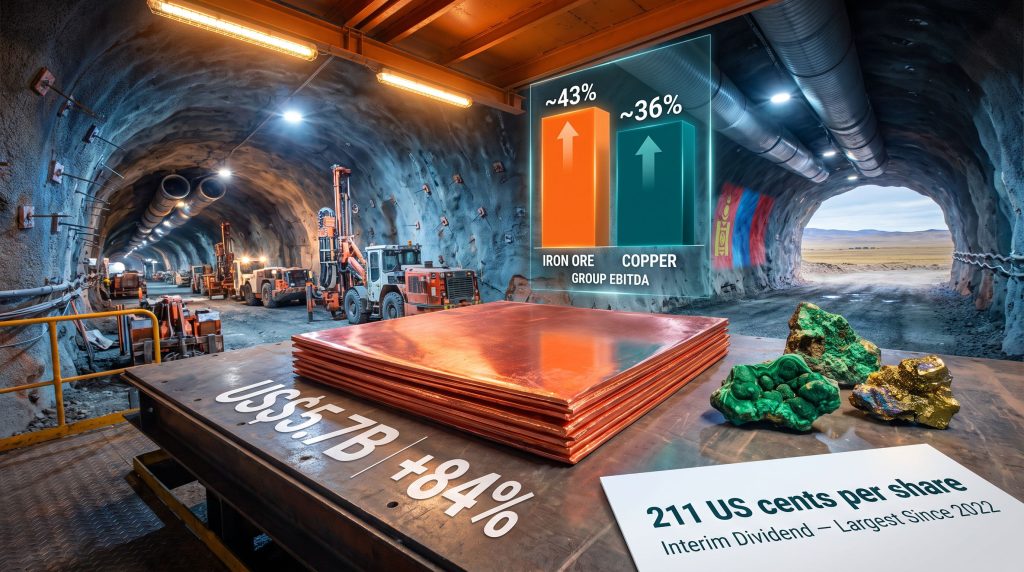
| Iron Ore | US$6.8 billion | Broadly flat | ~43% |
| Copper | US$5.7 billion | +84% | ~36% |
| Aluminium and Lithium | US$3.3 billion | +38% | ~21% |
The segment data reveals something structurally significant: for the first time in the company's modern history, copper, aluminium, and lithium combined account for more than half of group underlying EBITDA. Iron ore, while still the single largest divisional contributor, is no longer the dominant force it once was in shaping overall group earnings outcomes.
Key investor insight: The earnings mix shift in H1 2026 represents the culmination of a multi-year capital reallocation strategy. The copper segment's 84% EBITDA surge was not purely price-driven. Volume growth from the Oyu Tolgoi underground ramp-up played an equally important role, which means the earnings uplift has a durable operational component rather than being entirely dependent on commodity price levels.
Oyu Tolgoi: The Mine That Changed Rio Tinto's Earnings Architecture
Understanding the Oyu Tolgoi underground mine in Mongolia is essential to understanding the Rio Tinto copper pivot. The deposit, located in the South Gobi Desert near the Chinese border, is one of the largest known copper-gold deposits in the world. Its open-pit operations have been producing for over a decade, but the underground block cave represents an entirely different scale of production potential.
Block cave mining is a technically demanding method particularly suited to large, low-grade porphyry copper deposits. The technique involves undermining a large ore body and allowing gravity to progressively collapse the rock into collection points below. When executed at Oyu Tolgoi's scale, the method can deliver very high ore throughput volumes at competitive unit costs, provided the geological conditions are favourable and the underground infrastructure is properly established.
The Oyu Tolgoi ramp-up through 2024 and 2025 was the critical operational catalyst behind the copper earnings surge in H1 2026. As underground ore volumes build toward design capacity, Rio Tinto's guidance of approximately 1 million tonnes of annual copper equivalent production by 2030 moves from aspirational target to increasingly credible operational trajectory.
What Full-Rate Oyu Tolgoi Production Would Mean for Group Earnings
At current copper price levels, Oyu Tolgoi at full underground production capacity has the potential to generate segment EBITDA contributions that could further compress iron ore's relative earnings share even without any deterioration in Pilbara volumes or pricing. This is not a scenario most copper analysts have fully integrated into long-run earnings models, partly because the ramp-up timeline has historically been subject to revision.
The mine's underground ore grades are significantly higher than what was available at surface in the open pit, which consequently supports lower unit production costs as the operation matures. This grade premium effect is a meaningful but underappreciated dimension of the underground ramp-up's earnings potential.
Resolution Copper: The Long-Duration Option the Market Is Not Fully Pricing
Beyond Oyu Tolgoi, Rio Tinto holds a 55% interest in the Resolution Copper project in Arizona, one of the largest undeveloped copper deposits in North America. The orebody sits at significant depth, requiring shaft access rather than conventional open-pit or shallow underground methods, which adds both capital cost and technical complexity to the development pathway.
Permitting for Resolution Copper has been subject to a prolonged and complex regulatory process involving land access, environmental assessment, and indigenous heritage considerations. Rio Tinto has indicated that initial production could begin in the early-to-mid 2030s, though this timeline remains contingent on the resolution of outstanding permitting requirements rather than any confirmed approval pathway.
Resolution Copper's strategic value lies precisely in its scale and its location. North American copper production from a politically stable jurisdiction is increasingly valued by industries seeking supply chain security for domestic manufacturing, particularly in sectors with geopolitical sensitivity around critical mineral sourcing. Rio Tinto copper expansion across multiple continents underscores just how seriously the company is treating its long-term copper strategy.
Exploration Capital: 85% to Copper Is a Decisive Signal
One of the lesser-discussed but highly informative data points from Rio Tinto's recent disclosures is its allocation of approximately 85% of its FY2025 exploration budget toward copper. This is not an incremental tilt. It is a near-wholesale reorientation of the company's discovery pipeline toward a single commodity.
For context, diversified miners typically spread exploration capital across commodity categories to manage discovery risk and maintain optionality across cycle positions. When a major miner concentrates exploration spending to this degree, it signals genuine conviction about long-run demand rather than short-term price opportunism. According to an analysis of Rio Tinto's aggressive pivot, sustaining this growth trajectory into 2026 and beyond will depend heavily on execution across multiple project fronts.
This compares starkly with the exploration budget distributions of earlier years when iron ore and aluminium competed more evenly for exploration dollars. The implication for investors is that Rio Tinto's copper exposure, already growing through the Oyu Tolgoi ramp-up, has a further discovery optionality layer that the market has not yet quantified.
The next major ASX story will hit our subscribers first
Capital Expenditure, Divestments, and Balance Sheet Management
Rio Tinto has guided to capital expenditure of up to US$11 billion in both 2026 and 2027. This is a substantial investment commitment, particularly for a company simultaneously managing a dividend programme worth billions of dollars annually.
To fund this investment without excessive leverage growth, management announced a target of US$5 billion in divestment announcements during 2026. The strategic logic here is sound: selling non-core or lower-growth assets to redeploy capital into copper and energy transition metals is consistent with the portfolio repositioning thesis. In addition, the copper supply crunch provides a compelling long-term justification for accelerating this capital reallocation before the supply-demand gap widens further.
Net gearing of 16% following H1 2026 demonstrates that the balance sheet retains meaningful headroom relative to the capital programme. This is an important buffer given the commodity price sensitivity of mining cashflows.
| Metric | Position |
|---|---|
| Capital Expenditure Guidance (2026 and 2027) | Up to US$11 billion per year |
| Divestment Target (2026) | US$5 billion announced |
| Net Debt | US$14.1 billion |
| Net Gearing | 16% |
The Dividend: Largest Interim Payout Since 2022
The board declared an interim ordinary dividend of 211 US cents per share, representing a 43% increase on the prior year's 148 US cents per share. Total dividend value was US$3.4 billion, struck at a 50% payout ratio.
Key Dates for ASX-Listed RIO Shareholders:
- Ex-dividend date: 13 August 2026
- Payment date: 24 September 2026
Australian shareholders holding RIO on the domestic register will receive the dividend fully franked, meaning imputation credits accompany each dividend payment. For Australian resident investors, particularly those in superannuation or self-managed super funds, franking credits carry real economic value by reducing or eliminating the additional tax payable on dividend income.
The board's forward guidance on maintaining fully franked dividends strengthens the income investment thesis for Rio Tinto shares in the Australian market. When combined with the 75% surge in free cash flow underpinning the payout, the dividend increase reflects genuine operational cash generation improvement rather than a payout ratio manipulation.
Iron Ore Is Not Retreating, It Is Being Complemented
A critical misreading of the Rio Tinto copper pivot would be to interpret it as an exit from iron ore. The Pilbara operations delivered record first-half iron ore production in H1 2026, demonstrating that the division's operational quality remains world-class even as its relative earnings share declines within the group mix.
The structural headwinds facing seaborne iron ore are real: Chinese steel demand appears to be plateauing, decarbonisation pathways for steelmaking could reduce blast furnace iron ore consumption over the medium term, and price sensitivity to Chinese property sector health remains high. However, these are long-cycle pressures rather than immediate earnings threats.
The productivity programme adds an important dimension here. Rio Tinto banked US$870 million in productivity benefits during H1 2026 and is targeting an annualised run-rate of US$1.8 billion by year-end 2026. These efficiency gains create a structural earnings floor that partially insulates group results from commodity price volatility in any individual segment.
Scenario Analysis: Earnings Resilience Under Different Commodity Conditions
| Scenario | Iron Ore Environment | Copper Environment | Group Earnings Impact |
|---|---|---|---|
| Bull Case | Stable or firming | Prices sustained or rising | Diversification delivers meaningful outperformance |
| Base Case | Broadly flat EBITDA | Copper maintains ~36% share | Productivity gains support earnings stability |
| Bear Case | Pricing softens materially | Copper prices retreat | Significant earnings compression, partially offset by productivity |
What the Analyst Community Is Watching
Goldman Sachs upgraded Rio Tinto to a buy rating following the H1 2026 result, reflecting confidence in the copper growth trajectory and the quality of the cash generation improvement. As noted in a recent AFR report on Rio Tinto's copper ambitions, the company is explicitly targeting copper supply growth to meet AI-driven infrastructure demand, which adds a further structural demand dimension beyond traditional electrification narratives.
The bear case, however, centres on a different concern: that copper's current price environment already embeds the anticipated demand from electrification and data centre growth, meaning further upside is limited while downside exposure remains real if macro conditions soften.
Key metrics analysts will track through H2 2026 include:
- Copper production volumes relative to full-year guidance
- Productivity programme progress toward the US$1.8 billion annualised run-rate
- Divestment announcement progress toward the US$5 billion target
- Iron ore price trajectory and its effect on the segment's earnings contribution
- Oyu Tolgoi underground ramp-up milestones and throughput rates
Frequently Asked Questions: Rio Tinto's Copper Pivot
What percentage of Rio Tinto's earnings now comes from copper?
Copper contributed approximately 36% of group underlying EBITDA in H1 2026, a substantial increase from prior years driven by the Oyu Tolgoi underground ramp-up and stronger copper prices.
How much copper does Rio Tinto plan to produce by 2030?
Rio Tinto has guided toward approximately 1 million tonnes of annual copper equivalent production by 2030, with Oyu Tolgoi in Mongolia serving as the primary near-term production growth driver.
Is Rio Tinto abandoning iron ore?
No. Iron ore remains Rio's largest single earnings segment at approximately 43% of group EBITDA, and Pilbara operations achieved record first-half production volumes in H1 2026. The copper strategy represents portfolio diversification rather than an iron ore withdrawal.
What is Resolution Copper and when will it produce?
Resolution Copper is a large undeveloped deposit in Arizona, USA, in which Rio Tinto holds a 55% interest. Initial production is targeted for the early-to-mid 2030s, subject to outstanding permitting approvals.
What is Rio Tinto's net gearing position?
Net gearing stood at 16% following H1 2026, with net debt of US$14.1 billion, providing meaningful financial headroom relative to the US$11 billion annual capital expenditure programme.
Why did Rio Tinto's share price rise approximately 5% after the H1 2026 result?
The market responded positively to earnings that exceeded expectations across multiple metrics, including a 47% jump in net attributable earnings, a 75% surge in free cash flow, and a 43% increase in the interim dividend.
This article contains general information only and does not constitute financial advice. Past performance is not indicative of future returns. Commodity prices, production volumes, and company financial results are subject to material change. Investors should seek independent professional advice before making investment decisions. Forecasts and analyst targets referenced in this article represent opinions at a point in time and may not be realised.
Want to Catch the Next Major Copper Discovery Before the Market Does?
Discovery Alert's proprietary Discovery IQ model scans ASX announcements in real time, instantly identifying significant mineral discoveries across copper and 30+ other commodities — translating complex data into clear, actionable opportunities for investors at every experience level. Explore historic discovery returns on Discovery Alert's dedicated discoveries page and start your 14-day free trial today to position yourself ahead of the broader market.