July 15, 2026
The Hidden Architecture of Aluminium's Most Fragile Continent
Energy economics have quietly determined the fate of industrial production for decades, but nowhere has this dynamic played out more starkly than across sub-Saharan Africa. Long before headlines announced the Mozal shutdown in Africa's aluminium production landscape, the structural preconditions for collapse were accumulating in plain sight. Power subsidy frameworks built in a different era of energy politics, grid infrastructure linking multiple sovereign nations, and single-asset dependencies created a system that appeared stable right up until the moment it wasn't.
Understanding how Africa's aluminium sector arrived at its most serious supply contraction in recent memory requires looking past quarterly production tables and examining the underlying architecture of energy agreements, smelter economics, and continental production geography. Furthermore, broader aluminium market pressures were already weighing on the sector before this structural failure emerged.
When big ASX news breaks, our subscribers know first
Africa's Quarterly Production Trajectory: Stability as Camouflage
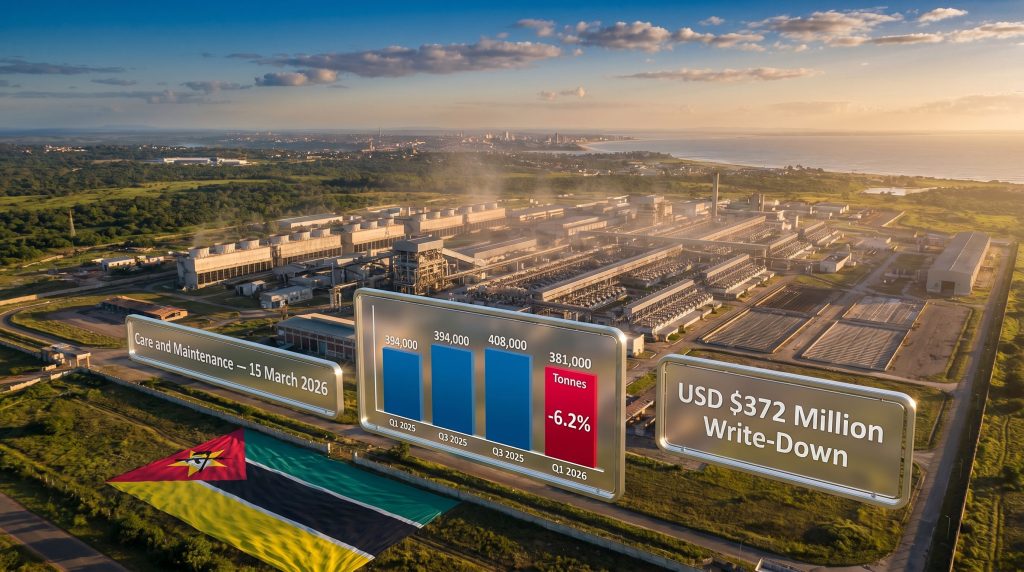
On the surface, Africa's aluminium output through 2025 told a reassuring story. Regional production climbed from 394,000 tonnes in Q1 2025 to a peak of 408,000 tonnes in Q3 2025, representing a measured growth trajectory that offered little indication of impending disruption. The modest Q4 2025 easing to 406,000 tonnes appeared to reflect normal seasonal variation rather than a warning signal.
Then Q1 2026 arrived.
| Quarter | Output (Tonnes) | Quarter-on-Quarter Change |
|---|---|---|
| Q1 2025 | 394,000 | Baseline |
| Q2 2025 | 407,000 | +3.3% |
| Q3 2025 | 408,000 | +0.2% |
| Q4 2025 | 406,000 | -0.5% |
| Q1 2026 | 381,000 | -6.2% |
The 25,000-tonne contraction from Q4 2025 to Q1 2026 was not a market-driven correction. It was a structural failure event rooted in a single facility's power arrangements. The year-on-year comparison reinforces this reading: Q1 2026 output sat 3.3% below Q1 2025 levels, ruling out a seasonal interpretation.
What the aggregated data consistently obscured was a critical geographic reality: Africa's aluminium production was overwhelmingly concentrated in two national markets, South Africa and Mozambique. Any disruption in either location would register immediately at the continental level, and the system had almost no redundancy to absorb the shock.
What Made Mozal Central to Africa's Supply Chain
To appreciate the scale of disruption that followed the Mozal shutdown in Africa's aluminium production network, it is necessary to understand what the facility actually represented, both commercially and industrially.
Mozal is Africa's second-largest aluminium smelter, positioned within the Beluluane Industrial Park on the outskirts of Maputo, Mozambique. Operated by South32 Ltd, an ASX-listed diversified mining company headquartered in Perth, Australia, the facility operated at a peak annual capacity of approximately 580,000 tonnes, making it the largest single contributor to Mozambique's export economy by a considerable margin.
The facility's commercial significance to Mozambique extended well beyond its physical output:
- Aluminium ranked as Mozambique's third-largest export commodity in 2025
- The sector generated approximately USD $1.1 billion in export value during that year
- Mozal represented the sole aluminium production asset within Mozambique, creating complete national dependence on a single smelting facility
- The smelter was powered through a subsidised hydroelectric electricity arrangement involving the Cahora Bassa hydroelectric facility, the electricity operator Hidroeléctrica de Cahora Bassa (HCB), and South Africa's state-owned utility Eskom
This tri-party energy structure was not merely an operational detail. It was the foundational competitive advantage upon which Mozal's entire economic model rested. Hydroelectric power delivered through a subsidised agreement represented one of the lowest-cost electricity inputs available to any primary aluminium smelter anywhere in the world. Remove that advantage, and the facility's commercial rationale collapses.
The Energy Economics of Aluminium Smelting: Why Power Is Everything
A critical piece of context that separates aluminium smelting from most other heavy industrial processes is its extraordinary dependence on electricity. Power costs typically account for 30 to 40 percent of total aluminium smelting operating expenditure, making electricity pricing the single most consequential variable in smelter profitability.
This structural characteristic creates a vulnerability that other mining sectors do not face in the same form. A copper mine can absorb moderate energy price increases through operational efficiencies. An aluminium smelter operating on marginal economics has almost no equivalent buffer. In this context, renewable power for mining has emerged as a critical long-term solution for energy-intensive operations across the continent.
"The electrolytic reduction process at the heart of aluminium smelting requires continuous, uninterrupted power delivery. Unlike most industrial equipment that can be powered down and restarted without significant consequence, aluminium smelting cells degrade rapidly when electricity is interrupted. Restarting damaged cells requires capital-intensive pot relining procedures, often costing tens of millions of dollars across a full facility."
This technical constraint explains why the operational decisions that preceded the formal shutdown carried such weight. When South32 suspended critical pot relining investments in August 2025, industry observers with knowledge of smelter maintenance cycles would have understood this as a signal that the company was preparing for extended or permanent curtailment rather than a temporary pause.
South32's Escalating Exit: A Timeline of Controlled Withdrawal
The Mozal shutdown did not occur overnight. It followed a sequence of escalating financial and operational decisions that traced back at least eight months before the formal suspension.
| Period | Decision | Significance |
|---|---|---|
| July 2025 onwards | Power negotiations with HCB, Mozambican government, and Eskom stalled | Multi-party deadlock established |
| August 2025 | South32 paused pot relining investment at Mozal | Operational wind-down signalled |
| Late 2025 | South32 recorded a USD $372 million write-down on Mozal assets | Full asset impairment anticipated |
| FY2026 forecast | Production guidance revised to 240,000 tonnes | Sharp operational curtailment confirmed |
| 15 March 2026 | Mozal formally placed into care and maintenance | Active production suspended |
The USD $372 million write-down is perhaps the most analytically significant indicator in this sequence. Asset write-downs of this scale reflect internal accounting judgements that an asset's recoverable value has permanently declined below its carrying value. In practical terms, South32's finance teams had assessed that Mozal's future cash flows, under any commercially plausible scenario, could no longer justify the asset's book value. This is a fundamentally different category of decision from a temporary production suspension.
The power agreement with Cahora Bassa formally expired in March 2026 without a replacement, and the proposed replacement tariffs under post-agreement market pricing rendered the energy-intensive smelting process commercially nonviable. Negotiations between all parties had stalled from at least mid-2025 onward, and no viable compromise emerged before the agreement lapsed.
Care and Maintenance: What the Industry Designation Actually Means
The term "care and maintenance" carries specific technical and financial meaning within the mining and smelting industry that deserves careful unpacking for readers unfamiliar with the sector.
When a smelter enters care and maintenance status, the following conditions apply:
- Active production ceases entirely across all operational lines
- Minimum staffing levels are retained for the sole purpose of preserving the physical integrity of the asset
- The facility remains theoretically restartable, but restart requires significant capital investment, time, and a commercially viable operating environment
- No production revenue is generated, though ongoing costs for facility preservation continue
- No restart timeline is implied by the designation itself
As of May 2026, South32 has not announced any restart timeline for Mozal. The Mozambican government has indicated its intent to pursue renewed negotiations, but South32 continues to identify ongoing viability concerns centred on electricity costs as the primary barrier to any return to production.
It is worth noting that the longer a smelting facility remains in care and maintenance, the higher the probability of permanent closure. Equipment degrades, skilled workforce disperses, and the capital required for restart increases with time. Industry experience from comparable facilities suggests that smelters inactive for more than 18 to 24 months face substantially reduced restart probability.
The next major ASX story will hit our subscribers first
Africa's Two-Node Problem: The Geography of Concentrated Risk
The Mozal shutdown in Africa's aluminium production system has exposed a structural concentration risk that extends far beyond Mozambique. South Africa and Mozambique together account for the vast majority of the continent's primary aluminium output, creating a geographic dependency that leaves Africa disproportionately vulnerable to disruptions in either market.
South Africa's own smelter base has experienced severe attrition driven by a parallel energy crisis. Consequently, South Africa's mining decline has compounded the broader continental supply challenge significantly. Eskom's rising and increasingly unreliable electricity costs have rendered dozens of energy-intensive industrial facilities commercially unviable over the past decade. Only 11 of 66 historical smelters remain operational across South Africa, representing an attrition rate of approximately 83 percent.
This parallel collapse in South Africa's industrial smelting capacity provides a sobering precedent for what prolonged energy price instability does to aluminium production infrastructure.
| Risk Factor | Severity | Market Most Affected |
|---|---|---|
| Power supply concentration | Critical | Mozambique, South Africa |
| Single-asset national dependency | Critical | Mozambique |
| Eskom tariff instability | High | South Africa |
| Climate sensitivity of hydro infrastructure | High | Mozambique |
| Limited backup production capacity | High | Pan-African |
| Export revenue concentration | Critical | Mozambique |
The continent's limited geographic diversification of production means that global aluminium markets receive very little buffering from African supply when disruptions occur. Unlike regions with dozens of production facilities spread across multiple energy grids, Africa's aluminium supply chain is functionally a two-node system where the failure of one node registers immediately across the entire continental output figure.
Economic Consequences Beyond the Smelter Gate
The immediate economic consequences of the Mozal suspension extend across multiple dimensions of Mozambique's national economy.
Employment: Approximately 2,500 direct jobs spanning permanent employees and contractors are at risk from the operational suspension. In a national context of structurally elevated unemployment, the loss of 2,500 formal industrial positions carries significant social and economic weight beyond the raw employment figure.
Export revenue: With aluminium generating approximately USD $1.1 billion in export value during 2025, the suspension creates a material gap in Mozambique's foreign currency earnings. This has downstream implications for the country's current account position, government revenue, and broader macroeconomic stability.
Energy reallocation: The suspension of Mozal's operations frees up approximately 950 MW of electricity capacity from the Cahora Bassa system. While this represents a significant volume of power that Mozambique could theoretically redirect toward regional electricity trading within the Southern African Power Pool framework, this outcome is cold comfort against the economic losses the shutdown generates.
Following the suspension, South32 repositioned its aluminium-related commercial activity toward purchasing and selling imported alumina at prevailing market prices, effectively decoupling its commercial operations from Mozambican production. The USD $372 million write-down has been fully reflected in the company's balance sheet, and South32 continues to cite viability concerns as the primary obstacle to any restart discussions.
Global Market Implications and Scenario Analysis
The removal of Mozal's annual production capacity from the global aluminium supply equation is not a trivial event for international markets. The facility's approximately 580,000 tonne annual output represents a meaningful volume in the context of global primary aluminium trade flows, and market analysts at Fastmarkets have characterised the shutdown as generating bullish sentiment for aluminium pricing as the supply-demand balance tightens.
This dynamic is amplified by the broader context facing global aluminium production: energy-driven cost pressures are simultaneously affecting smelting operations across multiple geographies, and the Mozal exit adds a supply-side signal to markets already navigating constrained production economics. Indeed, aluminium industry leaders are closely monitoring these developments as they reassess their own operational strategies.
Three scenarios describe the range of outcomes for Mozal and Africa's broader aluminium outlook:
Scenario 1: Negotiated Restart (Low Probability)
A revised power agreement incorporating government-supported tariff concessions enables a phased restart over 12 to 24 months. This requires alignment between South32's commercial requirements, Mozambique's policy objectives, HCB's revenue needs, and Eskom's capacity constraints. The political and commercial complexity makes this the least probable near-term outcome.
Scenario 2: Prolonged Care and Maintenance (Most Probable)
Mozal remains suspended indefinitely while negotiations continue without resolution. Africa's aluminium output stabilises at a structurally lower baseline, Mozambique redirects power capacity toward regional energy trading, and South32 pursues write-down recovery through alternative commercial channels. This is the most likely trajectory given current conditions.
Scenario 3: Permanent Closure (Longer-Term Risk)
If negotiations fail entirely within a 24-month window, Mozal transitions from care and maintenance to decommissioning. This permanently removes approximately 580,000 tonnes of African smelting capacity, and the continent's primary aluminium production base contracts to an even narrower geographic base.
The Structural Reforms Africa's Aluminium Sector Actually Needs
The Mozal shutdown is not an isolated failure. It is the latest event in a longer pattern of energy-driven industrial attrition across the African continent, and it carries lessons that extend beyond Mozambique's borders. Furthermore, the mining decarbonisation economics of transitioning to cleaner energy sources may ultimately provide the most sustainable pathway forward for African smelting operations.
Rebuilding continental aluminium production resilience requires addressing the structural conditions that created this vulnerability in the first place:
- Energy portfolio diversification: Industrial power supply agreements that blend hydroelectric, solar, and wind generation reduce dependence on single-source infrastructure and provide resilience against climate variability affecting hydro availability
- Long-term tariff architecture: Power agreements with built-in escalation caps and extended tenures provide the planning certainty that capital-intensive smelting operations require
- Geographic production expansion: Encouraging new smelter investment in markets outside the current South Africa and Mozambique concentration zone reduces continental-level single-point-of-failure risk
- Regional grid integration: Developing interconnected Southern African electricity infrastructure enables flexible cross-border energy sourcing, reducing individual market vulnerability
- Workforce transition frameworks: Establishing retraining and social support structures for displaced industrial workers reduces the long-term economic damage from facility closures
South Africa's experience, where the vast majority of historical smelter capacity has been lost to Eskom-related energy economics, provides a direct and sobering model for what sustained power instability does to an industrial sector over time. Without deliberate structural reform, Africa risks following the same trajectory toward becoming a net importer of primary aluminium despite possessing significant underlying bauxite and alumina resource potential.
Frequently Asked Questions
What is care and maintenance status for an aluminium smelter?
Care and maintenance is an industry designation indicating that active production has ceased but minimum staffing is retained to preserve the physical asset. It leaves open the theoretical possibility of future restart but does not indicate one is planned or imminent. The longer a facility remains in this status, the more capital-intensive and less probable a restart becomes.
How much did Africa's aluminium output fall after the Mozal suspension?
Africa's regional production declined to 381,000 tonnes in Q1 2026, representing a 6.2% drop from 406,000 tonnes in Q4 2025 and a 3.3% year-on-year decline compared to Q1 2025's 394,000 tonnes.
Why is electricity so critical to aluminium smelting economics?
Electricity accounts for approximately 30 to 40 percent of total aluminium smelting operating costs. The electrolytic reduction process that converts alumina to primary aluminium requires continuous, uninterrupted power. Interruptions cause cell damage requiring expensive pot relining procedures, making power pricing the single most consequential variable in smelter viability.
What happens to the power freed up by Mozal's suspension?
The operational suspension releases approximately 950 MW of electricity capacity from the Cahora Bassa hydroelectric system. Mozambique may redirect this toward regional electricity trade within the Southern African Power Pool, though this represents a partial economic offset rather than a replacement for lost industrial output and employment.
Could Mozal restart in the future?
As of May 2026, no restart timeline has been announced. Mozambique's government is pursuing negotiations, but South32 continues to identify electricity cost viability as the primary obstacle. The USD $372 million write-down recorded in late 2025 suggests the company had already internally assessed the asset's long-term viability as materially compromised.
Key Takeaways
- Africa's Q1 2026 aluminium output of 381,000 tonnes represents the sharpest quarterly contraction in recent years, driven primarily by the Mozal suspension
- The Mozal shutdown is fundamentally an energy economics failure rooted in the expiry of a subsidised hydroelectric power agreement, not a demand-side event
- South32's USD $372 million write-down and production guidance revision to 240,000 tonnes signalled that the financial consequences were anticipated well before the formal care and maintenance announcement
- Electricity costs representing 30 to 40 percent of smelting expenditure make aluminium production uniquely exposed to power pricing disruptions
- Africa's two-node production concentration in South Africa and Mozambique creates disproportionate continental-level vulnerability from single-asset failures
- The pathway to aluminium production resilience requires energy diversification, long-term tariff architecture, and geographic production expansion beyond the current concentrated model
- Without structural reform, Africa risks accelerating toward net aluminium importer status despite holding significant underlying mineral resources
This article is intended for informational purposes only and does not constitute financial or investment advice. Readers should conduct their own independent research and consult qualified advisers before making investment decisions. Forward-looking statements and scenario projections involve assumptions and uncertainties, and actual outcomes may differ materially from those described.
Want To Stay Ahead of Major Mineral Discoveries Shaping Global Commodity Markets?
The structural shifts driving Africa's aluminium supply contraction are a reminder of how quickly industrial commodity dynamics can change — and how critical it is to act on emerging signals before the broader market catches up. Discovery Alert's proprietary Discovery IQ model delivers real-time alerts on significant ASX mineral discoveries, turning complex commodity data into actionable investment insights, so begin your 14-day free trial today and explore historic discovery returns to understand just how transformative early positioning can be.