May 12, 2026
The Metal That Civilisation Cannot Afford to Run Short Of
Every major technological shift in modern history has been preceded by a raw material bottleneck. Steel shaped the industrial revolution. Silicon enabled the digital age. The question now being asked in boardrooms, government ministries, and mining operations across three continents is whether the Africa copper supply chain and the energy transition will determine the pace at which the world can decarbonise.
This is not a hypothetical concern. The physical properties that make copper uniquely suited to modern infrastructure, specifically its electrical conductivity, thermal performance, corrosion resistance, durability, and antimicrobial characteristics, have no commercially viable substitute that replicates the full performance profile across all major applications simultaneously.
As the International Copper Association confirmed at the Benchmark Summit 2026 in Cape Town, copper's indispensability extends well beyond clean energy into urbanisation, digitalisation, climate adaptation, and industrial modernisation, all of which are accelerating at the same time. The result is a copper supply crunch of rare structural intensity, and Africa sits squarely at its centre.
When big ASX news breaks, our subscribers know first
Why the Demand Picture Is More Complex Than Most Investors Realise
Electrification Is Only One Piece of a Four-Part Demand Story
The mainstream narrative around copper demand tends to focus almost exclusively on electric vehicles and renewable energy installations. While both are genuine and significant drivers, this framing underestimates the breadth of concurrent demand forces that are compounding simultaneously.
| Megatrend | Primary Copper Application | Demand Driver Intensity |
|---|---|---|
| Energy Transition | EVs, solar, wind, grid upgrades | Very High |
| Urbanisation | Buildings, water systems, construction | High |
| Digitalisation and AI | Data centres, telecommunications, semiconductors | High and Rising |
| Climate Adaptation | Flood defences, resilient infrastructure | Moderate and Growing |
Electric vehicles require approximately four times the copper content of conventional internal combustion engine vehicles, and a single offshore wind turbine can contain several tonnes of the metal across its generators, cabling, and transformers. Solar installations require copper wiring across generation, transmission, and storage systems.
However, layered on top of these well-understood drivers is an emerging and frequently underestimated demand source: AI data centre infrastructure. High-performance computing facilities require dense copper cabling for power distribution and thermal management at a scale that is only beginning to be reflected in long-range demand forecasts.
As AI infrastructure buildout accelerates globally, analysts tracking this segment are revising demand projections upward in a way that was not part of mainstream copper modelling even two years ago. Furthermore, the critical minerals demand picture is being reshaped by this convergence of forces across all four megatrends simultaneously.
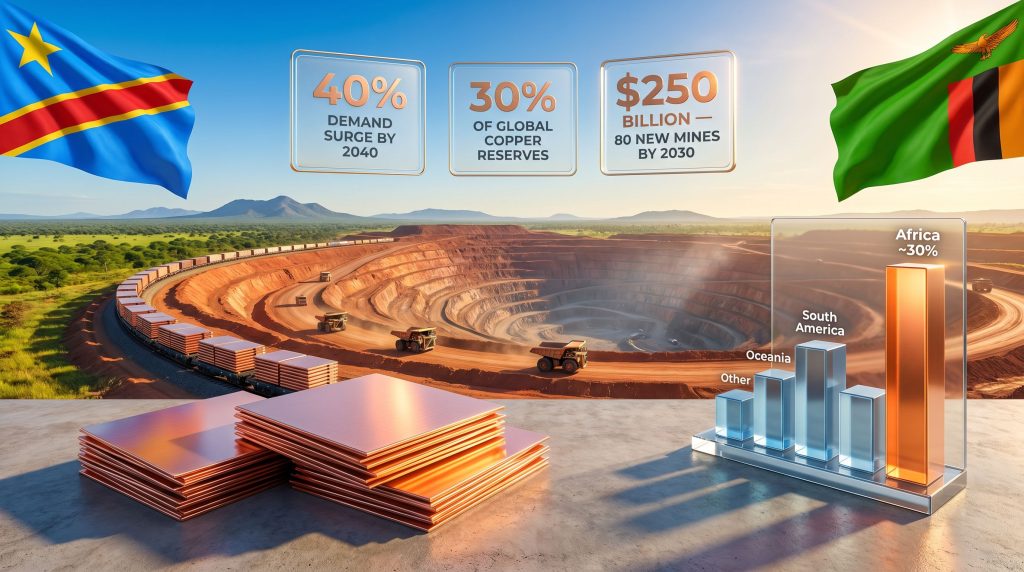
UNCTAD has projected global copper demand to rise by more than 40% by 2040, a forecast that reflects the convergence of these four megatrends rather than any single driver in isolation. Meeting this trajectory while simultaneously managing declining ore grades and multi-decade mine development timelines represents one of the most complex supply chain coordination challenges in modern commodity markets.
The Supply Side Mathematics Do Not Add Up Without Radical Action
The structural problem on the supply side is not simply a shortage of copper in the ground. It is a problem of timing, capital allocation, and geological reality converging in an unfavourable sequence. Consider the following dynamics:
-
Ore grade decline: Average copper ore grades at existing operations have been falling for decades, meaning more rock must be processed to produce the same output. This increases energy consumption, water usage, and cost per tonne.
-
Discovery-to-production lag: The average timeline from a copper discovery to first production is approximately 25 years, encompassing exploration, feasibility studies, permitting, financing, construction, and commissioning. Investment decisions made today will not deliver copper until the early 2050s in many cases.
-
Capital requirements: Industry analysts estimate that approximately 80 new mines and roughly $250 billion in capital investment are required by 2030 to meet projected demand. Longer-term projections suggest total value chain investment requirements could approach $2.1 trillion by 2050.
-
Permitting bottlenecks: In many jurisdictions, mine permitting challenges have extended regulatory approval processes to a decade or more, creating structural lag even when capital and intent are present.
The arithmetic of this situation is unambiguous: without coordinated action across mining investment, permitting reform, recycling expansion, and trade policy, a structural supply deficit will emerge well before 2030.
Africa's Position in the Global Copper Reserve Hierarchy
A Continent That Cannot Be Bypassed
Africa holds approximately 30% of global copper reserves, a figure confirmed by the International Copper Association at the Benchmark Summit 2026. This single statistic repositions Africa not as a peripheral participant in the energy transition supply chain, but as one of its three or four most strategically indispensable regions on earth.
| Region | Estimated Share of Global Copper Reserves | Key Producing Nations |
|---|---|---|
| South America | ~40% | Chile, Peru |
| Africa | ~30% | DRC, Zambia, Namibia, Angola |
| Oceania and Other | ~15% | Australia |
| Russia and Central Asia | ~10% | Russia, Kazakhstan |
| Rest of World | ~5% | Various |
The concentration of reserves in the DRC-Zambia Copper Belt is particularly significant. This geological formation stretches across the southern Democratic Republic of Congo and northern Zambia, hosting some of the highest-grade copper deposits found anywhere outside of South America.
What distinguishes the Copper Belt from many frontier exploration regions is not merely its size but the combination of ore grade, deposit accessibility, and the presence of established, if still developing, mining infrastructure. Furthermore, the global copper supply gap cannot be addressed without substantially increasing output from this region.
A less widely appreciated geological characteristic of the Central African Copper Belt is the prevalence of sediment-hosted stratiform copper deposits, a deposit type that tends to produce consistently high ore grades over large lateral extents. This geological architecture is fundamentally different from the porphyry copper systems that dominate South American production, and it creates a different economic extraction profile, one that in many cases supports lower strip ratios and more predictable metallurgical performance.
Infrastructure investment is gradually improving the economics of getting this copper to global markets. A rail corridor linking DRC and Zambia to Angola's Atlantic coast at the port of Lobito has attracted significant international capital commitment, with the US-backed project receiving funding in the hundreds of millions of dollars. This type of logistics infrastructure is not merely a transport convenience; it materially reduces the cost per tonne of export and expands the viable economics of otherwise marginal deposits along the route.
What Is Actually Being Built: Africa's Active Project Pipeline
Zambia's Production Ambition and the Projects Behind It
Zambia has set a national copper production target of 3.1 million tonnes per year by 2031, a figure that would represent a transformational increase from current output levels and would make Zambia one of the world's top copper producing nations. Achieving this target requires not one or two major projects, but a sustained wave of capital deployment across the country's Copper Belt.
Several projects are now advancing toward production:
-
Sinomine's Kitumba Mine: A capital expenditure commitment of approximately $600 million, with production scheduled to commence in 2026, targeting around 50,000 tonnes of copper cathode per year at steady state.
-
KoBold Metals' Mingomba deposit: Described by geologists as potentially the largest copper discovery in approximately a century, the Mingomba project has attracted a $200 million initial investment commitment, with total development capital requirements estimated at up to $2 billion. Production is targeted for the 2030s.
The Mingomba discovery is worth examining in more detail for investors tracking the supply pipeline. KoBold Metals uses machine learning and geospatial data analysis to identify deposit targets that traditional exploration methodology might have overlooked or underweighted.
Angola and Namibia: The Emerging Frontier
Beyond Zambia and the DRC, two additional nations are advancing their profiles as copper producing jurisdictions:
-
Angola's Tetelo Mine commenced open-pit operations in late 2025, marking Angola's emergence as a copper producing nation for the first time at commercial scale. A planned transition to underground mining in mid-2026 will deepen the operation and extend the productive life of the deposit.
-
Namibia's Haib Copper Project (Koryx Copper) and the Otavi Project (Midas Minerals) are progressing through exploration and feasibility stages, adding optionality to the continent's development pipeline.
In addition, the rise of African mining is reshaping global supply chain structures in ways that extend well beyond copper alone. Africa is currently leading global grassroots copper exploration activity, with brownfield expansions at existing operations considered insufficient on their own to close the projected supply gap.
The Geopolitical Contest for Copper Value Chain Control
China's Downstream Dominance and Africa's Raw Material Trap
Understanding the Africa copper supply chain and the energy transition requires confronting an uncomfortable structural reality: a significant proportion of the economic value generated by African copper leaves the continent before it is captured domestically.
China controls approximately 45% of global copper refining capacity and imports roughly 60% of global copper ore, making it the world's dominant downstream processor. The consequence for African producers is that most copper leaves the continent in raw or semi-processed form, with Chinese entities capturing the value-addition margin that comes from smelting and refining.
UNCTAD has explicitly called for African nations to develop domestic processing and refining capacity through targeted policy incentives, value-added tax restructuring, and infrastructure investment. The economic logic is straightforward: a tonne of copper cathode commands a meaningfully higher price than the equivalent copper content in concentrate form, and the difference represents value that currently accrues to processors rather than producing nations.
Western Capital and the Race for Strategic Supply Access
The competitive dynamic between Chinese and Western capital for influence over African copper supply chains has intensified considerably over the past three years. The US Development Finance Corporation and the Minerals Security Partnership have collectively deployed more than $200 million into African mining operations, with a focus on the DRC and Zambia.
Western investment frameworks in African copper are increasingly emphasising responsible sourcing standards, local processing potential, and long-term partnership structures rather than purely transactional capital deployment. This shift in approach reflects a strategic recognition that raw material access alone is insufficient without downstream resilience.
The competition between Chinese and Western capital is not simply a financial contest. It is reshaping governance frameworks, infrastructure financing structures, and the pace at which African nations can develop the institutional capacity needed to capture more value from their copper endowment.
Recycling's Real Role: Critical Contributor, Not Complete Solution
The Circular Economy Case for Copper
Copper's recyclability is genuinely exceptional. Approximately two-thirds of all copper ever produced throughout human history remains in active use today, a testament to the metal's durability and the efficiency with which it is retained in the economic system. Recycled copper currently supplies around one-third of global annual demand, equivalent to approximately 4.5 million tonnes of refined copper in recent years.
This circular economy performance is not accidental. Copper's value makes it economically rational to recover and recycle at end-of-life across virtually all applications. Scrap collection rates for copper in electrical applications, plumbing, and industrial equipment consistently outperform those of most competing metals.
Why Secondary Supply Cannot Bridge the Full Gap
Despite this strong recyclability track record, the mathematics of future demand growth make it clear that recycling alone cannot close the projected supply shortfall:
-
Scale mismatch: Recycled copper currently covers approximately 20% of refined copper demand on a global basis. Even with aggressive improvement in collection rates and processing efficiency, the absolute volume of scrap available is constrained by the amount of copper that was installed in infrastructure decades ago.
-
Long in-use lifetimes: Copper embedded in buildings, power grids, and industrial plant may remain in service for 30 to 50 years before reaching the end of its usable life and entering the recycling stream. The copper being installed today in EV charging networks and solar farms will not be available for recycling until the 2060s and beyond.
-
Demand growth trajectory: A greater than 40% rise in demand by 2040 means the absolute tonnage required from all sources is expanding faster than secondary supply can realistically grow.
As confirmed by industry leaders at the Benchmark Summit 2026, the only credible pathway to meeting future demand is an all-of-the-above strategy: expanding recycling, accelerating responsible primary production, reforming permitting processes, maintaining open trade frameworks, and embedding ESG standards throughout the value chain. No single lever is sufficient in isolation. The copper investment strategies that will succeed are those that account for all of these dimensions together.
The next major ASX story will hit our subscribers first
The Five Enabling Conditions That Will Determine Africa's Copper Future
Building the Policy and Infrastructure Foundation
Africa's reserve base makes its centrality to the Africa copper supply chain and the energy transition a geological certainty. What remains uncertain is whether the enabling conditions will be in place quickly enough to convert reserve potential into production reality on the timeline the energy transition demands.
Five critical pillars determine the answer:
-
Permitting Reform: Reducing mine approval timelines from the current multi-decade average to a globally competitive standard. Every year of unnecessary delay in the permitting process represents copper that will not be available when demand peaks.
-
Infrastructure Investment: Expanding rail, port, and energy infrastructure to reduce the production cost curve. The Lobito Corridor model demonstrates what targeted logistics investment can achieve for the viability of the broader supply region.
-
Value-Addition Policy: Implementing tax and regulatory incentives that encourage in-country smelting and refining rather than raw ore export. Retaining downstream processing within Africa is the single most powerful mechanism for improving the economic return that producing nations capture from their copper endowment.
-
Trade Openness: Maintaining open trade frameworks that allow African copper to reach global markets without prohibitive tariff or non-tariff barriers. Trade policy uncertainty, including the risk of export restrictions or tariff escalation, represents a material risk to supply chain resilience.
-
Responsible Production Standards: Embedding ESG frameworks and independent certification, including programmes such as The Copper Mark, into the fabric of new project development. Long-term institutional capital increasingly requires third-party verification of environmental, social, and governance performance as a condition of investment.
The question is not whether Africa will be central to the global copper supply chain. The reserve base and project pipeline make that a geological and economic inevitability. The defining question is whether the policy environment, infrastructure investment, and governance frameworks will be in place quickly enough to meet an accelerating demand timeline.
Frequently Asked Questions: Africa Copper Supply Chain and the Energy Transition
How much of the world's copper reserves are located in Africa?
Africa holds approximately 30% of global copper reserves, as confirmed by the International Copper Association. The majority of these reserves are concentrated in the DRC-Zambia Copper Belt, with additional deposits in Namibia, Angola, and other southern and central African nations.
What is the projected copper supply shortfall without new investment?
Without significant new mining investment, analysts project a structural supply deficit emerging before 2030. UNCTAD forecasts demand will rise more than 40% by 2040, and meeting this trajectory is estimated to require approximately 80 new mines and $250 billion in capital by 2030, with total value chain investment needs potentially reaching $2.1 trillion by 2050.
Can copper recycling alone meet future energy transition demand?
No. While recycled copper supplies approximately one-third of current global demand, the scale of projected demand growth means primary production must expand in parallel. The long in-use lifetime of copper in infrastructure means a large proportion of installed copper will not re-enter the recycling stream for decades, making recycling a critical but insufficient standalone solution.
Why is the DRC-Zambia Copper Belt strategically significant?
The Copper Belt hosts some of the world's highest-grade copper deposits and is central to any credible plan to diversify global copper supply away from South American concentration. The geological character of the region, specifically its sediment-hosted stratiform deposit type, produces high-grade ore over large lateral extents with relatively predictable metallurgy, distinguishing it from the porphyry systems that dominate Chilean production.
What role does China play in Africa's copper supply chain?
China dominates global copper refining, processing approximately 45% of world supply and importing roughly 60% of global copper ore. Most African nations currently export raw or semi-processed copper, with downstream value-addition occurring primarily in China. Developing local refining capacity is a key strategic priority for African governments and Western development finance institutions seeking to diversify the global value chain.
Want to Know Which ASX Copper Explorers Could Benefit From the Global Supply Crunch?
Discovery Alert's proprietary Discovery IQ model delivers real-time alerts the moment significant mineral discoveries — including copper — are announced on the ASX, transforming complex geological data into actionable investment insights before the broader market reacts. Explore historic examples of major mineral discoveries and their extraordinary returns to understand what early positioning in the right discovery can mean, then begin your 14-day free trial to secure your market-leading edge.