May 12, 2026
Underground Access as the Hidden Variable in Copper Mine Development
In underground hard-rock mining, the physical pathway into an orebody is rarely discussed in the same breath as resource grades or copper prices, yet it is frequently the single most consequential variable separating a defined resource from a producing mine. Before a single tonne of ore reaches surface, the engineering team must first solve the problem of access, and how that access is created determines almost everything that follows: development timelines, unit costs, first-production dates, and the capital expenditure profile that investors ultimately scrutinise.
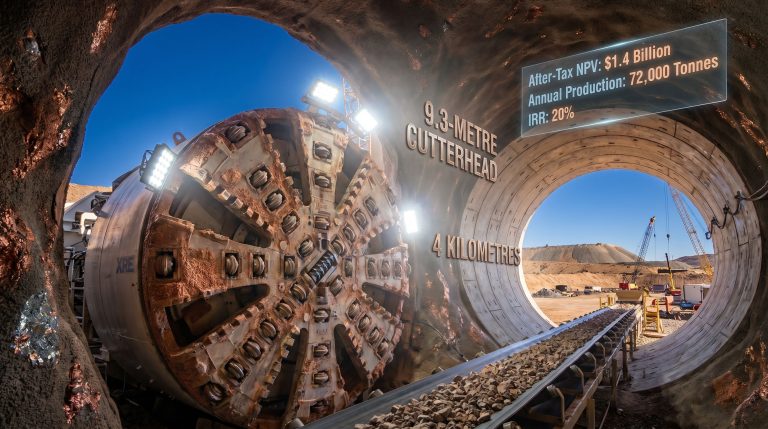
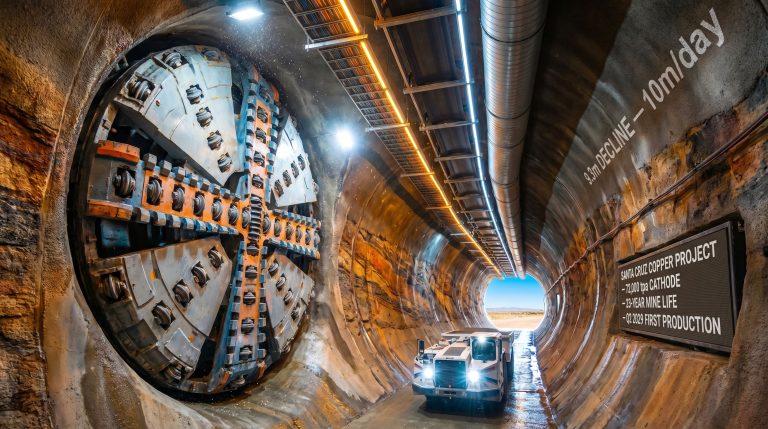
It is within this context that the Ivanhoe Electric Santa Cruz Copper Project tunnel boring machine acquisition carries significance well beyond the mechanics of a single equipment purchase. The decision to secure a purpose-built, operationally proven Robbins Crossover XRE TBM for decline development in Arizona reflects a calculated shift from feasibility-stage planning into construction-stage execution, backed by a documented rationale across technical, financial, and strategic dimensions.
When big ASX news breaks, our subscribers know first
The Engineering Problem That Determines Project Timelines
Why Decline Architecture Is the Critical Path Variable
For underground mines targeting bulk-tonnage extraction methods such as longhole stoping, the twin-decline configuration is the conventional solution for establishing primary access and ventilation. One decline typically serves as the primary haulage route, while the second functions as the return airway and emergency egress. The distance between the surface portal and the orebody determines how long decline development must proceed before any productive mining can begin, which is why construction methodology directly sets the clock on first-production dates.
Conventional drill-and-blast decline development relies on a cyclical process: drilling a pattern of blast holes, charging and firing, ventilating the smoke and fumes, scaling loose ground, and then mucking the broken rock. Each cycle advances the heading by a metre or two, and while experienced crews can maintain respectable progress rates in good ground, the method is fundamentally discontinuous. Ground condition variations, unexpected geology, and the inherent downtime between cycles all compress advance rates.
Mechanised TBM development approaches this problem differently. The machine applies a continuous rotating thrust against the rock face through disc cutters mounted on a rotating cutterhead, simultaneously conveying muck rearward through an integrated material handling system. In competent, moderately hard rock, sustained advance rates can materially exceed those achievable through drill-and-blast, and the circular excavation profile produced by the TBM is geometrically precise, reducing over-break and the associated ground support requirements that add both time and cost to conventionally driven headings.
What Makes Santa Cruz Structurally Suited to TBM Development
The Santa Cruz Copper Project sits within Arizona's Casa Grande copper belt, a region with well-documented rock mass characteristics from decades of historical mining and exploration. Ivanhoe Electric holds a 100%-owned private land position, a tenure structure that eliminates the federal permitting sequences that constrain competing projects developed on Bureau of Land Management or Forest Service lands. This is not a trivial distinction: federal permitting for major underground mines on public lands in the American Southwest has historically extended timelines by years. Furthermore, ongoing mining permits reform at a federal level may ultimately reshape this landscape, though private land projects remain insulated from such variables regardless.
The project's processing model reinforces the case for capital efficiency at the access development stage. Santa Cruz targets 99.99% pure copper cathode production through a wholly heap leach process, bypassing smelter dependency entirely. This eliminates treatment charges and refining costs that erode margins for conventional concentrate producers, and it simplifies the downstream logistics chain significantly. Against a 23-year mine life underpinned by bulk-tonnage extraction, the upfront capital committed to mechanised access development amortises across a long operating period.
Construction commencement is targeted for the first half of 2026, with first copper cathode production scheduled for 2028. The TBM acquisition is therefore a time-critical procurement decision, not a discretionary one.
What Is the Robbins Crossover XRE and Why Does Its History Matter?
Technical Architecture of the Crossover XRE Platform
The Robbins Company is a U.S.-headquartered manufacturer with a global reputation built across decades of tunnel boring projects spanning civil infrastructure, hydropower, and mining applications. The Crossover XRE designation refers to a machine architecture specifically engineered to operate across variable ground conditions, including transitions between hard rock and mixed-face geology. This adaptability is mechanically significant in mining applications, where ground conditions along a decline alignment may shift substantially over the development distance.
The acquisition encompasses not only the TBM unit itself but also the integrated material handling system, the conveyor and transfer infrastructure that transports excavated rock from the cutterhead back through the tunnel and onto surface. Acquiring the complete system rather than the boring machine alone is practically important: material handling bottlenecks are a common source of lost productivity in TBM operations, and a matched system with a documented compatibility history reduces integration risk during commissioning.
From Grosvenor to Arizona: The Machine's Operational Record
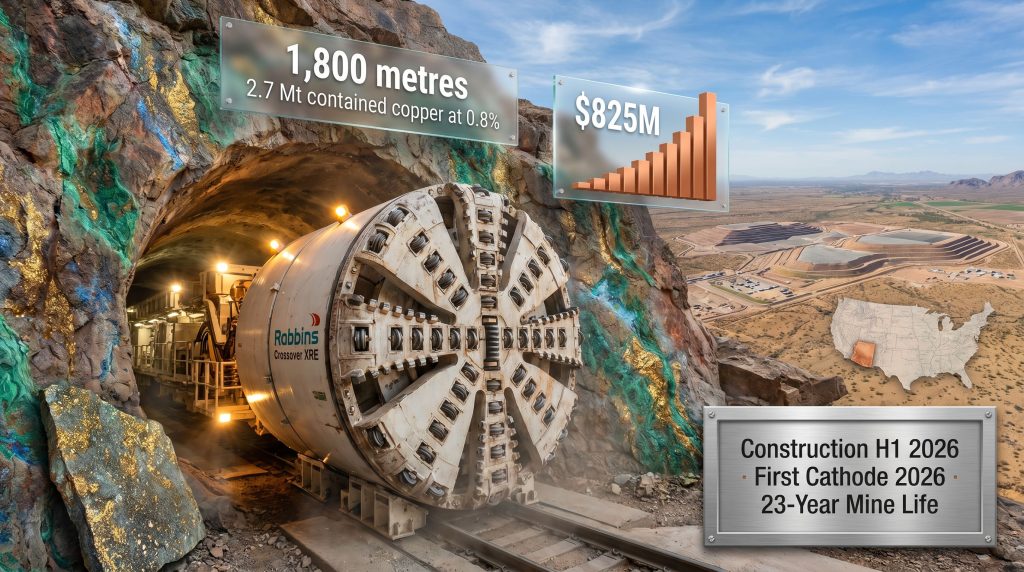
The Robbins TBM being acquired by Ivanhoe Electric previously completed two decline tunnels at Anglo American's Grosvenor coal mine in Queensland, Australia. Across those two declines, the machine accumulated 1,800 metres of total development in approximately 1,000 hours of underground operating time. This performance record is more valuable than it might first appear.
In underground TBM procurement, the difference between a machine with a documented operational history and a new build is the difference between a known risk profile and an unknown one. Commissioning a new TBM in an underground mining environment introduces variables that cannot be fully modelled in advance; a machine with verified completion of comparable headings has already demonstrated its mechanical behaviour under real-world conditions.
Following completion of the Grosvenor declines, the machine entered a care-and-maintenance state at the Queensland site. This period introduces its own considerations: extended storage requires systematic inspection of hydraulic systems, electrical infrastructure, disc cutters, cutterhead bearings, and seal integrity. The refurbishment scope resulting from this maintenance period will be assessed in the context of the two independent site visits that Ivanhoe Electric conducted with Robbins representatives before exercising the acquisition option.
How the Transaction Was Structured
The deal involved a two-stage chain of title that provides important technical protections for the acquirer. Robbins entered into a separate binding agreement to acquire the machine from Anglo American, and Ivanhoe Electric's option was exercised against Robbins as the intermediate party. This structure places refurbishment oversight and OEM warranty responsibility with the machine's original manufacturer, rather than requiring Ivanhoe Electric to assess and remediate the equipment independently.
| Milestone | Date |
|---|---|
| TBM opportunity identified at Grosvenor site | Late 2025 |
| Binding option secured from Robbins | March 2026 |
| Site inspections completed with Robbins representatives | Pre-May 2026 |
| Intent to exercise option notified to Robbins | 8 May 2026 |
| Definitive agreements expected to be completed | End of May 2026 |
TBM Development Versus Conventional Drill-and-Blast: A Technical Comparison
Understanding the Trade-Off Matrix
The decision to use a TBM for decline development rather than conventional methods involves genuine trade-offs. There is no universally superior approach, and the optimal choice depends on ground conditions, tunnel length, required profile dimensions, and the capital profile of the project. The table below synthesises the key comparative dimensions relevant to the Santa Cruz context.
| Factor | TBM-Driven Development | Conventional Drill-and-Blast |
|---|---|---|
| Advance rate (favourable ground) | Higher sustained advance rates | Variable; cycle-dependent |
| Profile geometry | Precise circular profile; minimal over-break | Irregular; over-break common |
| Ground disturbance | Minimal blast vibration; reduced damage zone | Significant vibration from blasting |
| Labour intensity | Lower per metre advanced | Higher crew requirements per blast cycle |
| Upfront capital | Higher equipment cost | Lower initial capital outlay |
| Operating cost per metre | Generally lower in suitable ground | Higher consumable and labour intensity |
| Equipment redeployability | Machine repositionable for future headings | Drill rigs and loaders are generic assets |
Redeployability as a Strategic Multiplier
A dimension frequently overlooked in simple TBM cost comparisons is redeployability. Once the initial Santa Cruz declines are complete, the Crossover XRE can be repositioned for further heading development, whether at depth extensions of the Santa Cruz Deposit or at a separately accessed resource on the same land package. In a project with a 23-year mine life and a defined adjacent resource, this optionality has measurable value.
The alternative, contracting a conventional development crew for each new heading, involves re-mobilisation costs, crew availability risk, and schedule uncertainty each time a new access requirement emerges. Equipment ownership converts those repeated procurement events into operational decisions rather than capital commitments. Consequently, the redeployability argument is a central pillar of the investment case for mechanised access at Santa Cruz, and it connects directly to the Texaco Deposit's longer-term development potential.
The Texaco Deposit: Quantifying the Expansion Case
Resource Definition and Proximity
Located approximately 2 kilometres northeast of the primary Santa Cruz orebody, the Texaco Deposit received its initial Mineral Resource Estimate in 2023. Subsequent drilling at the deposit margins confirmed the presence of broad, high-grade copper mineralisation zones that remain open both at depth and along strike. The 2025 Preliminary Feasibility Study defined an Inferred Resource at Texaco of 2.7 million tonnes of contained copper at an average grade of 0.8% copper.
This resource sits outside the current mine plan entirely. Its significance lies not in what it contributes today, but in what it represents as a defined, tenure-secured volume of copper mineralisation on contiguous private land, available for development once the primary Santa Cruz Deposit is in production. The 2-kilometre separation between the two orebodies is within practical TBM redeployment range, meaning the equipment being acquired today may be the same machine that opens Texaco to production years from now. In addition, this kind of staged, capital-efficient expansion mirrors the best-practice copper project partnerships increasingly being adopted across the sector.
An Inferred Resource under modern reporting frameworks carries a lower confidence classification than Indicated or Measured Resources, reflecting relatively sparse drill data. The Texaco figures should be understood as a directional indicator of expansion potential, not a production commitment. Resource classification upgrades require additional infill drilling before these tonnes can support mine planning at the Indicated level.
Typhoon Technology and the Discovery Advantage
Ivanhoe Electric's proprietary Typhoon geophysical surveying platform played a material role in identifying the resource extensions at Texaco that extend beyond what conventional drilling alone had revealed. Typhoon operates as an electrical geophysics system, using resistivity and induced polarisation methods to image sulphide copper mineralisation at depth. The capacity to detect conductivity contrasts associated with copper sulphide bodies at depth provides a meaningful exploration edge in a region where mineralisation frequently extends well below practical drill depths.
The competitive dynamic this creates is notable. Ivanhoe Electric holds both the discovery technology and the extraction infrastructure on a contiguous, privately owned land package. The combination reduces the cycle time between identifying mineralisation extensions and committing to their development.
| Development Phase | Asset | Status |
|---|---|---|
| Phase 1 | Santa Cruz Deposit | TBM decline development commencing 2026 |
| Phase 2 (potential) | Texaco Deposit | Inferred Resource: 2.7 Mt contained Cu at 0.8% |
| Exploration upside | Land package extensions | Open mineralisation; Typhoon surveying active |
De-Risking the Capital Stack: Financing and Tenure
The U.S. Export-Import Bank Letter of Interest
A Letter of Interest from the U.S. Export-Import Bank for up to $825 million in potential debt financing represents one of the more significant external validation signals for the Santa Cruz project's bankability. A Letter of Interest is not a funding commitment, and it should not be interpreted as one. What it does represent is a formal indication that the project's profile — its domestic copper production mandate, its resource base, and its development plan — has been reviewed by a federal financing institution and found to merit further engagement.
For equity investors evaluating pre-production mining assets, evidence that institutional debt financing is being actively explored at project-appropriate scale materially changes the risk calculus around capital formation. A project that cannot access debt financing must rely entirely on equity dilution to fund construction, while a project with credible debt interest can potentially build a more capital-efficient funding structure.
Land Tenure: The $39.3 Million Final Payment
In November 2025, Ivanhoe Electric completed $39.3 million in accelerated final payments to Wolff-Harvard Ventures LLC, satisfying all obligations under the 2023 Purchase and Sale Agreement and delivering unencumbered land ownership across the project footprint. Clearing this obligation ahead of construction commencement removes a category of pre-construction risk that institutional project finance lenders typically require to be resolved before debt commitments are formalised.
Project De-Risking Scorecard
Pre-production mining assets are most usefully assessed against a structured risk framework rather than through individual data points. Viewed across five standard investor dimensions, the current status of the Santa Cruz project reads as follows:
- Land tenure: Fully secured. $39.3 million in final payments completed November 2025; 100%-owned private land package.
- Resource definition: 2025 Preliminary Feasibility Study completed June 2025; Texaco Inferred Resource established at 2.7 Mt contained copper.
- Capital formation: U.S. Export-Import Bank Letter of Interest for up to $825 million in debt financing secured.
- Construction equipment: Robbins Crossover XRE TBM acquisition in progress; definitive agreements expected by end of May 2026.
- Permitting: Ongoing under Arizona regulatory framework.
- Construction commencement: Targeted H1 2026; first copper cathode production scheduled 2028.
The next major ASX story will hit our subscribers first
Why Arizona and Why Now: The Macro Copper Argument
The Supply-Demand Imbalance Driving Domestic Copper Development
The United States imports a material share of its refined copper despite hosting some of the world's highest-grade porphyry and sediment-hosted copper deposits. Structural demand growth from electric vehicle manufacturing, grid-scale battery storage, AI data centre build-out, and renewable energy infrastructure is creating forecast supply deficits that cannot be closed by demand-side adjustments alone. The broader copper supply crunch is already influencing capital allocation decisions across the mining sector globally. New primary copper supply requires 10 to 20 years from discovery to production at scale; the projects being advanced today are supplying a demand environment that does not yet exist.
Arizona's Casa Grande district offers a combination of geological endowment, regional infrastructure, and tenure clarity that few competing jurisdictions can match. The private land model at Santa Cruz is particularly significant in this context. Federal land permitting timelines for major Arizona copper projects on public land have in some historical cases extended well beyond a decade. A project on fully secured private land operates under a fundamentally different regulatory timeline.
Heap Leach Cathode Economics: Structural Margin Protection
The decision to process Santa Cruz ore through a 100% heap leach pathway to direct copper cathode, rather than through flotation to produce a copper concentrate, insulates the project from a cost category that has materially eroded returns at conventional copper mines globally. Smelter treatment charges and refining charges, collectively known as TC/RC, represent a negotiated deduction from the value of copper concentrate that concentrate-producing mines must absorb. These charges have been volatile and, in periods of smelter overcapacity, can compress producer margins significantly.
A direct cathode producer selling 99.99% pure copper at London Metal Exchange-linked prices has no TC/RC exposure. This structural margin advantage compounds across a 23-year mine life and becomes increasingly valuable as global smelter dynamics shift. For a broader perspective on how investors are approaching these structural dynamics, copper investment strategies focused on direct cathode producers are gaining notable traction in 2025.
Frequently Asked Questions
What is the Robbins Crossover XRE and why was it selected for Santa Cruz?
The Robbins Crossover XRE is a purpose-built tunnel boring machine manufactured by The Robbins Company, a U.S.-headquartered global leader in TBM technology. Its Crossover architecture is specifically designed to handle variable ground conditions, making it suited to mining environments where geology along the development alignment may not be uniform. Ivanhoe Electric is acquiring this machine, along with its integrated material handling system, to mechanise decline construction at the Santa Cruz Copper Project. The machine was selected partly because of its documented operational history: it previously completed two decline tunnels at Anglo American's Grosvenor coal mine in Queensland, accumulating 1,800 metres of development across approximately 1,000 hours of underground use.
What is the Santa Cruz Copper Project and what makes it different from other U.S. copper projects?
Santa Cruz is a high-grade underground copper project located near Casa Grande, Arizona. The project targets production of 99.99% pure copper cathode through a complete heap leach processing model over a 23-year mine life, eliminating smelter dependency. It sits on 100%-owned private land within one of the United States' most historically productive copper mining regions, a tenure structure that removes the federal permitting delays that affect many competing projects. Construction is targeted for H1 2026, with first copper production scheduled for 2028.
What is the Texaco Deposit and how does the TBM acquisition relate to it?
The Texaco Deposit is a copper resource located approximately 2 kilometres northeast of the primary Santa Cruz orebody. The 2025 Preliminary Feasibility Study defined an Inferred Resource of 2.7 million tonnes of contained copper at 0.8% copper grade. This resource sits outside the current mine plan but represents a defined volume of mineralisation on Ivanhoe Electric's privately owned land. The TBM acquired for Santa Cruz decline development can potentially be redeployed to access Texaco in future development phases, transforming a single-project equipment purchase into a longer-duration infrastructure asset.
What is Typhoon technology and what role has it played at Santa Cruz?
Typhoon is Ivanhoe Electric's proprietary geophysical surveying platform that uses electrical resistivity and induced polarisation methods to image copper sulphide mineralisation at depth. It was instrumental in identifying resource extensions at the Texaco Deposit that extend beyond the coverage achievable through conventional drilling alone. The platform provides an exploration advantage that is particularly relevant on a contiguous private land package where discoveries can be advanced to development without tenure complications.
When is first copper production expected, and what financing is in place?
Based on the current project schedule, construction commencement is targeted for H1 2026, with first copper cathode production anticipated in 2028. A Letter of Interest from the U.S. Export-Import Bank for up to $825 million in potential debt financing has been secured, representing a formal indicator of project bankability at institutional financing scale. Ivanhoe Electric also completed $39.3 million in final land acquisition payments in November 2025, removing a key pre-construction financial obligation.
Key Takeaways: What the TBM Acquisition Signals About Santa Cruz's Trajectory
The Ivanhoe Electric Santa Cruz Copper Project tunnel boring machine acquisition, viewed in isolation, is an equipment procurement. Viewed in context, it is something more consequential: a tangible marker of the transition from feasibility-stage planning to construction-stage execution at one of the United States' most advanced primary copper development projects. For those tracking large-scale development activity, Rio Tinto's copper expansion guide offers a useful benchmark for how major producers are thinking about similar capital commitments in the current environment.
Several dimensions of the acquisition merit particular attention:
- The Robbins Crossover XRE carries 1,800 metres of documented operational history across two completed declines, providing a verifiable mechanical baseline before the machine reaches Arizona. Furthermore, this mining technology overview provides additional technical context on the acquisition's significance within the broader industry.
- The two-stage transaction structure places refurbishment accountability with Robbins as OEM, rather than requiring Ivanhoe Electric to independently assess and remediate a machine acquired directly from a coal mine operator.
- TBM redeployability to the Texaco Deposit converts a single-use capital expenditure into a multi-decade infrastructure asset with option value across future development phases.
- Taken alongside the U.S. Export-Import Bank Letter of Interest for up to $825 million, completed land payments of $39.3 million, and a published Preliminary Feasibility Study, the TBM acquisition advances the construction-readiness dimension of a project that has been systematically de-risked across tenure, resource definition, and capital formation simultaneously.
- Arizona's private land model, combined with a direct cathode processing pathway and a 23-year mine life, positions Santa Cruz as one of the most structurally differentiated copper development assets currently advancing toward construction in the United States.
This article contains references to forward-looking statements, including project timelines, production schedules, resource estimates, and financing outcomes. These involve risks and uncertainties, and actual results may differ materially from those anticipated. Resource estimates classified as Inferred carry a lower confidence level than Indicated or Measured resources and should not be interpreted as production commitments. The U.S. Export-Import Bank Letter of Interest is not a financing commitment. Nothing in this article constitutes investment advice.
Want to Catch the Next Major Copper Discovery Before the Market Does?
Discovery Alert's proprietary Discovery IQ model scans ASX announcements in real time, instantly identifying significant mineral discoveries — including high-potential copper projects — and delivering actionable insights directly to subscribers ahead of the broader market. Explore historic discoveries and the returns they generated, then begin your 14-day free trial to position yourself at the forefront of the next major find.