May 12, 2026
The Engineering Calculus Behind Choosing a Tunnel Boring Machine Over Conventional Decline Development
Underground mine development has always forced project teams into a fundamental trade-off: speed versus control, capital intensity versus operating flexibility, and regulatory simplicity versus technological sophistication. For most of the twentieth century, that calculation almost universally favoured conventional methods. Drill-and-blast and roadheader technology dominated underground access development because they were familiar, widely supported by contract mining firms, and adaptable to tight capital budgets. What they were not, however, was predictable.
The growing adoption of full-face mechanised boring systems in copper mine development signals a structural reassessment of that trade-off. As project timelines grow more financially sensitive and regulatory environments more complex, the engineering community is increasingly willing to absorb higher upfront capital costs in exchange for schedule certainty, improved safety profiles, and operational integration benefits that conventional methods simply cannot match.
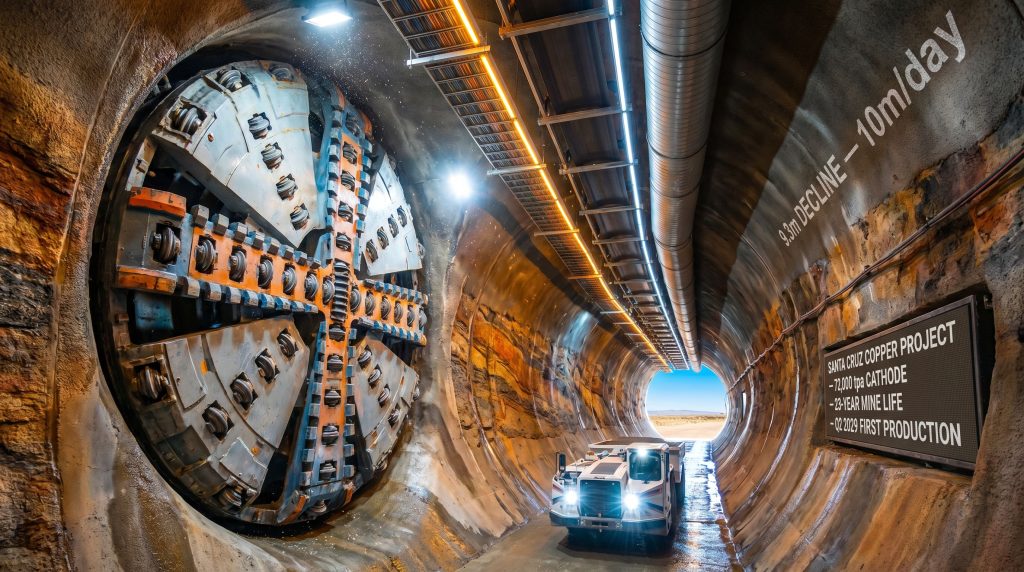
The decision by Ivanhoe Electric to deploy a Robbins Crossover XRE TBM at its Santa Cruz copper project in Arizona is one of the clearest expressions of this shift within North American copper development. The Ivanhoe Electric Robbins TBM Santa Cruz copper project represents a decisive move away from conventional decline methods. Understanding why requires looking not just at the machine itself, but at the full operational architecture it enables and the compounding risks it eliminates.
When big ASX news breaks, our subscribers know first
Why Conventional Underground Development Methods Carry Compounding Risk
Roadheader-based development and drill-and-blast have distinct and well-documented limitations that tend to compound when geology is variable, timelines are ambitious, and regulatory environments are stringent.
Roadheaders perform well in medium-strength rock but experience rapid cutter wear and significant productivity losses in harder formations. In a geologically heterogeneous environment like the copper-bearing districts of Arizona, where ground conditions can transition between competent hard rock and fractured or weaker zones within short distances, this variability creates meaningful schedule risk. Advance rates that look acceptable in planning assumptions can deteriorate sharply when unexpected ground is encountered.
Drill-and-blast introduces a different category of challenges. Ground disturbance from repeated blasting cycles can compromise tunnel stability in weaker zones, requiring more intensive ground support and increasing the exposure window between excavation and structural protection. Labour intensity is high, cycle times are variable, and the method generates operational complexity that scales poorly when the development target is several kilometres of decline.
Does Regulatory Permitting Add Risk to Conventional Methods?
There is also a less-discussed but operationally significant regulatory burden associated with roadheader development in silica-bearing ground. Dust suppression in these environments has historically required silica gel injection, which triggers the requirement for a Class V Underground Injection Control (UIC) permit under U.S. Environmental Protection Agency regulations. This permitting pathway adds complexity, cost, and timeline risk before a single metre of advance is achieved.
Furthermore, advances in underground copper mining technology demonstrate that mechanised boring systems are increasingly being favoured precisely to avoid these regulatory complications. The Ivanhoe Electric Robbins TBM selection at the Santa Cruz copper project addresses all of these limitations simultaneously, which is precisely what makes it technically and strategically significant.
What the Robbins Crossover XRE Actually Does Differently
The Crossover XRE platform from The Robbins Company is engineered specifically for mixed ground conditions. Unlike single-mode TBMs designed for uniform geology, the XRE configuration can adapt its excavation and ground support methodology across varying lithological formations without requiring a full machine replacement or extended stoppages. This is critical for a copper project where the decline trajectory passes through geologically heterogeneous ground.
The 9.3-metre bore diameter is a particularly important specification. At this scale, the resulting tunnel functions as far more than an access corridor. The internal envelope is large enough to simultaneously accommodate:
- A dedicated decline conveyor system for continuous ore and waste movement
- Ventilation infrastructure sized for a 20,000 tonne-per-day underground operation
- Heavy equipment movement, including large-format loaders and drills
- Service and utility lines
This multi-functional capacity is what allows the material handling system included in the $64.7 million acquisition to integrate directly with the decline conveyor infrastructure. Consequently, this eliminates the haulage truck dependency that defines ramp-access mines, removing a significant source of ongoing diesel consumption, ventilation loading, and operating cost from the project's financial model.
The machine is also not entering service without a track record. Prior to acquisition by Ivanhoe Electric, this specific Robbins Crossover XRE unit was deployed at Anglo American's Grosvenor coal mine in Queensland, Australia, where it completed 1.8 kilometres of decline tunnelling within 1,000 operating hours. Acquiring a machine with a documented operational history in a real mining environment provides a performance baseline that new-build procurement cannot offer, alongside a meaningful cost advantage over sourcing an equivalent unit from new manufacture.
Santa Cruz Project Fundamentals: Scale, Process, and Capital Architecture
The Santa Cruz copper project is located near Casa Grande, Arizona, within a state that hosts one of the most established copper mining districts in North America. The project sits entirely on 100% privately owned land, a factor that eliminates surface access negotiations, reduces the complexity of permitting interfaces, and removes a category of sovereign development risk that has derailed projects in other jurisdictions.
The operational design targets the following parameters:
| Metric | Specification |
|---|---|
| Mine throughput | 20,000 tonnes per day (tpd) |
| Mining method | Longhole stoping |
| Mine life | 23 years |
| Average annual copper cathode output (Years 1-15) | ~72,000 tonnes per annum |
| Underground fleet type | Teleremote electric |
| Metallurgical process | Heap leaching + SX-EW |
| Copper cathode purity | 99.99% |
| Copper recovery rate | 92.2% |
| Acid consumption | 6 kg per tonne of ore |
| Spent ore repurposed as backfill | Up to 50% |
Why Does the Heap Leach Design Matter?
Several of these specifications warrant closer examination. The 92.2% copper recovery rate combined with an acid consumption of only 6 kg per tonne of ore represents a notably efficient heap leach design. The copper leaching process is a key cost and environmental driver in operations, and lower acid consumption rates reduce both reagent expenditure and the complexity of environmental management at the leach pad.
The on/off heap leach design, feeding a solvent extraction and electrowinning circuit, produces 99.99% pure copper cathode as a direct-to-market product. This eliminates smelter dependence entirely and allows the project to supply domestic consumers without passing through international smelting infrastructure, a supply chain characteristic that carries strategic relevance in the current U.S. industrial policy environment.
The teleremote electric underground fleet reduces diesel consumption and the associated ventilation load underground, which directly benefits the project's operating cost profile. Ventilation is one of the largest ongoing energy costs in underground mining, and reducing the heat and exhaust load from diesel equipment meaningfully lowers the capital and operating requirements of the ventilation system.
Breaking Down the $64.7 Million TBM Investment
The gross acquisition cost of USD $64.7 million encompasses both the Robbins Crossover XRE TBM and its integrated material handling system. Understanding the net capital impact requires recognising what this acquisition displaces.
Ivanhoe Electric has indicated that the net capital impact on the project's initial development budget is less than USD $20 million. The approximately $44–45 million difference reflects cost offsets from:
- Roadheader fleet procurement costs that are no longer required
- The elimination of silica gel permitting infrastructure and associated Class V UIC permit costs
- Schedule acceleration value from the TBM's higher advance rate, which reduces the carrying cost of capital during the development phase
- The integration of the material handling system within the acquisition, displacing separately procured equipment
The advance rate mathematics support the schedule argument clearly:
| Development Method | Estimated Advance Rate | Notes |
|---|---|---|
| Robbins Crossover XRE TBM | ~10 metres per day | Targeted rate at Santa Cruz |
| Conventional Roadheader | ~5 metres per day | Industry average in comparable conditions |
| Drill-and-Blast | Variable | Ground condition dependent |
At a targeted rate of 10 metres per day, the 4-kilometre decline is achievable within approximately 12 months of excavation commencement. A roadheader-based approach at half that rate would extend the development phase by a full year, adding financing costs, delaying revenue generation, and increasing exposure to commodity price and cost escalation risk during the extended pre-production period.
"The $64.7 million gross acquisition figure is best understood as a capital reallocation rather than a cost addition. The machine displaces costs that would otherwise be incurred through alternative development approaches while also delivering schedule and regulatory benefits that carry their own financial value."
The steel-reinforced concrete lining specified for the Santa Cruz decline is installed progressively during the boring operation rather than as a separate follow-up phase. This integration shortens the overall development cycle and eliminates the ground exposure window between excavation and structural support that creates both safety risk and the potential for tunnel deterioration requiring remediation.
Development Roadmap: From Machine Delivery to First Copper Cathode
The phased development schedule for the Santa Cruz copper project builds from TBM acquisition through to commercial production across a clearly defined timeline:
| Development Phase | Target Timing |
|---|---|
| TBM acquisition agreements finalised | May 2026 |
| Updated technical report incorporating TBM design | Q3 2026 |
| TBM arrival, overhaul, and site assembly | Q1 2027 |
| Decline excavation commencement | Q3 2027 |
| Decline excavation completion (approx. 4 km) | Mid-2028 (estimated) |
| First oxide ore placed on heap leach pads | Q4 2028 |
| First 99.99% copper cathode production | Q2 2029 |
As of May 2026, all initial construction permits are confirmed as being in hand, and the project is characterised as on track for construction commencement in 2026. Debt financing is being pursued across two parallel channels: applications through the U.S. Export-Import Bank and complementary commercial banking facilities.
The approximately 35-month timeline from acquisition finalisation to first cathode production is internally consistent with the stated advance rates and operational design. The overhaul and assembly period for a large-diameter TBM of this specification typically involves significant refurbishment of cutter heads and mechanical systems, which accounts for the Q1 2027 arrival and Q3 2027 commencement gap in the schedule.
Investors and analysts should treat all forward-looking timeline statements as management guidance subject to geological, financing, permitting, and supply chain risks that may cause actual outcomes to differ materially from current projections.
The next major ASX story will hit our subscribers first
Expansion Optionality: The Decline as a Multi-Deposit Infrastructure Asset
One of the less-discussed dimensions of the Ivanhoe Electric Robbins TBM Santa Cruz copper project decision is the optionality it creates beyond the primary orebody. The 4-kilometre decline trajectory has been designed to position it as a future access corridor to the nearby Texaco deposit, located approximately 2 kilometres from the main mine workings.
The Texaco deposit currently holds inferred mineral resources. This classification means the resource has been defined but has not yet been elevated to the confidence level required for reserve declaration or inclusion in production planning. However, it represents a defined exploration target with the potential to extend mine life beyond the current 23-year projection or expand production capacity if future infill drilling upgrades the resource classification.
TBM-developed infrastructure is particularly well suited to supporting multi-deposit access strategies. The structural permanence and dimensional specification of a concrete-lined, 9.3-metre diameter decline are fundamentally superior to temporary or lower-specification development headings for long-duration, multi-use applications. The infrastructure investment made today for the primary Santa Cruz production case does not depreciate in value as a platform for accessing adjacent resources.
What Lies Below the Oxide Mineralisation?
Below the oxide copper mineralisation that forms the basis of the initial production design, Santa Cruz also hosts deeper sulphide mineralisation. Sulphide copper typically requires pyrometallurgical processing rather than the heap leach and SX-EW approach used for oxide ore, but it represents a long-term production extension scenario. The TBM decline's depth and structural integrity create the physical access pathway needed to evaluate and potentially develop these deeper zones in future project phases. In addition, completing a definitive feasibility study for these deeper zones would be an important next step in unlocking that long-term value.
Santa Cruz, U.S. Copper Supply, and the Domestic Industrial Context
The United States imports a substantial proportion of its refined copper requirements, creating supply chain exposure across sectors including electric vehicle manufacturing, power grid infrastructure, defence systems, and semiconductor fabrication. Arizona sits at the centre of North America's most established copper mining district, with existing processing expertise, a skilled workforce, and regulatory frameworks calibrated to large-scale mining operations.
The Santa Cruz SX-EW production model is particularly relevant to domestic supply discussions. By producing finished copper cathode without smelting, the project bypasses the international smelting bottleneck that affects concentrate-producing operations. This means the copper cathode output from Santa Cruz can reach domestic industrial consumers directly, without routing through offshore processing infrastructure. This positions it as a significant US copper project development in the broader North American supply context.
The equipment supply chain adds another layer of domestic alignment. The Robbins Company, manufacturer of the Crossover XRE TBM, is headquartered in Solon, Ohio. The combination of a U.S.-based copper developer, a U.S.-based machine manufacturer, and a project located on U.S. soil creates a coherent domestic industrial narrative that is directly relevant to federal financing discussions through mechanisms such as the Export-Import Bank.
It is important to note that publicly available information confirms the project has all initial construction permits in place and financing applications in progress. No confirmed government funding, strategic project designation, or official backing has been publicly announced, and readers should not interpret financing applications or domestic supply alignment as confirmed government support.
Frequently Asked Questions: Ivanhoe Electric Robbins TBM and Santa Cruz Copper Project
What is the Robbins Crossover XRE TBM and why was it chosen for the Santa Cruz copper project?
The Robbins Crossover XRE is a mixed-ground tunnel boring machine capable of adjusting its excavation approach across varying geological formations. It was selected because of its ability to handle ground condition variability characteristic of Arizona copper geology, its prior deployment record at a major coal mine in Queensland, Australia, and its capacity to eliminate a significant regulatory permitting requirement that would apply to roadheader-based development. Furthermore, the Ivanhoe Electric Robbins TBM Santa Cruz copper project benefits from the machine's documented operational history and cost efficiency relative to new-build alternatives.
What does the $64.7 million TBM acquisition include?
The total acquisition cost covers both the Robbins Crossover XRE TBM and an integrated material handling system. The net capital impact on the project's initial development budget is estimated at less than USD $20 million, reflecting the displacement of costs associated with alternative development approaches. Detailed acquisition information has been published via official project releases.
When is first copper production targeted?
Based on current management guidance, first 99.99% purity copper cathode production is targeted for Q2 2029, following first oxide ore placement on the heap leach pads in Q4 2028.
What is the project's annual production capacity?
The project is designed to produce an average of approximately 72,000 tonnes of copper cathode per year across the first 15 years of operation from a 20,000 tpd underground mine with a 23-year projected mine life. By comparison, a major copper project of similar scale typically requires substantially more complex permitting and development timelines when located outside private land boundaries.
Has the TBM operated in a mine before?
The specific Robbins Crossover XRE unit acquired by Ivanhoe Electric was previously operated at Anglo American's Grosvenor coal mine in Queensland, Australia, where it completed 1.8 kilometres of decline tunnelling within 1,000 operating hours.
What permits does the project currently hold?
As of May 2026, all initial construction permits are confirmed as being in hand, and the project is described as on track for construction commencement in 2026.
Key Takeaways: What the TBM Decision Reveals About Santa Cruz's Development Approach
-
Deploying a 9.3-metre diameter Robbins Crossover XRE TBM over conventional roadheader development prioritises schedule certainty, regulatory simplification, and long-term infrastructure value within the project's capital allocation framework
-
At a targeted advance rate of approximately 10 metres per day, the 4-kilometre decline is achievable within a 12-month excavation window, directly supporting the Q2 2029 first production target
-
The net capital impact of less than $20 million against a gross acquisition cost of $64.7 million reframes the decision as a cost-efficient reallocation rather than a capital escalation, once displaced development costs and schedule acceleration value are properly accounted for
-
The TBM infrastructure creates multi-deposit optionality, providing physical access pathways toward the Texaco deposit and deeper sulphide mineralisation zones beyond the primary orebody
-
The combination of an all-electric underground fleet, SX-EW cathode output, private land position, and domestic U.S. location positions Santa Cruz as a structurally differentiated copper project within the North American supply landscape
-
All production targets, financial projections, and development timelines represent forward-looking management guidance and are subject to geological, financing, regulatory, and market risks that may cause actual results to differ materially from current expectations
Want to Stay Ahead of the Next Major Copper Discovery on the ASX?
Discovery Alert's proprietary Discovery IQ model delivers real-time alerts the moment significant mineral discoveries are announced on the ASX, turning complex data across 30+ commodities into clear, actionable insights for both traders and long-term investors — start your 14-day free trial today and explore how historic discoveries have generated extraordinary returns for those who acted early.