May 12, 2026
The Hidden Economics of Mechanised Decline Development in Copper Mining
Underground mine development has historically been shaped by one dominant constraint: the speed at which miners can move rock. For decades, drill-and-blast techniques defined the pace of decline construction, setting the rhythm for everything from capital deployment schedules to first production timelines. Yet a fundamental recalibration is underway across the underground mining sector, driven by the convergence of mechanised tunneling technology, tightening permitting environments, and investor pressure for capital efficiency. The decision by Ivanhoe Electric TBM for Santa Cruz Copper Project deployment crystallises this shift into concrete financial and operational terms.
Understanding why this matters requires stepping back from the transaction itself to examine what it signals about the future of underground copper mine construction in the United States.
When big ASX news breaks, our subscribers know first
What the Ivanhoe Electric TBM for Santa Cruz Copper Project Actually Involves
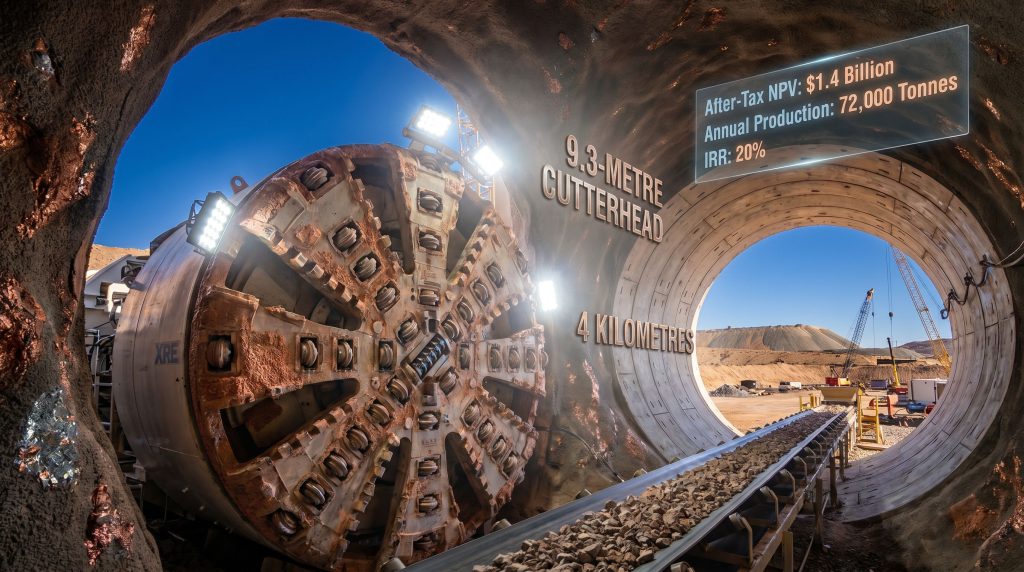
The Ivanhoe Electric TBM for Santa Cruz Copper Project centres on the acquisition of a Robbins Crossover XRE tunnel boring machine, a hybrid platform engineered to operate across variable geological conditions that would challenge purpose-built hard rock or soft ground machines operating in isolation. The Crossover XRE classification is technically significant: unlike conventional TBMs optimised for a single ground type, the crossover platform maintains operational flexibility across mixed geology, reducing the risk of performance degradation as the machine progresses through differing rock mass conditions along a 4-kilometre decline.
The machine carries a documented operational history that differentiates it from theoretical alternatives. Prior to this acquisition, the Crossover XRE completed two separate declines at the Grosvenor coal mine in Queensland, Australia, accumulating 1.8 kilometres of excavation within 1,000 hours of underground use. That field-proven track record represents a form of risk mitigation that purpose-built or first-deployment alternatives cannot offer.
The Transaction Structure and What It Includes
The procurement pathway followed an opportunistic sequence. Robbins Company reacquired the machine from an Anglo American division, and Ivanhoe Electric identified the availability in late 2025. A legally binding option to acquire was secured in March 2026, with final purchase agreements targeted for completion by the end of May 2026. The total acquisition cost is $64.7 million, inclusive of the integrated material handling system.
The full package encompasses:
- Complete refurbishment of the Crossover XRE TBM to operational standard
- A newly manufactured 9.3-metre-diameter cutterhead produced in Ohio, maintaining U.S. domestic supply chain alignment
- An integrated material handling system for underground ore and waste movement
- A permanent conveyor system
- Steel-reinforced concrete tunnel lining as part of the broader infrastructure scope
The aspect that reshapes the economic framing of the acquisition is the net capital impact. Despite the $64.7 million total cost, the expected incremental effect on initial project capital is less than $20 million, a figure reflecting capital offsets generated by the revised development methodology. On a total project capex base of $1.24 billion, that sub-$20 million net impact represents approximately 1.6% of total capital, positioning the TBM as a high-leverage efficiency mechanism rather than a capital burden.
The net capital impact of under $20 million on a $1.24 billion project captures an important principle in capital allocation: the most consequential infrastructure decisions are not always the most expensive ones.
Why Mechanised Decline Development Changes the Risk Profile
The engineering rationale for abandoning conventional drill-and-blast decline development extends beyond simple excavation speed. Conventional blast-and-muck methods generate irregular tunnel profiles that require significant support work, produce fragmented waste that complicates material handling, and create vibration and noise signatures with community and environmental implications. Mechanised TBM development, however, produces a cylindrical, steel-reinforced concrete-lined tunnel with consistent structural properties across its entire length.
Regulatory Simplification as a Financial Asset
One of the least discussed but most strategically valuable outcomes of the TBM approach is the elimination of the Class V Underground Injection Control permit requirement for silica gel. UIC Class V permits govern the injection of non-hazardous fluids into the subsurface, and in the context of underground mine construction involving silica gel ground treatment, the permitting process carries administrative complexity and timeline exposure.
By adopting mechanised decline development, Ivanhoe Electric removes this permitting obligation from the critical path entirely. This regulatory simplification translates into a reduction in both administrative burden and schedule risk during underground development phases when project momentum is most sensitive to delays. Furthermore, the elimination of this permit class represents a material contribution to the capital offset calculation underpinning the sub-$20 million net impact figure. In an era when mining permit reforms are reshaping project timelines across the sector, this kind of regulatory simplification carries genuine strategic weight.
The Ohio Cutterhead and Domestic Supply Chain Alignment
The manufacture of the 9.3-metre cutterhead in Ohio carries significance beyond logistics. In an environment where the domestic production provenance of critical minerals infrastructure components is increasingly scrutinised, deploying a machine with a U.S.-manufactured primary cutting component reinforces the project's domestic supply chain credentials. This is not merely symbolic: for a project pursuing U.S. Export-Import Bank financing, demonstrating domestic industrial content within the project's infrastructure has practical financing implications. The broader context of US copper project development underscores how domestic supply chain alignment is becoming a decisive factor in project financing.
Development Timeline: What the Schedule Adjustment Means in Practice
The adoption of TBM-based decline development introduces a schedule adjustment relative to prior production targets, shifting first copper cathode output from 2028 to Q2 2029. Understanding this adjustment requires recognising the sequential logic of TBM deployment.
| Milestone | Revised Timeline |
|---|---|
| TBM Arrival and Assembly | Early 2027 |
| Decline Development Commencement | Q3 2027 |
| Major Surface Infrastructure Construction | Q3 2027 through 2028 |
| First Oxide Ore on Heap Leach Pads | Q4 2028 |
| Copper Cathode Production Commencement | Q2 2029 |
The TBM assembly phase preceding underground commencement reflects the engineering reality of deploying a 9.3-metre diameter machine underground: surface assembly, launch pit preparation, and commissioning represent a front-loaded setup investment before the 12-month excavation campaign can begin.
Critically, surface infrastructure construction proceeds in parallel with underground decline development from Q3 2027 through 2028, meaning the schedule is not purely sequential. The parallel work streams allow capital to be deployed productively across multiple project components simultaneously, consequently partially mitigating the schedule extension.
Against the backdrop of a 23-year mine life, a one-year production delay warrants proportional perspective. The infrastructure produced by the TBM approach is designed as a permanent asset, with the steel-reinforced concrete lining providing structural integrity calibrated to decades of operational use rather than the mine's initial development phase alone.
The Texaco Deposit Optionality
The 4-kilometre decline is engineered to provide primary access to both the Santa Cruz and East Ridge orebodies, but its strategic value extends further. The Texaco Deposit, located approximately 2 kilometres from the main Santa Cruz orebody, sits within the access corridor created by the TBM decline. This positions the tunnel as dual-purpose infrastructure: an immediate production access solution and a long-term expansion platform.
Designing expansibility into initial capital deployment is a hallmark of disciplined mine planning. Rather than constructing minimum-viable access infrastructure and revisiting expansion later at higher cost and disruption, the TBM approach embeds future optionality within the initial capex envelope.
Project Economics: Scale, Recovery, and Return Profile
The Santa Cruz Copper Project is designed as a bulk-tonnage underground operation producing 99.99% pure copper cathode through a 100% heap leach process, supported by teleremote electric mining fleets and precision grade control systems. The copper leaching benefits associated with this processing methodology are directly relevant here, as heap leach processing applied to copper oxide mineralization avoids the capital and operating cost profile of concentrator-based flotation circuits, which are typically required for sulphide ore processing. For a deeper look at copper leaching benefits, the operational and financial advantages of this approach are well documented across comparable projects.
Production and Financial Parameters
| Metric | Value |
|---|---|
| Average Annual Production (First 15 Years) | 72,000 tonnes copper cathode |
| Total Lifetime Output | 1.4 million tonnes copper cathode |
| Copper Recovery Rate | 92.2% |
| Mine Life | 23 years |
| After-Tax NPV (June 2025 PFS) | $1.4 billion |
| Internal Rate of Return | 20% |
| Initial Capital Expenditure | $1.24 billion |
| Copper Price Assumption | $4.25/lb |
A copper recovery rate of 92.2% through heap leaching is a technically strong result for oxide copper mineralisation, reflecting favourable ore chemistry that responds well to acid leach processing. Heap leach copper projects typically achieve recovery rates ranging from the low 70s to the low 90s depending on mineralogy, particle size, and acid consumption characteristics. The 92.2% figure, therefore, positions Santa Cruz at the productive end of that range.
An after-tax IRR of 20% at a $4.25/lb copper price assumption, combined with a 92.2% recovery rate, places Santa Cruz among the more financially compelling development-stage copper projects globally. Investors should note these are preliminary feasibility study estimates and are subject to revision as engineering advances.
The porphyry copper system classification carries geological significance. Porphyry deposits are globally recognised as the world's primary source of copper supply, characterised by large tonnage, disseminated-to-stockwork mineralisation, and predictable grade distribution at depth. The underground configuration at Santa Cruz differentiates it from the open-pit porphyry operations that dominate global copper production, offering a materially smaller surface footprint and reduced community impact relative to open-cut alternatives of comparable scale.
Financing Architecture: EXIM Bank, Bridge Facility, and Capital Structure
Project financing for Santa Cruz is being advanced through multiple channels operating in parallel.
The U.S. Export-Import Bank has issued a letter of interest for up to $825 million in debt financing, structured as a 15-year term facility. This financing is being pursued within the context of the EXIM Bank's Make More in America initiative, which targets critical minerals production with domestic supply chain characteristics. It is important to note that a letter of interest represents a preliminary step in the EXIM Bank application process; full approval is conditional on completing the formal application, project due diligence, and satisfying EXIM Bank's lending criteria. A letter of interest does not constitute confirmed financing.
A $200 million senior secured bridge facility has received credit approval for the Santa Cruz subsidiary, designed to fund early construction activities and working capital requirements while the longer-term project financing is being finalised. Discussions with commercial banks and non-debt funding sources are ongoing, with a project financing close targeted for the first half of 2026.
The financing structure reflects the scale of capital required to advance a $1.24 billion project through construction. The $825 million EXIM Bank facility, if finalised, would fund the majority of project capital requirements, with equity contributions and the bridge facility covering near-term development expenditures.
The next major ASX story will hit our subscribers first
What Santa Cruz Represents for U.S. Copper Supply Capacity
Structural copper demand growth is being driven by electric vehicle manufacturing, grid infrastructure expansion, renewable energy deployment, and defence electronics procurement. The growing copper supply crunch means that U.S. domestic copper mine production has not expanded at a pace commensurate with projected demand trajectories, creating an increasingly well-documented supply gap.
Santa Cruz's positioning as a near-term domestic copper producer with a targeted production commencement of Q2 2029 situates it within a strategically significant window. The project's heap leach methodology, proximity to U.S. infrastructure and labour markets, and its existing permitting position — including Site Development Plan approval from the City of Casa Grande in March 2026 — all reduce the execution risk factors that create delays at more remote international alternatives.
The integration of U.S.-manufactured components within the TBM system, specifically the Ohio-produced cutterhead, strengthens the domestic industrial content narrative that supports the project's engagement with U.S. government financing mechanisms. This is not incidental project design; it reflects a deliberate alignment between operational procurement decisions and financing strategy.
CEO Taylor Melvin has characterised the project as positioned to become America's next major underground porphyry copper producer, a framing that reflects both the resource scale and the relatively rare configuration of a large-scale underground porphyry system within U.S. jurisdiction. For investors exploring copper investment strategies in this environment, the underground approach at Santa Cruz — enabled by the TBM decline infrastructure — differentiates the project's operating model and environmental footprint from open-pit alternatives of comparable scale.
Key Takeaways for Investors and Industry Observers
- The Robbins Crossover XRE TBM acquisition represents a technically de-risked approach to underground mine access, supported by 1,000 hours of documented operational performance at Grosvenor
- A net capital impact of under $20 million on a $1.24 billion project demonstrates that the TBM methodology is capital-accretive relative to conventional alternatives when permitting offsets and infrastructure quality are properly valued
- The Q2 2029 copper cathode production target reflects a modest schedule adjustment that preserves the long-term value of a 23-year, 1.4 million tonne production profile
- The EXIM Bank letter of interest for up to $825 million, combined with the $200 million bridge facility, establishes a credible financing pathway, though investors should monitor formal application progress as a key de-risking milestone
- The 9.3-metre decline infrastructure provides expansion optionality toward the Texaco Deposit, embedding future value creation within the initial capital programme
- A 20% after-tax IRR at $4.25/lb copper positions Santa Cruz competitively among global development-stage copper projects, though PFS-stage estimates carry inherent uncertainty that will reduce as feasibility study work advances
This article contains forward-looking statements and financial projections derived from Ivanhoe Electric's June 2025 Preliminary Feasibility Study and associated announcements. Actual results may differ materially from estimates due to changes in commodity prices, geological conditions, permitting outcomes, financing availability, and other risk factors. This content is informational only and does not constitute financial advice. Readers should conduct independent due diligence before making investment decisions.
Want to Identify the Next Major Copper Discovery Before the Market Does?
Discovery Alert's proprietary Discovery IQ model scans ASX announcements in real time, instantly flagging significant mineral discoveries — including copper projects — and converting complex geological data into actionable investment insights for traders and investors at every experience level. Explore historic examples of major mineral discoveries and their market returns on Discovery Alert's dedicated discoveries page, and begin your 14-day free trial today to position yourself ahead of the broader market.