July 9, 2026
The Undersea Domain Is Becoming the World's Next Strategic Frontier
Beneath the surface of every geopolitical conversation about critical minerals, battery supply chains, and energy transition lies a largely invisible contest playing out thousands of metres below the ocean surface. Africa deep-sea mining and maritime security has quietly become one of the most contested strategic domains on the planet. The deep seabed, long treated as a scientific curiosity or environmental concern, now carries profound implications for economic sovereignty and the continent's long-term position in global governance.
Understanding why this matters requires stepping back from the immediate policy debate and examining the structural forces converging on the ocean floor simultaneously: resource nationalism, the dual-use potential of civilian research infrastructure, and the accelerating breakdown of multilateral governance norms.
When big ASX news breaks, our subscribers know first
What the Ocean Floor Actually Contains and Why It Matters Now
Polymetallic Nodules and the Critical Mineral Connection
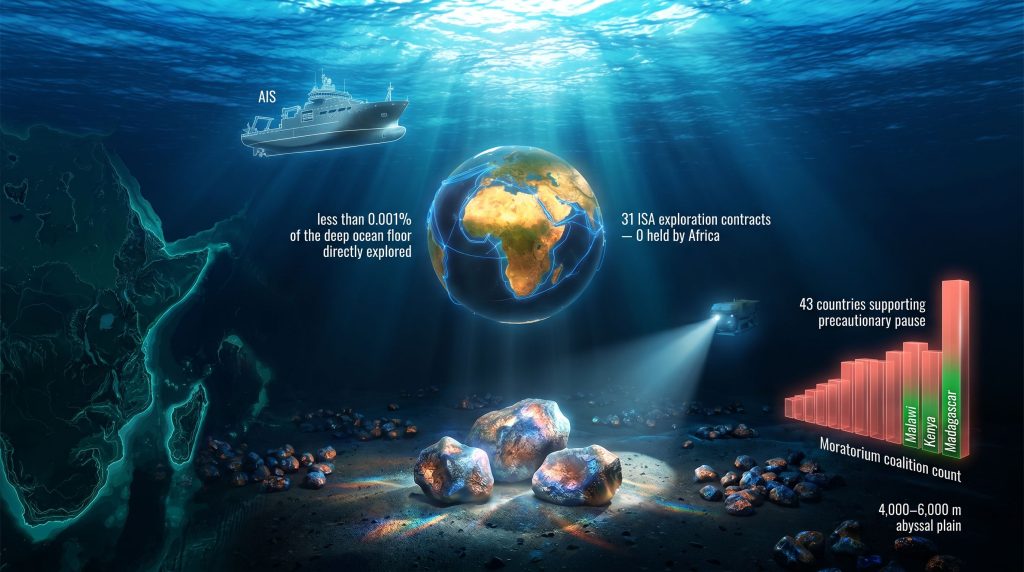
At depths ranging from 4,000 to 6,000 metres below the ocean surface, potato-sized formations called polymetallic nodules sit across vast stretches of the abyssal plain. These nodules contain concentrated deposits of copper, cobalt, manganese, and nickel — precisely the minerals that battery manufacturers, electric vehicle producers, and defence contractors require in growing volumes.
The scale of what remains unknown is genuinely extraordinary. Less than 30% of the global seafloor has been mapped with modern precision, and humans have directly explored less than 0.001% of the deep ocean floor — an area roughly equivalent to the total surface area of Cairo. Despite this, the pace of interest from states and corporations has accelerated dramatically, driven by the assumption that whoever maps and claims access first will hold lasting strategic advantage.
"The justification for deep-sea mining has shifted repeatedly over the past decade, moving from energy transition necessity to national security imperative, raising legitimate questions about whether the real driver is resource access or strategic dominance of the undersea domain."
The Circular Economy Counter-Argument
A dimension of this debate that receives insufficient attention is the growing body of evidence suggesting that the entire premise of seabed extraction as a necessity may be overstated. Research into circular economy approaches, including advanced battery recycling, materials substitution, and more efficient mineral use in manufacturing, increasingly indicates that critical mineral demand could be met without opening a new extractive frontier on the ocean floor.
Furthermore, a battery recycling breakthrough in recent years has strengthened the case that the recycling pathway may mature faster than seabed extraction technology. This matters for Africa not just as an environmental point, but as an economic one, potentially creating a stranded-asset scenario for any nation or corporation that has invested heavily in seabed exploitation infrastructure.
How the ISA Governs the Seabed and Why That Framework Is Under Pressure
The Legal Foundation of the Common Heritage Principle
The United Nations Convention on the Law of the Sea (UNCLOS) designates the international seabed, which lies beyond any national jurisdiction and covers 64% of the Earth's ocean surface, as the common heritage of humankind. This is not merely rhetorical language. It carries specific legal obligations: the seabed cannot be monopolised by individual states, must be administered for the collective benefit of all nations, and can only be used for peaceful purposes.
The International Seabed Authority (ISA), established under UNCLOS, holds responsibility for regulating all mineral-related activity across this vast area. Critically, commercial deep-sea mining remains prohibited under current international law, yet the ISA has already issued 31 exploration contracts covering more than 1.5 million square kilometres, concentrated primarily in the Pacific Ocean.
| Governance Metric | Current Status |
|---|---|
| ISA exploration contracts issued | 31 |
| Area covered by exploration contracts | 1.5 million km² |
| International waters as share of ocean surface | 64% |
| Countries supporting a precautionary moratorium | 43 |
| African nations endorsing precautionary pause | 3 (Malawi, Kenya, Madagascar) |
| African states party to UNCLOS | 47 |
The 2026 Mining Code and the Closing Window
The ISA Secretariat has been pushing to finalise its commercial mining code of rules in 2026, with the 27 to 31 July ISA Assembly representing a critical decision-making window. Once a commercial exploitation framework is codified, the architecture of rules tends to entrench the interests of those who shaped it, making meaningful reform progressively more difficult.
The momentum toward a precautionary pause is building but remains incomplete. Following the 11th Our Ocean Conference held in Mombasa in June 2025, Malawi, Kenya, and Madagascar became the first African nations to formally endorse a moratorium, joining 40 other countries. However, the total number of nations supporting precautionary measures — now standing at 43 — remains short of the supermajority needed to decisively redirect the ISA process. The deep-sea mining controversy surrounding these negotiations continues to intensify as the deadline approaches.
Africa Deep-Sea Mining and Maritime Security: The Dual-Use Threat
When Research Vessels Serve Military Purposes
The most underappreciated dimension of Africa deep-sea mining and maritime security is the dual-use threat embedded in civilian seabed research operations. In March 2025, an investigation published jointly by Mongabay and CNN documented that eight Chinese state-owned research vessels operating under ISA-affiliated exploration activities spent less than 10% of their operational time within designated ISA exploration zones.
These vessels maintained documented links to the Chinese Navy and made regular use of military port facilities. Their navigational patterns over a five-year period showed a consistent preference for strategically sensitive maritime corridors surrounding Guam, Taiwan, and adjacent regions. During transits through these areas, Automatic Identification System (AIS) transponders were routinely switched off, a practice with no legitimate civilian research justification.
"The switching off of AIS transponders in militarily sensitive maritime corridors represents a pattern that is fundamentally inconsistent with civilian scientific operations, raising questions that existing ISA governance frameworks have no mechanism to investigate or address."
Seabed Mapping as an Intelligence Asset
The connection between seabed mapping and military capability is direct and technically well-established. Bathymetric data collected by research vessels can identify the preferred transit corridors of rival nation submarines, locate critical undersea cable infrastructure, and refine the targeting parameters of anti-submarine warfare systems. Submarine data cables currently carry more than 95% of all global internet traffic, including classified military and intelligence communications.
A vessel equipped for mineral exploration survey work carries essentially the same acoustic and mapping instrumentation as one conducting military reconnaissance. The civilian designation of the mission creates no technical barrier to the intelligence utility of the data gathered. Consequently, the ISA's current governance framework, designed around environmental and commercial considerations, is structurally blind to the security implications of the activities it licences.
The US Unilateral Seabed Order
In April 2025, a US executive order directed the accelerated, unilateral exploitation of seabed resources outside the ISA framework, explicitly citing the objective of countering Chinese influence over critical seabed mineral reserves as a national security priority. US government statements made a direct connection between seabed mineral extraction and the manufacture of weapons systems.
When a permanent member of the UN Security Council operates outside the multilateral governance framework, the legal and institutional weight of that framework is fundamentally undermined. For African nations that helped construct the common heritage architecture through decades of diplomatic engagement, this represents a direct threat to a governance principle with deep roots in post-colonial diplomacy.
Africa's Specific Vulnerabilities and What Is Currently at Stake
A Coastline Already Under Strategic Pressure
African maritime corridors carry existing layers of geopolitical risk. Piracy, narcotics trafficking, arms flows, and an accelerating pace of foreign naval deployments and base agreements have already transformed the continent's sea lanes into a zone of compound insecurity. The Diego Garcia incident of March 2025, in which Iran's attempted ballistic missile strike on the US-UK military installation exposed the vulnerability of Mauritian and East African coastlines to spillover from great-power confrontations, illustrated concretely that Africa is not insulated from conflicts it has no role in initiating.
The addition of deep-sea mining activity, with its unresolved dual-use dimensions, introduces another layer of risk onto this existing security environment without any compensating governance mechanism capable of monitoring or constraining it.
Africa's Structural Exclusion from Seabed Governance
Despite 47 African states holding UNCLOS signatory status, the continent has not secured a single ISA exploration contract. This creates a structurally inequitable arrangement in which major powers and their corporate proxies accumulate seabed mapping data, strategic intelligence, and future exploitation rights while African nations remain as passive observers. As ISA Africa experts have noted, the continent must act decisively before this domain becomes a new geopolitical battleground.
The practical consequences extend well beyond procedural fairness:
- African states cannot independently verify what foreign-operated vessels are doing in waters adjacent to their coastlines
- The continent lacks the bathymetric data needed to identify whether its own adjacent seabed areas contain exploitable critical mineral deposits
- Without participation in ISA exploration activities, African nations have no standing to shape the technical standards, environmental provisions, or benefit-sharing mechanisms embedded in the 2026 mining code
- The enforcement capacity constraints facing African navies and coast guards mean that even if violations occurred, the tools to detect and respond to them are limited
The Threat to Africa's Terrestrial Mineral Economies
Africa is among the world's most consequential producers of the specific minerals targeted by deep-sea extraction operations. The Democratic Republic of Congo dominates global cobalt supply. South Africa and Gabon are major manganese producers. Zambia and the DRC together represent a critical share of global copper output.
If seabed extraction achieves commercial viability at scale, the price suppression effect on terrestrial markets could be severe. For economies where mineral royalties and export revenues represent a significant share of government income, this is not an abstract scenario. It is a fiscal risk with direct implications for development trajectories, particularly given the shifting battery metals landscape already reshaping global commodity markets.
A Comparative View: How Different Stakeholders Approach the Seabed Debate
| Stakeholder Group | Primary Concern | Governance Priority | Position on Moratorium |
|---|---|---|---|
| African coastal states | Economic disruption and security exposure | Equity in benefit-sharing | Generally supportive |
| Major naval powers (US, China) | Strategic seabed dominance | Unilateral exploitation rights | Opposed |
| Environmental coalitions | Ecosystem destruction | Indefinite moratorium | Strongly supportive |
| ISA Secretariat | Mining code finalisation | Regulatory framework completion | Neutral/procedural |
| African terrestrial mineral producers | Commodity price protection | Exclusion of seabed competition | Supportive of pause |
| Small island developing states | Climate and security vulnerability | Precautionary governance | Strongly supportive |
The next major ASX story will hit our subscribers first
What Africa Must Do Before the 2026 Deadline
A Six-Point Strategic Framework
The options available to African policymakers are concrete and time-sensitive. The 47-nation UNCLOS bloc represents substantial voting weight within ISA governance structures, but numerical strength without coordinated, technically grounded advocacy has historically failed to translate into durable institutional reform.
The following priority actions represent a coherent strategic framework:
- Submit a formal security-focused agenda item to the July ISA Assembly, specifically addressing the dual-use risks of seabed activities and the inadequacy of existing governance frameworks to address them
- Mandate military-linkage disclosure for all ISA contractors and associated research vessels, requiring declaration of any connections to state armed forces or military infrastructure before exploration licences are granted
- Commission independent legal analysis on whether the use of ISA-affiliated vessels for activities consistent with military reconnaissance violates UNCLOS's peaceful-purposes obligation
- Establish an AU-led continental coordination framework for deep-sea mining policy, potentially including a dedicated African Deep Seabed Mining Corporation to enable collective seabed governance participation
- Align formally with the 43-country moratorium coalition to build toward a supermajority position capable of blocking or significantly constraining premature mining code finalisation
- Invest in long-term capacity across deep-sea science, maritime surveillance technology, and seabed legal expertise to reduce the technical knowledge gap that currently limits effective African participation
The Common Heritage Principle as Legal Leverage
A dimension of this debate that African policymakers may be underutilising is the continent's foundational role in constructing the common heritage principle itself. The language of UNCLOS that designates the seabed as the heritage of all humanity was substantially shaped by contributions from developing nations, many of them African, during the extended diplomatic negotiations of the 1970s and 1980s.
This history provides both legal standing and moral authority for Africa to demand that the principle be enforced in ways consistent with its original intent — including the requirement that the seabed be used exclusively for peaceful purposes. Robust deep-sea mining regulations grounded in this principle represent a legitimate and powerful lever for African states to exercise.
"Africa's influence within ISA governance structures is not genuinely in question. The critical variable is whether the continent can translate its considerable numerical voting weight into coordinated, technically grounded advocacy before the 2026 mining code deadline closes the window for meaningful reform."
Frequently Asked Questions on Africa, Deep-Sea Mining and Maritime Security
Is commercial deep-sea mining currently permitted under international law?
Commercial extraction from the international seabed is not currently permitted. The ISA has issued 31 exploration contracts but no commercial extraction licences. The mining code expected to be finalised in 2026 would create the regulatory pathway for commercial operations to proceed.
Which African countries have formally endorsed a precautionary pause on deep-sea mining?
As of mid-2025, Malawi, Kenya, and Madagascar have formally joined the precautionary pause framework, alongside 40 other nations, following the Our Ocean Conference in Mombasa. No other African states have yet taken a formal position, though the 47-nation UNCLOS bloc gives the continent substantial potential influence if it coordinates effectively.
How does seabed mapping create military intelligence value?
Bathymetric surveys conducted by research vessels can identify the underwater topography that determines preferred submarine transit routes, locate critical undersea infrastructure including data cables, and generate data that refines anti-submarine warfare targeting. The same instrumentation serves both civilian mineral survey and military intelligence purposes, creating a dual-use risk that existing ISA governance was never designed to address.
Why does Africa's exclusion from ISA exploration contracts matter strategically?
Without exploration contracts, African states cannot accumulate the seabed mapping data, technical expertise, or institutional knowledge needed to participate meaningfully in governance decisions. The rules being written now will govern commercial operations for decades, and a framework shaped without African input will inevitably reflect the strategic priorities of the powers that shaped it.
What critical minerals are found in deep-sea nodules and why are they significant?
Polymetallic nodules located at depths of 4,000 to 6,000 metres contain copper, cobalt, manganese, and nickel. These are precisely the minerals required for battery manufacturing, renewable energy infrastructure, and defence systems production. Several of them are also primary exports of African terrestrial mining economies, meaning Africa deep-sea mining and maritime security concerns are directly linked to real commodity revenue risks for the continent.
Want to Track the Mineral Discoveries Reshaping Global Supply Chains?
As competition for critical minerals intensifies across both terrestrial and deep-sea frontiers, Discovery Alert's proprietary Discovery IQ model delivers real-time alerts on significant ASX mineral discoveries — instantly identifying actionable opportunities in copper, cobalt, nickel, and manganese before the broader market reacts. Explore historic discoveries and their market returns on Discovery Alert's dedicated discoveries page, or begin your 14-day free trial today to position yourself at the forefront of the critical minerals revolution.