August 6, 2026
The Supply Chain Vulnerability Reshaping Indo-Pacific Energy Geopolitics
When a single nation controls roughly 90% of the world's rare earth refining capacity, the global clean energy transition becomes structurally hostage to the geopolitical decisions of that one country. This is not a hypothetical risk scenario — it is the operating reality that has shaped India Australia critical minerals and clean energy ties for several years. The third India-Australia Annual Summit, held in July 2026, marked a decisive shift from quiet engineering into visible, operational architecture. What emerged was not a single agreement but a multi-pillar framework designed to rewire how critical minerals flow through the Indo-Pacific economy.
Understanding the depth of this partnership requires moving beyond the diplomatic communiqués and examining the structural economics underneath them.
When big ASX news breaks, our subscribers know first
Why the Resource-Demand Asymmetry Makes This Alliance Logical
Australia and India occupy almost perfectly complementary positions in the global clean energy supply chain, and this complementarity is the genuine foundation of their deepening relationship.
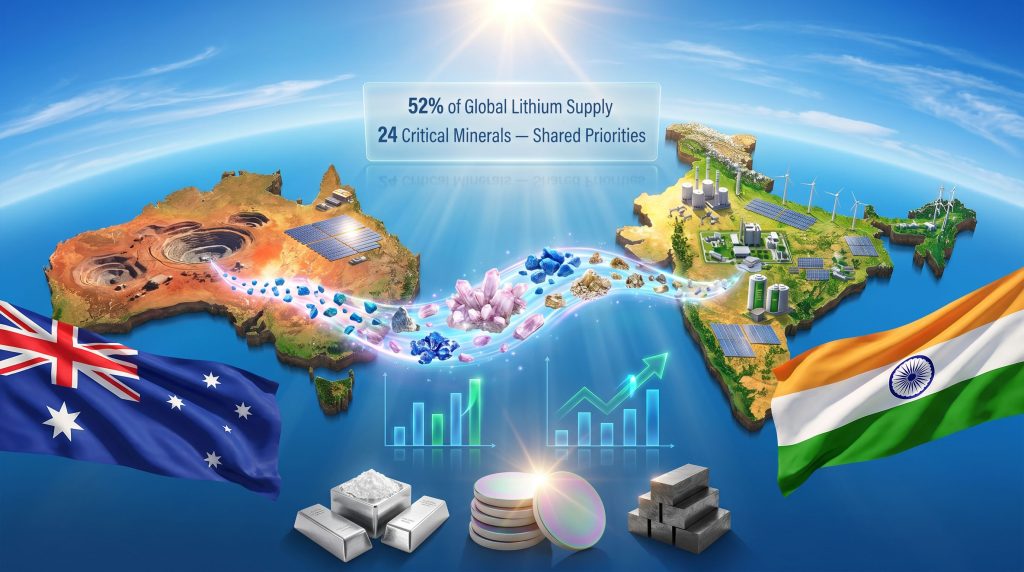
Australia is the world's largest lithium producer, accounting for approximately 52% of global lithium output, concentrated primarily in hard-rock spodumene deposits in Western Australia. Beyond lithium, Australia holds substantial reserves of cobalt, graphite, gallium, nickel, and rare earth elements — minerals that sit at the core of every major clean technology platform, from lithium-ion batteries to permanent magnet motors used in wind turbines and electric vehicles.
India's position is almost the inverse. It possesses rapidly scaling demand driven by three structural forces:
- Ambitious renewable energy installation targets, including 500 GW of non-fossil fuel capacity by 2030
- An electric vehicle penetration goal targeting 30% of new vehicle sales shifting to EVs within the decade
- An expanding domestic solar photovoltaic manufacturing sector that requires mineral inputs at industrial scale
India's National Critical Minerals Mission (NCMM) formalised this demand reality into explicit policy, identifying secure bilateral sourcing as a strategic imperative. The two governments have aligned on 24 critical minerals as shared development priorities, spanning lithium, cobalt, graphite, gallium, nickel, and rare earth elements — each feeding directly into India's clean energy manufacturing pipeline. Furthermore, the broader context of critical minerals demand globally has only intensified pressure on both nations to act decisively.
The structural vulnerability created by rare earth refining concentration in a single country is not merely a supply chain inconvenience. It represents a potential lever over the entire global energy transition timeline, one that both India and Australia are actively working to neutralise through formalised bilateral cooperation.
From Declarations to Deal Structures: What the 2026 Summit Actually Delivered
Previous iterations of India-Australia cooperation were characterised by memoranda of understanding and aspirational language. The 2026 summit was materially different because it moved into operational mechanisms with identified funding structures and named project targets.
The India-Australia Critical Minerals Investment Partnership established co-investment frameworks across five specifically identified projects, creating a joint funding architecture rather than leaving investment to private market signals alone. Alongside this, long-term offtake agreements from Australian lithium operations were formalised — a critical instrument because offtake certainty is precisely what de-risks downstream battery manufacturing investment in India.
Without guaranteed material flows, Indian battery producers face pricing volatility and sourcing uncertainty that undermines their ability to attract long-term capital. A Critical Minerals Research Hub was also established, focused on joint research and development, processing technology transfer, and shared technical expertise.
This is a dimension that tends to receive less attention in headline coverage but carries significant long-term strategic weight. Australia has historically exported raw and partially processed minerals rather than refined products, meaning the real value addition — and the associated employment and industrial capacity — has accrued elsewhere.
The full architecture of summit deliverables spans multiple domains:
| Collaborative Initiative | Primary Focus | Operational Mechanism |
|---|---|---|
| Critical Minerals Investment Partnership | Exploration and processing co-investment | Joint funding across five identified projects |
| Offtake Agreements | Lithium supply security | Binding supply contracts from Australian mines |
| Critical Minerals Research Hub | R&D and technology transfer | Shared expertise in mining and processing |
| Renewable Energy Partnership | Solar PV, green hydrogen, energy storage | Track 1.5 Dialogue with policymakers and industry |
| PACTS Framework | Supply chain and digital resilience | Bilateral cyber and critical technology framework |
| ACITI Partnership | Trilateral technology innovation | Australia-Canada-India MOU |
| Uranium Administrative Arrangement | Nuclear fuel supply | Long-term exports under IAEA safeguards |
The Processing Gap: Why Raw Minerals Are Not Enough
One of the less widely understood dimensions of the India-Australia minerals partnership is the distinction between mining and processing. Australia has long been a dominant producer of raw critical mineral feedstocks, but spodumene extraction processes and the transformation of ore into battery-grade lithium hydroxide have historically been dominated by Chinese refining infrastructure.
This creates a paradox: Australia can mine the lithium, but without processing capacity, the material may still flow through Chinese refineries before reaching Indian battery manufacturers. The explicit summit commitment to developing processing and value-addition capabilities addresses this gap at the policy level.
The comparison with China-dominated refining models is instructive. China's control over rare earth supply chains was built over decades through sustained state investment in technical expertise, environmental tolerance for processing waste streams, and deliberate pricing strategies that made competing infrastructure economically unviable.
Building alternative processing capacity requires not just capital but also the technical workforce to operate it — which is precisely why the establishment of a National Centre of Excellence for Skilling in Mining in Bhubaneswar carries more strategic significance than it might initially appear.
Rare earth processing is technically demanding, chemically complex, and produces significant waste byproducts. The concentration of this capacity in one country was not accidental — it was the result of decades of deliberate industrial policy. Replicating or diversifying it requires equivalent long-term commitment.
Trade Architecture: How ECTA and CECA Accelerate the Minerals Supply Chain
The legal and commercial scaffolding for the minerals partnership rests on the Australia-India Economic Cooperation and Trade Agreement (ECTA), which eliminated tariffs on more than 85% of Australian goods exported to India, including critical mineral inputs. Lower input costs translate directly into more competitive renewable energy manufacturing at scale — a linkage that is easy to overlook when trade agreements are discussed in abstract terms.
The ECTA's successor, the Comprehensive Economic Cooperation Agreement (CECA), is currently under negotiation. The CECA is expected to deepen liberalisation into services, investment, and value-added goods — meaning processed mineral products, not just raw ore. For India's battery supply chain, this distinction matters enormously. Tariff-free access to processed lithium hydroxide or refined cobalt compounds would reduce costs at a fundamentally different point in the manufacturing chain than access to raw spodumene concentrate.
Both countries also identified the complementarity between India's Make in India industrial policy framework and Australia's Future Made in Australia strategy. Both programmes create domestic manufacturing incentives that, when aligned bilaterally, generate overlapping investment opportunities in sectors like solar panel manufacturing, battery assembly, and green hydrogen production equipment.
Multilateral Frameworks Amplifying the Bilateral Core
No bilateral partnership operates in isolation, and the India-Australia relationship is deliberately embedded within several multilateral frameworks that amplify its resilience and reach.
Key multilateral mechanisms supporting the partnership include:
- The Minerals Security Partnership (MSP), through which India and Australia coordinate with allied nations to collectively diversify global critical mineral supply chains away from single-source dependencies
- Quad alignment on supply chain resilience, using technology-sharing and coordinated investment to reduce systemic vulnerability
- The Indo-Pacific Economic Framework (IPEF) as a complementary trade and investment facilitation mechanism
- The Indian Ocean Rim Association (IORA) and the Indo-Pacific Oceans Initiative (IPOI), which provide institutional context for maritime cooperation that directly supports mineral trade route security
The newly launched PACTS framework (Australia-India Partnership on Cyber, Critical Technologies and Supply Chains) is particularly noteworthy because it recognises that supply chain security in the 21st century is not purely a physical logistics question. Digital infrastructure vulnerabilities, cybersecurity threats to port management systems, and data integrity in logistics networks are all potential points of disruption that can affect mineral flows as surely as a shipping lane closure.
The Australia-Canada-India Technology and Innovation (ACITI) Partnership, formalised through a memorandum of understanding at the summit, extends this logic into a trilateral format, creating a force-multiplier effect for critical technology development that no two-way partnership could achieve independently.
The next major ASX story will hit our subscribers first
Nuclear Energy and the Long-Cycle Energy Transition
An underappreciated dimension of India Australia critical minerals and clean energy ties is the nuclear energy component. The administrative arrangement finalised at the summit enables long-term Australian uranium exports to India for peaceful purposes under International Atomic Energy Agency (IAEA) safeguards. Australia holds some of the world's largest uranium reserves, and uranium for nuclear growth has become central to India's expansion programme.
Australia also reiterated its support for India's membership of the Nuclear Suppliers Group (NSG) — a position with significant commercial and strategic implications. NSG membership would expand India's access to nuclear technology and fuel on the international market, accelerating its ability to deploy nuclear power as a low-carbon baseload complement to intermittent renewables.
India's energy planning for 2047 — its centenary of independence — positions nuclear energy as a meaningful component of a diversified clean energy mix, sitting alongside solar, wind, green hydrogen, and grid-scale storage. Australian uranium supply directly supports that long-cycle planning horizon.
Mapping Mineral Supply to Clean Energy Targets
The strategic stakes of India Australia critical minerals and clean energy ties become most concrete when mapped against specific Indian deployment targets:
| India Clean Energy Target | Relevant Critical Mineral | Australian Supply Role |
|---|---|---|
| 500 GW renewable capacity by 2030 | Silicon, cobalt, rare earths | Exploration co-investment and offtake agreements |
| 30% EV penetration target | Lithium (52% of global supply from Australia) | Long-term supply contracts and processing partnerships |
| Green hydrogen production scale-up | Nickel, platinum group metals | Joint R&D through Critical Minerals Research Hub |
| Grid-scale energy storage deployment | Lithium, graphite, cobalt | Investment Partnership framework |
| Nuclear baseload expansion | Uranium | Long-term export arrangement under IAEA safeguards |
The EV penetration target carries particularly acute mineral demand implications. Lithium-ion battery manufacturing at the scale required for 30% EV penetration in a market of India's size would require lithium volumes that cannot be met through domestic sourcing alone. Furthermore, India's lithium supply strategy directly positions Australia's dominant global lithium supply as a technical prerequisite rather than a diplomatic nicety.
The Geopolitical Canvas: Indo-Pacific Strategic Alignment
The minerals and clean energy partnership does not exist in a vacuum — it is embedded within a broader strategic alignment that both nations describe as a commitment to a free, open, and rules-based Indo-Pacific. As analysts at the Lowy Institute have noted, making the most of this cooperation requires deliberate institutional architecture, not just goodwill.
The India-Australia Maritime Security Collaboration Roadmap adopted at the summit is directly relevant to minerals trade, even though it is typically discussed in defence rather than commercial terms. Mineral supply chains depend on secure sea lanes, and the roadmap's focus on information sharing, capability development, and operational coordination between the Australian Maritime Border Command and the Indian Coast Guard protects the physical infrastructure through which resource trade flows.
The summit also produced a Joint Declaration on Defence and Security Cooperation and established an Annual Defence Ministers' Dialogue — institutional mechanisms that ensure strategic coordination continues at the highest levels regardless of changes in the day-to-day diplomatic calendar.
Australia's reiteration of support for India's permanent seat on a reformed United Nations Security Council, alongside mutual endorsement of each other's non-permanent UNSC candidatures for 2028-29 and 2029-30, reflects the reciprocal diplomatic currency embedded in a relationship that has moved well beyond transactional trade.
Skills, Education, and the Human Capital Dimension
Perhaps the most underappreciated element of the summit's outcomes is the emphasis on workforce development. The establishment of a National Centre of Excellence for Skilling in Mining in Bhubaneswar addresses a structural constraint that tends to receive far less attention than raw material access or capital investment: the technical human capital required to operate a sophisticated minerals sector.
Mining and processing at industrial scale requires geologists, metallurgists, environmental engineers, and process chemists. University-level collaboration — including Flinders University's planned Bengaluru campus and Victoria University's Gurugram campus — creates pipelines for the clean energy and technology talent that both nations will require as their bilateral industrial relationship matures.
In a long-cycle industry where projects take a decade from discovery to production, workforce development initiated today becomes operational capacity in the period when India's clean energy demand is expected to be at its most intensive.
Frequently Asked Questions: India Australia Critical Minerals and Clean Energy Ties
What critical minerals are covered under the India-Australia partnership?
The two countries have identified 24 common critical minerals as shared development priorities. These include lithium, cobalt, graphite, gallium, rare earth elements, and nickel — all central to clean energy manufacturing, battery storage, and advanced industrial applications.
How does Australia's lithium dominance benefit India's EV sector?
Australia supplies approximately 52% of global lithium output. Formalised offtake agreements and co-investment structures give Indian battery manufacturers access to reliable, competitively priced lithium without dependence on single-source refining intermediaries that introduce geopolitical risk into the supply chain.
What is the practical difference between the ECTA and the CECA?
The ECTA is the existing framework eliminating tariffs on more than 85% of Australian goods exported to India, including critical mineral inputs. The CECA is a deeper successor agreement currently under negotiation, intended to expand liberalisation into services, investment, and processed or value-added goods — a distinction that matters significantly for downstream manufacturing cost competitiveness.
How does the PACTS framework connect to minerals supply chain security?
PACTS embeds supply chain security within a broader critical technology cooperation framework. It addresses cybersecurity vulnerabilities in logistics and port systems, digital infrastructure resilience, and supply chain diversification — all of which affect the reliability of mineral flows as much as physical infrastructure does.
Why does Australian uranium supply matter for India's clean energy ambitions?
The administrative arrangement for long-term uranium exports under IAEA safeguards gives India a stable, ally-sourced nuclear fuel supply. This directly supports the expansion of nuclear power as low-carbon baseload energy, complementing the intermittency of solar and wind generation in India's long-term energy mix planning through 2047.
Disclaimer: This article contains forward-looking statements, policy projections, and analysis of bilateral frameworks that involve uncertainty. Targets, timelines, and cooperation outcomes referenced here are subject to political, regulatory, and market conditions. This content is intended for informational purposes only and does not constitute financial or investment advice.
Want to Track the Next Major Critical Minerals Discovery Before the Market Does?
Discovery Alert's proprietary Discovery IQ model delivers real-time alerts on significant ASX mineral discoveries — transforming complex geological data into actionable investment insights across lithium, rare earths, cobalt, and the full spectrum of critical minerals driving the Indo-Pacific clean energy transition. Explore historic discoveries and their returns to understand what's at stake, then begin your 14-day free trial at Discovery Alert to position yourself ahead of the market.