July 23, 2026
The Infrastructure Bottleneck Holding Back Africa's Electric Mobility Revolution
The global electric vehicle industry has reached a point where momentum is self-reinforcing. Falling battery costs, expanding model availability, and tightening emissions regulations in major economies have combined to make EV adoption a structural trend rather than a policy experiment. Yet beneath this global narrative sits a striking anomaly: the continent that supplies a disproportionate share of the raw materials powering this revolution is itself almost entirely disconnected from its benefits.
Africa's position in the EV supply chain is one of the more consequential ironies in contemporary industrial economics. The continent holds substantial reserves of cobalt, manganese, and lithium, three minerals central to modern battery chemistry, yet its own transport sector remains overwhelmingly dependent on internal combustion engines. More critically, Africa EV charging infrastructure is not merely a symptom of low vehicle ownership rates — it is an active constraint on the continent's ability to transition at all.
Understanding why this gap exists, how deep it runs, and what it would take to close it requires looking beyond headline EV sales figures and into the structural realities of power supply, financing access, industrial policy, and market segmentation across dozens of distinct national contexts.
When big ASX news breaks, our subscribers know first
Africa's EV Market: Growth Signals Against a Low Base
Quantifying the Current Opportunity
The numbers tell a story of genuine early momentum constrained by an enormous infrastructure deficit. According to the United Nations Economic Commission for Africa (UNECA) 2026 Economic Report on Africa, titled Growth through Innovation: Harnessing Data and Frontier Technologies for Africa's Economic Transformation, electric car sales on the continent more than doubled in 2024, reaching approximately 11,000 units. That growth rate is competitive with global trends.
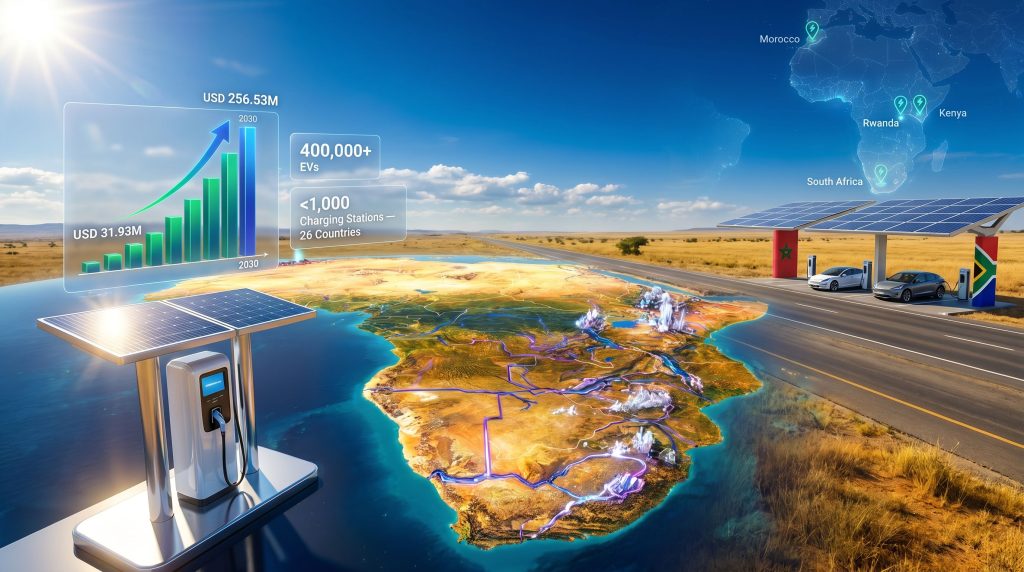
Globally, EV sales rose 35% in 2023 year-on-year, with roughly 3.5 million additional units sold worldwide in that single year alone. Africa's doubling from a low base is, in percentage terms, even more dramatic, but the absolute numbers reveal the challenge. A fleet of around 400,000+ electric vehicles across the continent, spanning cars, motorcycles, three-wheelers, and buses, is being served by fewer than 1,000 charging stations across 26 countries as of early 2025.
The market-level projections are encouraging:
- The African EV market is forecast to grow at a 10.6% compound annual growth rate (CAGR), reaching an estimated USD 314 million by 2029 (UNECA, 2026)
- Africa's EV charging infrastructure market specifically was valued at USD 31.93 million in 2022 and is projected to reach USD 256.53 million by 2030, representing approximately 8x growth over the period
- Morocco's EV market alone is projected to reach USD 163.4 million by 2029, growing at a 10.8% CAGR
These forecasts carry inherent uncertainty and should be treated as directional indicators rather than guaranteed outcomes. Actual market development will depend heavily on policy execution, financing availability, and grid investment decisions that remain unresolved across most African markets.
How Africa's Charging Network Compares Globally
A Stark Infrastructure Benchmarking Exercise
No single data point better captures Africa's infrastructure challenge than a direct comparison with other major EV markets. The gap is not measured in years of delay — it is measured in orders of magnitude.
| Region | Public Charging Points | Notes |
|---|---|---|
| China | ~70% of global light vehicle charging infrastructure | 2023 |
| Europe | 600,000+ public charging points | End of 2023 |
| Europe (projected) | 2.7 million public charging points | By 2035 |
| United States | 192,000+ publicly accessible charging ports | 2024 |
| United States (growth rate) | ~1,000 new stations installed per week | 2024 |
| Africa (entire continent) | Fewer than 1,000 charging stations | Early 2025, across 26 countries |
| South Africa (leading market) | 300-350+ public charging locations | 2024-2025 |
The implications of this table are worth unpacking carefully:
- Europe's charging network is roughly 600 times larger than Africa's entire continental total
- The United States adds more new charging stations in a single week than Africa has deployed cumulatively
- China's dominance in charging infrastructure directly mirrors its dominance in battery manufacturing and EV supply chains, offering a model of vertically integrated industrial strategy that African policymakers are beginning to study
- South Africa, as the continent's most advanced charging market, accounts for roughly 30-35% of Africa's entire public charging stock on its own
This concentration of infrastructure in a single country is itself a revealing data point. It reflects how unevenly distributed both vehicle ownership and enabling conditions remain across the continent.
The Three-Layer Problem: Grid, Capital, and Geography
Why Conventional Charging Models Fail in Most of Africa
The infrastructure deficit cannot be explained by a single cause. Three overlapping structural barriers interact to make charging deployment commercially and technically difficult across most of the continent.
Grid reliability sits at the foundation. Ultra-fast DC charging (Level 3) requires stable, high-capacity power supply. This condition is not met reliably in large portions of Africa outside major urban commercial districts. Load shedding, voltage instability, and insufficient grid capacity mean that operators deploying expensive fast-charging equipment face both technical risk and commercial unpredictability.
Capital access compounds the grid problem. High upfront equipment costs, particularly for DC fast charging, combined with limited access to long-term project finance at competitive rates, make the business case for charging infrastructure investment difficult to close without either significant utilisation volumes or concessional funding. In markets where vehicle penetration is still low, achieving the utilisation rates needed to service debt on charging equipment is a genuine commercial challenge.
Geographic concentration creates a third layer. Existing infrastructure is heavily clustered in cities, commercial districts, highway corridors, and premium retail locations. Rural and peri-urban populations, which represent a substantial share of Africa's total population, are almost entirely unserved. This is both an equity problem and a market development constraint, since many of the transport use cases most suited to electrification occur outside the urban core.
Three Tiers of Market Readiness Across the Continent
A Framework for Understanding Africa's Heterogeneity
One of the most analytically useful contributions of the UNECA 2026 report is its segmentation of African EV markets into three distinct development tiers. Treating Africa as a single market obscures the dramatically different conditions that exist between, for example, Morocco and a landlocked Sub-Saharan economy with low vehicle ownership and no formal EV policy framework.
Tier 1: Emulators
These are markets where conditions most closely resemble those of developed economies, but financing constraints remain the primary binding limitation.
- Countries: Morocco, South Africa, Mauritius, Seychelles
- Characteristics: Established EV incentive frameworks, growing consumer demand, formal automotive sectors, early charging infrastructure deployment
- Primary constraint: Cost of capital and access to long-term project finance
Tier 2: Innovators
These markets are leapfrogging the passenger car-centric model by focusing on electric two- and three-wheelers, supported by fintech-enabled ownership and payment structures.
- Countries: Kenya, Rwanda
- Characteristics: Strong mobile money ecosystems enabling battery-swap schemes, pay-as-you-go ownership models, and fleet electrification for motorcycle taxis (boda-bodas)
- Primary constraint: Scaling from successful pilots to mass deployment
Tier 3: Laggards
A majority of African countries fall into this category, facing multiple structural disadvantages simultaneously.
- Only 28% have established national EV targets
- 76% have low vehicle ownership rates, limiting near-term market size
- Limited regulatory frameworks and insufficient public investment capacity
Of the 26 countries covered in the UNECA survey, 18 were actively developing national EV strategies or supporting policy frameworks as of the report period, suggesting movement even among laggard-category nations.
Morocco and Ethiopia: Two Contrasting Models of Policy-Led Transition
Morocco: Industrial Integration as the EV Accelerator
Morocco has built what is arguably the most coherent electric mobility ecosystem on the continent, grounded in industrial policy rather than consumer incentives alone. In 2023, EVs represented 4.5% of Morocco's total automotive market, with 7,165 units sold out of 161,504 total vehicle sales, a 25.3% year-on-year increase.
The enabling framework includes:
- Full exemptions from customs duties and VAT on EVs and charging equipment
- Purchase incentives for consumers and fleet operators
- Preferential nighttime electricity tariffs designed to shift charging demand to off-peak periods
- The National Electric Mobility Development Plan 2021-2030, targeting 150,000 EVs on Moroccan roads by the end of the decade
Morocco's industrial base amplifies these policy signals. Annual vehicle production capacity stands at approximately 700,000 units, including 70,000 electric vehicles. The automotive sector employed more than 220,000 people and accounted for 19% of GDP as of 2019, according to Oxford Business Group. Critically, 11 of the world's 20 largest automakers operate within the Tanger Med industrial zone, giving Morocco both manufacturing credibility and supply chain connectivity that few African nations can match.
The climate case reinforces the economic one. Increased EV adoption in Morocco could reduce annual emissions to approximately 2.6 million tonnes of CO2 equivalent by 2050, compared with an estimated 30 million tonnes under a business-as-usual scenario (UNECA, 2026). Furthermore, annual hydrocarbon demand could fall by roughly 2 billion litres of fuel per year.
Ethiopia: Regulatory Boldness Without Demand Infrastructure
Ethiopia's approach represents a different and more speculative model. In 2024, it became the first country in the world to ban imports of internal combustion engine passenger vehicles, an extraordinary regulatory intervention that signals genuine political commitment to electrification.
Domestic EV production capacity now includes:
- 1,350 passenger cars per year
- 700 three-wheelers per year
- 350 minibuses per year
- 100 buses per year
- 100 four-wheel mini-cars per year
However, most production facilities are operating at below 50% of capacity, constrained by weak domestic demand and operational inefficiencies. This illustrates a risk that applies across multiple African markets: supply-side policy boldness without matching demand-side infrastructure investment risks creating stranded industrial assets. An ICE import ban without a parallel and well-funded charging infrastructure rollout may simply suppress vehicle adoption rather than redirect it.
The next major ASX story will hit our subscribers first
The Economic Case: Quantifying What Infrastructure Investment Unlocks
Per-Vehicle Economics and System-Level Benefits
The economic rationale for accelerating Africa EV charging infrastructure extends well beyond environmental benefit. Research cited by UNECA from Siemens indicates that each electric vehicle generates measurable economic value across multiple dimensions:
| Benefit Category | Estimated Value per EV |
|---|---|
| Lifetime fuel savings | USD 12,000 |
| Electricity grid benefits | USD 3,500 |
| Broader economic gains | USD 7,000 |
At a fleet level, these figures translate into substantial aggregate economic impact, particularly in oil-importing African economies where fuel expenditure represents a meaningful share of household budgets and national foreign exchange outflows.
Additional system-level benefits include:
- Job creation across charging infrastructure installation, maintenance, grid upgrades, and component manufacturing
- Reduced fuel import dependency, strengthening foreign exchange positions in net oil-importing economies
- Lower vehicle operating costs, improving household purchasing power in urban transport markets
- Grid stabilisation benefits when charging is managed intelligently through demand-response programmes
Off-Grid and Solar-Integrated Charging: Africa's Structural Workaround
Why Distributed Generation Changes the Calculus
A crucial insight emerging from operational experience in Africa's more advanced EV markets is that the grid reliability problem, while real, is not necessarily a permanent barrier to charging deployment. It is, instead, a design parameter that pushes deployment toward distributed solar-integrated models rather than conventional grid-tied charging stations. In this context, renewable energy solutions are increasingly central to making the economic case for off-grid charging work.
South Africa's ongoing buildout along the Johannesburg-Durban N3 corridor, with planned extension along the N1, demonstrates how highway charging can be structured around solar generation rather than grid dependency. This corridor-first deployment model, prioritising high-traffic routes between major economic centres, offers a replicable template for other markets.
Key considerations in the AC versus DC charging deployment decision across African markets:
- AC (Level 2) charging draws lower power, is less expensive to install, and is more compatible with Africa's grid realities. It is the logical primary deployment format across most markets in the near term.
- DC fast charging (Level 3) offers speed advantages but demands stable high-capacity power supply and carries significantly higher equipment and installation costs. Its deployment should be concentrated in markets and locations with reliable grid or dedicated solar-storage systems.
- Standalone off-grid stations paired with battery storage represent the frontier of deployment in rural and peri-urban contexts, where neither grid extension nor conventional commercial models are viable in the near term.
The collapse in funding for local off-grid solar firms in Africa, which raised just USD 9.9 million in 2025, down 81% year-on-year according to recent reporting, highlights that the capital environment for distributed energy solutions remains challenging, even as the operational logic for solar-integrated charging strengthens.
Africa's Critical Minerals: Supplier to the World, Bystander in the Value Chain
The Mineral Wealth Paradox in Concrete Terms
Africa's position as a major supplier of cobalt, manganese, and lithium — while remaining peripheral to battery manufacturing and EV assembly — represents one of the more consequential missed opportunities in contemporary development economics. The critical minerals transition unfolding globally is, in many respects, being built on African resources without African participation in the higher-value stages of the supply chain.
The value differential between raw mineral exports and processed battery-grade materials is enormous. A tonne of cobalt exported as ore captures a fraction of the value of the same material processed into battery precursor chemicals, assembled into cells, and integrated into battery packs. The continent currently operates primarily at the first stage of this value chain.
Considering the broader battery metals landscape, UNECA's 2026 report explicitly frames moving upstream as a strategic continental priority, arguing that industrial policy should target battery precursor processing, cell manufacturing, and EV component production rather than simply extracting and exporting raw materials. The steps required to realise this vision include:
- Investment in battery precursor processing facilities co-located with extraction operations
- Trade frameworks that incentivise in-country value addition before mineral export
- Development finance vehicles to fund domestic EV manufacturing capacity
- Alignment between EV charging infrastructure rollout and renewable energy generation to ensure charging networks are powered by clean electricity
Furthermore, the lithium demand growth driven by battery storage expansion globally makes the case for African upstream participation increasingly urgent. Similarly, China's mineral controls over key battery materials are reshaping global supply chain strategies, creating potential openings for African producers willing to invest in processing capacity.
Policy Architecture: What Separates Leaders from Laggards
The Regulatory Maturity Spectrum
Policy frameworks across Africa's 26 surveyed EV markets range from legally binding regulations to aspirational targets to near-complete absence of formal policy. The key levers being deployed in leading markets include:
- Import duty and VAT exemptions on EVs and charging equipment (Morocco's model)
- Preferential electricity tariffs for EV charging, particularly off-peak nighttime pricing
- National EV deployment targets with defined timelines and accountability mechanisms
- ICE vehicle import restrictions (Ethiopia's pioneering but high-risk approach)
- Public-private partnership frameworks for charging infrastructure financing
- Integration of EV policy into national energy transition strategies, ensuring alignment between charging demand growth and renewable generation investment
Countries including South Africa, Nigeria, and Ethiopia have adopted legally binding EV measures. However, the majority of the 26 surveyed countries remain at the aspirational target or pilot programme stage.
Three Scenarios for Africa's EV Charging Future
Scenario A: Business as Usual
Charging infrastructure grows incrementally, concentrated in South Africa and Morocco. Most African countries remain structurally disadvantaged through 2030. Africa continues to export critical minerals without capturing battery manufacturing value. The continent's share of global EV supply chain value remains minimal.
Scenario B: Policy-Led Managed Transition
Ten or more African countries adopt binding EV targets and incentive frameworks by 2027. Regional development banks deploy substantial blended finance for charging corridors. Morocco and South Africa emerge as continental manufacturing hubs for EV components. The charging infrastructure gap narrows meaningfully but does not close.
Scenario C: Leapfrog Industrialisation
Africa leverages critical mineral reserves to negotiate preferential terms in global battery supply chains. Domestic battery manufacturing capacity comes online in DRC, Morocco, and South Africa. A pan-African EV charging corridor network, powered primarily by solar, becomes operational by 2035. Consequently, the continent shifts from raw material exporter to integrated EV industry participant.
The difference between these scenarios is not resource endowment. Africa already has the minerals, the solar irradiance, and the consumer demand trajectory. The determining variable is the speed and coherence of policy action, industrial investment, and infrastructure financing over the next five to seven years. (Source: UNECA, 2026 Economic Report on Africa)
Frequently Asked Questions: Africa EV Charging Infrastructure
How many EV charging stations does Africa currently have?
As of early 2025, fewer than 1,000 EV charging stations were operational across 26 African countries, serving a fleet exceeding 400,000 electric vehicles. South Africa leads with approximately 300-350 publicly accessible charging locations, making it the continent's most developed market for Africa EV charging infrastructure.
Which African country has the most advanced EV market?
Morocco leads in EV market share and policy framework maturity, with EVs representing 4.5% of total automotive sales in 2023. South Africa has the most developed public charging network. Kenya and Rwanda are innovating with electric two- and three-wheeler ecosystems supported by fintech-enabled ownership models.
What is the projected market size for Africa's EV charging infrastructure?
The market was valued at USD 31.93 million in 2022 and is projected to reach USD 256.53 million by 2030, representing approximately 8x growth over the period. For broader context on EV market projections, independent research firms offer detailed regional breakdowns.
Why is Africa's EV charging infrastructure so underdeveloped?
The primary barriers include unreliable electricity grid infrastructure, high upfront capital costs for charging equipment, limited long-term project financing access, low vehicle ownership rates in many markets, and insufficient regulatory frameworks across the majority of African countries.
Does Africa produce the minerals used in EV batteries?
Yes. Africa holds significant reserves of cobalt, manganese, and lithium, all critical to EV battery production. However, the continent currently exports these primarily as raw materials, capturing limited value from the broader EV supply chain.
Further analysis of Africa's electric mobility transition and broader economic development data is available through the Ecofin Agency at ecofinagency.com, which provides ongoing coverage of African energy, transport, and economic policy developments. This article contains forward-looking projections sourced from UNECA and other research institutions. Such projections are subject to significant uncertainty and should not be treated as investment advice or guaranteed outcomes.
Want to Invest in the Minerals Powering Africa's Electric Mobility Revolution?
Discovery Alert's proprietary Discovery IQ model delivers real-time alerts on significant ASX mineral discoveries — including the cobalt, lithium, and manganese plays central to the global EV battery supply chain — instantly translating complex geological data into actionable investment insights for both new and experienced investors. Explore historic discoveries and the returns they generated, then begin your 14-day free trial to position yourself ahead of the market.