July 23, 2026
The Hidden Chokepoint: How a Single Waterway Is Reshaping Global Aluminium Supply
Most discussions about industrial metals vulnerability focus on mine strikes, smelter energy costs, or Chinese policy shifts. Far less attention has been paid to maritime chokepoints as structural risks to base metals supply chains. Yet in 2026, the global aluminium deficit amid Hormuz shipping disruptions has become one of the most consequential variables in commodity market modelling. Understanding why requires looking at how the aluminium supply chain is physically structured, where its geographic vulnerabilities concentrate, and what happens when both sides of a critical trade corridor are disrupted at once.
When big ASX news breaks, our subscribers know first
Why the Middle East Is More Central to Aluminium Than Most Investors Realise
The Gulf region's role in global oil markets is universally understood. Its significance to primary aluminium production is far less appreciated, yet structurally substantial. The Middle East contributes approximately 10% of total global primary aluminium output, with major smelting operations concentrated in countries such as the UAE, Bahrain, Saudi Arabia, and Oman. These facilities benefit from access to low-cost energy, which is the single largest input cost in electrolytic aluminium production, making the region a highly competitive smelting corridor.
What makes this geographic concentration particularly significant is that Gulf smelters are not self-sufficient in raw materials. They are net importers of alumina, the intermediate product refined from bauxite that is fed into electrolytic reduction cells to produce primary aluminium. Furthermore, alumina supply to Gulf smelters flows primarily from Australia, Guinea, and Brazil, all via maritime routes that transit the Strait of Hormuz for inbound delivery.
This creates an unusual dual-channel exposure. The Strait of Hormuz functions simultaneously as:
- The outbound corridor for finished aluminium and aluminium products destined for global markets
- The inbound corridor for alumina and bauxite raw material inputs essential to keeping smelters operational
When the Strait is disrupted, both flows are constrained at the same time. This is fundamentally different from most supply disruptions, which typically affect either production or logistics, but rarely both simultaneously.
Quantifying the Global Aluminium Deficit Amid Hormuz Shipping Disruptions
Global trade disruptions of this nature have forced analysts to reconsider their deficit forecasting models. The scale of the shortfall depends heavily on assumptions around disruption duration, smelter response capacity, and demand resilience, which explains why published forecasts span an unusually wide range.
| Forecasting Body | Estimated 2026 Deficit | Key Assumption |
|---|---|---|
| Wood Mackenzie | Up to 4,000,000 tonnes | Sustained Hormuz restriction over 18+ months |
| Goldman Sachs | ~720,000 tonnes | Baseline demand, partial route diversions |
| CMBI | ~2% of global demand | Softer demand environment |
| ING (base case) | ~200,000 tonnes | Limited additional smelter outages |
| ING (stress case) | ~600,000 tonnes | Expanded smelter capacity losses |
| Norsk Hydro | ~900,000 tonnes | Prolonged Gulf conflict scenario |
| WBMS (Q1 2026 actual) | 363,700 tonnes | Recorded market data through March 2026 |
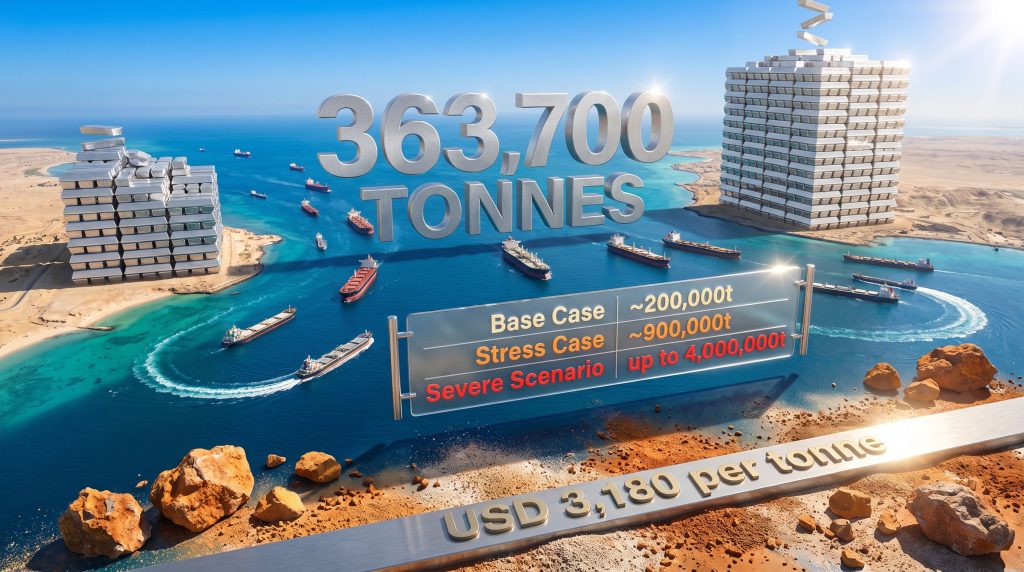
The World Bureau of Metal Statistics confirmed a 363,700-tonne deficit in Q1 2026, providing a hard data anchor at the lower end of the forecast spectrum. The distance between that baseline figure and Wood Mackenzie's stress scenario of 4 million tonnes illustrates just how consequential the duration of Hormuz disruptions will prove to be.
Why the Forecast Range Is So Unusually Wide
The divergence between analyst estimates is not simply a function of different modelling approaches. It reflects genuine uncertainty across several variables that are difficult to quantify in real time:
- How long commercial shipping restrictions through Hormuz will remain in force as US-Iran tensions evolve
- Whether Chinese and Indonesian smelter output growth continues above earlier projections, providing partial global offset
- How quickly Gulf producers can establish operationally reliable alternative routing around the Strait
- The degree to which demand destruction in price-sensitive end markets moderates the physical supply shortfall
- Whether European downstream manufacturers exhaust pre-positioned inventories before Gulf supply normalises
Each of these variables can shift the deficit estimate by hundreds of thousands of tonnes, which is why analysts working from the same underlying data are arriving at figures that differ by an order of magnitude.
The Dual-Channel Disruption Mechanism Explained
To understand why the global aluminium deficit amid Hormuz shipping disruptions is potentially more severe than energy market analogies suggest, it helps to trace the full three-stage aluminium supply chain and identify where Hormuz restrictions bite hardest.
Stage 1: Bauxite Mining
Bauxite, the ore from which aluminium is ultimately derived, is mined primarily in Guinea, Australia, Brazil, Jamaica, and Indonesia. It is a bulky, low-value-per-tonne commodity that travels long distances by sea. The top aluminium producers rely heavily on these maritime supply routes to maintain consistent raw material flows.
Stage 2: Alumina Refining
Bauxite is processed into alumina (aluminium oxide) at refineries, which are often located near mining sites or at coastal facilities to minimise transport costs. Alumina is then shipped to smelters. Consequently, alumina market pressures have intensified as Hormuz constraints disrupt these flows.
Stage 3: Primary Smelting
Alumina is fed into electrolytic reduction cells, where an electric current separates aluminium metal from oxygen. This stage is extremely energy-intensive and represents the bulk of production cost.
Hormuz disruptions introduce critical vulnerability at the interface between Stage 2 and Stage 3 for Gulf smelters. If alumina shipments cannot reach Gulf facilities, those smelters face a choice between drawing down on-site stockpiles, securing emergency alternative supply at premium cost, or curtailing production. Curtailments, once initiated, are operationally costly to reverse and can affect production continuity for months beyond the physical disruption period.
An often-overlooked risk in this scenario is that alumina prices can escalate independently of London Metal Exchange aluminium prices during a disruption event. This means Gulf smelters face the paradoxical situation of rising finished metal prices alongside rising input costs, potentially compressing margins even as LME benchmarks move in their favour.
How Gulf Producers Are Adapting Their Logistics
Gulf aluminium producers have not been passive in responding to Hormuz transit constraints. Several adaptive strategies have been implemented or explored, each with different lead times and cost implications:
- Activation of alternative maritime routing that avoids the Strait entirely, though at significantly higher freight cost and longer transit times
- Acceleration of raw material stockpile drawdowns to maintain near-term operational continuity without requiring new inbound shipments
- Engagement with logistics operators to assess the viability of overland transit corridors as a non-maritime alternative for at least partial raw material supply
- Targeted capacity reductions at smelting lines where raw material supply security cannot be guaranteed over a rolling horizon
Norsk Hydro's chief executive noted publicly that Gulf producers have begun utilising alternative shipping routes, while producers in other regions including Hydro itself have been increasing output to compensate for the disruption. This confirms that the market response is already underway, but also highlights that substitution takes time and carries a cost premium.
LME Price Response and What the Market Is Pricing In
Aluminium prices on the London Metal Exchange have moved materially in response to the escalating Middle East situation. As of July 2026, LME aluminium was trading at approximately USD 3,180 per tonne, representing a 0.7% month-on-month gain as Hormuz tensions intensified. This followed a pullback in June, when geopolitical conditions appeared to ease temporarily before resuming deterioration.
| Scenario | Hormuz Status | Estimated Deficit Range | Price Implication |
|---|---|---|---|
| Base Case | Partial disruption, alternative routes active | 200,000 to 720,000 tonnes | Moderate support above USD 3,000/t |
| Stress Case | Prolonged closure, smelter curtailments expand | 600,000 to 900,000 tonnes | Significant upside potential |
| Severe Scenario | Extended conflict, raw material supply interrupted | Up to 4,000,000 tonnes | Structural price re-rating |
An important dimension that options market participants may be underweighting is the asymmetry of the tail risk. The base case and stress case are clustered relatively closely together, but the severe scenario represents a historically unprecedented supply shock for aluminium markets. If Wood Mackenzie's 4-million-tonne scenario were to materialise, it would dwarf prior aluminium market dislocations and imply a price response of a magnitude not seen since the 2021-2022 supply crisis.
The next major ASX story will hit our subscribers first
The CBAM Variable: How Carbon Policy Created a Temporary Buffer
One of the less widely discussed dynamics that has shaped market outcomes in early 2026 is the interaction between the EU's Carbon Border Adjustment Mechanism and the timing of Hormuz disruptions. CBAM applies a carbon cost to aluminium imports into the European Union based on the carbon intensity of their production process, which creates strong incentives for importers to front-load purchases before implementation.
This pre-positioning behaviour produced above-normal port inventory levels across European markets at the start of 2026. Those inventory buffers have functioned as an inadvertent cushion against the immediate impact of Gulf supply disruptions, preventing the kind of acute shortage signals that would otherwise have been visible in spot markets.
However, this buffer is not inexhaustible, and it was not designed as a strategic supply reserve. Norsk Hydro's leadership indicated publicly that the critical question for the second half of 2026 is whether sufficient cargo volumes arrive to replenish inventories before they are drawn down to levels that trigger physical supply constraints for downstream manufacturers.
CBAM also introduces a complicating factor for substitution. Chinese aluminium, which carries a significantly higher carbon intensity profile than Gulf or Norwegian production, faces a cost penalty when exported to European markets under CBAM rules. This limits Europe's ability to substitute Chinese supply for disrupted Gulf volumes, even as China adds above-forecast primary production capacity domestically.
Regional Dynamics: Winners, Losers, and the Secondary Market Beneficiary
China and Indonesia as Partial Offsets
Both China and Indonesia have added more aluminium supply in 2026 than market forecasters anticipated entering the year. China industrial demand dynamics and continued domestic smelter utilisation at high rates, supported by relatively stable energy availability in key smelting regions, underpin this expansion. Indonesia's growing smelting base is increasingly relevant as a swing supplier serving Asian demand centres previously reliant on Gulf-origin metal.
However, neither country fully substitutes for Gulf supply in all markets. Chinese aluminium faces CBAM friction in Europe and trade policy complications in other Western markets. Indonesian supply is geographically advantaged in Asia but lacks the established logistics infrastructure to rapidly pivot to European or North American delivery.
European Manufacturers: The Inventory Cliff Risk
European downstream producers, spanning automotive, construction, packaging, and engineering sectors, are the most structurally exposed to a prolonged Gulf supply disruption. Their current buffer of pre-CBAM inventory is a non-renewable resource in the near term. Once that inventory is consumed, replacement supply must come from alternative origins or at spot market premiums that significantly exceed LME benchmarks.
The Secondary Aluminium Advantage
One of the structurally underappreciated beneficiaries of primary aluminium supply tightness is the recycled aluminium sector. When LME prices rise and primary availability tightens, the economics of secondary production improve substantially. Recycling facilities that were already operational see margin expansion simply from the shifting price environment, without any increase in their own input costs.
Norsk Hydro's recycling operations produced approximately 225,000 tonnes of secondary aluminium in Q2 2026, representing growth of 15% year-on-year. The company's adjusted earnings for the period reached NOK 8.92 billion (approximately USD 927 million), exceeding analyst consensus expectations. This performance directly reflects the competitive advantage that integrated producers with substantial recycling capacity hold in a supply-constrained environment.
For investors evaluating aluminium sector exposure, this performance differential is structurally significant. A supply disruption that damages pure-play primary producers simultaneously benefits integrated players with recycling assets, creating divergent return profiles across what appears on the surface to be a uniform commodity sector.
Strategic Implications Across Stakeholder Groups
For Downstream Industrial Manufacturers
- Procurement strategy review is urgent: the CBAM-driven inventory buffer that masked disruption in H1 2026 was a one-time event that cannot be replicated through the same mechanism
- Supplier diversification away from sole reliance on Gulf-origin primary aluminium is a risk management imperative, not an optional optimisation
- Hedging programme calibration must account for a widening spread between LME spot prices and regional physical premiums in European and North American markets
For Investors and Portfolio Analysts
- Integrated producers with recycling capacity and geographic diversification away from Hormuz-exposed supply chains carry structurally lower risk and demonstrated earnings resilience in Q2 2026
- The 200,000-tonne to 4-million-tonne uncertainty band in deficit forecasts is abnormally wide by historical standards, suggesting that options market pricing may be underestimating tail risk scenarios
- Regional premium differentials between European, Asian, and North American physical aluminium markets are likely to widen further if Gulf supply constraints persist through H2 2026
For Supply Chain Strategists and Trade Bodies
- The Hormuz episode has exposed a concentration risk in Western aluminium supply chains that extends well beyond energy security frameworks
- Strategic stockpile adequacy reviews, domestic recycling capacity expansion, and raw material source diversification represent the three most actionable policy levers
- In addition, mining decarbonisation trends intersect with these supply security concerns, as carbon-intensive substitution options face growing regulatory friction precisely when they are most needed
Three Variables That Will Determine the Second Half of 2026
The trajectory of the global aluminium deficit amid Hormuz shipping disruptions through the remainder of the year will ultimately be shaped by three observable developments:
-
Hormuz shipping status: Any normalisation of commercial transit through the Strait would rapidly compress the geopolitical risk premium embedded in current LME prices. Conversely, further deterioration toward the severe scenario would trigger smelter curtailments with multi-month production implications.
-
European inventory replenishment: Whether sufficient aluminium cargo volumes arrive before pre-CBAM stockpiles are drawn down to critical levels will determine whether downstream European manufacturers face genuine allocation constraints or navigate the disruption without visible shortages.
-
Chinese and Indonesian output trajectory: If both nations sustain above-forecast production rates, the theoretical ceiling for the global deficit is meaningfully lower, though trade policy and carbon intensity restrictions limit how much of that supply can reach the markets most exposed to Gulf disruption.
The convergence of geopolitical disruption, raw material supply chain vulnerability, carbon policy-driven inventory dynamics, and uneven geographic production capacity has created one of the most complex and consequential aluminium market environments in recent years. The degree to which the deficit widens beyond current consensus estimates depends almost entirely on the duration and geographic intensity of Hormuz constraints, and on the speed at which Gulf producers can establish operationally viable alternative logistics corridors. For market participants across the supply chain, the margin for analytical error has rarely been smaller.
This article contains forward-looking assessments and market scenario analysis drawn from publicly available forecasts. Commodity market outcomes are inherently uncertain and subject to rapid change based on geopolitical, regulatory, and operational developments. Nothing in this article constitutes financial or investment advice.
Want to Identify ASX Mineral Discoveries Before the Broader Market Does?
Discovery Alert's proprietary Discovery IQ model delivers real-time alerts on significant ASX mineral discoveries, translating complex commodity data across more than 30 minerals into clear, actionable insights for both short-term traders and long-term investors. Explore historic discoveries and their market returns, then begin your 14-day free trial to position yourself ahead of the market.