July 23, 2026
The Quiet Consolidation Reshaping Global Aluminium's Most Critical Upstream Market
The global aluminium industry is built on a supply chain that most consumers never see. Before a car panel is stamped, before a beverage can is formed, before a solar panel frame is extruded, an enormous volume of raw ore must be extracted from the ground, shipped across oceans, and chemically transformed across multiple industrial stages. At the very beginning of that chain sits bauxite, and increasingly, Guinea bauxite exports to China define the economics of that entire process.
What has unfolded in Guinea's bauxite export market over the past five years is not simply a story of rising volumes. It is a structural transformation in how one of the world's most industrially critical raw materials is produced, controlled, and priced, with consequences that extend far beyond West Africa and deep into the cost structures of global aluminium production.
When big ASX news breaks, our subscribers know first
Why Guinea Now Anchors China's Aluminium Supply Chain
Guinea holds an estimated one-third of the world's total known bauxite reserves, and critically, much of that ore is of high quality with relatively low silica content, making it well-suited for the Bayer process used by Chinese alumina refineries. This geological advantage, combined with large-scale Chinese investment in mining infrastructure beginning in the early 2010s, has repositioned Guinea from a secondary supplier into the single most important foreign source of bauxite for China's aluminium industry.
The displacement of Australia and Indonesia as China's primary bauxite sources was not accidental. Indonesia's 2014 ban on unprocessed mineral exports removed a significant supply source almost overnight, forcing Chinese refiners to accelerate investment in alternative geographies. Furthermore, Australia, while still a meaningful supplier, faces higher extraction and logistics costs relative to Guinea's largely open-cast, high-grade deposits located in the Boké region and surrounding areas.
Guinea filled the gap not merely because it had the ore, but because Chinese capital was already positioned to extract and export it at scale. Understanding global bauxite production patterns helps contextualise just how dominant Guinea's position has become within this broader landscape.
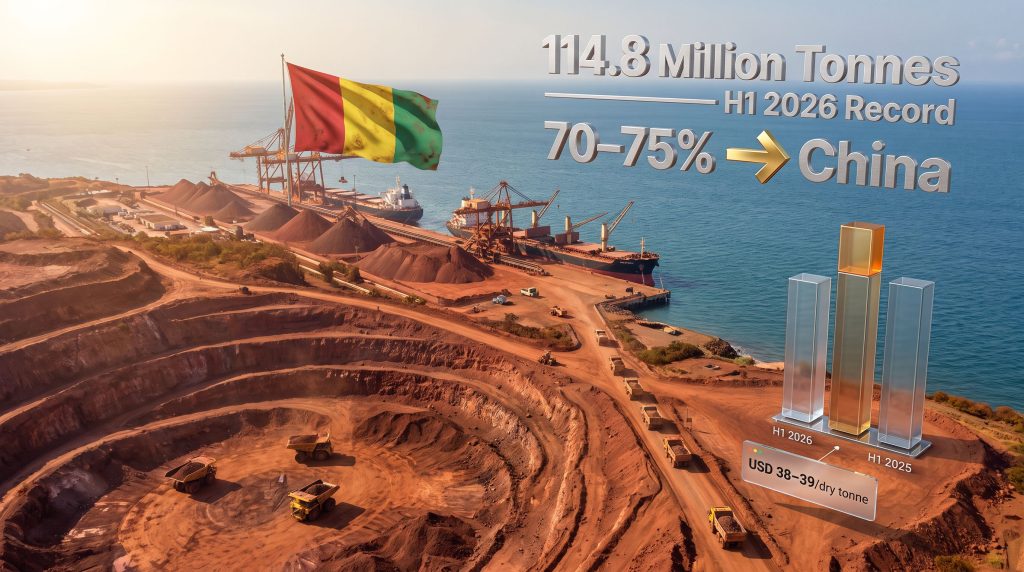
The result is a concentration of dependency that now defines the economics of Chinese alumina refining. Approximately 70 to 75 percent of Guinea's total bauxite exports are directed to Chinese buyers, a share that has remained broadly consistent even as absolute volumes have grown dramatically.
Record Export Volumes: The Numbers Behind Guinea's H1 2026 Performance
Data sourced from Guinea's Ministry of Mines and reported by Reuters confirms that Guinea exported a record 114.8 million tonnes of bauxite during the first half of 2026, representing a 15 percent year-on-year increase from the 99.8 million tonnes recorded in H1 2025. Within that total, the second quarter alone contributed 53.9 million tonnes, a 5.3 percent increase compared with the 51.2 million tonnes shipped in Q2 2025.
| Period | Total Guinea Bauxite Exports | China's Share | Year-on-Year Growth |
|---|---|---|---|
| H1 2025 | 99.8 million tonnes | ~74% | Baseline |
| Full Year 2025 | 182.8 million tonnes | ~74% | +25% YoY |
| Q1 2026 | 60.9 million tonnes | >70% | Elevated |
| H1 2026 | 114.8 million tonnes | ~70% | +15% YoY |
| Q2 2026 alone | 53.9 million tonnes | ~70% | +5.3% YoY |
If the H1 2026 trajectory is sustained across the full year, total 2026 export volumes could approach or surpass 220 million tonnes, a figure that would far exceed even Guinea's own previously discussed policy ceiling. Guinea also exported 238,563 tonnes of alumina during H1 2026, a relatively small but symbolically meaningful figure given ongoing discussions about in-country value-add processing.
In broader context, China's raw material demand has driven total bauxite imports to 200.5 million tonnes in 2025, reflecting not just demand growth but an accelerating programme of alumina refinery capacity expansion within China itself. Chinese alumina output has grown substantially over the past decade, requiring an ever-larger feedstock pipeline from overseas sources, with Guinea at its centre.
Corporate Architecture: Who Controls Guinea's Export Pipeline
Understanding Guinea's bauxite export market requires looking beyond the bilateral trade relationship between two nations. The operational reality is that Chinese capital is deeply embedded within Guinea's mining sector, creating a supply structure that more closely resembles a cross-border vertically integrated operation than a conventional export market.
The three largest exporters in Q2 2026 illustrate this point clearly:
| Operator | Q2 2026 Export Volume | Ownership Character |
|---|---|---|
| SMB (Société Minière de Boké) | 16.95 million tonnes | Chinese-backed consortium |
| Chalco (Aluminum Corporation of China) | 7.73 million tonnes | Chinese state enterprise |
| CBG (Compagnie des Bauxites de Guinée) | 4.13 million tonnes | Mixed ownership structure |
SMB's position as the single largest exporter reflects years of sustained Chinese investment in logistics, port infrastructure, and extraction capacity in the Boké region. Chalco, as a Chinese state-owned enterprise, represents the direct involvement of Beijing's industrial policy in securing upstream feedstock for domestic aluminium production. CBG, while structured differently, operates within an environment where the largest and most capitalised players are Chinese-aligned.
Additional operators including CDM-CHINE and SPIC further reinforce Chinese corporate presence across the export chain. When the dominant exporters from a resource-rich nation are operationally controlled by, or financially linked to, the destination country's corporations, conventional commodity market price discovery mechanisms are significantly altered. Consequently, Guinea's bauxite trade with China is increasingly functioning as a managed supply relationship rather than an open spot market.
Ore Quality and Why Guinea's Bauxite Grade Matters
What Makes Guinean Ore Technically Distinct?
One dimension of Guinea's dominance that is less frequently discussed in trade commentary is the specific quality characteristics of its bauxite. Guinean ore is predominantly gibbsite-type bauxite, meaning the aluminium hydroxide mineral is in a form that dissolves readily under relatively low-temperature, low-pressure Bayer process conditions. This reduces energy consumption per tonne of alumina produced compared with boehmite or diaspore-type ores common in other geographies.
Chinese refineries that have been constructed or expanded over the past decade are specifically calibrated to process Guinean ore specifications, including its silica ratio and moisture content profile. This technical lock-in is a dimension of dependency that raw trade volume statistics alone do not capture. Even if alternative bauxite sources were theoretically available in sufficient quantity, the cost and time required to recalibrate refinery chemistry and processing parameters would create a meaningful transition period during which Chinese alumina output would be disrupted.
This is why Guinea's leverage over China extends considerably beyond what simple import share figures suggest. The leading bauxite mines globally demonstrate that very few alternative sources can match the combination of volume, quality, and logistics infrastructure that Guinea now provides.
The Cost Squeeze Eliminating Smaller Producers
While headline export volumes are at record levels, the operating environment for smaller Guinean mining companies has deteriorated materially. Three compounding pressures are simultaneously eroding the economics of lower-scale operators:
- Fuel cost escalation: Operational fuel costs have increased by more than 80 percent, fundamentally altering cost-per-tonne economics for mines lacking the purchasing power and logistics efficiency of large-scale operators.
- Maritime freight disruption: Ongoing conflict in the Middle East has extended voyage times for vessels transiting affected routes, pushing freight costs higher and compressing margins across the export chain.
- Seasonal weather vulnerability: Guinea's wet season creates recurring disruptions to overland haulage, stockpiling operations, and port loading schedules, a structural challenge that disproportionately affects smaller operations with less infrastructure redundancy.
The consequences of this cost environment are already visible. Dynamic Mining has suspended operations entirely, representing the most prominent casualty of the current conditions. Three additional smaller producers have either halted output or materially reduced production volumes. Lower-grade bauxite producers face a compounded disadvantage: their extraction costs are inherently higher while the prices they can realise for inferior ore quality are lower than those commanded by premium Guinean gibbsite.
Industry analysts note that Guinea's overall production trajectory is unlikely to be materially affected in 2026, because major producers are simultaneously expanding capacity and new entrants are adding volume to offset the withdrawal of marginal operators. The net effect, however, is accelerating market concentration, with an increasing share of total export volume flowing through Chinese-controlled or Chinese-backed entities.
The next major ASX story will hit our subscribers first
Bauxite Pricing: The Paradox of Record Volumes and Soft Prices
The coexistence of record export volumes and subdued pricing reflects a structural dynamic that runs counter to basic supply-and-demand intuition. Guinea FOB bauxite prices were tracking at approximately USD 38 to 39 per dry tonne in 2026, according to commodity price analysis from Procurement Resource, a level that represents a softened market environment relative to earlier years in the cycle.
| Year | Market Conditions | Approximate Guinea FOB Price Range |
|---|---|---|
| 2023 | Moderate demand growth | USD 42-46/dry tonne (estimated) |
| 2024 | Supply expansion accelerating | USD 40-44/dry tonne (estimated) |
| 2025 | Oversupply emerging | USD 39-42/dry tonne (estimated) |
| 2026 | Confirmed oversupply | USD 38-39/dry tonne |
Several dynamics explain why prices remain soft even as volumes reach new records:
- Supply additions from major Chinese-backed operators have consistently outpaced demand growth, creating a structural oversupply condition in the physical market.
- Because Chinese entities dominate both the supply and offtake sides of the trade relationship, the arm's-length price discovery process that characterises open commodity markets is structurally limited.
- The exit of marginal producers does not tighten supply when large operators are simultaneously ramping capacity, meaning the market-clearing mechanism that would normally support prices is effectively bypassed.
For Guinea's government and its smaller domestic miners, this pricing environment represents a fiscal and developmental challenge. The country generates royalty and taxation revenue linked to export volumes and values, and sustained price softness reduces the per-tonne benefit even as total volumes grow.
The Export Cap Debate: Guinea's Policy Lever and Its Market Implications
Could a Volume Ceiling Reshape the Market?
Guinea's government has previously signalled consideration of an annual export ceiling of 150 million tonnes, a policy mechanism intended to protect smaller domestic producers from being priced out of the market, constrain oversupply, and create incentives for greater in-country processing of raw bauxite into alumina or eventually aluminium metal. Bloomberg has reported that Guinea is set to unveil formal export control measures, signalling that this debate is moving from discussion into policy action.
As of mid-2026, no such restriction has been formally enacted, and Guinea's annualised export run-rate significantly exceeds that threshold. However, the policy remains under active discussion and represents a material risk to Guinea bauxite exports to China that deserves careful scenario analysis.
| Scenario | Annual Export Cap | Estimated Market Deficit | China Impact |
|---|---|---|---|
| No restriction (current path) | ~220+ million tonnes projected | None | Continued supply security |
| Moderate cap implemented | 150 million tonnes | ~33 million tonnes deficit | Significant feedstock shortfall |
| Strict cap with processing mandate | Under 120 million tonnes raw ore | Over 60 million tonnes equivalent | Severe aluminium cost escalation |
The downstream amplification effect is critical to understand. A shortfall in bauxite feedstock does not produce a proportional reduction in aluminium output — it produces a disproportionately larger disruption because of the refinery bottleneck. Approximately two tonnes of bauxite are required to produce one tonne of alumina, and approximately two tonnes of alumina are required to smelt one tonne of primary aluminium. A 33-million-tonne bauxite deficit therefore translates into potential impacts across the alumina and aluminium value chain that are many multiples of the raw ore shortfall in economic terms.
From Mine to Metal: The Full Value Chain in Context
Understanding why Guinea bauxite exports to China matter to global markets requires tracing the complete production pathway:
- Bauxite extraction in Guinea's Boké region and surrounding areas, predominantly open-cast mining of near-surface gibbsite deposits.
- Seaborne export via West African ports, primarily Kamsar, to Chinese coastal terminals after voyages of approximately 20 to 25 days under normal routing conditions.
- Alumina refining at Chinese facilities using the Bayer process, dissolving aluminium hydroxide in caustic soda and precipitating purified alumina.
- Primary aluminium smelting via the Hall-Heroult electrolysis process, reducing alumina to metallic aluminium using large quantities of electrical power.
- Downstream manufacturing into rolled sheet, extruded profiles, cast components, and other semi-fabricated products.
- Global distribution of Chinese-manufactured aluminium products to end markets across Europe, North America, Southeast Asia, and beyond.
Disruption at the first step of this chain creates amplified consequences at every subsequent stage. This is why global aluminium markets, and the industries they serve, carry an exposure to Guinea's political and operational stability that extends well beyond the countries directly involved in the bauxite trade itself.
Geopolitical Dimensions: Resource Control Beyond Trade Statistics
China's deepening integration into Guinea's bauxite supply chain reflects a broader strategic approach to securing upstream access to critical industrial raw materials. By financing and operating the mines, building the port infrastructure, and controlling the logistics chains that move ore from mine to ship, Chinese entities have created a supply relationship in which the distinction between foreign trade and domestic supply chain management has become blurred.
The top aluminium miners globally are acutely aware of this dynamic, and many are actively reassessing their upstream exposure and strategic positioning in light of Guinea's growing policy ambitions. In addition, broader aluminium sector investment trends are increasingly being shaped by concerns about feedstock security and the geopolitical concentration of bauxite supply.
For third-party aluminium-consuming nations, particularly in Europe and North America, this concentration carries indirect exposure. Chinese aluminium production volumes, competitiveness, and export pricing are all influenced by the cost and security of Guinea feedstock. Any disruption or policy-driven restriction in Guinea therefore has the potential to transmit through Chinese production economics and into global aluminium prices, affecting buyers far removed from the original supply chain event.
Guinea, for its part, holds substantial negotiating leverage in this relationship — leverage that is not always fully reflected in the FOB prices its ore currently commands. The country's ability to restrict exports, mandate domestic processing, or renegotiate the terms of existing concessions represents a set of policy options whose economic impact on Chinese aluminium production would be significant and difficult to offset in the short term.
Disclaimer: This article contains forward-looking scenario analysis and market projections based on publicly available trade data, industry pricing information, and policy discussions as reported at the time of writing. All price estimates, volume projections, and scenario modelling are indicative only and do not constitute financial or investment advice. Readers should consult qualified advisors before making any decisions based on this information.
Frequently Asked Questions: Guinea Bauxite Exports to China
How Much Bauxite Did Guinea Export in H1 2026?
Guinea exported a record 114.8 million tonnes of bauxite during the first half of 2026, representing a 15 percent year-on-year increase from 99.8 million tonnes in H1 2025, according to data from Guinea's Ministry of Mines as reported by Reuters.
What Percentage of Guinea's Bauxite Goes to China?
China consistently absorbs approximately 70 to 75 percent of Guinea's total bauxite exports, a share that has remained broadly stable as both total volumes and Chinese alumina refining capacity have expanded in parallel.
Why Is Guinea Bauxite Particularly Valuable for Chinese Refineries?
Guinea's deposits are predominantly gibbsite-type bauxite, which requires lower processing temperatures and pressures than boehmite or diaspore ores. Chinese refineries constructed or expanded over the past decade are specifically calibrated to this ore type, creating a technical dependency that extends beyond simple volume considerations.
What Is the Current Guinea Bauxite FOB Price?
Guinea FOB bauxite prices were tracking at approximately USD 38 to 39 per dry tonne in 2026, according to Procurement Resource, reflecting a softened market driven by supply growth outpacing demand expansion.
What Would Happen If Guinea Implemented an Export Cap?
A formal cap of 150 million tonnes annually would create an estimated deficit of approximately 33 million tonnes against current demand levels, with amplified downstream consequences for Chinese alumina refining and primary aluminium production given the multi-stage conversion ratios involved in the value chain.
Which Companies Dominate Guinea's Bauxite Exports?
SMB (Société Minière de Boké) is the largest exporter with 16.95 million tonnes shipped in Q2 2026 alone. Chalco, a Chinese state enterprise, contributed 7.73 million tonnes in the same period. CBG (Compagnie des Bauxites de Guinée) exported 4.13 million tonnes in Q2 2026.
Want to Stay Ahead of Major Mineral Discoveries Before the Broader Market Catches On?
Discovery Alert's proprietary Discovery IQ model delivers real-time alerts on significant ASX mineral discoveries, turning complex commodity data into clear, actionable investment insights — explore historic examples of exceptional discovery returns to understand the scale of opportunity, and begin your 14-day free trial today to position yourself ahead of the market.