
July 23, 2026
The Secondary Aluminium Margin Trap: Why the Recycling Arbitrage Is Structurally Broken
The circular economy promise built around aluminium recycling rested on one foundational assumption: that processing used metal would always cost dramatically less than producing virgin material. For decades, that assumption held. Today, it is unravelling under simultaneous pressure from thermodynamic limits, carbon regulation, geopolitical supply fragmentation, and escalating hazardous waste compliance costs. The secondary aluminium margin trap is not a temporary pricing dislocation. It is a structural reconfiguration of the entire sector's economics, and understanding its architecture is essential for any operator, investor, or policymaker with exposure to the recycled metals value chain.
When big ASX news breaks, our subscribers know first
What Is Driving the Collapse of the Secondary Aluminium Margin Trap?
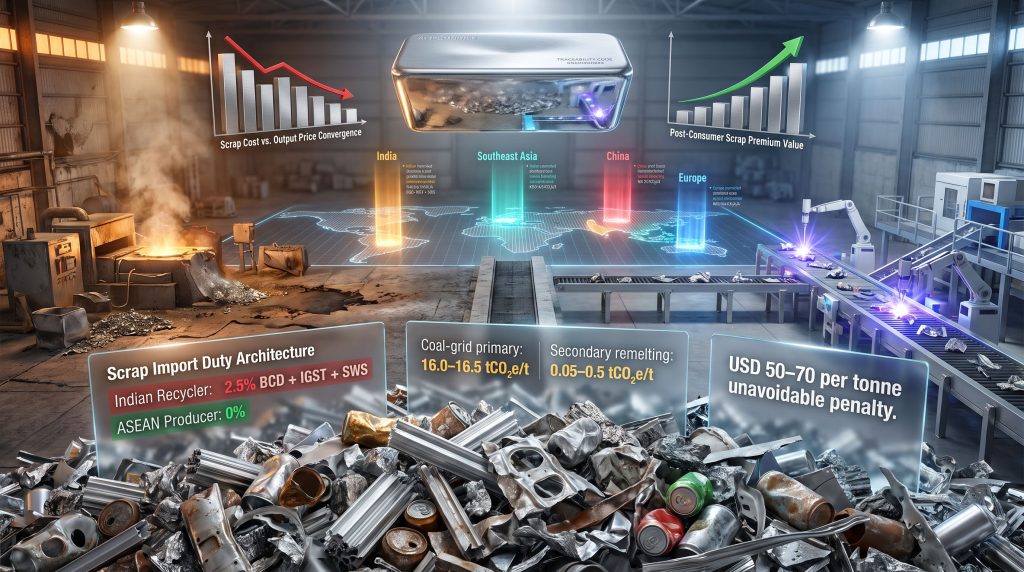
The traditional case for secondary aluminium was compelling in its simplicity. Remelting scrap consumes roughly 5% of the energy required for primary electrolytic smelting via the Hall-Héroult process, bypassing the immense carbon burden of bauxite mining and alumina refining entirely. Secondary production delivers an embedded carbon intensity of just 0.05 to 0.5 tCO₂e per tonne, compared to 16.0 to 16.5 tCO₂e per tonne for coal-grid primary smelting.
Yet this energy and carbon advantage is being systematically neutralised. High-quality aluminium scrap now trades at more than 90% of the primary London Metal Exchange (LME) ingot price, effectively compressing the cost buffer that once subsidised inefficient processing. As global aluminium consumption approaches the 100-million-tonne threshold, three compounding forces are simultaneously inflating input costs and suppressing achievable output prices:
- Metallurgical constraints that prevent impurity removal through conventional remelting
- Carbon regulation tightening that has closed pre-consumer scrap loopholes and imposed financial penalties on embedded emissions
- Geopolitical supply disruption that is fracturing open scrap trade flows across developing markets
Each force is damaging in isolation. In combination, they constitute a margin trap of unprecedented severity. Furthermore, top aluminium mining companies are responding by accelerating primary output in ways that further distort the scrap pricing dynamic.
A Regional Snapshot of Margin Pressure
| Region | Primary Margin Pressure Driver | Competitive Position |
|---|---|---|
| India | 2.5% BCD + 18% IGST + 10% SWS cost stack | Severely disadvantaged vs. ASEAN FTA competitors |
| Southeast Asia | Scrap price inflation against flat ADC12 OEM pricing | Production curtailments reported |
| China | Tax enforcement compressing scrap-to-refined spreads | Year-to-date spread at multi-year lows |
| Europe | CBAM enforcement + WSR scrap export restrictions | Structural scrap scarcity accelerating |
The margin trap is not isolated to any single geography. It is a globally synchronised profitability crisis driven by distinct but deeply interconnected regional mechanisms. For instance, Southeast Asia's secondary aluminium sector has already recorded significant ADC12 plant curtailments driven by raw material surges.
The Thermodynamic Ceiling: Why Impurities Cannot Be Removed in the Furnace
At the core of the secondary aluminium cost crisis lies a fundamental and immutable constraint from materials science. Standard remelting and fluxing are physically incapable of purifying liquid aluminium. Unlike steel or copper, aluminium's extreme chemical reactivity means tramp elements introduced through contaminated scrap remain permanently dissolved in the melt, regardless of processing temperature or flux chemistry.
When end-of-life vehicles or mixed consumer products are mechanically shredded, highly diverse alloy grades are conflated into a single heterogeneous feedstock. Iron is the most damaging contaminant in this matrix. When iron concentrations exceed just 0.2 wt%, it reacts during solidification to form brittle intermetallic phases, specifically Al₃Fe and the needle-like Al₅FeSi structures. These microscopic stress concentrators cause premature part fractures during stamping, elevated defect rates on manufacturing floors, and significant downstream warranty liabilities for end-users.
Because tramp elements cannot be removed through conventional processing, the industry has historically relied on two cost-intensive workarounds, both of which are now economically unviable:
Strategy 1: Downcycling to Cast Alloys
- Contaminated scrap is cascaded into Al-Si 300-series cast alloys with higher impurity tolerance
- The global automotive electrification transition is destroying this exit route, driving demand toward high-strength wrought alloys and away from cast engine block applications
- The commercial result is a structural dead end: shrinking markets absorbing growing contaminated volumes at declining margins
Strategy 2: Dilution (Sweetening) with Primary Aluminium
- High-purity virgin metal is blended into the scrap melt to suppress tramp element concentrations
- This introduces a dual cost penalty: premium-priced primary aluminium procurement costs combined with a massive carbon accounting liability under modern emissions frameworks
- CBAM enforcement in 2026 has transformed sweetening from a cost management strategy into a direct regulatory liability
The hidden cost stack facing secondary producers extends well beyond scrap procurement. It accumulates across metallurgical sweetening premiums, remelting energy, dross disposal liabilities, and carbon compliance costs. Each layer individually appears manageable; in combination, they constitute a structurally compressing margin environment.
How the CBAM Omnibus 2026 Shattered the Carbon Economics of Secondary Production
The European Union's Carbon Border Adjustment Mechanism entered definitive financial enforcement on January 1, 2026, fundamentally reshaping the cost curve for aluminium exporters worldwide. The mechanism's direct carbon pricing on imports was already well understood. What caught many operators off-guard was a highly consequential regulatory update embedded within EU Regulation 2025/2083, the so-called CBAM Omnibus revision.
Under the original 2023 CBAM framework, secondary producers could classify pre-consumer manufacturing scrap — including machining chips, factory offcuts, and dross from high-carbon primary smelters — as zero-emission inputs. This classification allowed them to present their exported secondary aluminium products with a near-zero carbon footprint, avoiding CBAM financial penalties entirely.
Article 7a of the CBAM Omnibus explicitly closed this pathway. Pre-consumer scrap must now legally carry the full embedded emission factor of the original primary production process from which it was generated. For secondary producers sourcing pre-consumer scrap from coal-powered primary smelters, the consequence is devastating: their exported products now inherit a coal-heavy upstream carbon footprint, triggering severe CBAM penalty exposure. Consequently, Europe's critical minerals supply chain is being restructured around CBAM-verified feedstock as a matter of competitive survival.
| Production Route | Embedded Carbon Intensity (tCO₂e per tonne) |
|---|---|
| Coal-grid primary smelting | 16.0 to 16.5 |
| Secondary aluminium (remelting) | 0.05 to 0.5 |
| Secondary using pre-consumer scrap (post-CBAM Omnibus) | Inherits full primary upstream footprint |
The strategic consequence is significant. Verified post-consumer scrap has become the only CBAM-clean feedstock available to export-oriented secondary producers. This recognition is driving post-consumer scrap prices into a self-reinforcing upward spiral, pushing valuations progressively closer to primary metal parity and intensifying the very margin trap CBAM was never explicitly designed to create.
Geopolitical Chokepoints and India's Inverted Duty Architecture
The urgent need for verified post-consumer scrap is colliding with a rapidly fracturing global supply landscape. The European Union's revised Waste Shipment Regulation (WSR) is moving toward a prohibition on non-hazardous recyclable aluminium scrap exports to non-OECD nations. Removing the EU as a major open-market supply node will intensify procurement competition and drive price spikes across import-dependent developing economies at precisely the moment demand for CBAM-clean feedstock is peaking.
No country sits more exposed to this geopolitical supply shock than India. As the world's largest aluminium scrap importer, India's secondary industry depends on imported feedstock for 80 to 85% of total scrap requirements. The country's historically low per capita aluminium consumption means its domestic end-of-life scrap reservoir remains structurally immature, leaving no credible short-term substitution pathway.
Despite this near-total import dependence, the government maintains a 2.5% Basic Customs Duty (BCD) on imported aluminium waste and scrap classified under HSN Code 7602. When sequentially stacked with 18% IGST and a 10% Social Welfare Surcharge, the landed cost of every imported tonne is substantially inflated before processing begins. At current premium scrap valuations, this compounded duty structure imposes an estimated USD 50 to USD 70 per tonne unavoidable penalty on working capital. The broader impact of US aluminium tariffs has further distorted global scrap trade flows, amplifying India's procurement disadvantage.
The competitive asymmetry this creates is stark:
| Competitor Profile | Scrap Import Duty | Market Access to India |
|---|---|---|
| Indian secondary recycler | 2.5% BCD + IGST + SWS | Domestic market only |
| ASEAN secondary producer | 0% | Duty-free FTA access to India |
| EU secondary producer | Internal market focus post-WSR | Limited |
The Material Recycling Association of India (MRAI) has actively advocated for the removal of the BCD on aluminium scrap imports, noting that the current structure forces Indian recyclers to compete on unequal terms in their own domestic market. ASEAN manufacturers face zero duty on raw material procurement, manufacture finished secondary alloys at lower cost, and export those products into India under preferential Free Trade Agreement terms. It represents one of the most acute competitive disadvantages in global aluminium recycling today.
The Black Dross Liability: Regulatory Crackdowns and Hazardous Waste Costs
Compounding the procurement and compliance pressures is a physical byproduct challenge that has historically been underpriced and inadequately managed. Secondary aluminium processing generates between 200 and 600 kg of black dross per tonne of aluminium metal produced, a volume that scales directly with output levels.
Black dross is not a benign industrial residue. Its composition includes:
- Aluminium oxide (Al₂O₃) as the primary constituent
- Soluble chloride salts at high concentrations
- Aluminium nitride (AlN) and aluminium carbide (Al₄C₃) as reactive hazardous impurities
When exposed to ambient humidity, AlN and Al₄C₃ undergo rapid hydrolysis, releasing ammonia (NH₃) and methane (CH₄) — a toxic and explosive gas combination that legally classifies black dross as a hazardous waste stream requiring controlled disposal.
The era of informal, low-cost dross disposal is ending abruptly. The West Bengal Pollution Control Board (WBPCB) recently executed a wave of closure orders across Howrah and Hooghly districts targeting informal dross processors operating without adequate Air Pollution Control Devices. Facilities using rudimentary coal-fired Tapai Bhatti furnaces with non-functional suction hoods faced immediate electricity disconnection. This enforcement action signals a broader national and global trend toward zero-tolerance hazardous waste compliance across the secondary aluminium sector.
The financial consequence of full compliance is material. Informal dross disposal costs were historically externalised, artificially inflating apparent operating margins. The transition to regulated management reveals a previously hidden liability that, when properly accounted for, compounds the existing secondary aluminium margin trap significantly.
The next major ASX story will hit our subscribers first
Hydrometallurgy and AI Sorting: The Technology Escape Routes
The compounding pressures of thermodynamic limits, CBAM penalties, geopolitical scrap scarcity, and dross liabilities converge on a single strategic imperative: the margin trap cannot be resolved through conventional processing. It requires technological transformation at both the feedstock and byproduct ends of the production cycle.
Converting Dross from Liability to Revenue Through Hydrometallurgy
Hydrometallurgical processing offers the most viable pathway for dross valorisation. The cold-processing wet technique applies aqueous leaching to dissolve the hazardous chloride salts from black dross without requiring high-temperature reprocessing. Advanced bench-scale research has demonstrated salt recovery rates exceeding 97% through evaporation and crystallisation of the leachate, with recovered high-purity salts suitable for direct recycling back into smelting furnaces.
The water-insoluble oxide residue generated by this process can achieve alumina purity levels exceeding 98%, making it suitable for synthesising high-performance refractory products including magnesium-aluminium spinel (MgAl₂O₄). The economic transformation is significant: a regulated hazardous waste disposal cost is converted into a premium secondary mineral revenue stream, directly improving net margins.
Precision Sorting: Defeating Contamination Before the Furnace
On the feedstock side, the only viable strategy for breaking the thermodynamic ceiling is to achieve alloy-specific separation before scrap enters the melting furnace. This has driven rapid adoption of multi-stage AI-driven sorting technology. The economic benefits of decarbonising mining operations through such circular approaches are increasingly well-documented across the broader metals sector.
The foundational layer is X-Ray Transmission (XRT) sorting, which achieves binary separation of light metals from heavy tramp contaminants including copper, brass, and free iron. XRT sorting technology is effective for bulk separation but insufficient alone for alloy-specific grade recovery.
The transformative layer is Laser-Induced Breakdown Spectroscopy (LIBS) combined with AI analysis. As scrap fragments move along a conveyor at industrial speeds, a high-energy laser pulse ablates a microscopic layer of metal, generating a localised microplasma. A high-resolution spectrometer captures the optical emission signature in milliseconds, allowing AI algorithms to quantify exact elemental concentrations of silicon, magnesium, copper, zinc, manganese, and iron in real time.
The operational case for this technology is illustrated by the experience of Italian recycler Raffineria Metalli Cusiana S.p.A., which installed a fully automated multi-stage sorting system with annual throughput capacity of 100,000 tonnes. By achieving near-virgin elemental purity from 100% post-consumer scrap inputs, Cusiana introduced branded recycled ingots engineered specifically to qualify for CBAM-favourable carbon accounting under European export frameworks. More innovatively, LIBS-sorted scrap achieved sufficient elemental precision that specific streams could be sold directly to downstream manufacturers as premium, furnace-ready, alloy-specific feedstock, completely eliminating the energy, time, and capital costs of ingot casting for those volumes.
| Technology | Primary Benefit | CBAM Impact | Dross Benefit | Capex Intensity |
|---|---|---|---|---|
| XRT Sorting | Tramp metal removal | Indirect | None | Moderate |
| LIBS + AI Sorting | Alloy-specific separation | High (feedstock carbon verification) | None | High |
| Hydrometallurgy | Dross valorisation | Indirect (waste cost elimination) | Direct | High |
| Multi-sensor integration | Full margin recovery | Maximum | Partial | Very High |
Two Futures for Secondary Aluminium Operators
The divergence between operators who adapt and those who do not is sharpening rapidly. Two distinct trajectories are emerging:
Scenario A: The Commodity Trap
Operators continuing to rely on bulk mixed-scrap purchasing without alloy-grade verification, using primary aluminium sweetening to manage contamination, and disposing of dross through informal or low-compliance channels will face progressive margin erosion. CBAM penalties, scrap cost inflation, and regulatory compliance enforcement will structurally price these operations out of export markets and eventually domestic competition from better-capitalised ASEAN rivals. The aluminium extrusion profitability crisis unfolding in parallel further illustrates how deeply the secondary aluminium margin trap has penetrated the broader value chain.
Scenario B: The Precision Recycling Premium
Operators who invest in LIBS-AI sorting infrastructure, hydrometallurgical dross processing, and supply chain carbon traceability systems capable of producing CBAM-verified, post-consumer scrap-based output will access premium pricing power, European export market participation, and disproportionate margin expansion as decarbonisation-driven demand for verified low-carbon metal accelerates globally.
The secondary aluminium margin trap is not a cyclical pricing problem that will self-correct as commodity markets rebalance. It is a structural transformation requiring a permanent shift from volume-driven commodity processing to precision metallurgical engineering. Operators who build the technical and compliance infrastructure to deliver verified, low-carbon, alloy-specific output will capture the margins others surrender.
Disclaimer: This article contains forward-looking analysis, scenario projections, and cost estimates based on publicly available industry data and reported market conditions as of mid-2026. Figures including duty rates, cost penalties, and carbon intensity benchmarks are subject to regulatory and market changes. This content does not constitute financial or investment advice.
Want to Profit From the Next Major ASX Mineral Discovery Before the Market Catches On?
While structural shifts in secondary aluminium reshape global metals value chains, the real wealth-creation opportunities in commodities have historically emerged from significant new mineral discoveries — and Discovery Alert's proprietary Discovery IQ model delivers real-time ASX alerts the moment those discoveries are announced. Explore historic examples of exceptional discovery returns and begin your 14-day free trial at Discovery Alert to position yourself ahead of the broader market.