July 23, 2026
The Hidden Signal in Warehouse Numbers: How Inventory Mechanics Drive LME Aluminium Pricing
Commodity markets have a habit of burying their most important signals in data that most participants overlook. For aluminium, one of the most reliable leading indicators of near-term price direction is not found in central bank minutes or manufacturing surveys. It sits quietly inside daily warehouse stock reports published by the London Metal Exchange. When those numbers decline consistently, the LME aluminium cash offer price rises as opening stocks decline, often before broader sentiment catches up.
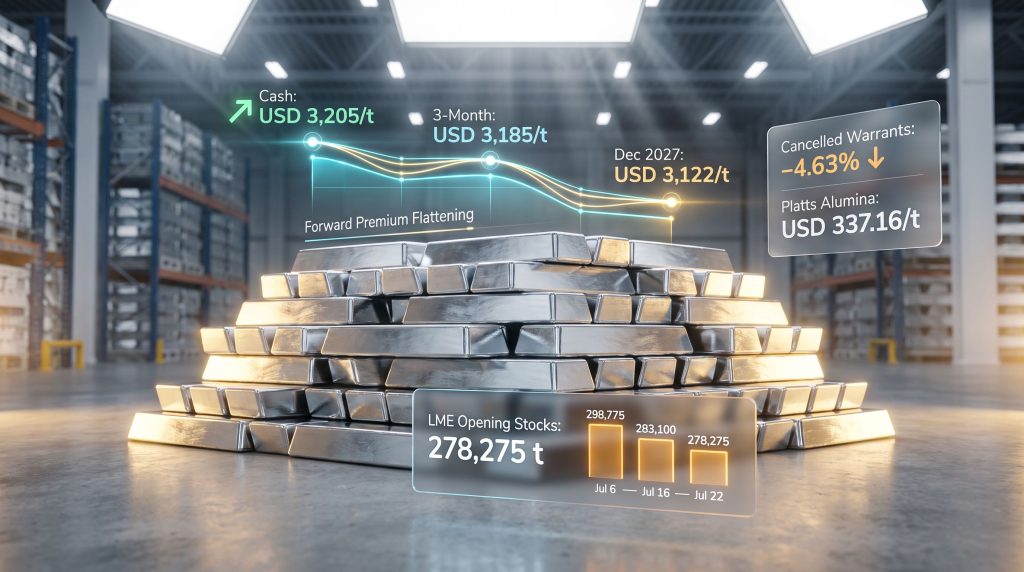
July 2026 has provided a textbook illustration of this dynamic. Over roughly three weeks, LME-registered aluminium stocks fell from approximately 298,775 tonnes in early July to 278,275 tonnes by July 22, a cumulative decline of around 6.8%. Over the same period, the cash offer price climbed from USD 3,105 per tonne to USD 3,205 per tonne. The directionality is not coincidental.
When big ASX news breaks, our subscribers know first
The Inventory-to-Price Transmission Mechanism Explained
Understanding why warehouse stocks influence prices requires a brief detour into how the LME physically operates. Unlike equity exchanges, the LME deals in physical commodities. Metal registered in its certified warehouse network acts as the exchange's ultimate buffer between paper trading and real-world delivery obligations.
When a party holds a live warrant, that document represents a specific parcel of aluminium sitting in a certified facility, available for exchange settlement. When that warrant is cancelled, the metal has been earmarked for physical collection and removed from the tradeable pool. Once the withdrawal is complete, total opening stocks fall.
The critical insight here is one that procurement professionals and commodity traders often underestimate: the exchange-registered stock pool is not the same as global aluminium inventory. It represents only the fraction of global supply that producers, traders, and financial institutions have chosen to deposit into LME-certified facilities. That fraction can be significantly smaller than production data alone would suggest, making it disproportionately sensitive to even modest withdrawal activity. Furthermore, top aluminium mining companies actively monitor these dynamics when making production and supply decisions.
When LME stocks tighten, the market for prompt delivery becomes more competitive. Buyers willing to pay above the prevailing bid pull the cash offer price upward, a process that accelerates when multiple buyers face the same limited pool simultaneously.
July 22 Snapshot: Key Price Levels Across the Curve
On July 22, 2026, the LME aluminium cash offer price reached USD 3,205 per tonne, a gain of 0.68% from the prior session's USD 3,183.5 per tonne. This was the strongest percentage gain recorded across the entire forward curve on that date, a detail that carries significant analytical weight. For broader context on how LME aluminium prices have behaved across recent sessions, the easing trend that preceded this period makes July's recovery all the more notable.
Table: LME Aluminium Price Summary — July 21 vs. July 22, 2026
| Contract | July 21 Bid (USD/t) | July 22 Bid (USD/t) | Change | July 21 Offer (USD/t) | July 22 Offer (USD/t) | Change |
|---|---|---|---|---|---|---|
| Cash | 3,183 | 3,204 | +0.66% | 3,183.5 | 3,205 | +0.68% |
| 3-Month | 3,170 | 3,183 | +0.41% | 3,170.5 | 3,185 | +0.46% |
| Dec 2027 | 3,105 | 3,117 | +0.39% | 3,110 | 3,122 | +0.39% |
| Asian Ref (3M) | — | 3,192.5 | — | — | — | — |
Several things stand out from this data:
- The cash contract outperformed every other tenor, gaining the most in both absolute and percentage terms, a hallmark of genuine prompt tightness rather than speculative long positioning at the back end of the curve
- The spread between cash and December 2027 offers narrowed to approximately USD 83 per tonne, suggesting the market is pricing short-term scarcity rather than anticipating structural long-run undersupply
- The Asian Reference Price of USD 3,192.5 per tonne sat above the three-month offer price of USD 3,185, reflecting firm demand absorption across Asia-Pacific markets during regional trading hours
What the Inventory Breakdown Reveals About Physical Market Conditions
The headline stock decline of 0.54% on July 22 conceals a more nuanced picture when the breakdown is examined carefully.
Table: LME Aluminium Inventory Breakdown — July 21 vs. July 22, 2026
| Inventory Metric | July 21 | July 22 | Change |
|---|---|---|---|
| Opening Stocks (tonnes) | 279,775 | 278,275 | -0.54% |
| Live Warrants (tonnes) | 245,900 | 245,900 | Unchanged |
| Cancelled Warrants (tonnes) | 32,375 | 30,875 | -4.63% |
The 4.63% decline in cancelled warrants is the most instructive figure in this table. A falling cancelled warrant count, when combined with declining opening stocks, indicates that metal previously flagged for physical removal has now cleared the system. In practical terms, those withdrawals are done. The metal has left the building.
What this means for near-term pricing dynamics is subtle but important: the current reduction in cancelled warrants does not signal fresh buying interest or new withdrawal pressure. It signals that prior demand has been satisfied. However, live warrants held unchanged at 245,900 tonnes, meaning the remaining tradeable pool has not been replenished by new deposits. The float has not recovered.
A market where cancelled warrants are falling and live warrants are not growing is one where the available physical buffer is contracting at both ends. New withdrawals are completing without replacement stock arriving to offset them.
Tracking the July 2026 Pattern: Three Sessions, One Consistent Story
Table: Intra-Month LME Aluminium Price and Stock Correlation — July 2026
| Session Date | Cash Offer (USD/t) | Opening Stocks (tonnes) | Price Direction | Stock Direction |
|---|---|---|---|---|
| July 6 | 3,105 | 298,775 | ↑ | ↓ |
| July 16 | Recovery noted | 283,100 | ↑ | ↓ |
| July 22 | 3,205 | 278,275 | ↑ | ↓ |
Across these three observable sessions, the directional relationship between inventory drawdown and rising cash prices has been consistent. The LME aluminium cash offer price rises as opening stocks decline pattern has played out with notable regularity throughout July 2026, reinforcing the hypothesis that prompt supply tightness is the dominant pricing mechanism operating in the current market environment.
That said, correlation should not be mistaken for an iron rule. Several external variables can override inventory signals entirely:
- US dollar strength tends to suppress dollar-denominated commodity prices regardless of physical fundamentals, as it raises the effective cost for non-dollar buyers
- Risk-off episodes driven by macroeconomic data releases, credit events, or geopolitical escalation can simultaneously drag the entire base metals complex lower
- Chinese smelter policy shifts represent perhaps the largest non-inventory variable in global aluminium pricing. China produces more than half the world's primary aluminium, and any change in energy rationing, environmental compliance windows, or export tax policy can rapidly reset supply expectations
- Guinea bauxite disruptions periodically reintroduce upstream cost volatility, as Guinea now supplies a substantial portion of global bauxite to non-Chinese refineries
- Demand deterioration in key consuming sectors, including automotive manufacturing, construction, and packaging, can neutralise bullish inventory signals by reducing offtake at the smelter level before metal ever reaches the exchange
In addition, the broader policy landscape matters considerably. For instance, US aluminium tariffs in 2025 demonstrated how trade interventions can abruptly alter the calculus for exchange-registered supply and prompt pricing.
Alumina Pricing and the Cost Floor Beneath the LME Number
The LME Platts alumina benchmark price of USD 337.16 per tonne on July 22 provides an important upstream reference point for assessing smelter economics.
Alumina is the intermediate product sitting between bauxite mining and primary aluminium smelting. It typically represents between 15% and 18% of primary aluminium production costs under normal energy conditions, though this share can shift materially when electricity prices spike, as smelting is extraordinarily energy-intensive.
A lesser-known dynamic within the value chain is how alumina contract structures interact with LME price movements. A significant portion of global alumina is traded under long-term supply agreements priced as a percentage of the LME aluminium price, historically around 12% to 14% of the prevailing three-month LME rate. When LME prices rise, these formula-linked contracts automatically push alumina costs higher for smelters without any change in physical alumina supply conditions.
This creates a self-reinforcing cost escalation loop during aluminium bull runs that can constrain margin expansion at the smelting stage even as headline LME prices climb. Consequently, major producers have been actively restructuring their upstream exposure. The Alcoa and IGNiS EQT joint venture is one such example of how integrated producers are repositioning to manage this cost complexity more effectively.
At USD 337.16 per tonne, the current alumina price is broadly consistent with a margin-positive environment for low-cost smelters, particularly those with access to captive or competitively priced power. However, for higher-cost producers operating in regions with elevated electricity tariffs, the current alumina price combined with rising LME cash levels requires careful monitoring of the aluminium-to-alumina price ratio as an ongoing profitability indicator.
The next major ASX story will hit our subscribers first
The Cash-to-Three-Month Spread as a Diagnostic Tool
One of the most underutilised analytical instruments available to both traders and industrial buyers is the cash-to-three-month price spread, sometimes referred to as the tom-next or prompt spread depending on the settlement terms being examined.
When the cash price trades at a premium to the three-month price, the market is said to be in backwardation. This structure signals that prompt metal is scarcer and more valuable than deferred supply. When the three-month price exceeds the cash price, the market is in contango, reflecting comfortable near-term availability and the cost-of-carry embedded in holding metal forward.
On July 22, the cash offer of USD 3,205 per tonne sat above the three-month offer of USD 3,185 per tonne, placing the nearby spread in a mild backwardation of approximately USD 20 per tonne. This is not a deep backwardation by historical standards, but its direction is meaningful: it confirms that the market is not currently rewarding deferred delivery, which is consistent with the ongoing stock drawdown narrative.
A mild backwardation in a market where warehouse stocks are at multi-week lows and cancelled warrants are clearing is not automatically a buy signal. It is, however, a structural warning for procurement teams with unhedged spot exposure that the cost of delay may be rising.
Furthermore, initiatives such as Rio Tinto repowering Gladstone aluminium operations signal that major producers are making strategic investments that could influence future supply dynamics and, by extension, the spread structure over the medium term.
Procurement Strategy Considerations for Industrial Buyers
For manufacturers and fabricators with ongoing aluminium requirements, the current market configuration raises several practical considerations:
- Spot buyers facing the USD 3,205 per tonne cash offer are encountering the highest prompt cost level observed in July 2026, with further upside possible if the stock drawdown continues
- Three-month forward contracts at USD 3,185 per tonne offer a modest but meaningful USD 20 per tonne discount to spot, providing a near-term hedging option without locking in long-dated exposure
- December 2027 contracts at USD 3,122 per tonne represent an approximate USD 83 per tonne discount to the current cash offer, a relevant consideration for capital-intensive projects or construction programs with extended procurement horizons
- Weekly tracking of cancelled warrants provides an early-warning indicator of upcoming stock changes before they register in opening stock figures, giving hedging teams a half-session head start on directional positioning
- Asian Reference Price monitoring is particularly relevant for buyers sourcing material across Asia-Pacific supply chains, where physical premiums and contract structures may diverge from LME floor pricing
FAQ: LME Aluminium Prices and Exchange Inventory Mechanics
What is the LME aluminium cash offer price?
The cash offer price is the lowest price at which a seller is willing to deliver aluminium for immediate spot settlement on the London Metal Exchange. It reflects the most current market valuation for prompt physical delivery and is the benchmark most sensitive to short-term supply conditions.
Why do declining LME stocks push aluminium prices higher?
When registered aluminium volumes in LME warehouses contract, the pool of immediately accessible metal shrinks. Buyers competing for a smaller available float drive the cash offer price upward as competitive tension increases around prompt delivery. Detailed aluminium price recovery analysis confirms this relationship has been consistent across multiple market cycles.
What are cancelled warrants on the LME?
Cancelled warrants are documents representing aluminium tonnes formally earmarked for physical withdrawal from an LME-certified facility. A high cancelled warrant level signals impending stock reductions. A declining cancelled warrant count, as seen on July 22, indicates those withdrawals have been completed.
What is the LME Asian Reference Price?
This is a daily pricing benchmark derived from LME three-month aluminium prices during Asian trading hours. It is widely embedded in physical supply contracts across the Asia-Pacific region and often diverges from LME floor pricing due to regional demand conditions and timing differentials.
How does the alumina price relate to LME aluminium prices?
Alumina is the primary feedstock for primary aluminium production. Its cost influences the smelter production cost floor. When alumina prices rise without a proportional increase in LME aluminium prices, smelter margins compress, potentially triggering output curtailments that reduce future exchange-registered supply. The Alcoa downgrade and its impact on alumina markets illustrated precisely this dynamic in 2025.
What is the difference between live warrants and opening stocks?
Opening stocks represent the total registered aluminium within the LME system. Live warrants are the tradeable subset of that total, excluding metal already earmarked for withdrawal via cancellation. The live warrant figure is therefore a more precise measure of what is genuinely available to the market at any given session. For further reading, LME aluminium inventory and cash offer data from earlier in July 2026 provides useful context for how these metrics have tracked through the month.
Key Takeaways: LME Aluminium Market Signals for July 22, 2026
- The cash offer price reached USD 3,205 per tonne, recording the strongest gain across the forward curve at +0.68%
- Opening stocks fell to 278,275 tonnes, extending a multi-week drawdown that has progressively removed approximately 20,500 tonnes from the LME-registered pool since early July
- Cancelled warrants declined 4.63% to 30,875 tonnes, indicating previously flagged withdrawal activity has largely completed without replacement inflows
- The three-month Asian Reference Price of USD 3,192.5 per tonne reflects firm regional demand conditions in Asia-Pacific markets
- LME Platts alumina at USD 337.16 per tonne provides a stable upstream cost reference, though formula-linked alumina contracts mean smelter input costs may respond automatically to further LME price rises
- The consistent July 2026 pattern, with the LME aluminium cash offer price rising from USD 3,105 per tonne on July 6 to USD 3,205 per tonne on July 22 against a backdrop of stocks declining from roughly 298,775 to 278,275 tonnes, reinforces prompt supply tightness as the dominant near-term pricing mechanism
- A mild cash backwardation of approximately USD 20 per tonne relative to the three-month contract confirms the market is currently rewarding prompt delivery over deferred supply
Disclaimer: This article is intended for informational purposes only and does not constitute financial, investment, or procurement advice. Commodity prices are subject to rapid change driven by macroeconomic, geopolitical, and sector-specific factors. All figures referenced reflect data reported for July 22, 2026. Readers should conduct independent due diligence before making any trading or hedging decisions.
Want to Spot the Next Major Commodity Discovery Before the Market Does?
While LME inventory mechanics drive near-term aluminium pricing, the most transformative returns in the resources sector often emerge from significant new mineral discoveries — and Discovery Alert's proprietary Discovery IQ model instantly alerts subscribers to exactly these moments on the ASX, turning complex data across 30+ commodities into clear, actionable opportunities. Explore Discovery Alert's dedicated discoveries page to see the historic returns major mineral discoveries have delivered, and begin your 14-day free trial today to position yourself ahead of the broader market.