July 23, 2026
The Geopolitical Risk Premium: How Military Conflict Reprices Global Oil Markets
Few mechanisms in global finance operate with the speed and sensitivity of crude oil futures markets when military conflict intersects with critical maritime infrastructure. Unlike equity markets, which can absorb geopolitical shocks through diversification and sector rotation, oil markets face a structurally unique problem: the physical commodity underpinning global economic activity moves through a handful of irreplaceable geographic chokepoints. When those chokepoints are threatened, price discovery shifts from fundamental supply-demand analysis to conflict scenario modelling almost instantaneously.
This dynamic explains why oil prices rise on US-Iran tensions with a consistency that has held across decades of escalation cycles. Furthermore, the current confrontation, now extending into a sustained multi-week military campaign, is generating oil price movements that are overriding even bearish inventory data from the United States.
Understanding the Fear Premium Built Into Crude Oil Prices
The concept of a geopolitical risk premium in oil pricing is not speculative — it is a documented, quantifiable market behaviour. When credible military threats emerge near strategic shipping lanes, futures traders embed a forward-looking premium into contracts to compensate for the probability of supply interruption, even before a single barrel of oil is physically blocked.
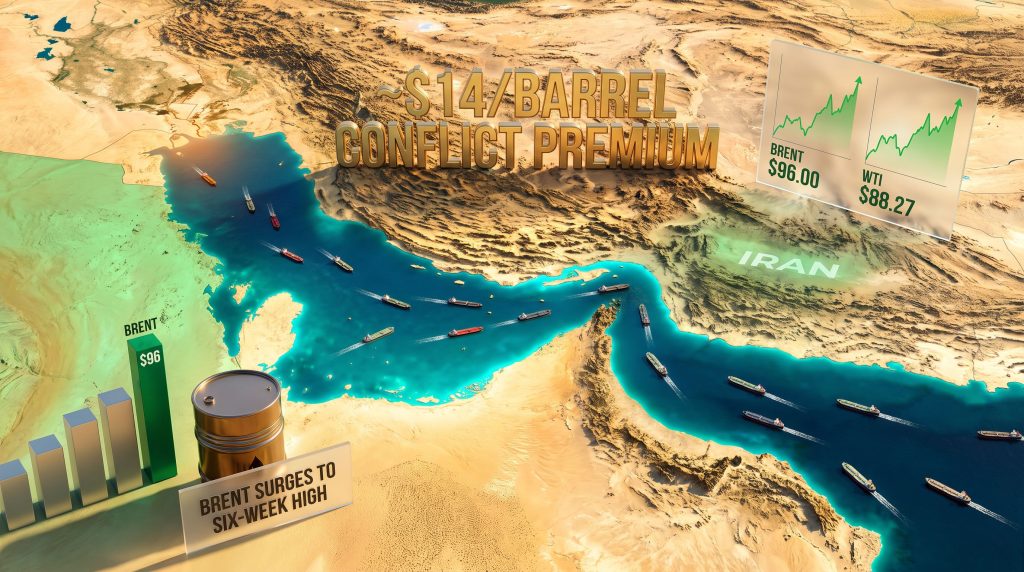
Goldman Sachs has estimated that the conflict-related premium built into crude futures during the current US-Iran escalation cycle reached approximately $14 per barrel. This figure represents pure fear pricing — the market's collective actuarial assessment of disruption probability multiplied by the magnitude of potential supply loss. It does not reflect any confirmed physical reduction in output or tanker flow. It reflects anticipated risk alone.
This distinction matters profoundly for investors and analysts. A $14 fear premium is inherently unstable — it can compress rapidly if escalation de-escalates, or it can expand further if military operations intensify. Understanding that oil prices are currently being driven by probability-weighted scenario modelling, rather than actual supply shortfalls, is essential context for any market participant.
How Traders and Institutions Price Conflict Risk Before Physical Disruptions Occur
Professional energy traders use a layered risk assessment framework when geopolitical events threaten oil infrastructure. The key variables include:
- Chokepoint criticality: How much global supply transits the threatened route?
- Actor capability: Does the threatening party have the technical means to execute a meaningful disruption?
- Historical precedent: How have similar threats resolved in prior escalation cycles?
- Diplomatic circuit breakers: Are negotiations or third-party mediators creating off-ramps?
- OPEC+ spare capacity: Can major producers compensate for any disrupted supply within an acceptable timeframe?
When all five variables align toward elevated risk, as they currently do in the US-Iran context, the resulting price premium can persist for weeks or months, even absent confirmed physical supply disruption. For a broader geopolitical oil price analysis, these structural drivers have been building throughout 2025.
When big ASX news breaks, our subscribers know first
What Is Driving the Current Oil Price Rise? US-Iran Tensions Explained
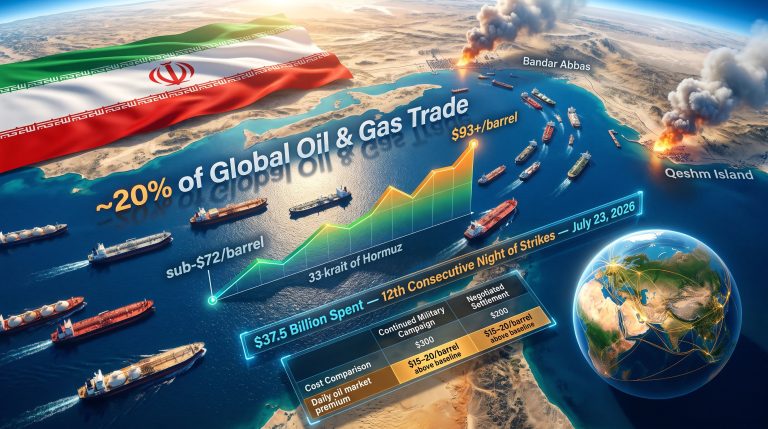
The current escalation represents a qualitative shift from diplomatic confrontation to sustained military exchange. The US military confirmed it conducted a 12th consecutive night of strikes against Iran, marking one of the most prolonged American military campaigns against Iranian targets in recent history. This operational tempo, combined with explicit threats from US President Donald Trump to destroy Iranian infrastructure in retaliation for any attacks on shipping, has materially altered the market's base-case assumptions about conflict duration and intensity.
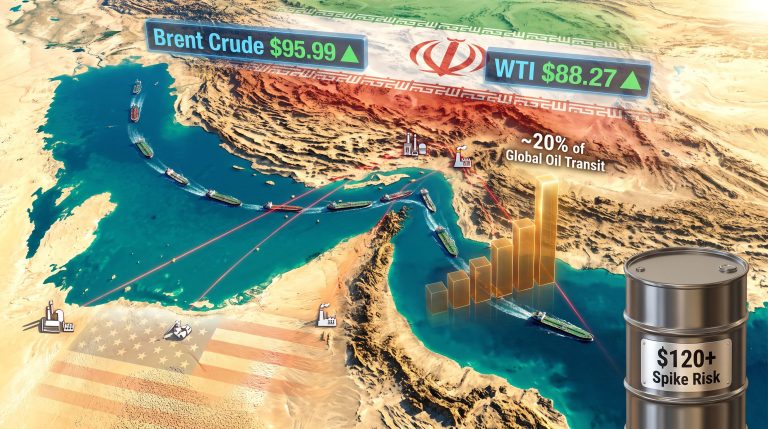
The price response has been immediate and significant. Brent crude futures climbed $1.93, or approximately 2%, to $96 per barrel, reaching their highest point since June 8. This followed a prior session in which Brent had already settled over $3 higher at $94.07, representing back-to-back sessions of substantial gains. West Texas Intermediate crude rose $1.44, or approximately 1.7%, to $88.27, after surging nearly 3% the preceding day.
Key Market Data Summary
| Event | Price Level | Move |
|---|---|---|
| Brent crude intraday high (current cycle) | $96.00 | +2% single session |
| Brent prior session settlement | $94.07 | +$3 (six-week high) |
| WTI crude (current session) | $88.27 | +1.7% |
| WTI prior session surge | Approx. +3% overnight | Elevated conflict pricing |
| Goldman Sachs estimated conflict premium | ~$14/barrel | Built into futures |
| Reuters poll analyst forecast (US stocks) | -1.1 million barrels draw | Expectation |
| EIA actual US crude stock change | +2 million barrels build | Bearish data overridden |
Iran's Revolutionary Guards and the Strait of Hormuz Declaration
The single most alarming development for global energy markets came from Iran's Revolutionary Guards, who announced that the Strait of Hormuz was under their control and effectively closed to tanker traffic while US military operations continued in the region. The Guards also confirmed that an oil tanker had caught fire following an explosion while attempting to pass through a southern Hormuz route they described as mined, with two additional tankers reportedly turning back.
The Revolutionary Guards' spokesperson posted on social media platform X explicitly warning shipping companies that the southern Hormuz route contains mines — a statement with direct operational consequences for the global tanker industry. Insurance underwriters, tanker operators, and commodity trading houses all receive and act upon such declarations within hours.
The Strait of Hormuz: Why This 33-Kilometre Waterway Controls Global Energy Prices
The Strait of Hormuz is a narrow maritime passage between Iran and Oman, connecting the Persian Gulf to the Gulf of Oman and, ultimately, the broader global oil market. At its narrowest point, the navigable shipping lane measures approximately 33 kilometres wide, yet this sliver of water carries an estimated 20 to 21% of global oil consumption in daily tanker flows, according to the US Energy Information Administration.
The strait's strategic importance cannot be overstated. It is the sole maritime exit route for crude oil exports from Saudi Arabia, Iraq, Kuwait, the UAE, Bahrain, and Qatar. There is no pipeline infrastructure capable of replacing even a fraction of Hormuz tanker capacity in the near term, although Saudi Arabia's East-West Pipeline provides limited alternative routing capacity for Saudi crude specifically.
Historical Precedents: When Hormuz Threats Have Pushed Brent Above $100
The current escalation is not the first time Iran has weaponised Hormuz as a pressure point. A review of prior cycles reveals a consistent pattern of sharp price spikes followed by partial retreats once markets determined that physical closure had not materialised:
- 2011-2012: Iranian threats to close Hormuz amid nuclear sanctions drove Brent above $120 per barrel before diplomatic progress eased the premium.
- 2019: Tanker attacks in the Gulf of Oman attributed to Iran triggered immediate single-session price spikes of 3-4%, though prices retreated within weeks as US naval presence increased.
- 2020: The assassination of Iranian General Qasem Soleimani produced an overnight Brent spike above $70, reversing within 48 hours as markets concluded Iranian retaliation would remain calibrated.
The critical lesson from these precedents is that the transition from threatened closure to actual closure has never fully materialised. However, the threat alone has consistently produced measurable and tradeable price premiums. The current scenario is the most operationally advanced Iran has ever been in executing on that threat, with confirmed tanker incidents and official mining declarations marking a significant escalation beyond prior cycles.
The Red Sea Dimension: Houthi Naval Operations and the Bab el-Mandeb Threat
Compounding the Hormuz risk is the simultaneous activation of a second strategic chokepoint. Yemen's Houthi movement, aligned with Iran, has declared a naval blockade of Saudi Arabia and shifted its targeting campaign toward Saudi oil tankers transiting the Red Sea and the Bab el-Mandeb Strait. The Houthis confirmed military operations against two Saudi oil tankers, and maritime security sources indicated that the Saudi-flagged tanker Encelia sustained a hit in the Red Sea.
The Houthis also claimed to have forced approximately 10 vessels to retreat after issuing warnings against sailing toward Saudi ports, though independent verification of this specific claim was not immediately available at time of reporting.
Bab el-Mandeb: A Second Chokepoint Under Threat
The Bab el-Mandeb Strait, located between Yemen and Djibouti at the southern entrance to the Red Sea, carries an estimated 6 to 8% of global seaborne trade, including significant volumes of crude oil bound for European markets via the Suez Canal. Disruption here forces tankers onto the longer Cape of Good Hope routing, adding weeks to voyage times and materially increasing shipping costs and insurance premiums.
Scenario Modelling: Dual Chokepoint Disruption Impact
| Scenario | Affected Volume | Estimated Price Pressure |
|---|---|---|
| Hormuz partially restricted | ~10-15% of global supply at risk | +$10-$20/barrel premium |
| Bab el-Mandeb disrupted independently | ~6-8% of global seaborne trade | +$5-$12/barrel premium |
| Both chokepoints simultaneously threatened | Compounding supply anxiety | Potential Brent breach of $100+ |
| Full physical blockade (extreme tail risk) | Global supply shock | Structural price dislocation above $120 |
The dual-chokepoint scenario is what makes the current situation structurally different from prior escalation cycles. For the first time, both Hormuz and Bab el-Mandeb face credible, active, and coordinated pressure simultaneously. The compounding effect on shipping risk premiums, cargo insurance costs, and voyage routing is already being absorbed into delivered oil prices across Asian and European import markets.
How US Crude Inventories Are Complicating the Price Picture
Against this geopolitical backdrop, the EIA's weekly inventory report delivered what would typically be a price-suppressing result. US crude stocks rose by 2 million barrels during the prior week, driven by reduced refinery run rates, a decline in crude exports, and a concurrent rise in imports. Analysts surveyed by Reuters had collectively forecast a 1.1 million-barrel draw, making the actual result a significant miss in the bearish direction.
Under normal market conditions, a 2 million-barrel inventory build against expectations of a 1.1 million-barrel draw would place meaningful downward pressure on crude benchmarks. The fact that Brent surged past $96 regardless illustrates the degree to which geopolitical risk signals are currently overriding fundamental supply-demand data entirely.
This divergence between physical market fundamentals and price behaviour is itself an important signal. It tells market participants that the geopolitical risk premium is not just additive to supply-demand pricing — it is currently dominant. When fear overwhelms fundamentals to this degree, the subsequent price correction, if and when diplomatic de-escalation occurs, can be equally sharp in the opposite direction.
What Oil Price Spikes During US-Iran Tensions Mean for Global Economies
Sustained elevated crude prices transmit through the global economy through several interconnected channels, and the impact is deeply asymmetric between nations. In addition, understanding OPEC's market influence during such periods is essential to gauging how effectively production adjustments can cushion these shocks.
Import-Dependent Nations: Who Faces the Greatest Exposure?
The nations most exposed to a sustained Brent price above $95-$100 include:
- India: The world's third-largest oil importer sources approximately 85% of its crude requirements from overseas, with Middle Eastern suppliers dominant. A $10 per barrel sustained increase adds roughly $12-15 billion to India's annual import bill, widening the current account deficit and pressuring the rupee.
- Japan and South Korea: Both are almost entirely import-dependent for crude and are geographically positioned to absorb the full impact of Hormuz disruptions, as a substantial portion of their supply transits the strait.
- Southeast Asian economies: Nations including the Philippines, Thailand, and Vietnam are energy importers with limited foreign currency buffers, making them acutely vulnerable to sustained oil price inflation.
- Sub-Saharan African economies: Many run structural current account deficits that are directly sensitive to global energy prices, with limited capacity to deploy strategic reserves as a buffer.
The Asymmetric Impact: Emerging Markets vs. Developed Economies
Developed economies with diversified energy mixes, strategic petroleum reserves, and deeper financial markets have greater capacity to absorb temporary price shocks. The United States, for example, has become a net energy exporter and benefits in revenue terms from elevated crude prices even as consumers face higher fuel costs. Emerging market economies, by contrast, face a structurally more painful adjustment — currency depreciation, imported inflation, and fiscal pressure on energy subsidy programmes.
The next major ASX story will hit our subscribers first
Scenario Analysis: Three Trajectories for Oil Prices Under Continued US-Iran Conflict
Scenario 1: Controlled Escalation (Base Case)
Military strikes continue at their current tempo, but Hormuz remains operationally open for most tanker traffic. Iran applies selective pressure through mining warnings and incident creation without executing a full closure. Brent stabilises in the $90-$98 per barrel range, sustained by the conflict premium without a physical supply shock materialising. This scenario assumes US naval assets successfully deter a full Hormuz shutdown.
Scenario 2: Partial Hormuz Restriction (Elevated Case)
Iran enforces partial tanker controls through coordination requirements and intermittent interference with transit. Effective tanker throughput falls by 10-15%. Brent pushes toward $105-$115 as supply anxiety intensifies. OPEC+ emergency response capability becomes a critical market variable. Saudi Arabia's willingness and ability to accelerate production becomes the key offset mechanism.
Scenario 3: Full Maritime Closure (Tail Risk)
A coordinated disruption scenario in which both Hormuz and Bab el-Mandeb face simultaneous physical interference. Global supply shock conditions emerge. Brent could breach $120-$130 in a short-term shock scenario before emergency strategic petroleum reserve releases from the IEA's coordinated member states and emergency diplomacy create a ceiling. This scenario carries meaningful probability only if US military action directly targets Iranian oil infrastructure, triggering a retaliatory closure commitment Iran calculates it can sustain.
What History Tells Us About Oil Markets During US-Iran Confrontations
The historical record of US-Iran escalation events reveals a remarkably consistent behavioural pattern in crude futures markets. Initial military escalation events produce sharp, front-loaded price spikes driven by fear premium accumulation. These spikes are typically followed by a partial retreat phase as markets assess whether actual physical supply disruption has materialised.
The duration and depth of the sustained premium depends almost entirely on one variable: whether disruption moves from threatened to confirmed and ongoing. Consequently, oil prices and trade war dynamics further complicate the pricing environment when multiple geopolitical pressures overlap simultaneously.
The 2019 tanker attack cycle saw Brent spike approximately 4% on the day of confirmed attribution to Iran, then give back nearly half those gains within two weeks as US naval patrols intensified without further incidents. The Soleimani assassination in January 2020 produced a more violent initial spike but an even faster retreat, as markets quickly concluded that Iranian retaliation, while symbolically significant, would not directly threaten oil flows.
The current cycle is different in one critical structural respect: it is sustained. Twelve consecutive nights of military strikes, combined with active Revolutionary Guards operations in the strait and Houthi naval blockade declaration, represent a duration of active conflict premium maintenance that prior cycles did not achieve. This sustained character is what makes oil prices rise on US-Iran tensions more structurally supported at elevated levels than previous episodic spikes. Al Jazeera's reporting on this reversal of pre-war price levels further underscores the scale of the market's reassessment.
FAQ: Oil Prices Rise on US-Iran Tensions
Why do oil prices rise when US-Iran tensions escalate?
Oil markets price forward-looking supply risk before physical disruptions occur. When military conflict credibly threatens major shipping lanes, traders embed a risk premium into futures contracts to compensate for potential supply interruption probability.
How high could Brent crude go if the Strait of Hormuz is blocked?
Scenario analysis suggests Brent could breach $120-$130 per barrel in a severe physical disruption scenario. Goldman Sachs has estimated that the conflict premium alone reached approximately $14 per barrel during the current escalation cycle.
What is the Houthi naval blockade and how does it affect oil prices?
The Houthi movement has declared a naval blockade targeting Saudi oil tankers in the Red Sea and Bab el-Mandeb Strait, creating a second pressure point on global energy shipping routes that compounds the risk posed by Hormuz tensions.
Did US crude inventory data support the oil price rise?
No. The EIA reported a 2 million-barrel build against analyst expectations of a 1.1 million-barrel draw. Prices surged regardless, demonstrating that geopolitical risk signals are currently overriding fundamental supply-demand data.
How long do oil price spikes from geopolitical events typically last?
Historical precedent suggests conflict-driven spikes partially reverse within days to weeks unless physical supply disruption is confirmed. Sustained military campaigns threatening maritime chokepoints can maintain elevated pricing for extended periods.
Key Takeaways: What Energy Market Participants Should Monitor Now
- Strait of Hormuz operational status: Any confirmed restriction of tanker movement is the primary upside price catalyst
- Revolutionary Guards communications: Official declarations about mining and closure enforcement represent the highest-risk signal category
- Houthi operational tempo: Expansion of Red Sea targeting beyond Saudi vessels would compound global supply risk materially
- US strategic response posture: Explicitly stated retaliatory infrastructure strike policy introduces significant escalation uncertainty
- OPEC+ emergency coordination signals: Whether major producers move to compensate for disrupted supply is a critical downside price limiter
- EIA weekly inventory trajectory: A return to inventory draws alongside sustained geopolitical tension would create a powerful dual-driver price environment
- Insurance and shipping market signals: War risk premium adjustments by Lloyd's of London and other underwriters often lead crude futures pricing as the most granular real-time measure of perceived physical disruption risk
Disclaimer: This article contains forward-looking scenario analysis and market commentary for informational purposes only. It does not constitute financial advice. Crude oil price projections, scenario modelling, and geopolitical risk assessments involve material uncertainty and should not be relied upon for investment decisions. Readers are encouraged to consult the International Energy Agency, US Energy Information Administration, and qualified financial advisors for current data and professional guidance.
Want to Stay Ahead of the Next Major Resource Discovery Driven by Shifting Commodity Markets?
When geopolitical shocks reprice global energy markets at speed, the flow-on effects for ASX-listed resource and exploration companies can be equally dramatic. Discovery Alert's proprietary Discovery IQ model delivers real-time alerts on significant ASX mineral discoveries, transforming complex market data into actionable insights the moment they are announced — start your 14-day free trial today and position yourself ahead of the broader market.